POW Experiences in WWII
A free social sciences worksheet ready for your classroom. Open in Kuraplan to grab the print-ready PDF, customize it for your students, or generate a fresh version in seconds.
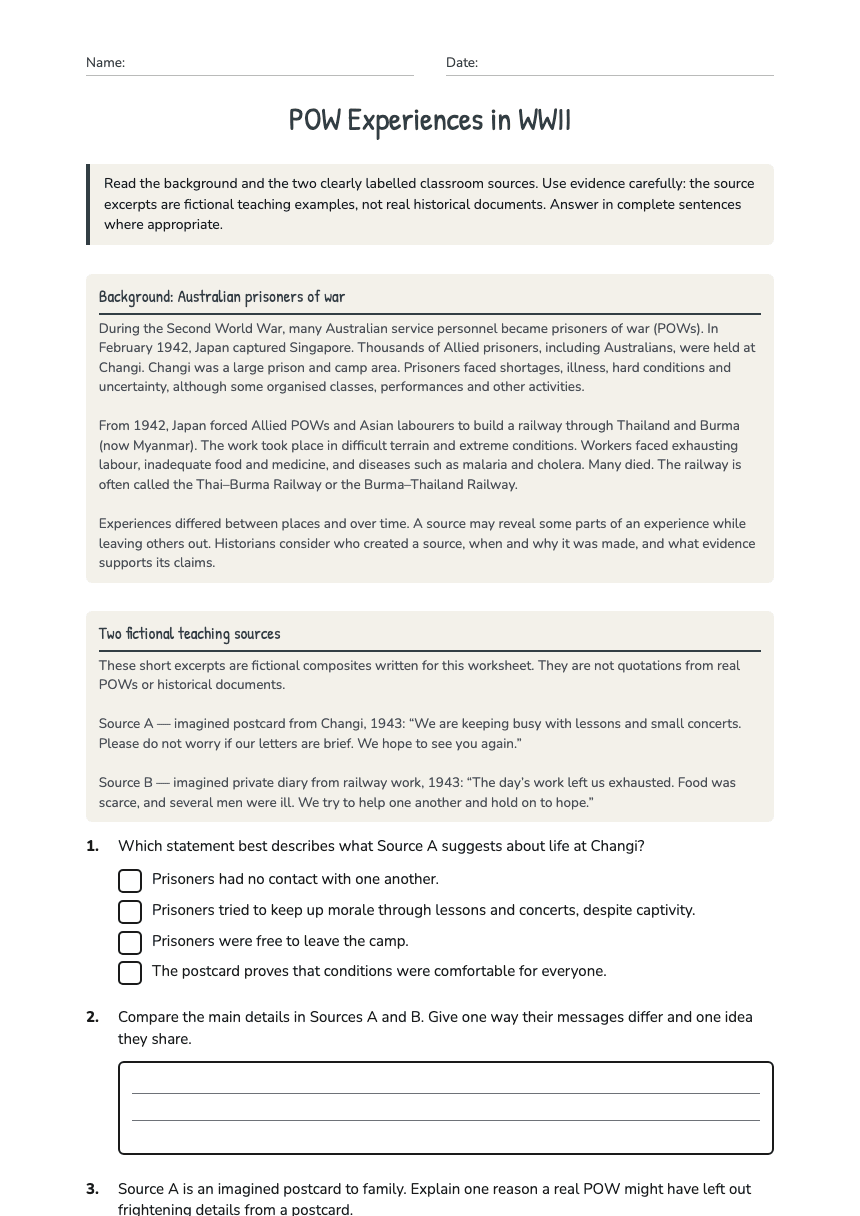
POW Experiences in WWII
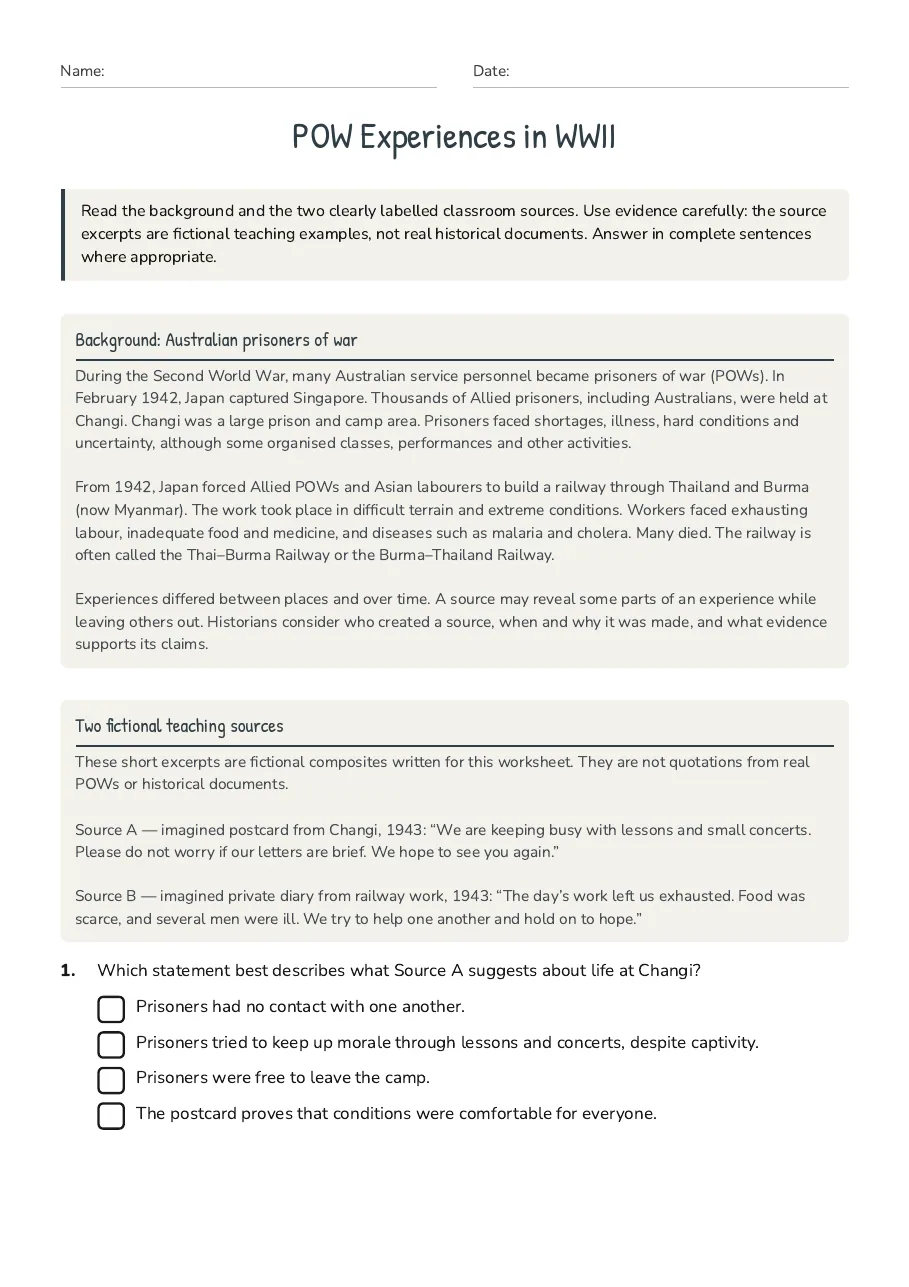
Background: Australian prisoners of war
During the Second World War, many Australian service personnel became prisoners of war (POWs). In February 1942, Japan captured Singapore. Thousands of Allied prisoners, including Australians, were held at Changi. Changi was a large prison and camp area. Prisoners faced shortages, illness, hard conditions and uncertainty, although some organised classes, performances and other activities. From 1942, Japan forced Allied POWs and Asian labourers to build a railway through Thailand and Burma (now Myanmar). The work took place in difficult terrain and extreme conditions. Workers faced exhausting labour, inadequate food and medicine, and diseases such as malaria and cholera. Many died. The railway is often called the Thai–Burma Railway or the Burma–Thailand Railway. Experiences differed between places and over time. A source may reveal some parts of an experience while leaving others out. Historians consider who created a source, when and why it was made, and what evidence supports its claims.
Two fictional teaching sources
These short excerpts are fictional composites written for this worksheet. They are not quotations from real POWs or historical documents. Source A — imagined postcard from Changi, 1943: “We are keeping busy with lessons and small concerts. Please do not worry if our letters are brief. We hope to see you again.” Source B — imagined private diary from railway work, 1943: “The day’s work left us exhausted. Food was scarce, and several men were ill. We try to help one another and hold on to hope.”
- Prisoners had no contact with one another.
- Prisoners tried to keep up morale through lessons and concerts, despite captivity.
- Prisoners were free to leave the camp.
- The postcard proves that conditions were comfortable for everyone.
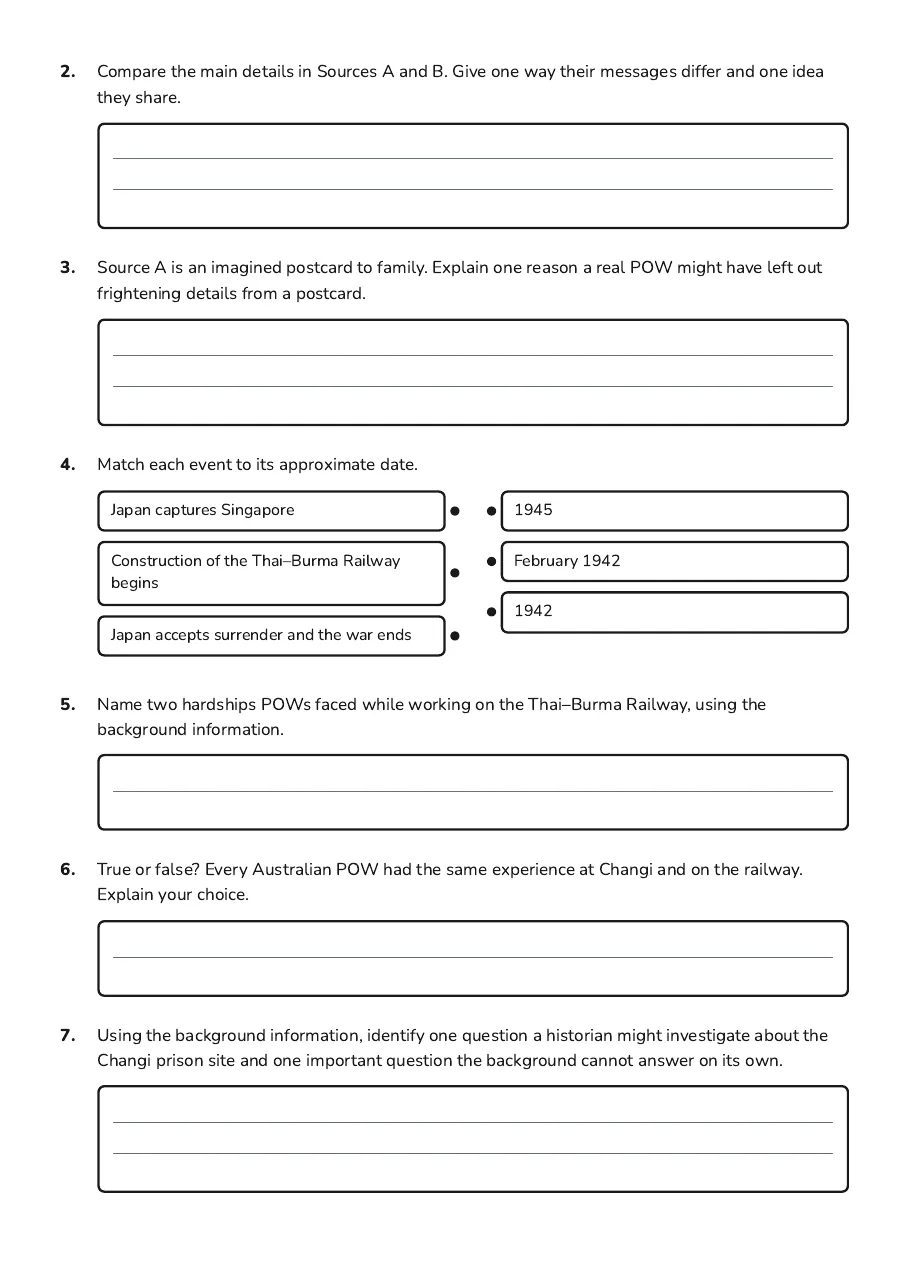
- Japan captures Singapore
- Construction of the Thai–Burma Railway begins
- Japan accepts surrender and the war ends
- 1945
- February 1942
- 1942
3 printable pages
Page 1
Page 2
Page 3
About This Worksheet
Free in Kuraplan
Sign up free, grab the PDF, and customize it for your class.
Print-Ready
Formatted for standard paper. Clean layout, easy to read.
AI-Generated
Created with Kuraplan's AI, designed for real classroom use.
For Teachers & Parents
Use in classrooms, for homework, tutoring, or homeschool.
Need a custom version of this worksheet?
Kuraplan's AI generates custom worksheets in seconds — differentiated for every learner, aligned to your curriculum.
Generate Custom Worksheets — Free