Robber Barons Group Worksheet
A free social sciences worksheet ready for your classroom. Open in Kuraplan to grab the print-ready PDF, customize it for your students, or generate a fresh version in seconds.
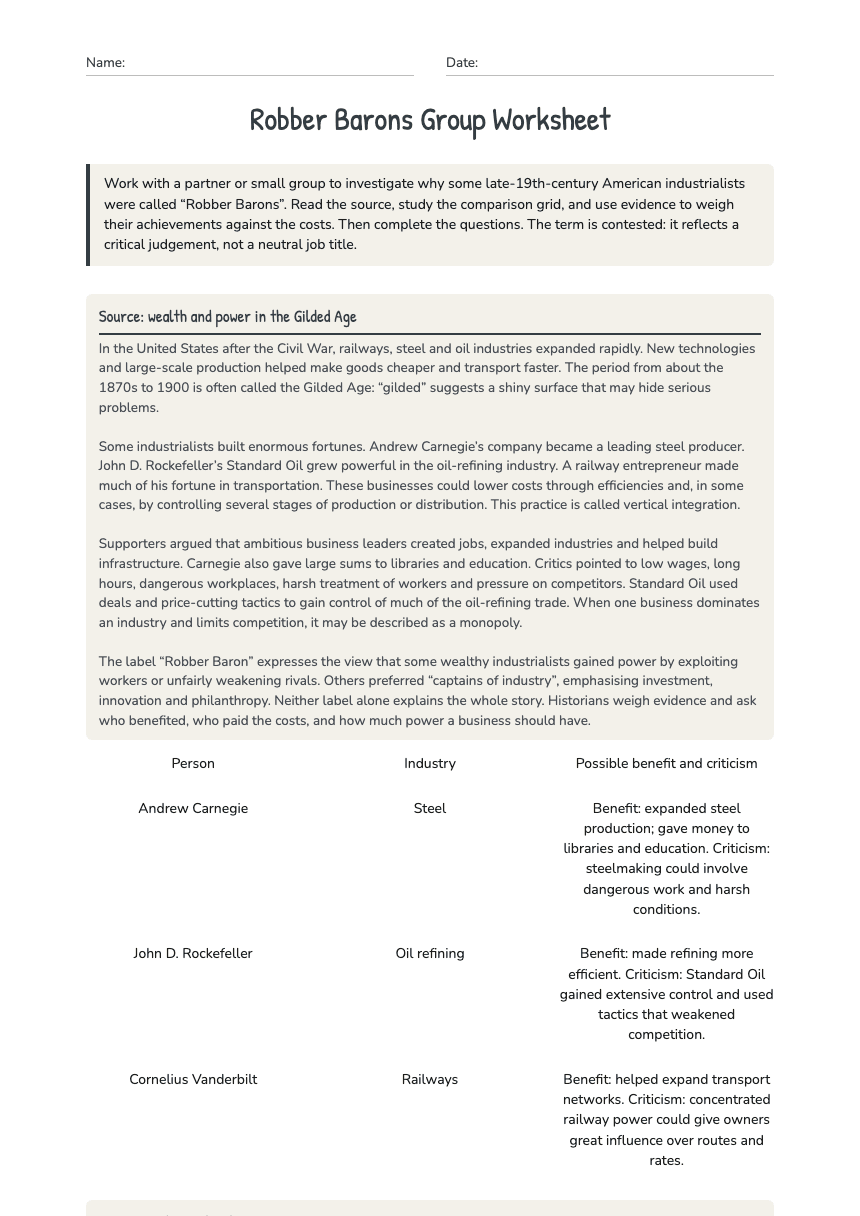
Robber Barons Group Worksheet
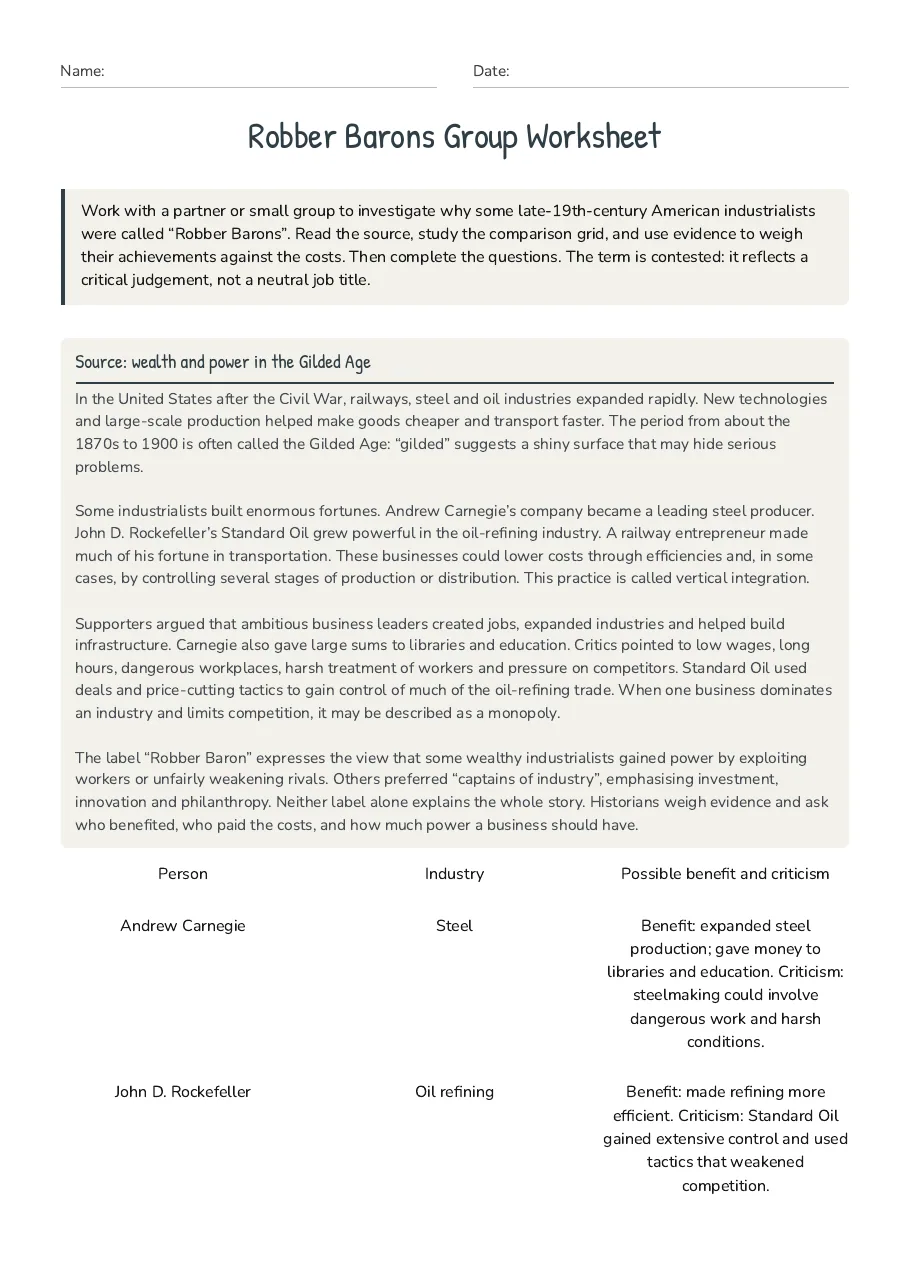
Source: wealth and power in the Gilded Age
In the United States after the Civil War, railways, steel and oil industries expanded rapidly. New technologies and large-scale production helped make goods cheaper and transport faster. The period from about the 1870s to 1900 is often called the Gilded Age: “gilded” suggests a shiny surface that may hide serious problems. Some industrialists built enormous fortunes. Andrew Carnegie’s company became a leading steel producer. John D. Rockefeller’s Standard Oil grew powerful in the oil-refining industry. A railway entrepreneur made much of his fortune in transportation. These businesses could lower costs through efficiencies and, in some cases, by controlling several stages of production or distribution. This practice is called vertical integration. Supporters argued that ambitious business leaders created jobs, expanded industries and helped build infrastructure. Carnegie also gave large sums to libraries and education. Critics pointed to low wages, long hours, dangerous workplaces, harsh treatment of workers and pressure on competitors. Standard Oil used deals and price-cutting tactics to gain control of much of the oil-refining trade. When one business dominates an industry and limits competition, it may be described as a monopoly. The label “Robber Baron” expresses the view that some wealthy industrialists gained power by exploiting workers or unfairly weakening rivals. Others preferred “captains of industry”, emphasising investment, innovation and philanthropy. Neither label alone explains the whole story. Historians weigh evidence and ask who benefited, who paid the costs, and how much power a business should have.
Person
Industry
Possible benefit and criticism
Andrew Carnegie
Steel
Benefit: expanded steel production; gave money to libraries and education. Criticism: steelmaking could involve dangerous work and harsh conditions.
John D. Rockefeller
Oil refining
Benefit: made refining more efficient. Criticism: Standard Oil gained extensive control and used tactics that weakened competition.
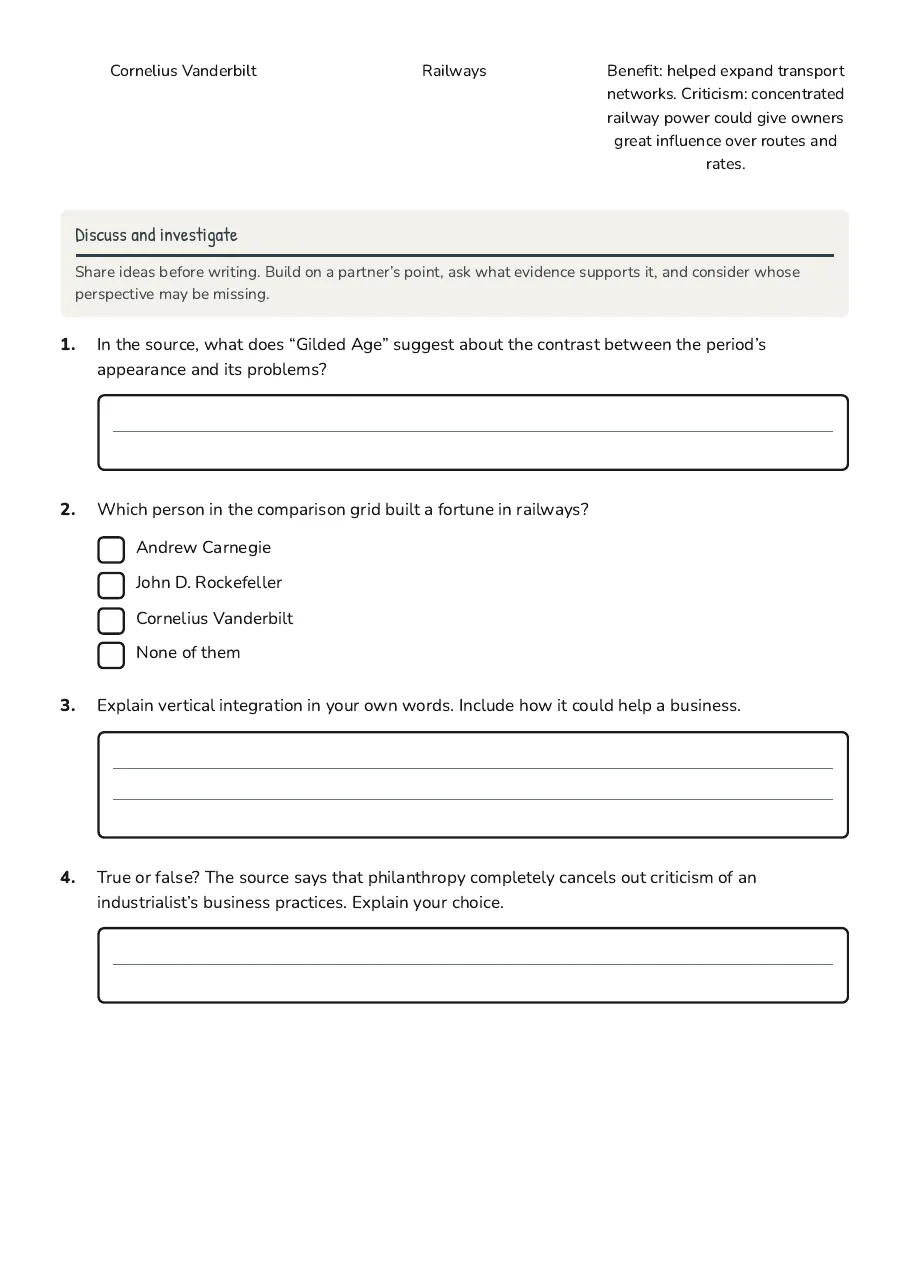
Cornelius Vanderbilt
Railways
Benefit: helped expand transport networks. Criticism: concentrated railway power could give owners great influence over routes and rates.
Discuss and investigate
Share ideas before writing. Build on a partner’s point, ask what evidence supports it, and consider whose perspective may be missing.
- Andrew Carnegie
- John D. Rockefeller
- Cornelius Vanderbilt
- None of them
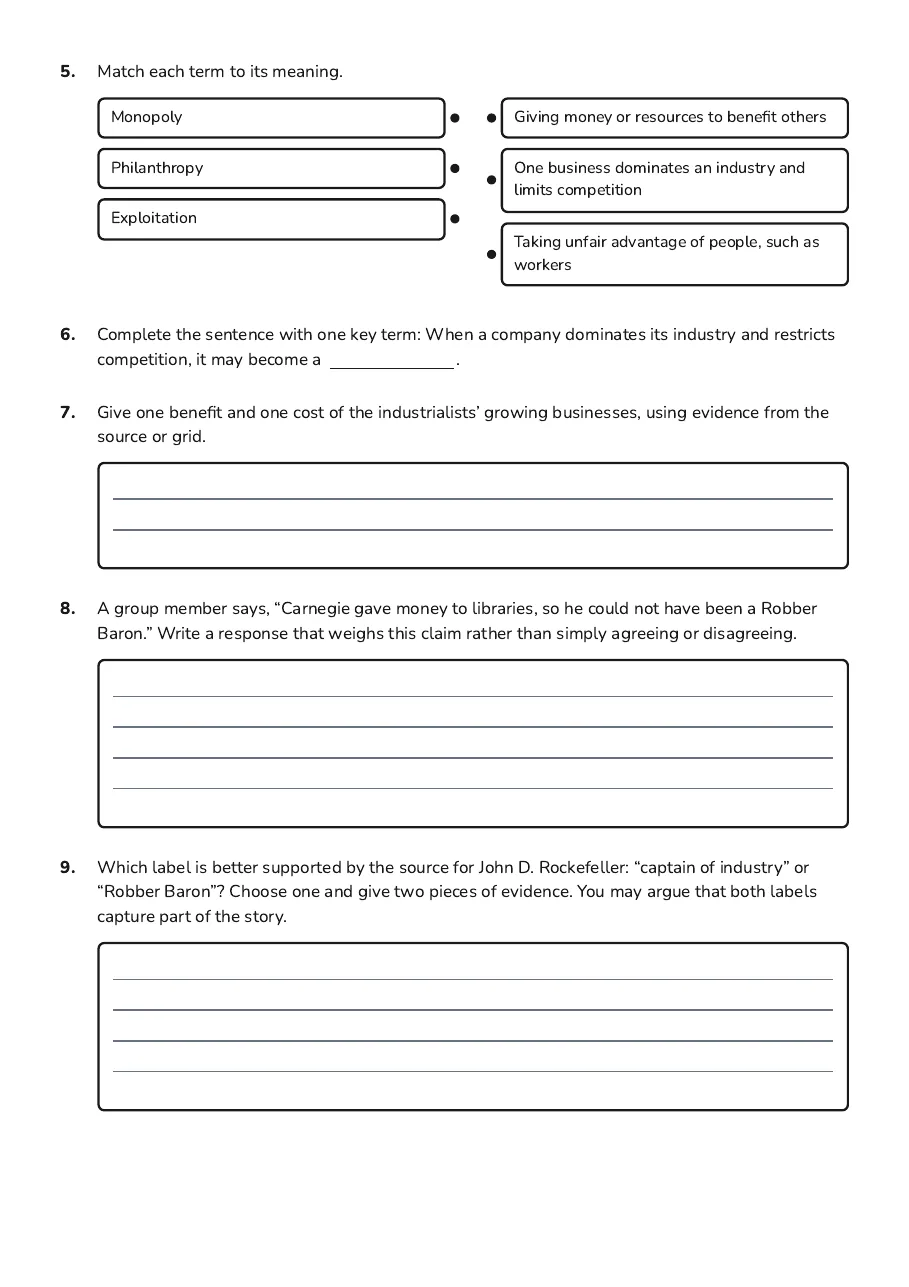
- Monopoly
- Philanthropy
- Exploitation
- Giving money or resources to benefit others
- One business dominates an industry and limits competition
- Taking unfair advantage of people, such as workers
4 printable pages
Page 1
Page 2
Page 3

Page 4
About This Worksheet
Free in Kuraplan
Sign up free, grab the PDF, and customize it for your class.
Print-Ready
Formatted for standard paper. Clean layout, easy to read.
AI-Generated
Created with Kuraplan's AI, designed for real classroom use.
For Teachers & Parents
Use in classrooms, for homework, tutoring, or homeschool.
Need a custom version of this worksheet?
Kuraplan's AI generates custom worksheets in seconds — differentiated for every learner, aligned to your curriculum.
Generate Custom Worksheets — Free