Social SciencesFreePrintable

Native Title Act Summary

A free social sciences worksheet ready for your classroom. Open in Kuraplan to grab the print-ready PDF, customize it for your students, or generate a fresh version in seconds.
Native Title Act Summary worksheet preview
Name:Date:

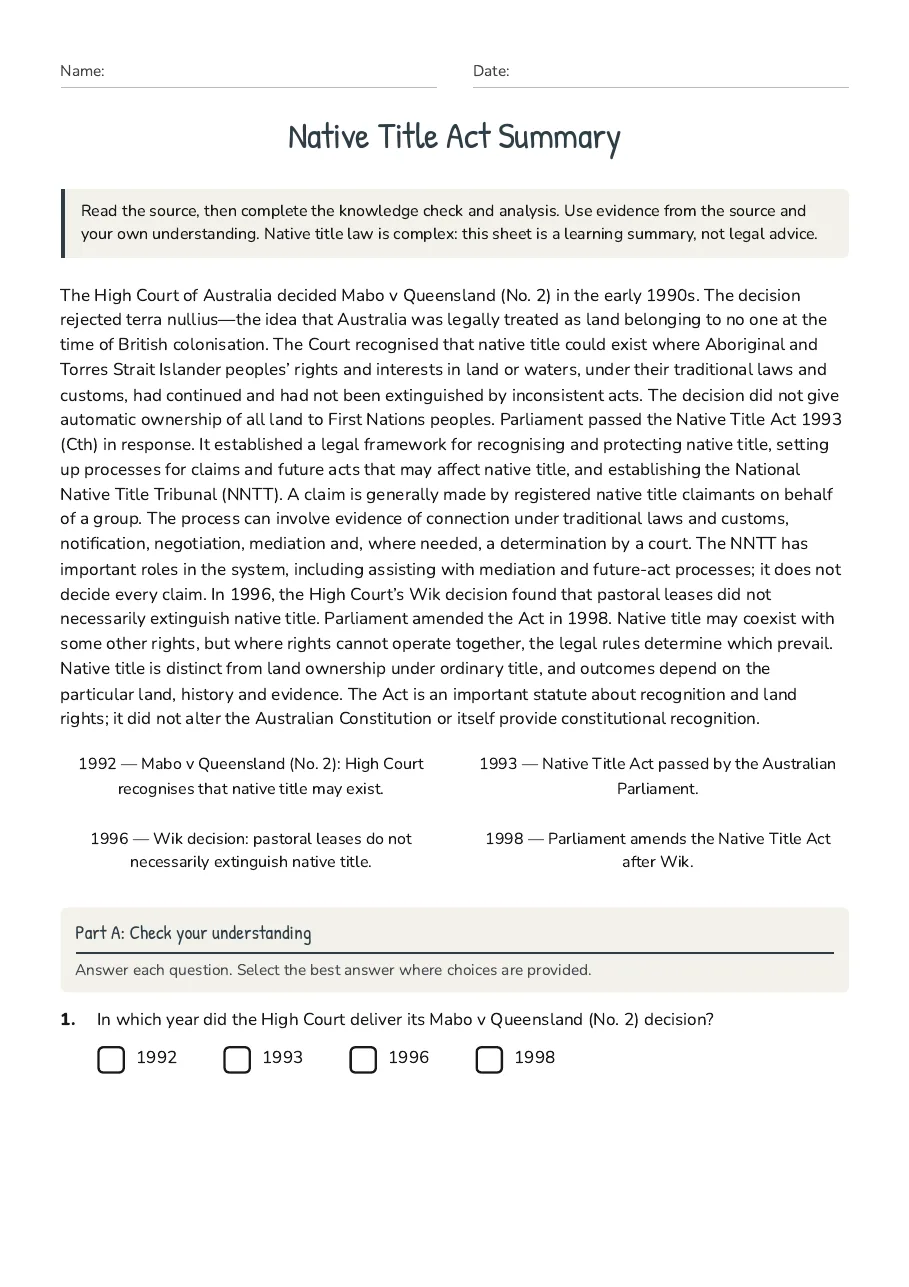
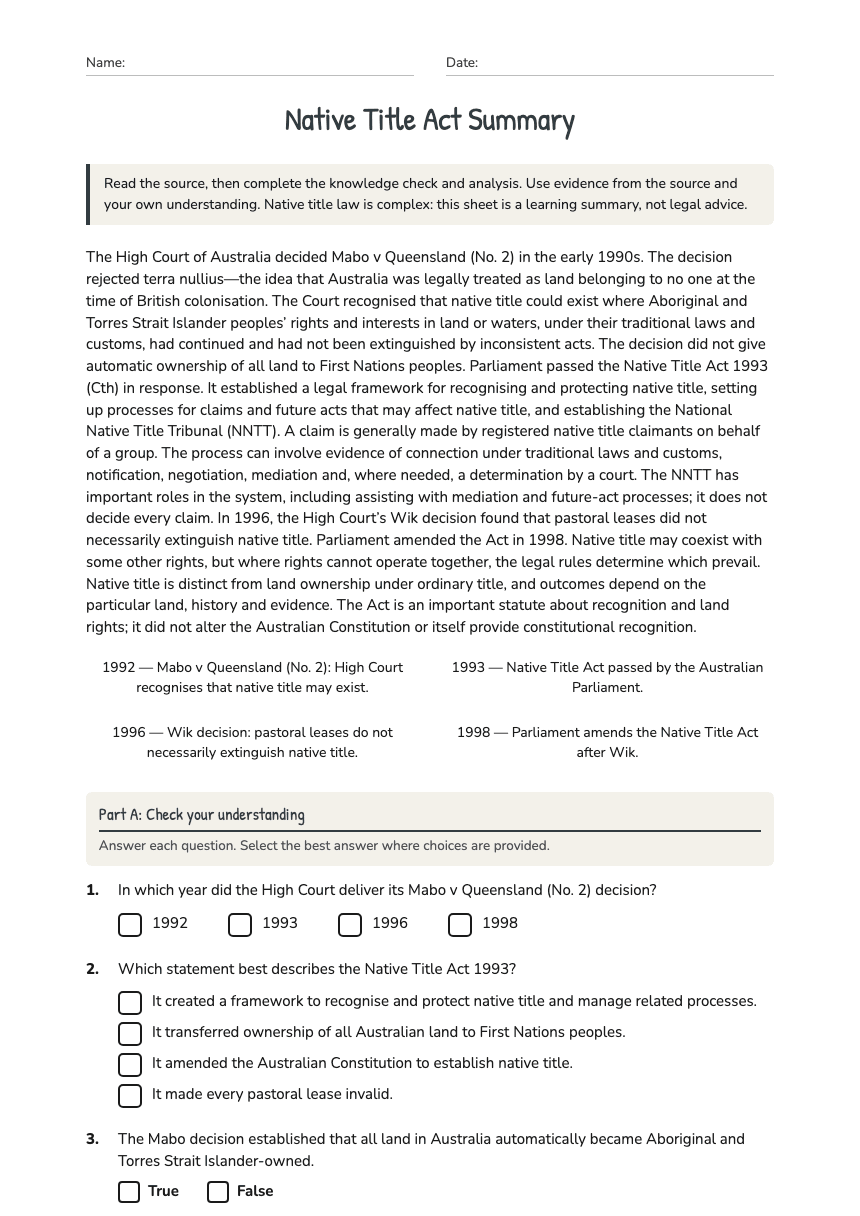
Native Title Act Summary

Read the source, then complete the knowledge check and analysis. Use evidence from the source and your own understanding. Native title law is complex: this sheet is a learning summary, not legal advice.
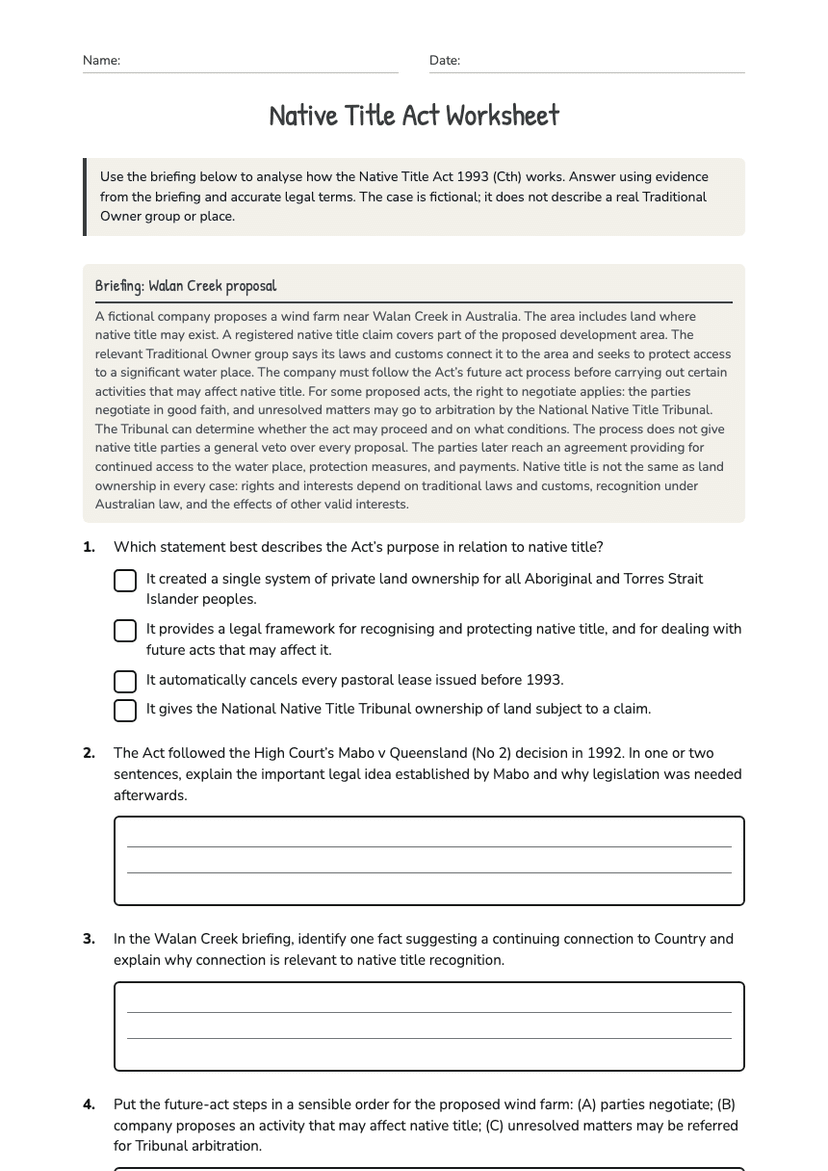
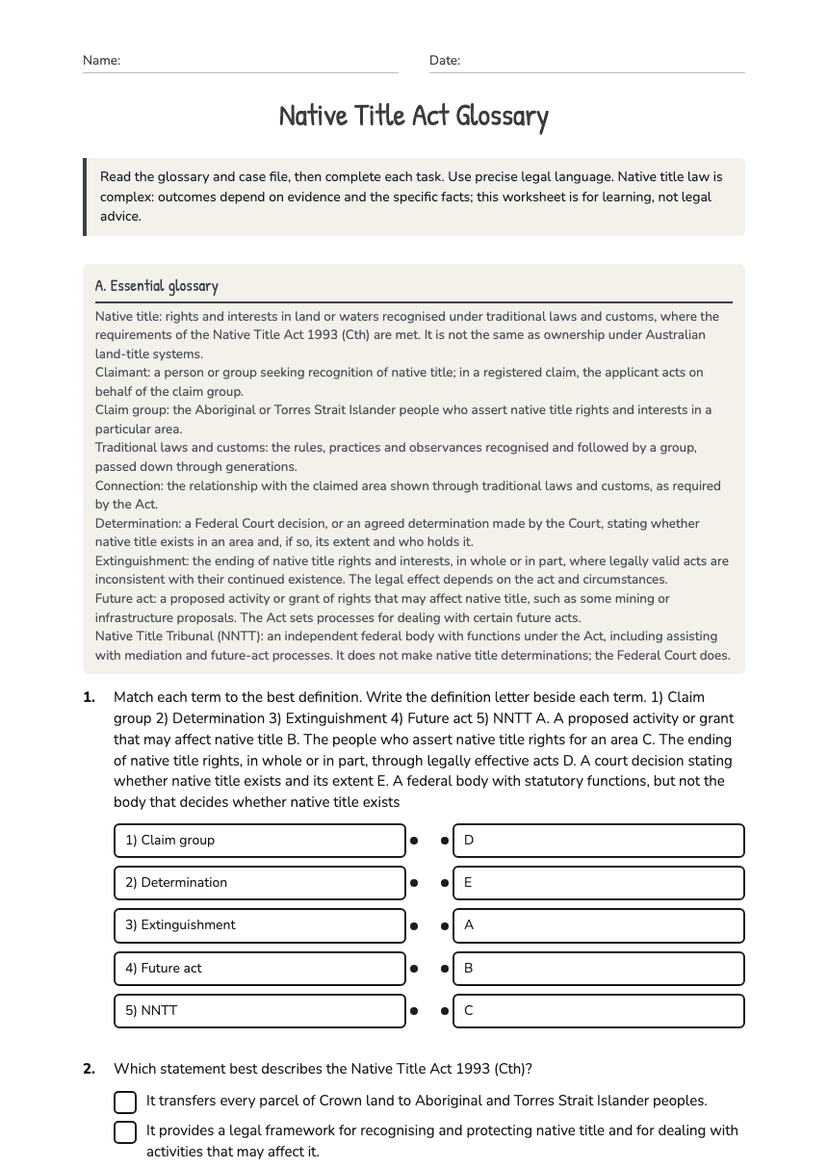
The High Court of Australia decided Mabo v Queensland (No. 2) in the early 1990s. The decision rejected terra nullius—the idea that Australia was legally treated as land belonging to no one at the time of British colonisation. The Court recognised that native title could exist where Aboriginal and Torres Strait Islander peoples’ rights and interests in land or waters, under their traditional laws and customs, had continued and had not been extinguished by inconsistent acts. The decision did not give automatic ownership of all land to First Nations peoples. Parliament passed the Native Title Act 1993 (Cth) in response. It established a legal framework for recognising and protecting native title, setting up processes for claims and future acts that may affect native title, and establishing the National Native Title Tribunal (NNTT). A claim is generally made by registered native title claimants on behalf of a group. The process can involve evidence of connection under traditional laws and customs, notification, negotiation, mediation and, where needed, a determination by a court. The NNTT has important roles in the system, including assisting with mediation and future-act processes; it does not decide every claim. In 1996, the High Court’s Wik decision found that pastoral leases did not necessarily extinguish native title. Parliament amended the Act in 1998. Native title may coexist with some other rights, but where rights cannot operate together, the legal rules determine which prevail. Native title is distinct from land ownership under ordinary title, and outcomes depend on the particular land, history and evidence. The Act is an important statute about recognition and land rights; it did not alter the Australian Constitution or itself provide constitutional recognition.

1992 — Mabo v Queensland (No. 2): High Court recognises that native title may exist.

1993 — Native Title Act passed by the Australian Parliament.

1996 — Wik decision: pastoral leases do not necessarily extinguish native title.

1998 — Parliament amends the Native Title Act after Wik.

Part A: Check your understanding

Answer each question. Select the best answer where choices are provided.

1.In which year did the High Court deliver its Mabo v Queensland (No. 2) decision?
  • 1992
  • 1993
  • 1996
  • 1998
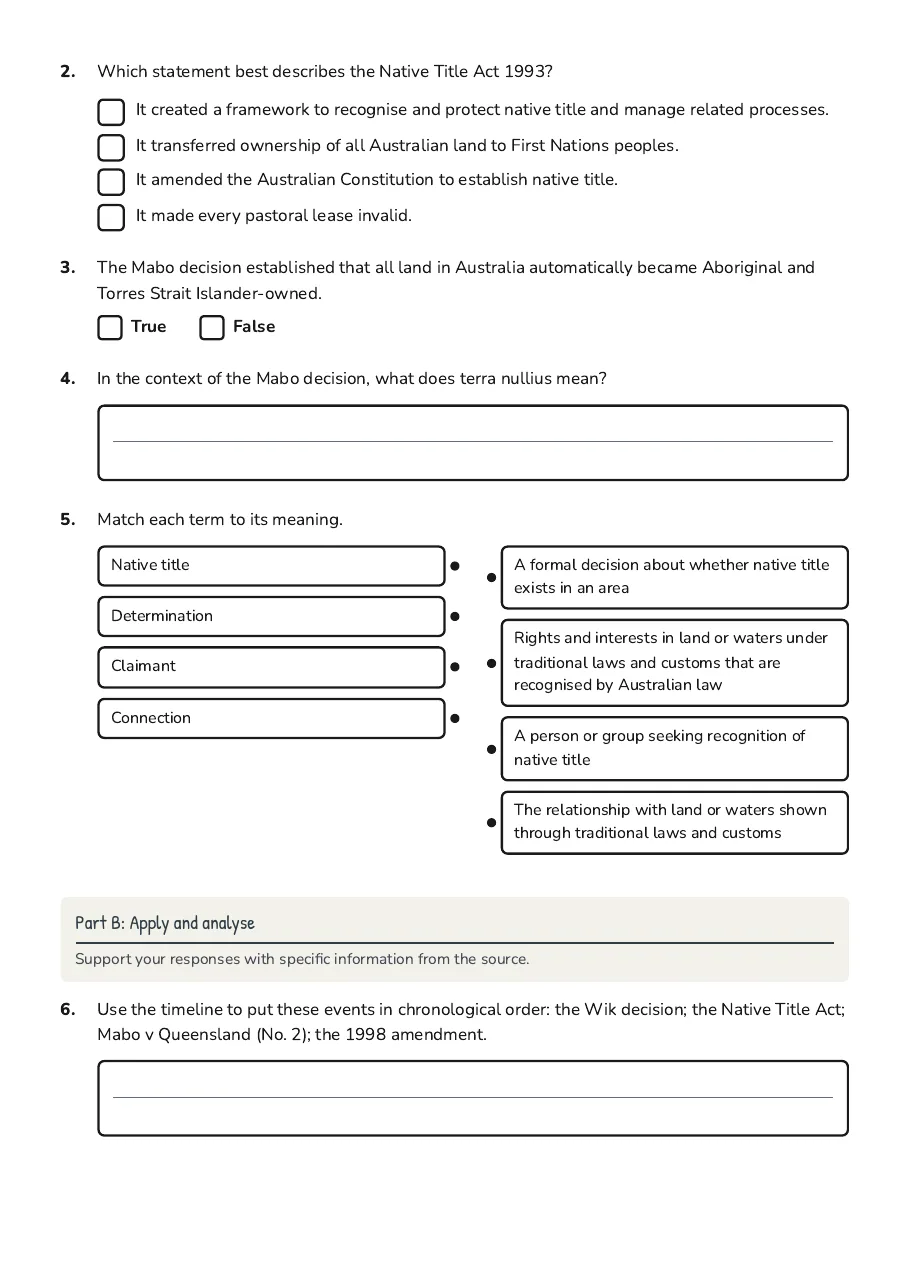
2.Which statement best describes the Native Title Act 1993?
  • It created a framework to recognise and protect native title and manage related processes.
  • It transferred ownership of all Australian land to First Nations peoples.
  • It amended the Australian Constitution to establish native title.
  • It made every pastoral lease invalid.
3.The Mabo decision established that all land in Australia automatically became Aboriginal and Torres Strait Islander-owned.
TrueFalse
4.In the context of the Mabo decision, what does terra nullius mean?
5.Match each term to its meaning.
  • Native title
  • Determination
  • Claimant
  • Connection
  • A formal decision about whether native title exists in an area
  • Rights and interests in land or waters under traditional laws and customs that are recognised by Australian law
  • A person or group seeking recognition of native title
  • The relationship with land or waters shown through traditional laws and customs

Part B: Apply and analyse

Support your responses with specific information from the source.

6.Use the timeline to put these events in chronological order: the Wik decision; the Native Title Act; Mabo v Queensland (No. 2); the 1998 amendment.
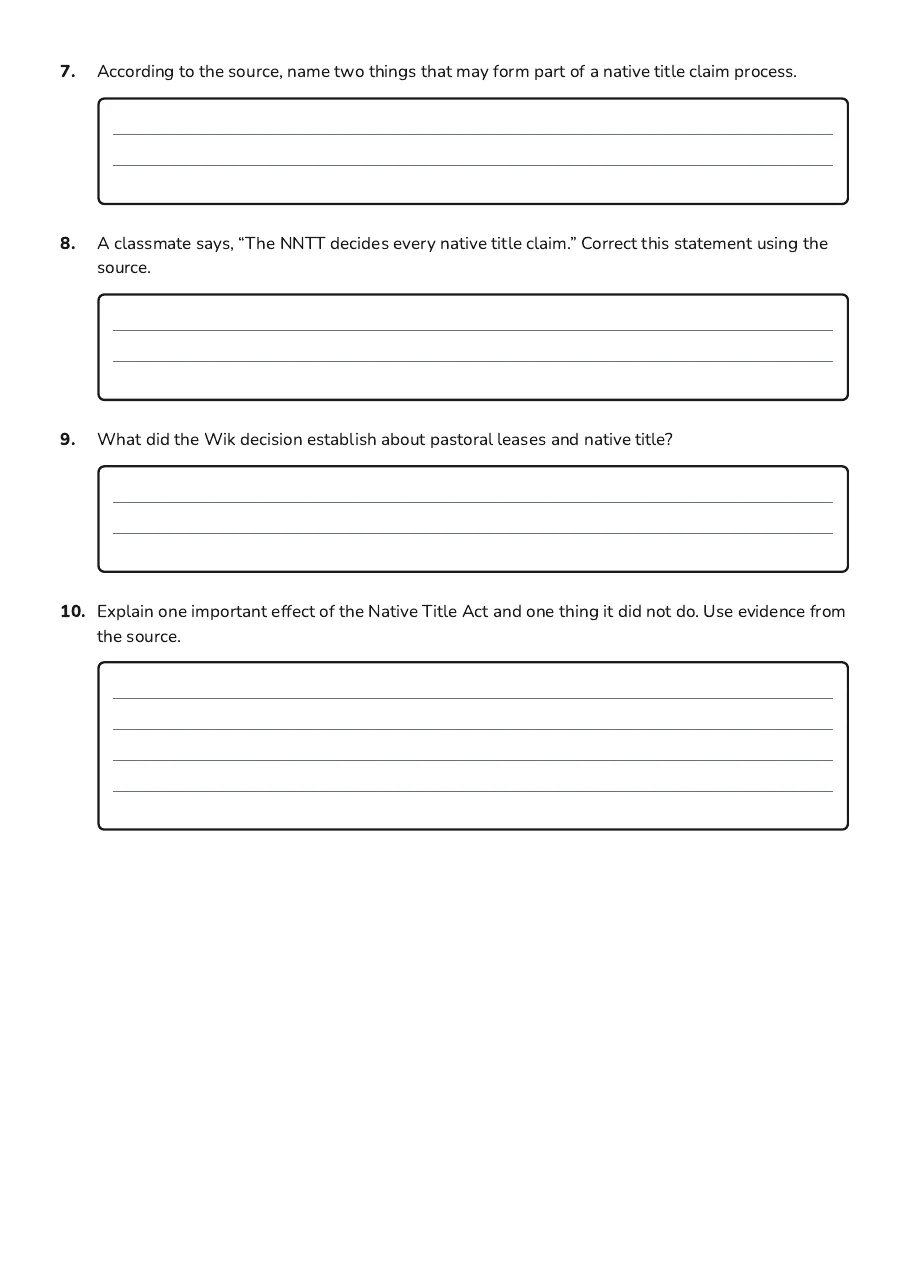
7.According to the source, name two things that may form part of a native title claim process.
8.A classmate says, “The NNTT decides every native title claim.” Correct this statement using the source.
9.What did the Wik decision establish about pastoral leases and native title?
10.Explain one important effect of the Native Title Act and one thing it did not do. Use evidence from the source.

3 printable pages

  • Native Title Act Summary, page 1 of 3: Part A: Check your understanding

    Page 1

  • Native Title Act Summary, page 2 of 3: Part B: Apply and analyse

    Page 2

  • Native Title Act Summary, page 3 of 3: 7. According to the source, name two things that may form part of a native title claim…

    Page 3

About This Worksheet

Free in Kuraplan

Sign up free, grab the PDF, and customize it for your class.

Print-Ready

Formatted for standard paper. Clean layout, easy to read.

AI-Generated

Created with Kuraplan's AI, designed for real classroom use.

For Teachers & Parents

Use in classrooms, for homework, tutoring, or homeschool.

Need a custom version of this worksheet?

Kuraplan's AI generates custom worksheets in seconds — differentiated for every learner, aligned to your curriculum.

Generate Custom Worksheets — Free
No credit card Curriculum-aligned Under 60 seconds