Safe Situations and Help-Seeking
A free health worksheet ready for your classroom. Open in Kuraplan to grab the print-ready PDF, customize it for your students, or generate a fresh version in seconds.
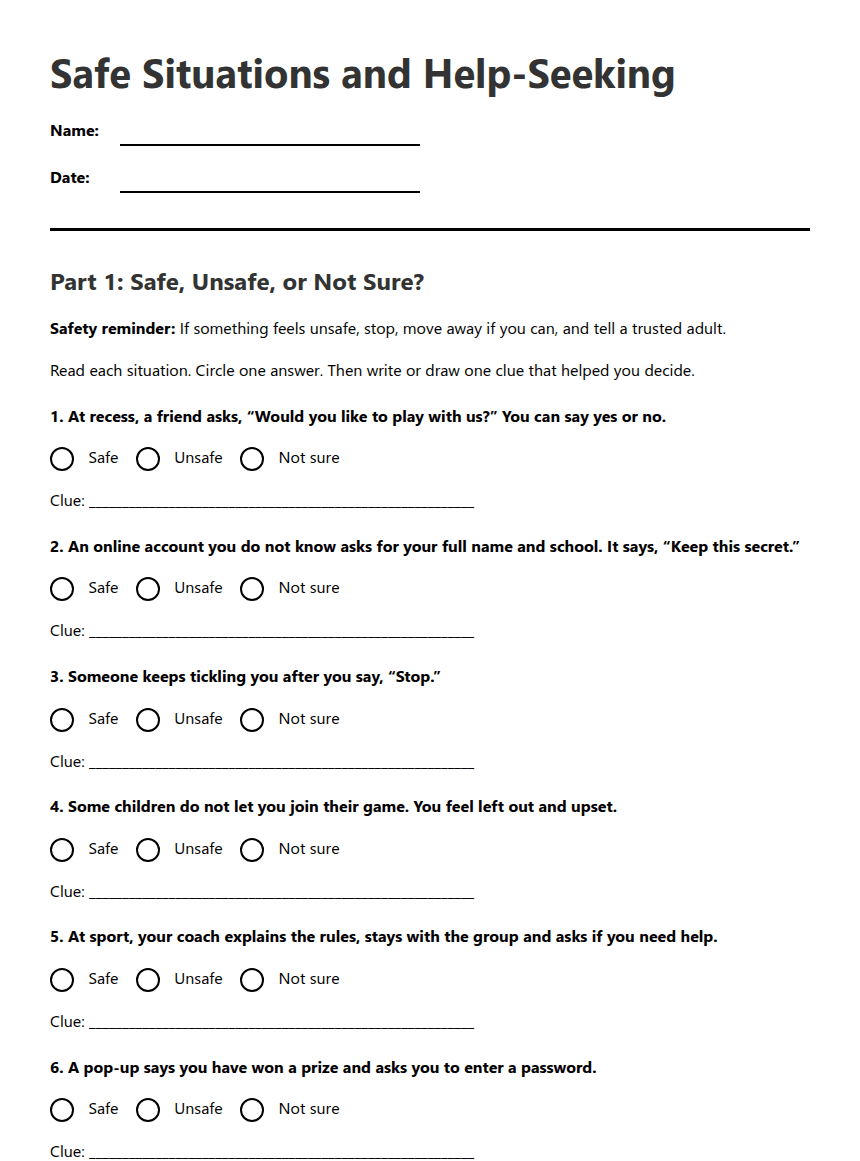
Safe Situations and Help-Seeking
Part 1: Safe, Unsafe, or Not Sure?
Safety reminder: If something feels unsafe, stop, move away if you can, and tell a trusted adult.
Read each situation. Circle one answer. Then write or draw one clue that helped you decide.
Clue: __________________________________________________________
Clue: __________________________________________________________
Clue: __________________________________________________________
Clue: __________________________________________________________
Clue: __________________________________________________________
Clue: __________________________________________________________
Part 2: What Could I Do?
Use the same steps each time:
STOP: Pause. Take three slow breaths. Say “Stop” if it is safe to do so.
MOVE: Move away or go to a safer place.
TELL: Tell a trusted adult. Keep telling until someone helps.
Word bank: stop breathe move away safe place trusted adult help
STOP: I can ____________________________________________________
MOVE: I can ____________________________________________________
TELL: I can say, “I feel __________________ because __________________. I need help from __________________.”
STOP: I can ____________________________________________________
MOVE: I can ____________________________________________________
TELL: I can say, “I feel __________________ because __________________. I need help from __________________.”
STOP: I can ____________________________________________________
MOVE: I can ____________________________________________________
TELL: I can say, “I feel __________________ because __________________. I need help from __________________.”
STOP: I can ____________________________________________________
MOVE: I can ____________________________________________________
TELL: I can say, “I feel __________________ because __________________. I need help from __________________.”
Part 3: Trusted Adults and Exit Check
Write or draw three trusted adults you could ask for help.
Exit check
Circle one answer for each statement.
Teacher answer guide
Suggested answers:
1. Safe — the friend asks respectfully and accepts a choice.
2. Unsafe — an unknown person asks for personal information and secrecy.
3. Unsafe — the person does not respect “stop”.
4. Uncomfortable — the student feels left out and upset. A student may choose “not sure” if more information is needed.
5. Safe — the adult explains the activity, stays with the group and offers help.
6. Unsafe — the pop-up asks for a password. Close it or move away and tell a trusted adult.
7–10. Look for the sequence: pause and breathe, move to safety if possible, and tell a trusted adult using a clear sentence. Accept equivalent safe responses.
Trusted adults may include a parent, carer, teacher, school leader, counsellor, family member or another safe adult. Contact methods may include speaking, calling, sending a message or asking another adult to help.
Important: “Not sure” can be a valid response when context is missing. Ask, “What extra information would help you decide?” Do not require students to share private experiences.
About This Worksheet
Free in Kuraplan
Sign up free, grab the PDF, and customize it for your class.
Print-Ready
Formatted for standard paper. Clean layout, easy to read.
AI-Generated
Created with Kuraplan's AI, designed for real classroom use.
For Teachers & Parents
Use in classrooms, for homework, tutoring, or homeschool.
Need a custom version of this worksheet?
Kuraplan's AI generates custom worksheets in seconds — differentiated for every learner, aligned to your curriculum.
Generate Custom Worksheets — FreeMore Health Worksheets
Safe Swallowing Skills Worksheet
Free
Drug Education Healthy Choices
Free
Understanding Digital Identity
Free
Digital Wellbeing Worksheet
Free
Privacy Settings Practice
Free
Community Safety Planning Worksheet
Free
Personal Hygiene Habits
Free