EnglishFreePrintable

Shakespeare Essay Drafting

A free english worksheet ready for your classroom. Open in Kuraplan to grab the print-ready PDF, customize it for your students, or generate a fresh version in seconds.
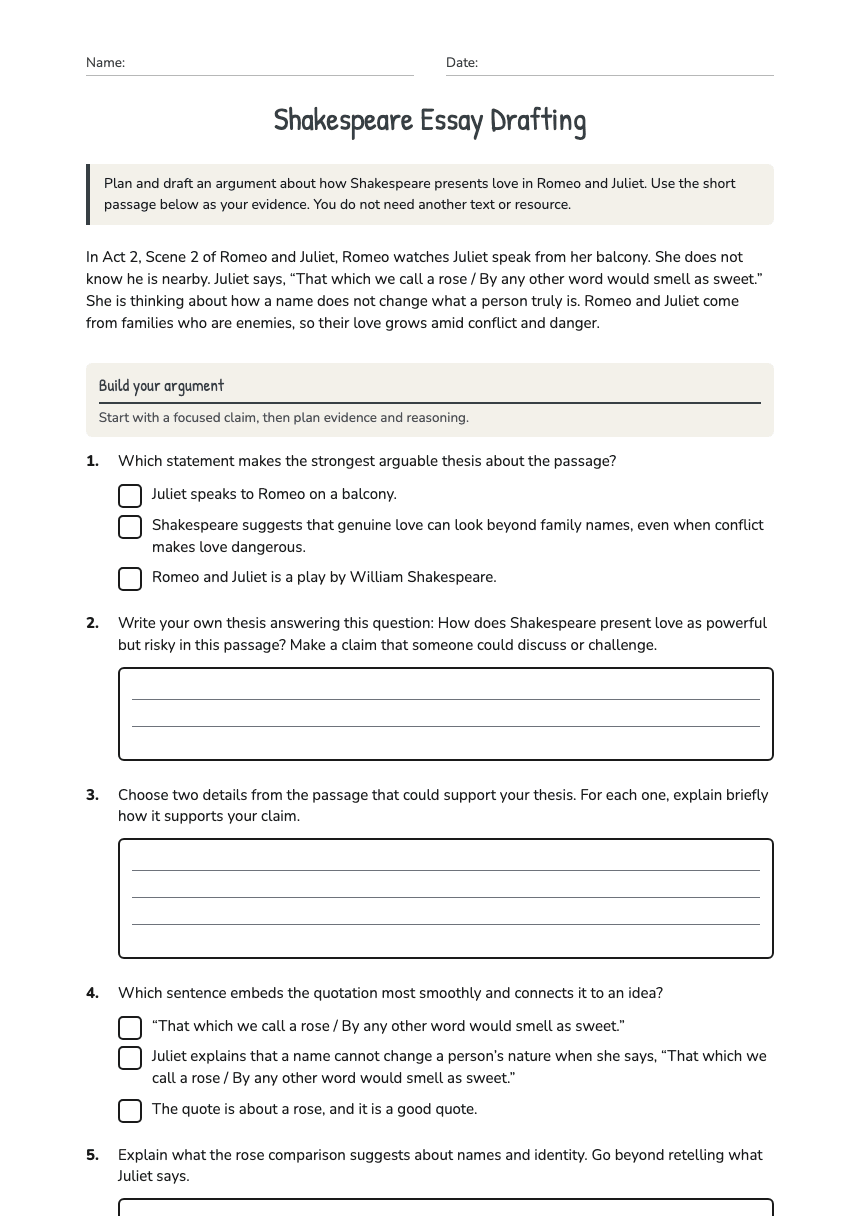
Shakespeare Essay Drafting worksheet preview
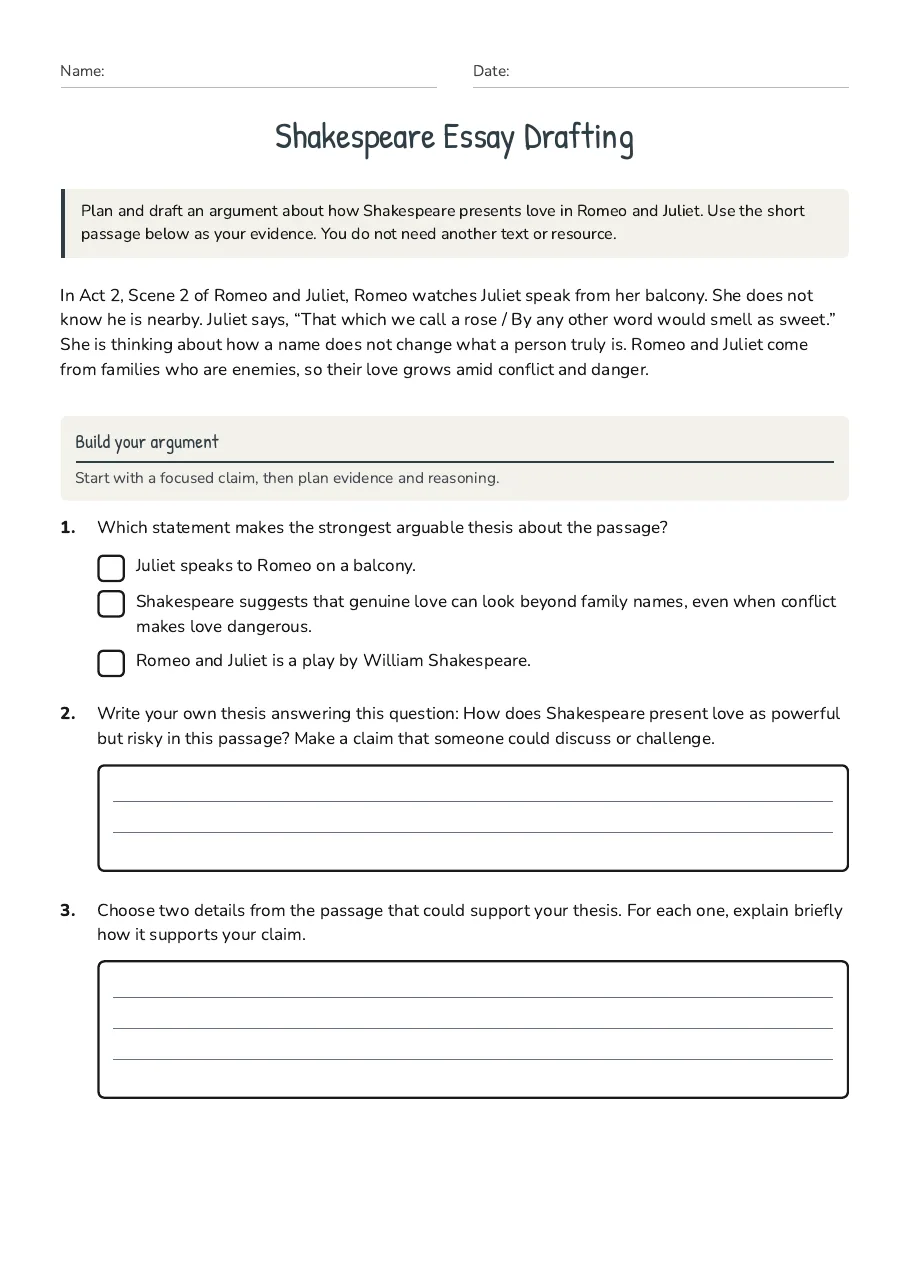
Name:Date:

Shakespeare Essay Drafting

Plan and draft an argument about how Shakespeare presents love in Romeo and Juliet. Use the short passage below as your evidence. You do not need another text or resource.
In Act 2, Scene 2 of Romeo and Juliet, Romeo watches Juliet speak from her balcony. She does not know he is nearby. Juliet says, “That which we call a rose / By any other word would smell as sweet.” She is thinking about how a name does not change what a person truly is. Romeo and Juliet come from families who are enemies, so their love grows amid conflict and danger.

Build your argument

Start with a focused claim, then plan evidence and reasoning.

1.Which statement makes the strongest arguable thesis about the passage?
  • Juliet speaks to Romeo on a balcony.
  • Shakespeare suggests that genuine love can look beyond family names, even when conflict makes love dangerous.
  • Romeo and Juliet is a play by William Shakespeare.
2.Write your own thesis answering this question: How does Shakespeare present love as powerful but risky in this passage? Make a claim that someone could discuss or challenge.
3.Choose two details from the passage that could support your thesis. For each one, explain briefly how it supports your claim.
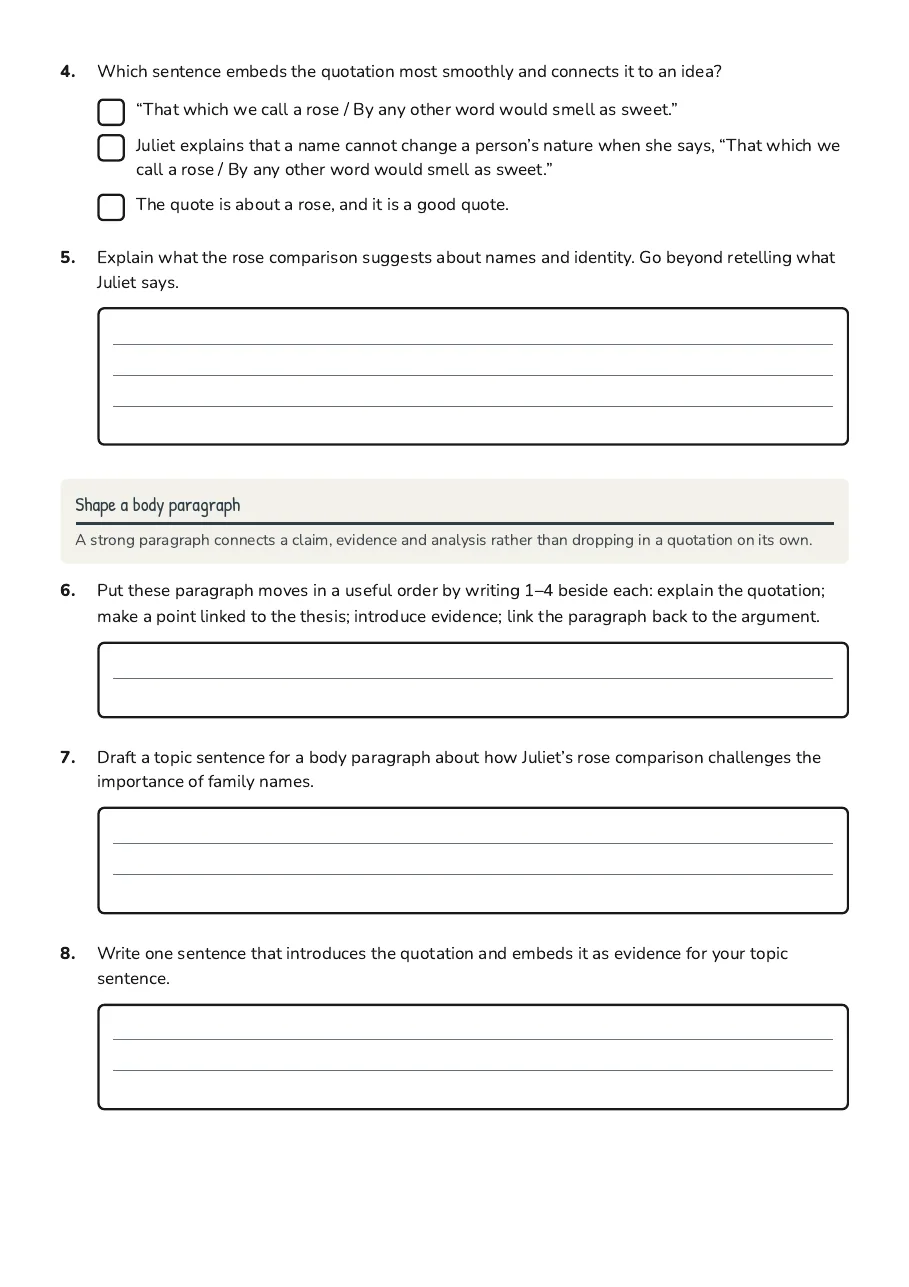
4.Which sentence embeds the quotation most smoothly and connects it to an idea?
  • “That which we call a rose / By any other word would smell as sweet.”
  • Juliet explains that a name cannot change a person’s nature when she says, “That which we call a rose / By any other word would smell as sweet.”
  • The quote is about a rose, and it is a good quote.
5.Explain what the rose comparison suggests about names and identity. Go beyond retelling what Juliet says.

Shape a body paragraph

A strong paragraph connects a claim, evidence and analysis rather than dropping in a quotation on its own.

6.Put these paragraph moves in a useful order by writing 1–4 beside each: explain the quotation; make a point linked to the thesis; introduce evidence; link the paragraph back to the argument.
7.Draft a topic sentence for a body paragraph about how Juliet’s rose comparison challenges the importance of family names.
8.Write one sentence that introduces the quotation and embeds it as evidence for your topic sentence.
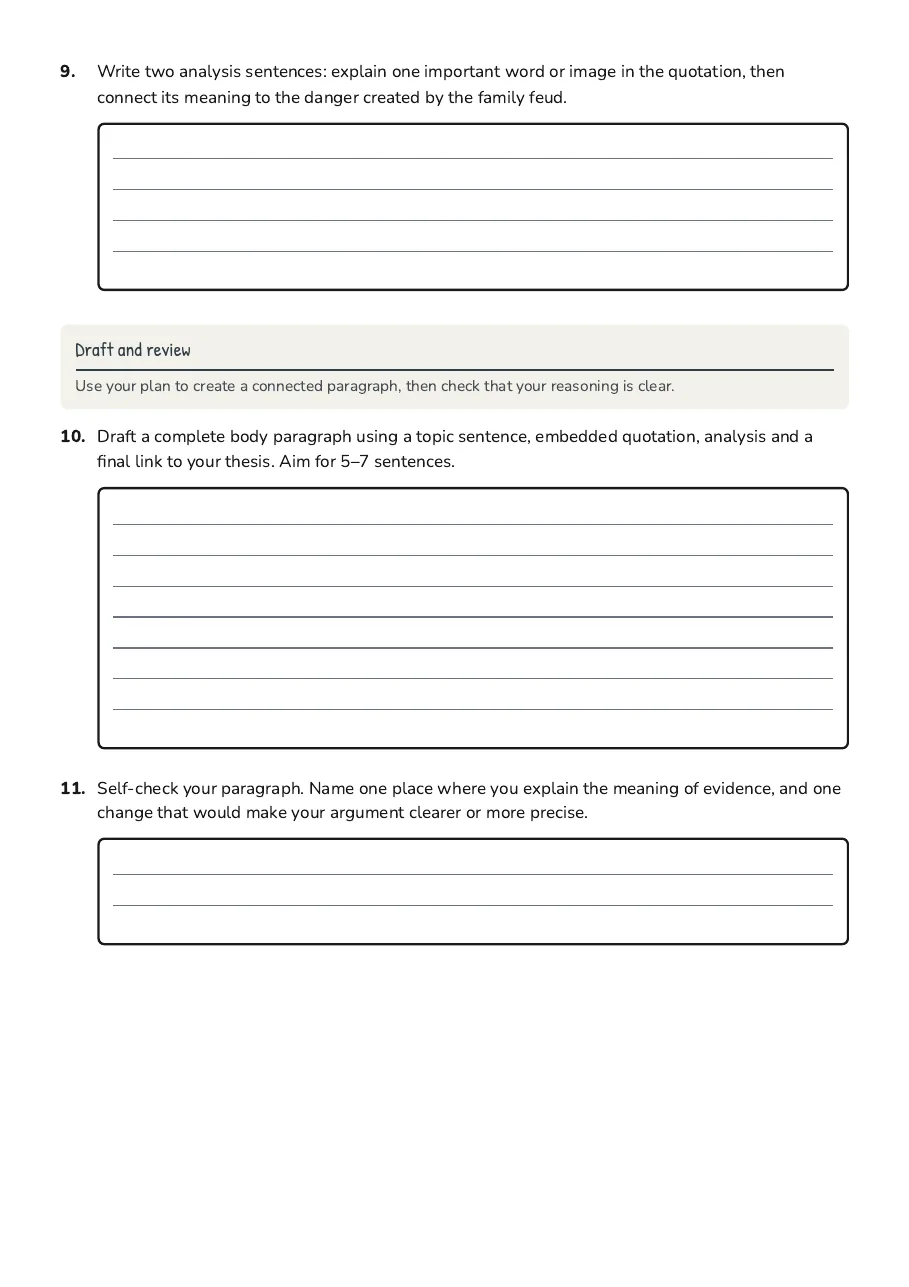
9.Write two analysis sentences: explain one important word or image in the quotation, then connect its meaning to the danger created by the family feud.

Draft and review

Use your plan to create a connected paragraph, then check that your reasoning is clear.

10.Draft a complete body paragraph using a topic sentence, embedded quotation, analysis and a final link to your thesis. Aim for 5–7 sentences.
11.Self-check your paragraph. Name one place where you explain the meaning of evidence, and one change that would make your argument clearer or more precise.

3 printable pages

  • Shakespeare Essay Drafting, page 1 of 3: Build your argument

    Page 1

  • Shakespeare Essay Drafting, page 2 of 3: Shape a body paragraph

    Page 2

  • Shakespeare Essay Drafting, page 3 of 3: Draft and review

    Page 3

About This Worksheet

Free in Kuraplan

Sign up free, grab the PDF, and customize it for your class.

Print-Ready

Formatted for standard paper. Clean layout, easy to read.

AI-Generated

Created with Kuraplan's AI, designed for real classroom use.

For Teachers & Parents

Use in classrooms, for homework, tutoring, or homeschool.

Need a custom version of this worksheet?

Kuraplan's AI generates custom worksheets in seconds — differentiated for every learner, aligned to your curriculum.

Generate Custom Worksheets — Free
No credit card Curriculum-aligned Under 60 seconds