EnglishFreePrintable

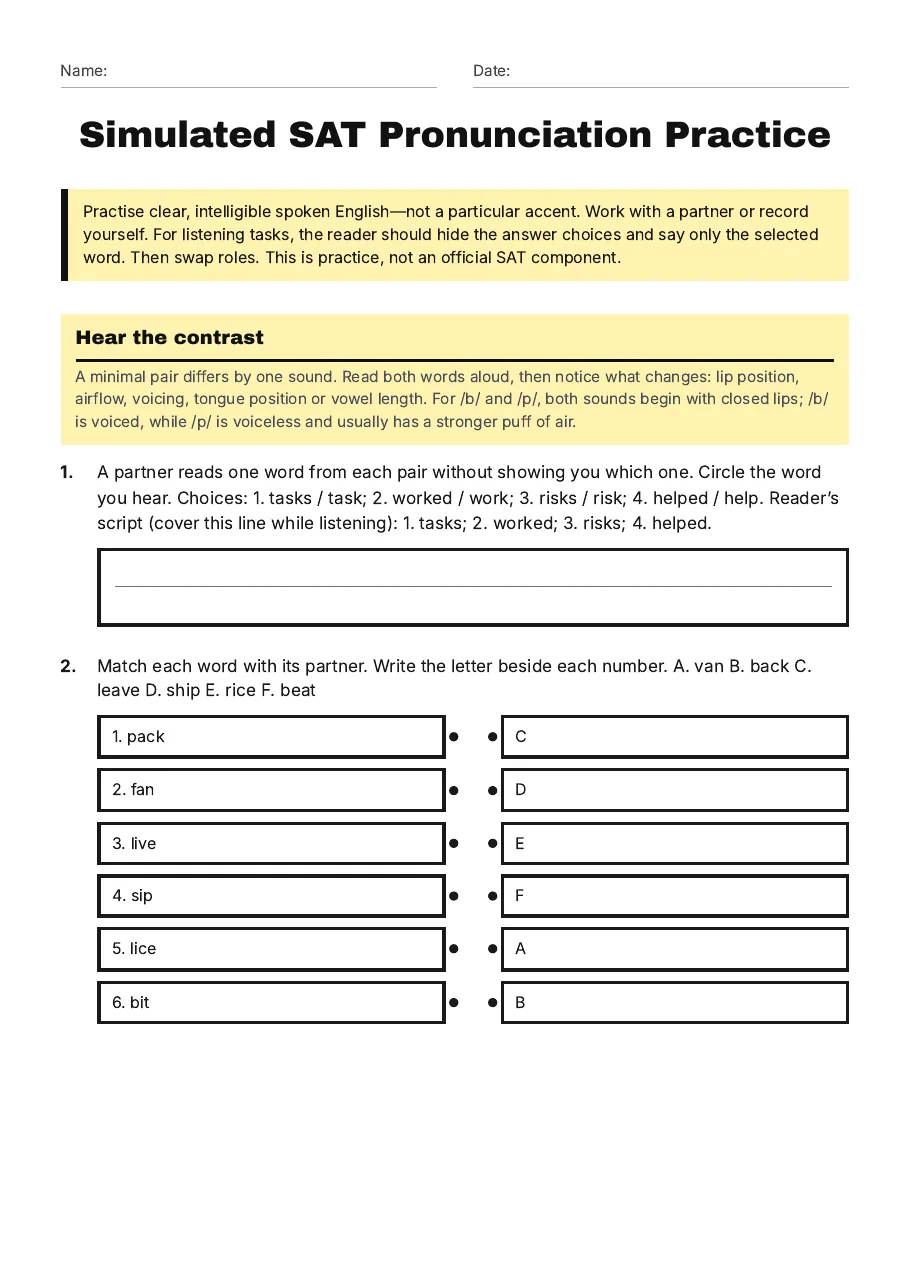
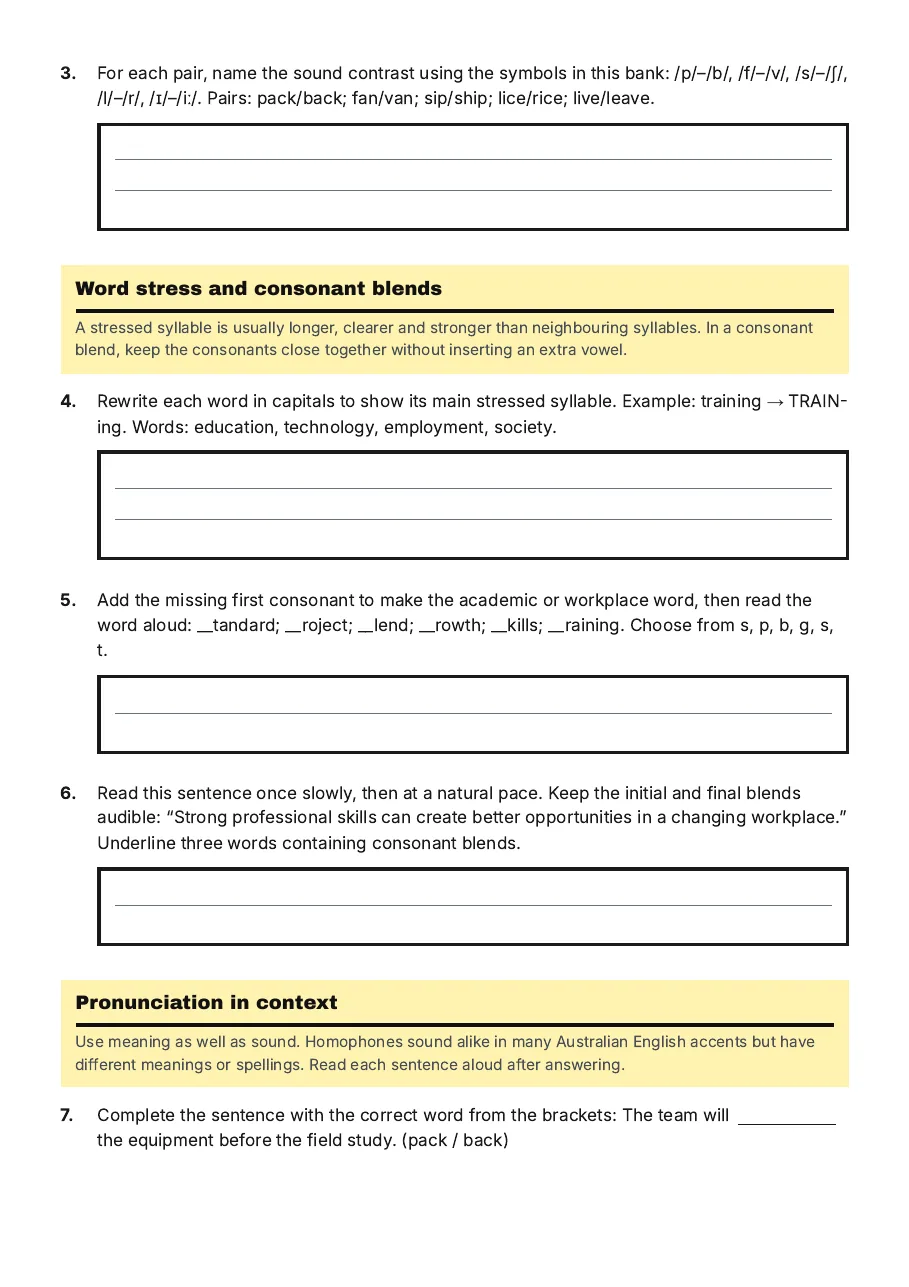
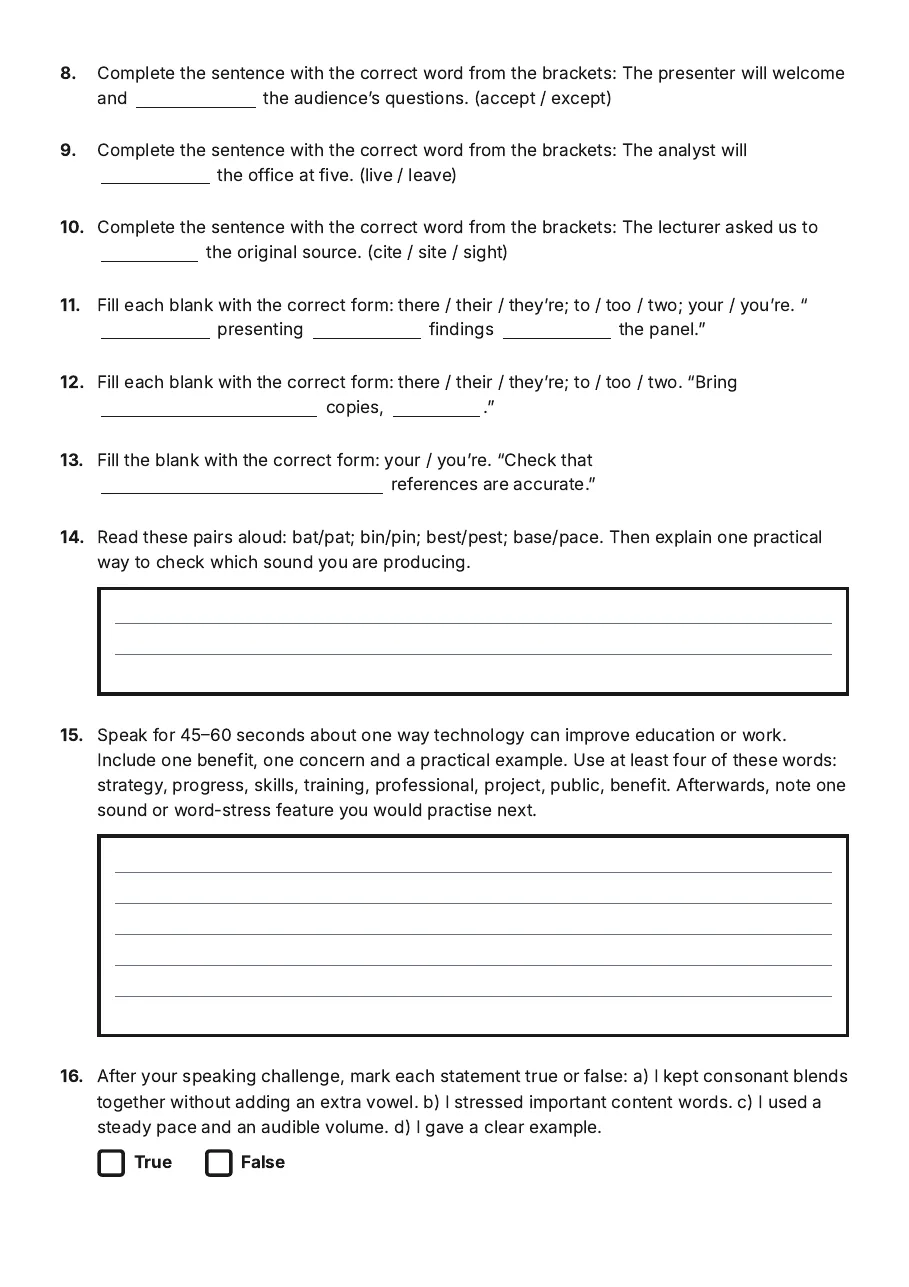
Simulated SAT Pronunciation Practice

A free english worksheet ready for your classroom. Open in Kuraplan to grab the print-ready PDF, customize it for your students, or generate a fresh version in seconds.
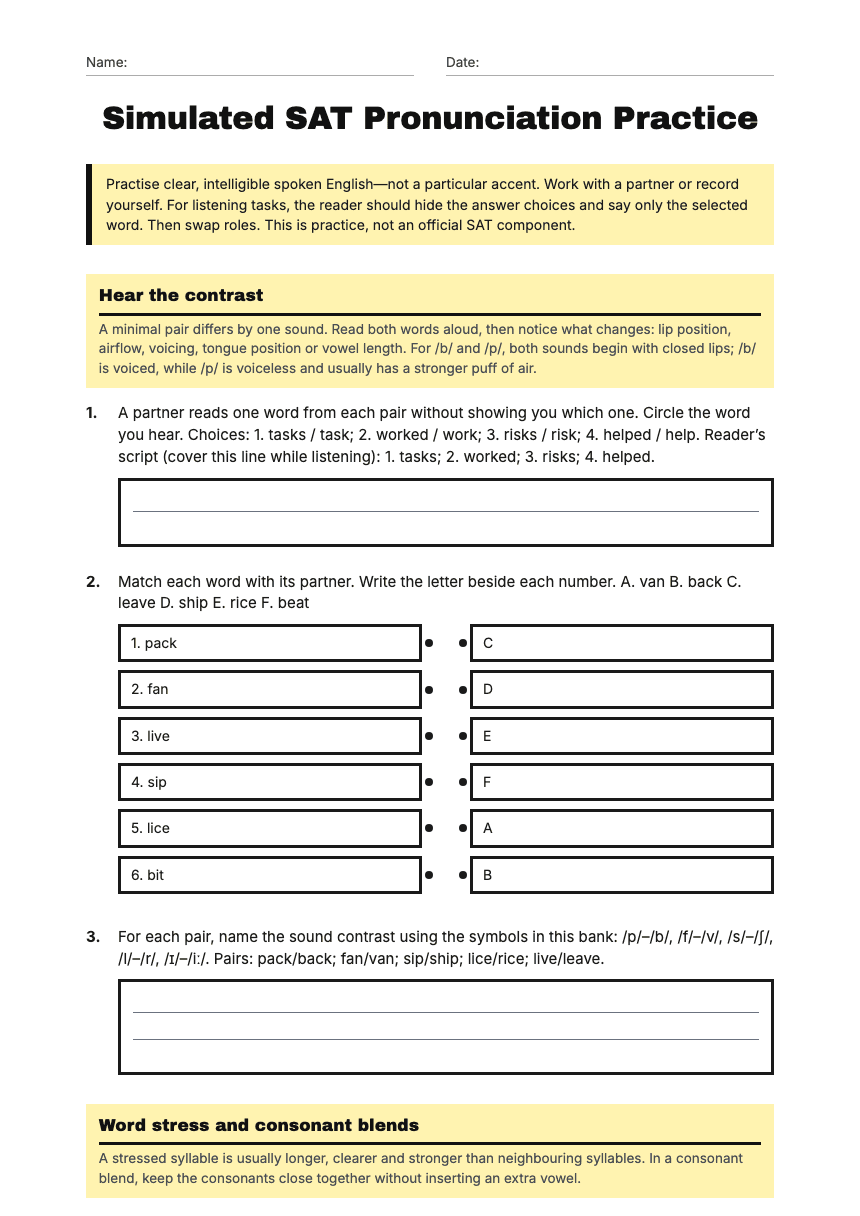
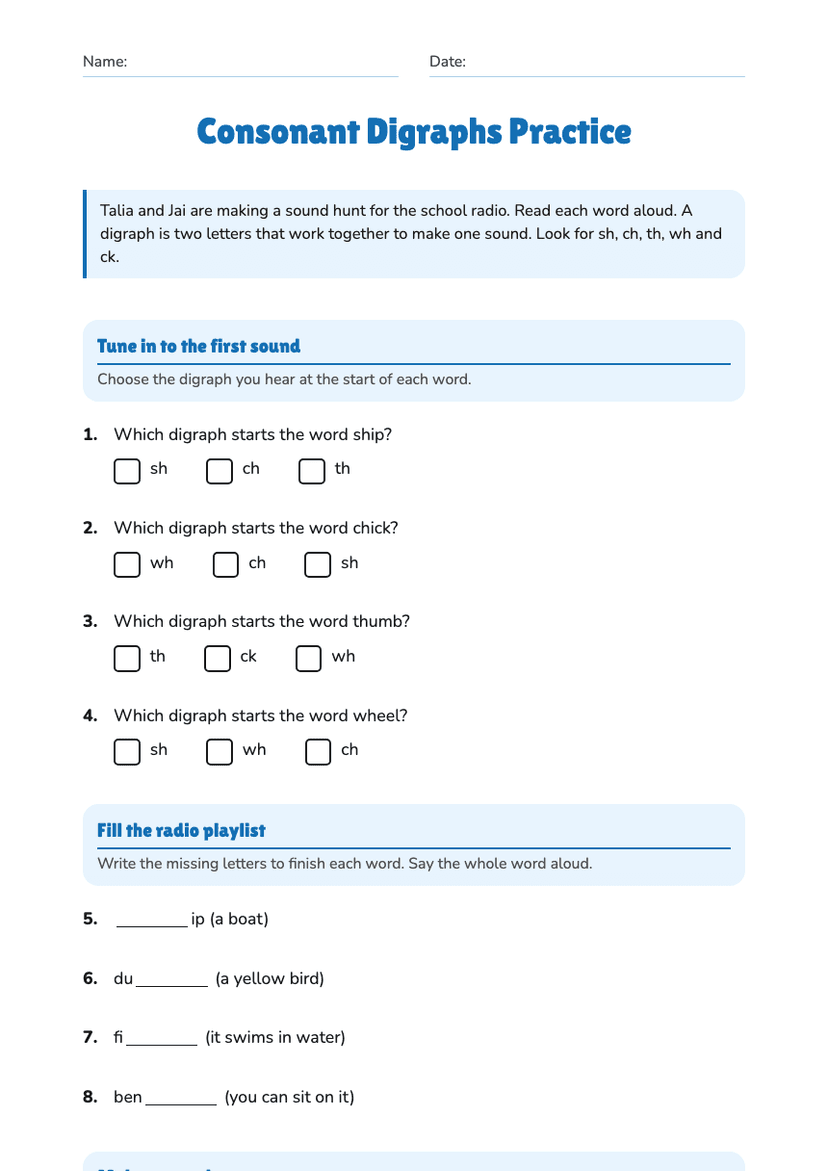
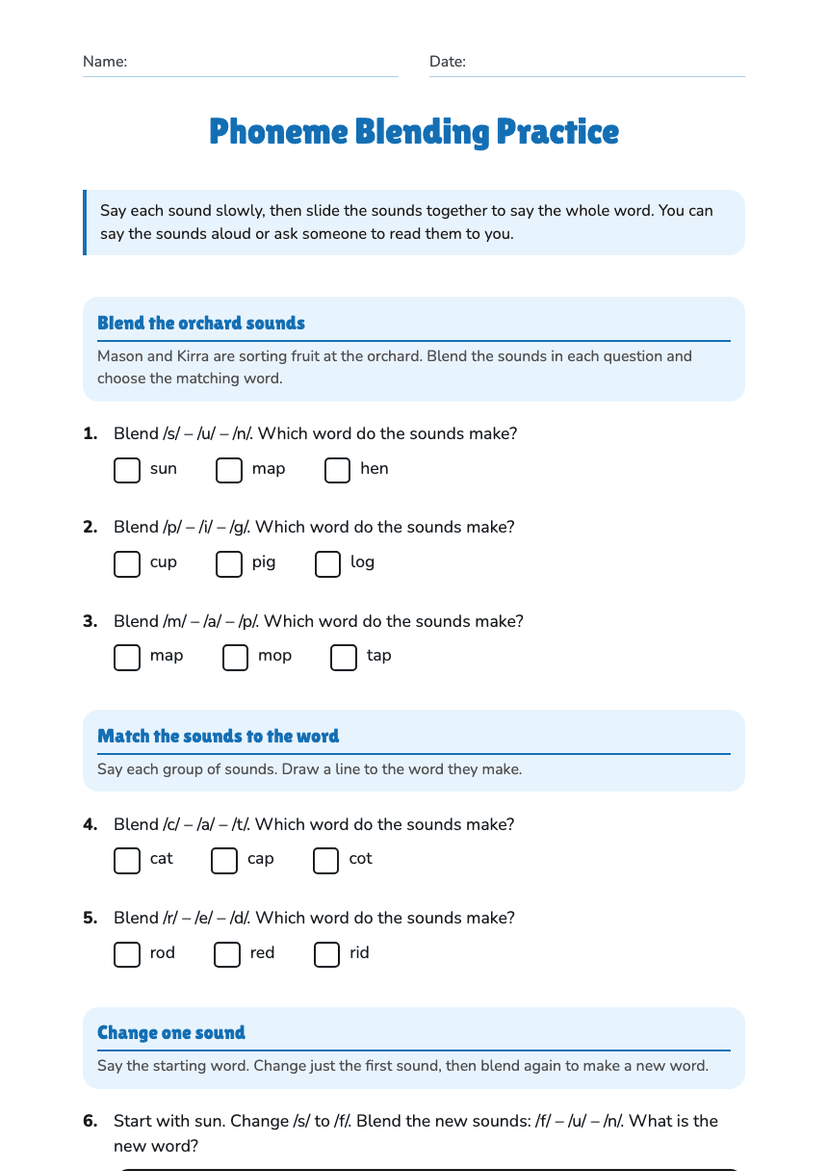
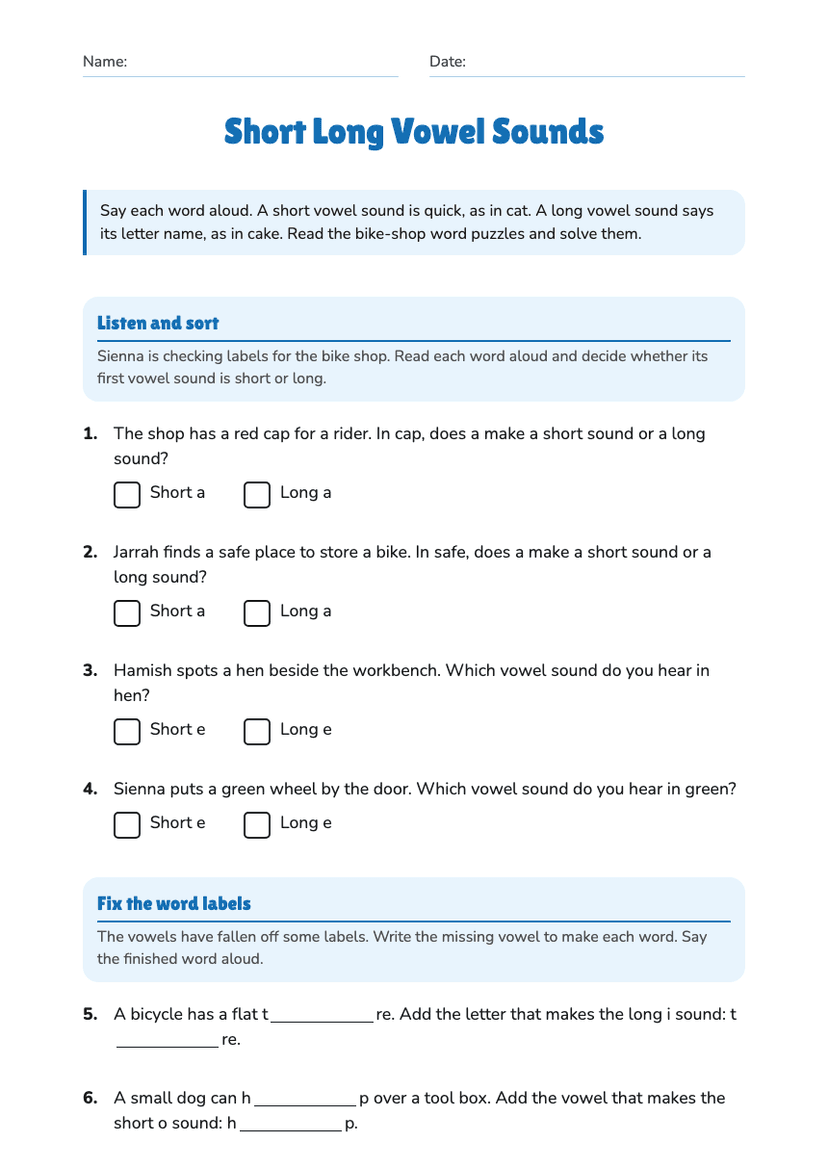
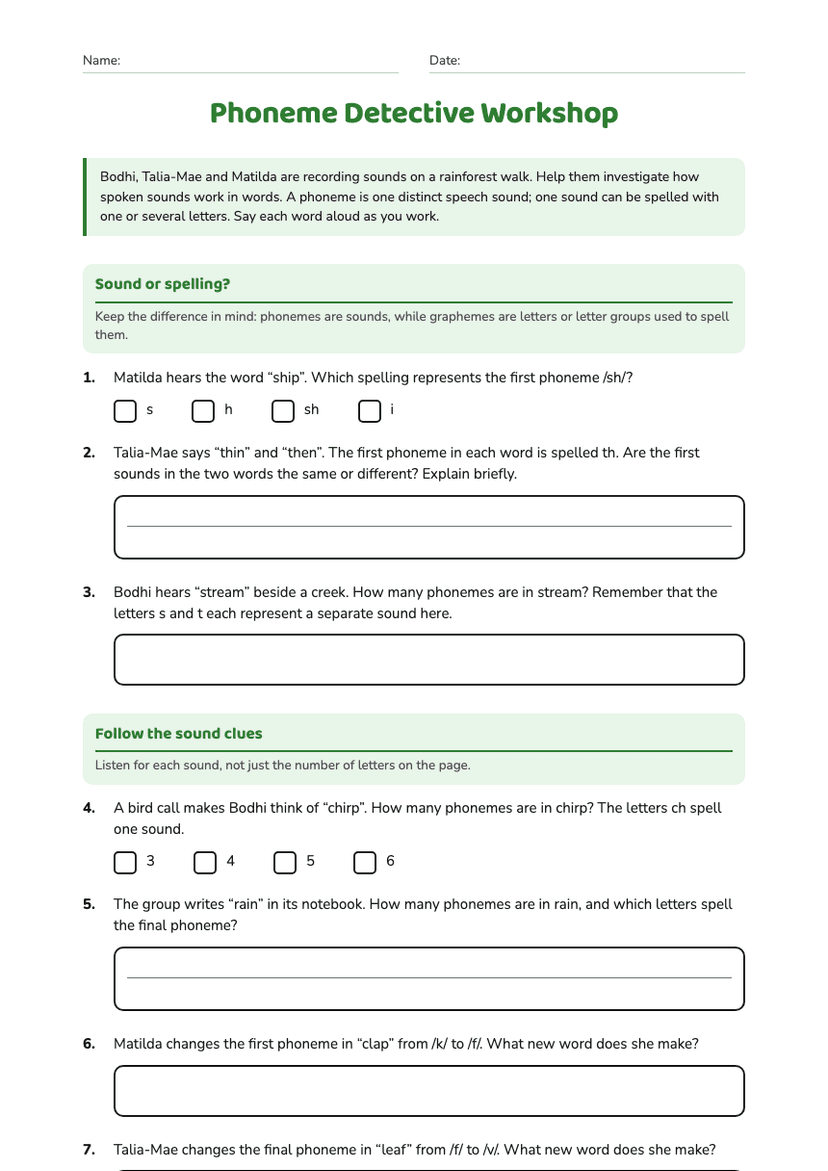
Simulated SAT Pronunciation Practice worksheet preview

Simulated SAT Pronunciation Practice

Worksheet illustration

Key Pronunciation Definitions

Use these adult-friendly definitions as a reference while completing the activities.

Sound blend or consonant blend: Two or more consonant sounds spoken closely together. Keep each sound, but do not add an extra vowel between them. Examples include st, tr, and bl.

Pronunciation: The way a word or sound is spoken, including its individual sounds, syllables, stress, rhythm, and clarity.

Syllable: A word part that contains one main vowel sound. For example, training has two syllables: train-ing.

Word stress: The extra emphasis placed on one syllable in a word. The stressed syllable is usually longer, clearer, and louder than the others.

Homophone: A word that sounds the same as another word, or almost the same in some accents, but has a different meaning or spelling. Examples include there, their, and they’re.

Minimal pair: Two words that differ by only one sound, such as ship and sheep or pack and back.

Discriminate between sounds: To listen carefully and identify the difference between two sounds or words. In these activities, you may need to decide which word you heard.

Voiced sound: A sound made when the vocal cords vibrate. You can usually feel this vibration by placing your fingers lightly on your throat.

Voiceless sound: A sound made without vibration of the vocal cords. Air moves through the mouth, but your throat does not vibrate.

/b/: A voiced sound made by closing both lips and then opening them to release the air. Your vocal cords vibrate when you say /b/.

/p/: A voiceless sound made by closing both lips and then opening them to release the air. Your vocal cords do not vibrate, and /p/ usually has a stronger puff of air than /b/.

Academic vocabulary: Words commonly used in education, research, formal discussions, presentations, and professional or workplace communication, such as research, policy, benefit, and strategy.

Part 1: Blend Accuracy

Important: This is simulated speaking-exam practice, not an official SAT component.

A consonant blend contains two or more consonants spoken closely together. Keep each sound, but do not add an extra vowel: say st, not “suh-tuh”. Move smoothly from one sound to the next.

Mouth and airflow tip: Keep your jaw relaxed. Start the airflow for the first consonant and continue it into the next sound. For st, let air pass over the tongue; for tr and dr, briefly touch the tongue behind the top teeth, then release.

1. Read each initial blend aloud twice. Underline the word you find most difficult.

st: strategy   sp: speech   sk: skills   sl: slowly

tr: training   dr: driven   bl: blended   cl: clearly

fl: fluent   gr: growth   pr: professional

2. Blend the sounds, then read the complete words. Do not insert a vowel between the consonants.

/s/ + /t/ + andard = __________    /p/ + /r/ + oject = __________

/b/ + /l/ + end = __________    /g/ + /r/ + owth = __________

/s/ + /k/ + ills = __________    /t/ + /r/ + aining = __________

3. Read these words, paying attention to the final blends. Circle the word in each pair with the clearer ending.

tasks    tax

worked    word

risks    race

helped    held

4. Read this sentence slowly, then at a natural pace.

Strong professional skills can create better opportunities in a changing workplace.

Part 2: Listening, Stress and Similar Sounds

Work with a partner, or record yourself. The reader says one word from each pair. The listener circles the word heard, then checks the spelling.

5. Discriminate between similar sounds.

1. price    prize

2. glass    grass

3. ship    sheep

4. thin    tin

Expanded Academic-English Minimal-Pair Practice

For Items 5–16, work with a partner or record yourself. In listening mode, the reader says one word from each pair without showing the listener the answer. The listener circles or writes the word heard. In reading mode, read both words aloud, identify the sound that changes, and then read the pair again at a natural pace.

Pay attention to voicing, tongue position, lip position, and vowel length. These contrasts commonly occur in adult academic and workplace communication.

Word-pair discrimination: Circle or identify the word you hear. Then read both words aloud.

5. pack    back

6. fan    van

7. thin    then

8. sip    ship

9. led    red

10. live    leave

11. cap    cab

12. lice    rice

13. park    bark

14. safe    save

15. seal    zeal

16. fill    feel

Sentence-level discrimination: The reader chooses one word from the pair in parentheses and reads the complete sentence. The listener circles or writes the word heard. Then switch roles.

1. The research team will __________ the equipment before the field study. (pack / back)

2. The consultant placed a __________ beside the microphone during the presentation. (fan / van)

3. The lecturer explained the difference between “__________” and “then” in the passage. (thin / then)

4. Please __________ the first word clearly so the audience can follow the instructions. (sip / ship)

5. The project manager __________ the discussion toward a practical solution. (led / red)

6. The analyst will __________ the results next week, but the interns will __________ the office at five. (live / leave)

Reading check: For each pair above, write the sound contrast you hear. Use the symbols in the support box.

5. pack / back: __________    6. fan / van: __________

7. thin / then: __________    8. sip / ship: __________

9. led / red: __________    10. live / leave: __________

11. cap / cab: __________    12. lice / rice: __________

13. park / bark: __________    14. safe / save: __________

15. seal / zeal: __________    16. fill / feel: __________

Sound support: /p/–/b/   /f/–/v/   /θ/–/ð/   /s/–/ʃ/   /l/–/r/   /ɪ/–/iː/

Answer Key for Expanded Reading Practice

Word pairs 5–16: 5. /p/–/b/; 6. /f/–/v/; 7. /θ/–/ð/; 8. /s/–/ʃ/; 9. /l/–/r/; 10. /ɪ/–/iː/; 11. /p/–/b/; 12. /l/–/r/; 13. /p/–/b/; 14. /f/–/v/; 15. /s/–/z/; 16. /ɪ/–/iː/. In listening mode, the selected answer depends on the word spoken by the reader.

Sentence items: The target contrasts are 1. /p/–/b/; 2. /f/–/v/; 3. /θ/–/ð/; 4. /s/–/ʃ/; 5. /l/–/r/; 6. /ɪ/–/iː/. Accept answers that accurately identify the word spoken and distinguish the target sounds.

6. Mark the stressed syllable with a capital letter, then read each word aloud.

education: ____________________    technology: ____________________

employment: ____________________    society: ____________________

7. Read the academic sentences. Stress the bold words and keep the final blends audible.

The research suggests that digital access supports lifelong learning.

Effective training helps employees respond to complex social challenges.

Universities should develop practical skills for a changing economy.

Extended Practice: Discriminate between Similar Sounds

For Questions 15–17, work with a partner or record yourself. The reader should say one target word at a time without showing the listener the answer. The listener uses the context, circles or writes the word heard, and then checks the answer key.

15. Choose the word you hear. The reader should say one word from each pair.

1. ship    sheep

2. live    leave

3. full    fool

4. bit    beat

16. Match each word in Column A with its minimal-pair partner in Column B. Then read each pair aloud and describe the sound difference.

Column A

5. fan ______

6. thin ______

7. three ______

8. rice ______

Column B

A. tree    B. lice    C. van    D. sin

17. Complete each short academic or workplace sentence with the word that fits the meaning. Then read the sentence aloud, making the initial sound clear.

9. Please turn on the __________ before the presentation begins. (light / right)

10. Select the __________ answer on the evaluation form. (light / right)

11. The cafeteria offers a __________ vegetarian meal at lunchtime. (cheap / sheep)

12. The project team will __________ the revised schedule with the client. (coat / goat)

13. The manager wore a dark __________ during the interview. (coat / goat)

14. The western office is located __________ of the central branch. (west / vest)

18. Read the following contrast sentences aloud. Your partner should identify which target word you used.

The analyst will live near the office, but the interns will leave after the meeting.

The training room was full, but the presenter did not act like a fool.

The researcher found one small bit of evidence that helped the team beat its deadline.

The consultant prepared a three-step plan and planted a tree outside the workplace.

Answer and Pronunciation Guide for Extended Practice

Question 15: Reader’s script and answer sequence may vary. For a complete practice set, read these words in order: 1. ship; 2. leave; 3. fool; 4. beat. The listener should circle the word actually spoken. The contrast is /ɪ/ versus /iː/ in each pair.

Question 16: 5-C, 6-D, 7-A, 8-B. The pairs are fan/van, thin/sin, three/tree, and rice/lice. The main contrasts are /f/ versus /v/, /θ/ versus /s/, /θ/ versus /t/, and /r/ versus /l/.

Question 17: 9. light; 10. right; 11. cheap; 12. coat; 13. coat; 14. west. The unused distractors are sheep, goat, goat, vest, and the alternate word in each pair. Answers should be pronounced clearly in context.

Question 18: Suggested contrasts are live/leave, full/fool, bit/beat, and three/tree. Accept responses that accurately distinguish the target sounds and communicate the intended meaning.

Distinguishing /b/ and /p/

This adult-focused practice targets the difference between /b/ and /p/, a contrast that is important in academic discussions, meetings, presentations, and workplace communication.

Voicing test: Both sounds are made by closing the lips and then releasing the air. Put two fingers lightly on your throat. For /b/, your vocal cords vibrate: it is voiced. For /p/, your vocal cords do not vibrate: it is voiceless. You should feel a stronger puff of air after /p/. Keep the lips in the same position, close them firmly, and release them cleanly without adding an extra vowel.

1. Listening and discrimination: Work with a partner or record yourself. The reader says one word from each pair. The listener circles the word heard, then switches roles.

1. bat    pat

2. berry    perry

3. best    pest

4. boat    poat

5. bin    pin

6. bill    pill

7. base    pace

8. buy    pie

9. badge    patch

10. public    public (with /p/ emphasized in a careful contrast)

2. Word-completion practice: Choose b or p to complete each academic or workplace word. Then read the complete word aloud.

a. pu__lic (b / p)    b. __udget (b / p)

c. cam__us (b / p)    d. __roject (b / p)

e. re__ort (b / p)    f. __enefit (b / p)

g. o__erate (b / p)    h. em__loyee (b / p)

i. __olicy (b / p)    j. a__ility (b / p)

3. Sentence-reading practice: Read each sentence aloud. Make /b/ voiced and /p/ voiceless. Keep the lips closed before releasing the sound.

The public briefing presented a clear budget plan.

Each participant received a written benefit summary.

The project team will prepare a brief report for the board.

Our department values practical problem-solving and reliable support.

The supervisor approved the proposal before the afternoon meeting.

Employees should report problems promptly so the team can respond.

4. Short speaking task: Speak for 45–60 seconds about a project, policy, or workplace improvement. Use at least six words containing /b/ or /p/, including budget, benefit, project, public, prepare, problem, or support. Try the task once slowly and once at a natural pace.

I felt vibration in my throat for /b/.

I released a clear puff of air for /p/.

I kept both sounds at the lips without adding “uh.”

Answer Key and Pronunciation Guide

Question 1: The reader’s selected word determines the answer. The target contrast is /b/–/p/ in each pair. Poat is a practice nonce word; use it only to focus attention on the initial sound.

Question 2: a. public; b. budget; c. campus; d. project; e. report; f. benefit; g. operate; h. employee; i. policy; j. ability.

Questions 3–4: Answers depend on accurate pronunciation and intelligibility. For /b/, check for throat vibration. For /p/, check for no throat vibration and a noticeable puff of air. Both sounds should begin with firm lip closure and should not be followed by an extra vowel.

Part 3: Simulated Speaking Response and Review

8. Speak for 60–90 seconds. Explain whether technology has improved education and work. Give one benefit, one concern, and a practical example. Use at least three blend words, such as strategy, progress, skills, training, global or professional.
9. Self-assessment: Tick each statement that is true after your response.

I kept blends together without adding “uh” or “uhs” between sounds.

I pronounced initial and final blends clearly.

I stressed important content words.

I used a steady pace and understandable volume.

I gave a clear example and organised my ideas.

10. Write one pronunciation goal for your next practice session.

Answer and Pronunciation Guide

Question 2: standard (“STAN-dud”); project (“PROJ-ekt”); blend (“blend”); growth (“grohth”); skills (“skilz”); training (“TRAY-ning”). Keep the first consonants close together.

Question 3: Accept either choice if the ending is pronounced accurately. Final blends should not disappear: tasks = “task-s”; worked = “workt”; risks = “risk-s”; helped = “helpt”.

Question 5: price = “pryss”, prize = “pryze”; glass = “glass”, grass = “grass”; ship = “ship”, sheep = “sheep”; thin = “thin” with the tongue lightly between the teeth, tin = “tin”.

Question 6: eduCAtion; techNOLogy; emPLOYment; soCIety. Exact stress may vary slightly by accent, but the stressed syllable should be longer, clearer and louder.

Part 4: Homophones in Academic English

Homophones are words that sound the same, or almost the same in some accents, but have different meanings and spellings. In academic speaking and writing, choosing the correct spelling helps communicate your ideas clearly.

11. Match each homophone group with its meaning. Write the correct letter on the line.

1. there / their / they’re ______

2. to / too / two ______

3. your / you’re ______

4. its / it’s ______

5. affect / effect ______

6. accept / except ______

7. principal / principle ______

8. cite / site / sight ______

A. belonging to you; you are

B. a location; belonging to them; they are

C. influence or change; result

D. toward or used before a verb; also; the number 2

E. receive or agree to; excluding

F. belonging to it; it is or it has

G. the head of a school or organization; a basic rule or belief

H. refer to a source; a place; something seen

12. Fill in each blank with the correct word from the group in parentheses.

a. The students placed ______ research notes on the table. (there / their / they’re)

b. ______ going ______ present ______ findings to the class. (there / their / they’re; to / too / two; to / too / two)

c. ______ important to check ______ sources before submitting ______ essay. (its / it’s; cite / site / sight; your / you’re)

d. The survey may ______ students’ attitudes, but the final ______ will be measured later. (affect / effect)

e. The committee will ______ all complete applications ______ those submitted late. (accept / except)

f. The school ______ explained the academic ______ of honesty. (principal / principle)

g. The research ______ included a clear ______ of the laboratory, and the students had a useful ______ of the equipment. (cite / site / sight)

13. Read each sentence aloud. Pronounce the homophones clearly and use the context to show their different meanings.

They’re presenting their findings there after lunch.

You’re expected to submit your response, too.

It’s important to explain how the policy may affect its users.

The principal explained the principle during the academic meeting.

Please cite the source and describe the research site in your report.

14. Read the paragraph aloud at a natural pace. Then underline each homophone group.

They’re studying their notes there before the exam. You’re allowed to use two examples, and you may refer to your course materials too. It’s useful to explain the effect of a policy and how it can affect society. Remember to cite each source, even when the site provides a clear sight of the issue.

Answer Key

Question 11: 1-B; 2-D; 3-A; 4-F; 5-C; 6-E; 7-G; 8-H.

Question 12: a. their; b. They’re, to, their; c. It’s, cite, your; d. affect, effect; e. accept, except; f. principal, principle; g. site, cite, sight.

Questions 13–14: Answers are based on accurate pronunciation and correct use of context. In Question 13, the pairs or groups are: they’re/their/there, you’re/your/too, it’s/its/affect, principal/principle, and cite/site. In Question 14, the groups are: they’re/their/there, you’re/two/your/too, it’s/effect/affect, and cite/site/sight.

About This Worksheet

Free in Kuraplan

Sign up free, grab the PDF, and customize it for your class.

Print-Ready

Formatted for standard paper. Clean layout, easy to read.

AI-Generated

Created with Kuraplan's AI, designed for real classroom use.

For Teachers & Parents

Use in classrooms, for homework, tutoring, or homeschool.

Need a custom version of this worksheet?

Kuraplan's AI generates custom worksheets in seconds — differentiated for every learner, aligned to your curriculum.

Generate Custom Worksheets — Free
No credit card Curriculum-aligned Under 60 seconds