Social SciencesFreePrintable

Social Causes of Colonisation

A free social sciences worksheet ready for your classroom. Open in Kuraplan to grab the print-ready PDF, customize it for your students, or generate a fresh version in seconds.
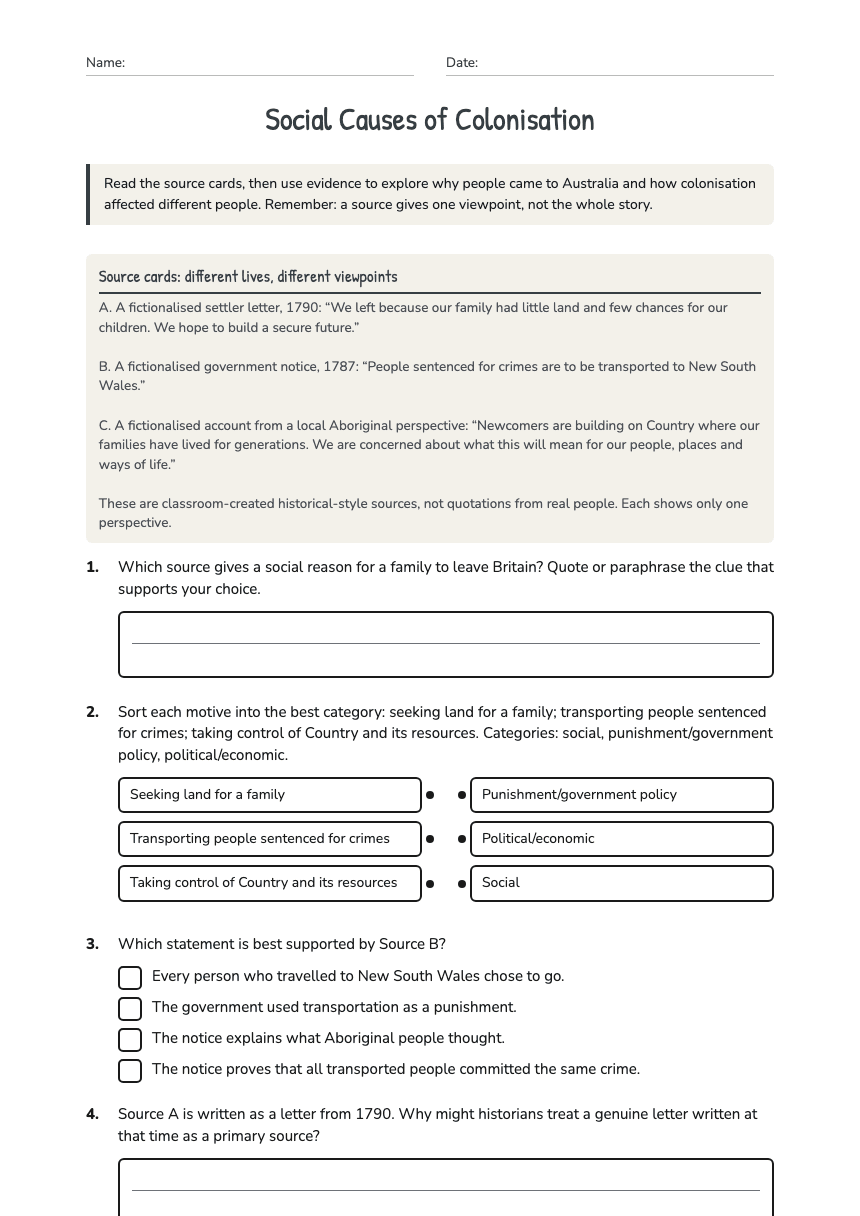
Social Causes of Colonisation worksheet preview
Name:Date:

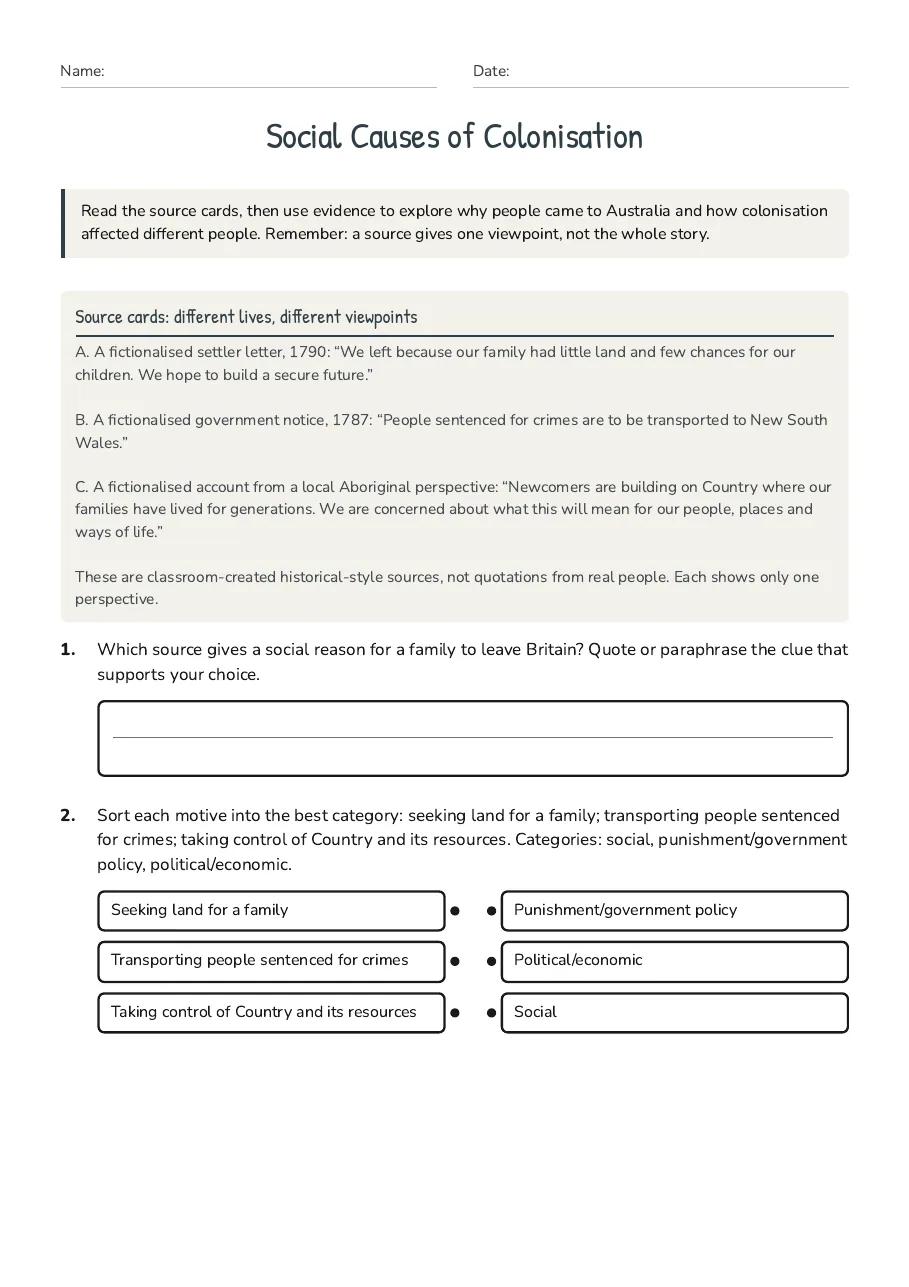
Social Causes of Colonisation

Read the source cards, then use evidence to explore why people came to Australia and how colonisation affected different people. Remember: a source gives one viewpoint, not the whole story.

Source cards: different lives, different viewpoints

A. A fictionalised settler letter, 1790: “We left because our family had little land and few chances for our children. We hope to build a secure future.” B. A fictionalised government notice, 1787: “People sentenced for crimes are to be transported to New South Wales.” C. A fictionalised account from a local Aboriginal perspective: “Newcomers are building on Country where our families have lived for generations. We are concerned about what this will mean for our people, places and ways of life.” These are classroom-created historical-style sources, not quotations from real people. Each shows only one perspective.

1.Which source gives a social reason for a family to leave Britain? Quote or paraphrase the clue that supports your choice.
2.Sort each motive into the best category: seeking land for a family; transporting people sentenced for crimes; taking control of Country and its resources. Categories: social, punishment/government policy, political/economic.
  • Seeking land for a family
  • Transporting people sentenced for crimes
  • Taking control of Country and its resources
  • Punishment/government policy
  • Political/economic
  • Social
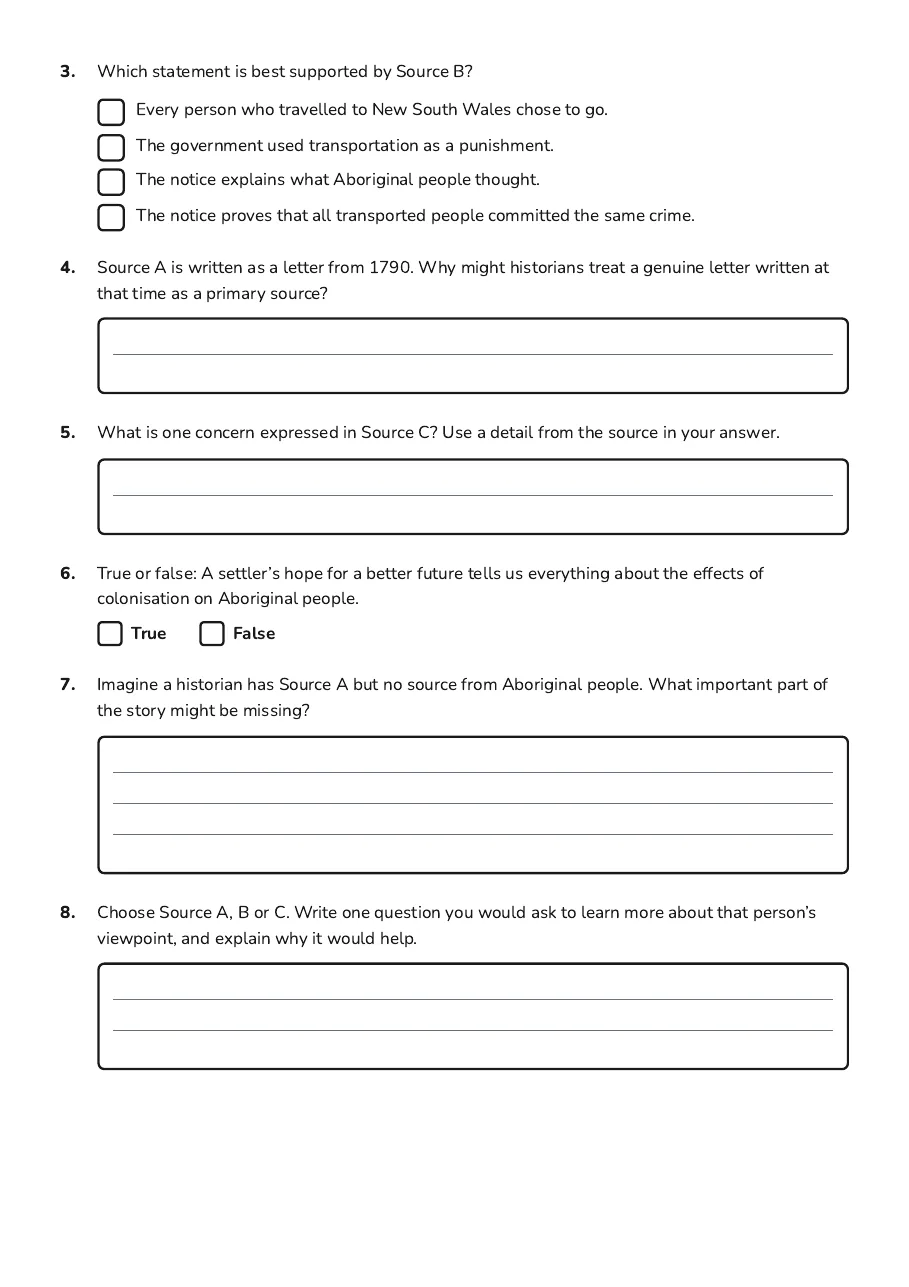
3.Which statement is best supported by Source B?
  • Every person who travelled to New South Wales chose to go.
  • The government used transportation as a punishment.
  • The notice explains what Aboriginal people thought.
  • The notice proves that all transported people committed the same crime.
4.Source A is written as a letter from 1790. Why might historians treat a genuine letter written at that time as a primary source?
5.What is one concern expressed in Source C? Use a detail from the source in your answer.
6.True or false: A settler’s hope for a better future tells us everything about the effects of colonisation on Aboriginal people.
TrueFalse
7.Imagine a historian has Source A but no source from Aboriginal people. What important part of the story might be missing?
8.Choose Source A, B or C. Write one question you would ask to learn more about that person’s viewpoint, and explain why it would help.
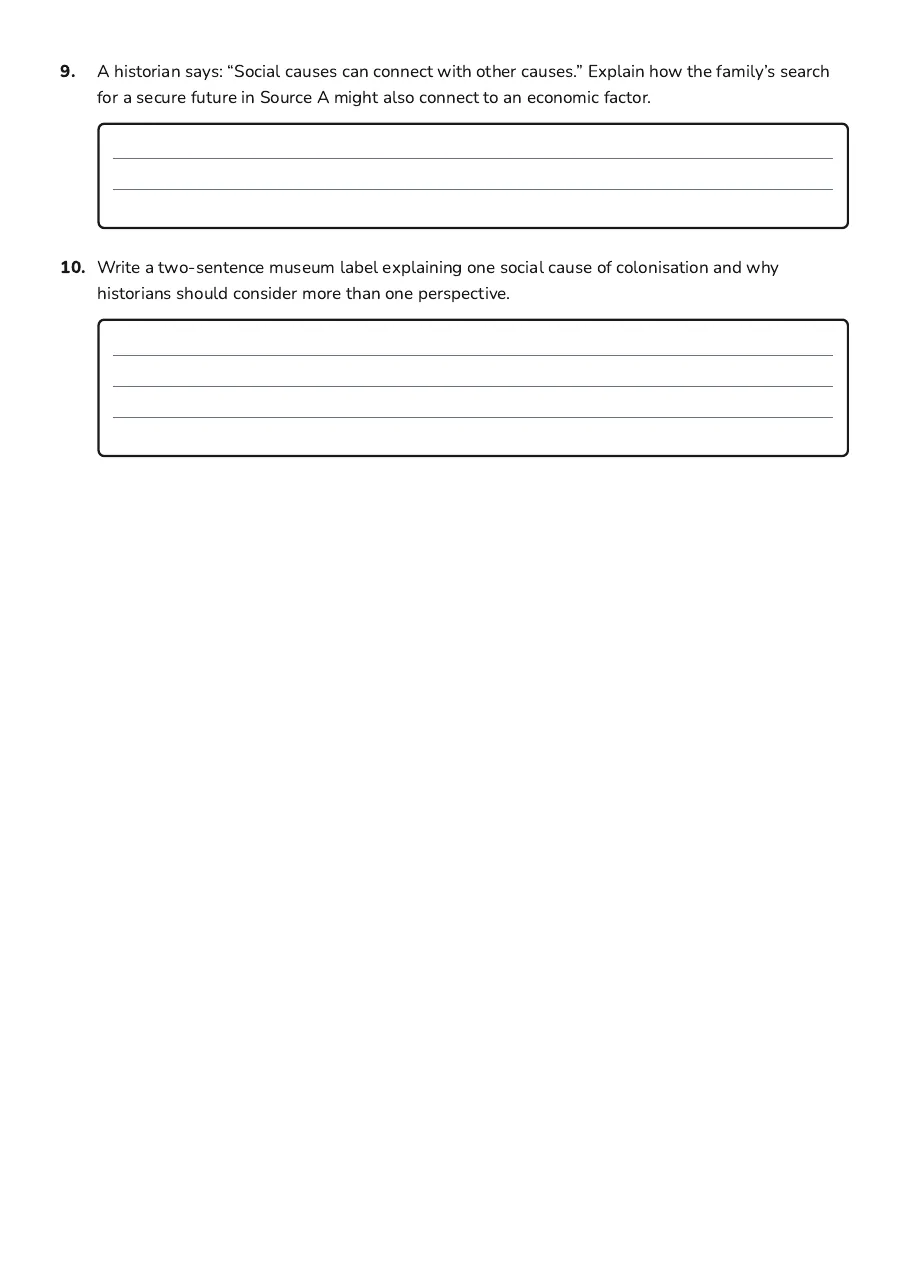
9.A historian says: “Social causes can connect with other causes.” Explain how the family’s search for a secure future in Source A might also connect to an economic factor.
10.Write a two-sentence museum label explaining one social cause of colonisation and why historians should consider more than one perspective.

3 printable pages

  • Social Causes of Colonisation, page 1 of 3: Source cards: different lives, different viewpoints

    Page 1

  • Social Causes of Colonisation, page 2 of 3: 3. Which statement is best supported by Source B?

    Page 2

  • Social Causes of Colonisation, page 3 of 3: 9. A historian says: “Social causes can connect with other causes.” Explain how the…

    Page 3

About This Worksheet

Free in Kuraplan

Sign up free, grab the PDF, and customize it for your class.

Print-Ready

Formatted for standard paper. Clean layout, easy to read.

AI-Generated

Created with Kuraplan's AI, designed for real classroom use.

For Teachers & Parents

Use in classrooms, for homework, tutoring, or homeschool.

Need a custom version of this worksheet?

Kuraplan's AI generates custom worksheets in seconds — differentiated for every learner, aligned to your curriculum.

Generate Custom Worksheets — Free
No credit card Curriculum-aligned Under 60 seconds