DramaFreePrintable

Sound and Movement Integration

A free drama worksheet ready for your classroom. Open in Kuraplan to grab the print-ready PDF, customize it for your students, or generate a fresh version in seconds.
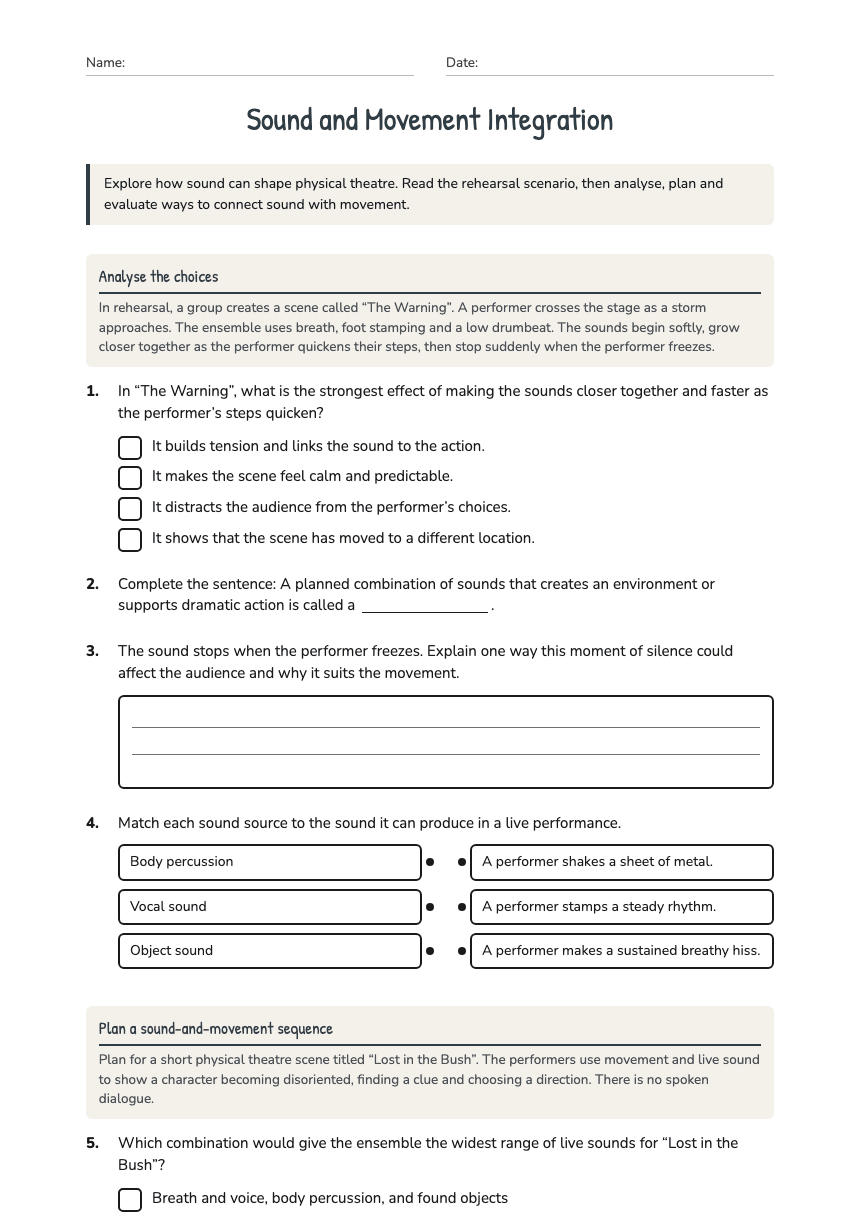
Sound and Movement Integration worksheet preview
Name:Date:

Sound and Movement Integration

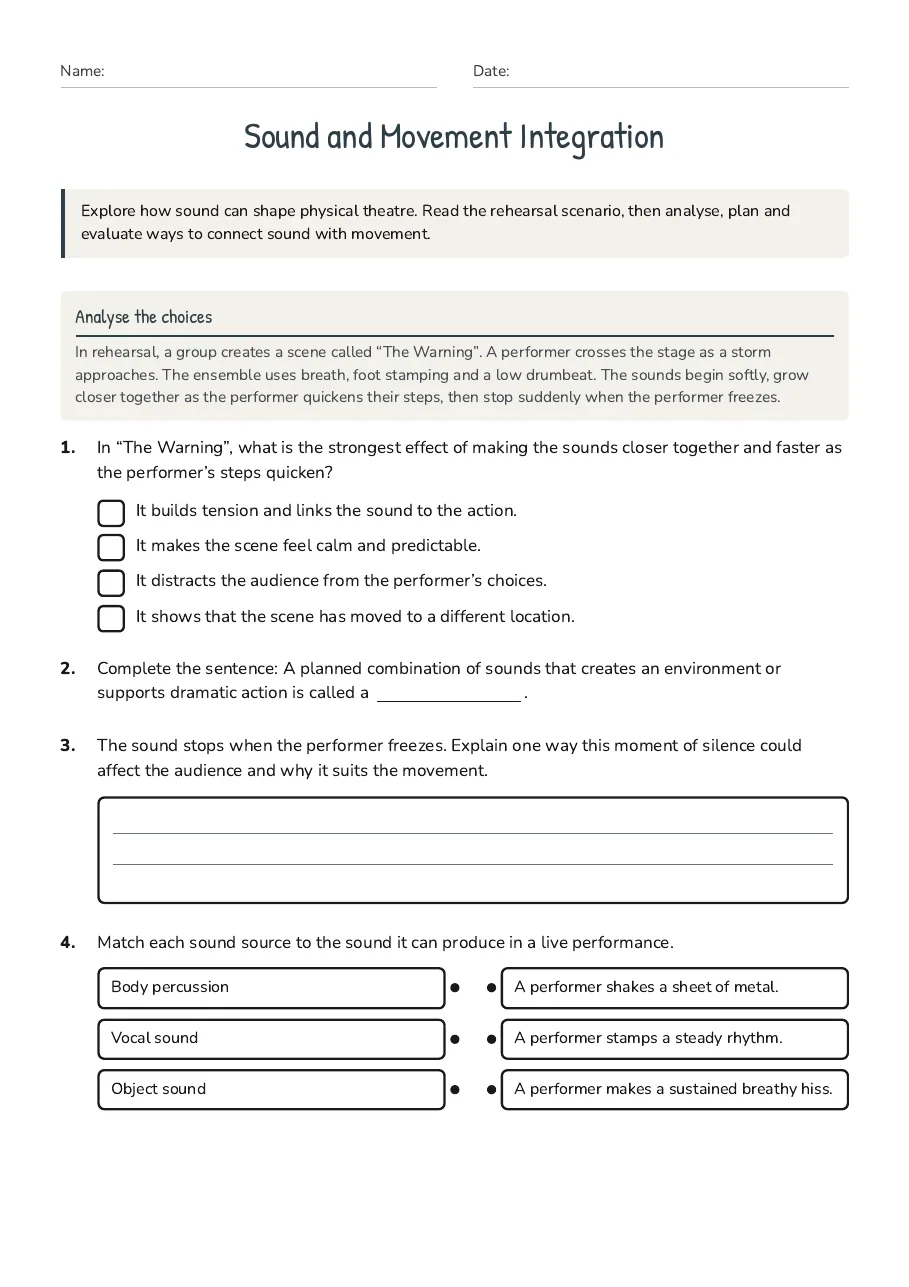
Explore how sound can shape physical theatre. Read the rehearsal scenario, then analyse, plan and evaluate ways to connect sound with movement.

Analyse the choices

In rehearsal, a group creates a scene called “The Warning”. A performer crosses the stage as a storm approaches. The ensemble uses breath, foot stamping and a low drumbeat. The sounds begin softly, grow closer together as the performer quickens their steps, then stop suddenly when the performer freezes.

1.In “The Warning”, what is the strongest effect of making the sounds closer together and faster as the performer’s steps quicken?
  • It builds tension and links the sound to the action.
  • It makes the scene feel calm and predictable.
  • It distracts the audience from the performer’s choices.
  • It shows that the scene has moved to a different location.
2.Complete the sentence: A planned combination of sounds that creates an environment or supports dramatic action is called a .
3.The sound stops when the performer freezes. Explain one way this moment of silence could affect the audience and why it suits the movement.
4.Match each sound source to the sound it can produce in a live performance.
  • Body percussion
  • Vocal sound
  • Object sound
  • A performer shakes a sheet of metal.
  • A performer stamps a steady rhythm.
  • A performer makes a sustained breathy hiss.

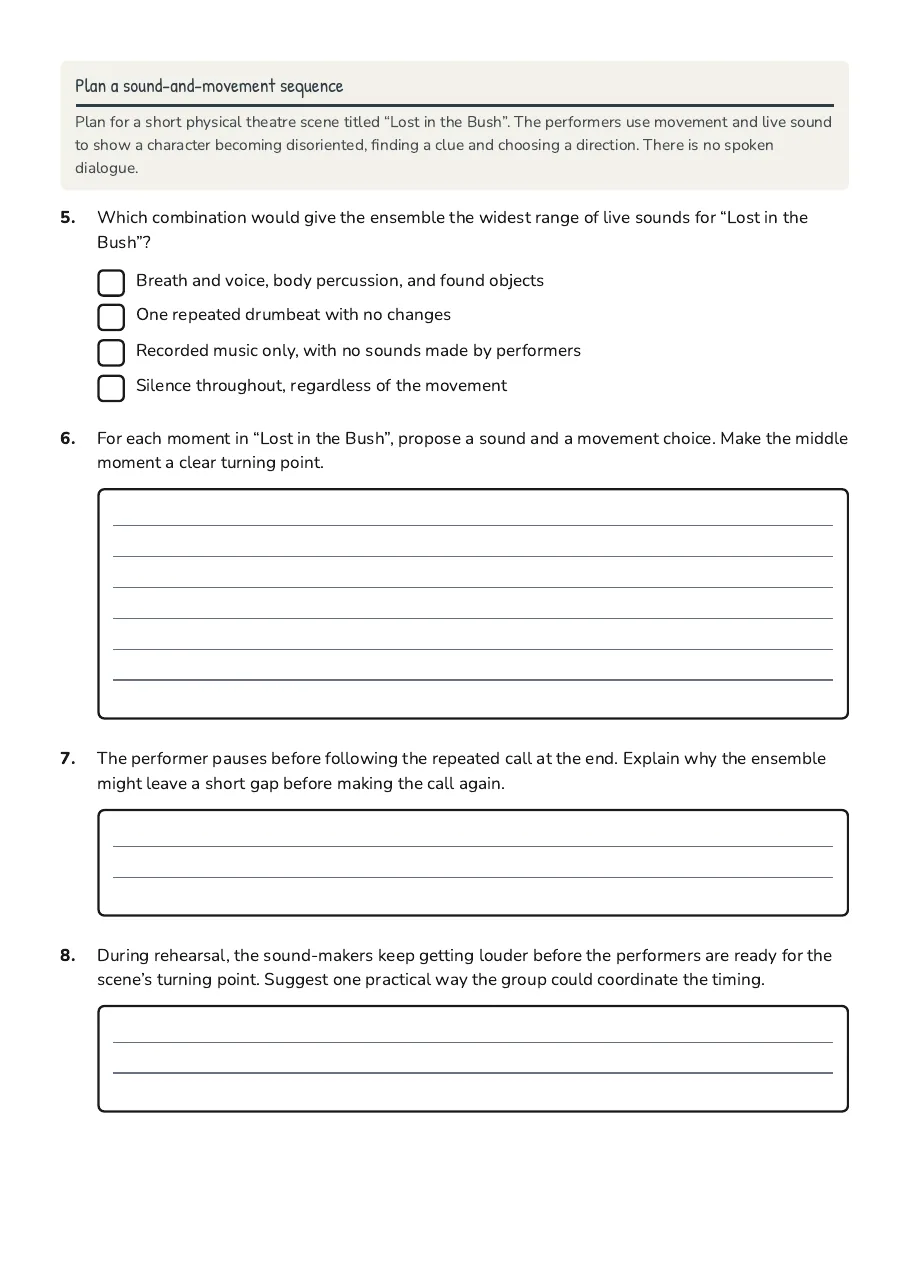
Plan a sound-and-movement sequence

Plan for a short physical theatre scene titled “Lost in the Bush”. The performers use movement and live sound to show a character becoming disoriented, finding a clue and choosing a direction. There is no spoken dialogue.

5.Which combination would give the ensemble the widest range of live sounds for “Lost in the Bush”?
  • Breath and voice, body percussion, and found objects
  • One repeated drumbeat with no changes
  • Recorded music only, with no sounds made by performers
  • Silence throughout, regardless of the movement
6.For each moment in “Lost in the Bush”, propose a sound and a movement choice. Make the middle moment a clear turning point.
7.The performer pauses before following the repeated call at the end. Explain why the ensemble might leave a short gap before making the call again.
8.During rehearsal, the sound-makers keep getting louder before the performers are ready for the scene’s turning point. Suggest one practical way the group could coordinate the timing.
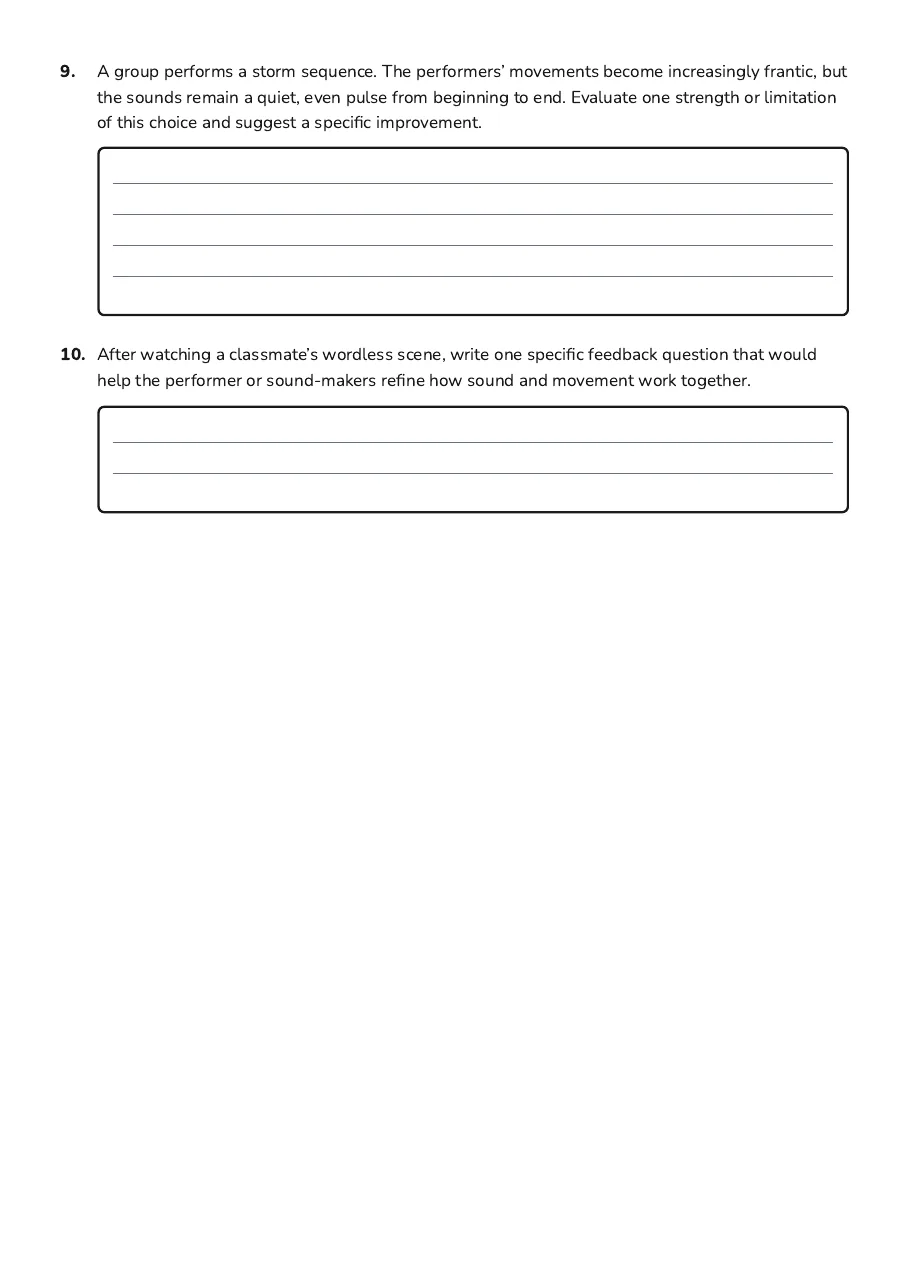
9.A group performs a storm sequence. The performers’ movements become increasingly frantic, but the sounds remain a quiet, even pulse from beginning to end. Evaluate one strength or limitation of this choice and suggest a specific improvement.
10.After watching a classmate’s wordless scene, write one specific feedback question that would help the performer or sound-makers refine how sound and movement work together.

3 printable pages

  • Sound and Movement Integration, page 1 of 3: Analyse the choices

    Page 1

  • Sound and Movement Integration, page 2 of 3: Plan a sound-and-movement sequence

    Page 2

  • Sound and Movement Integration, page 3 of 3: 9. A group performs a storm sequence. The performers’ movements become increasingly…

    Page 3

About This Worksheet

Free in Kuraplan

Sign up free, grab the PDF, and customize it for your class.

Print-Ready

Formatted for standard paper. Clean layout, easy to read.

AI-Generated

Created with Kuraplan's AI, designed for real classroom use.

For Teachers & Parents

Use in classrooms, for homework, tutoring, or homeschool.

Need a custom version of this worksheet?

Kuraplan's AI generates custom worksheets in seconds — differentiated for every learner, aligned to your curriculum.

Generate Custom Worksheets — Free
No credit card Curriculum-aligned Under 60 seconds