Specialist Courts and Tribunals
A free social sciences worksheet ready for your classroom. Open in Kuraplan to grab the print-ready PDF, customize it for your students, or generate a fresh version in seconds.
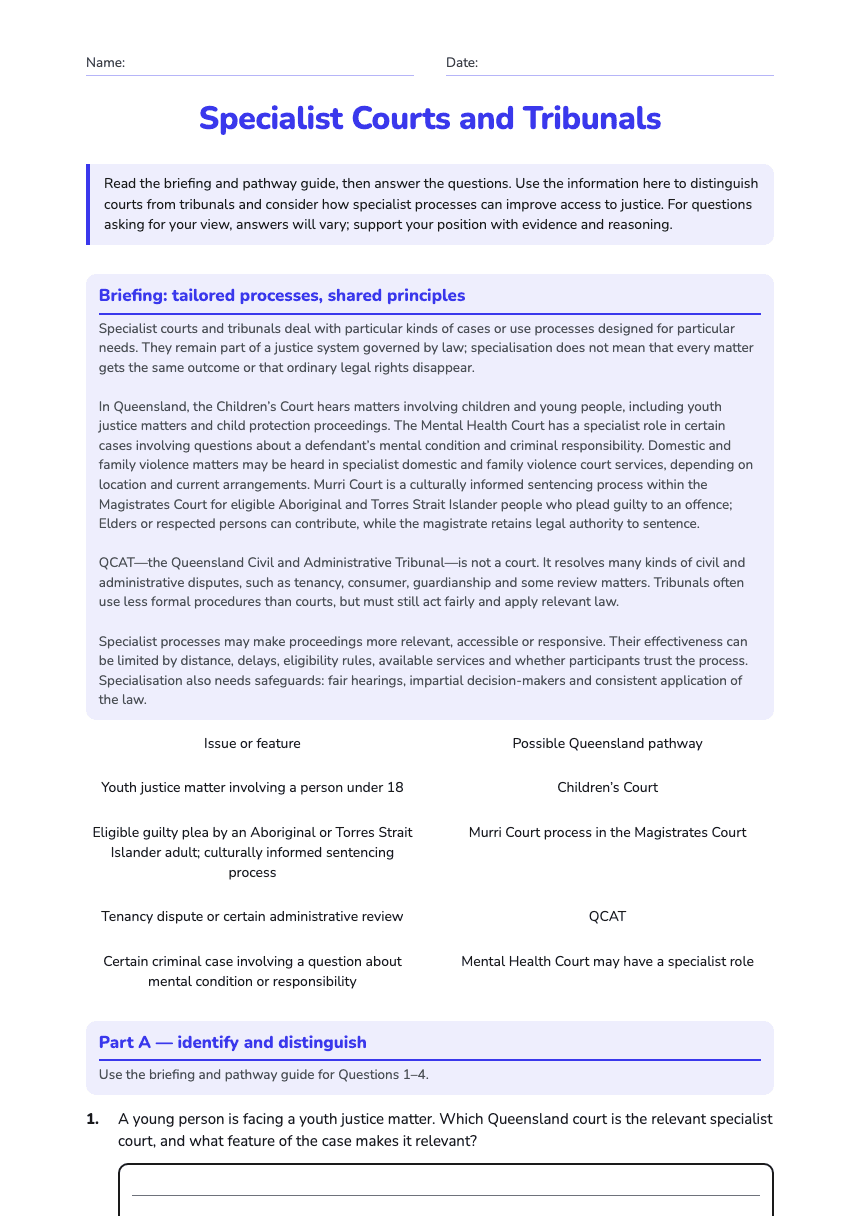
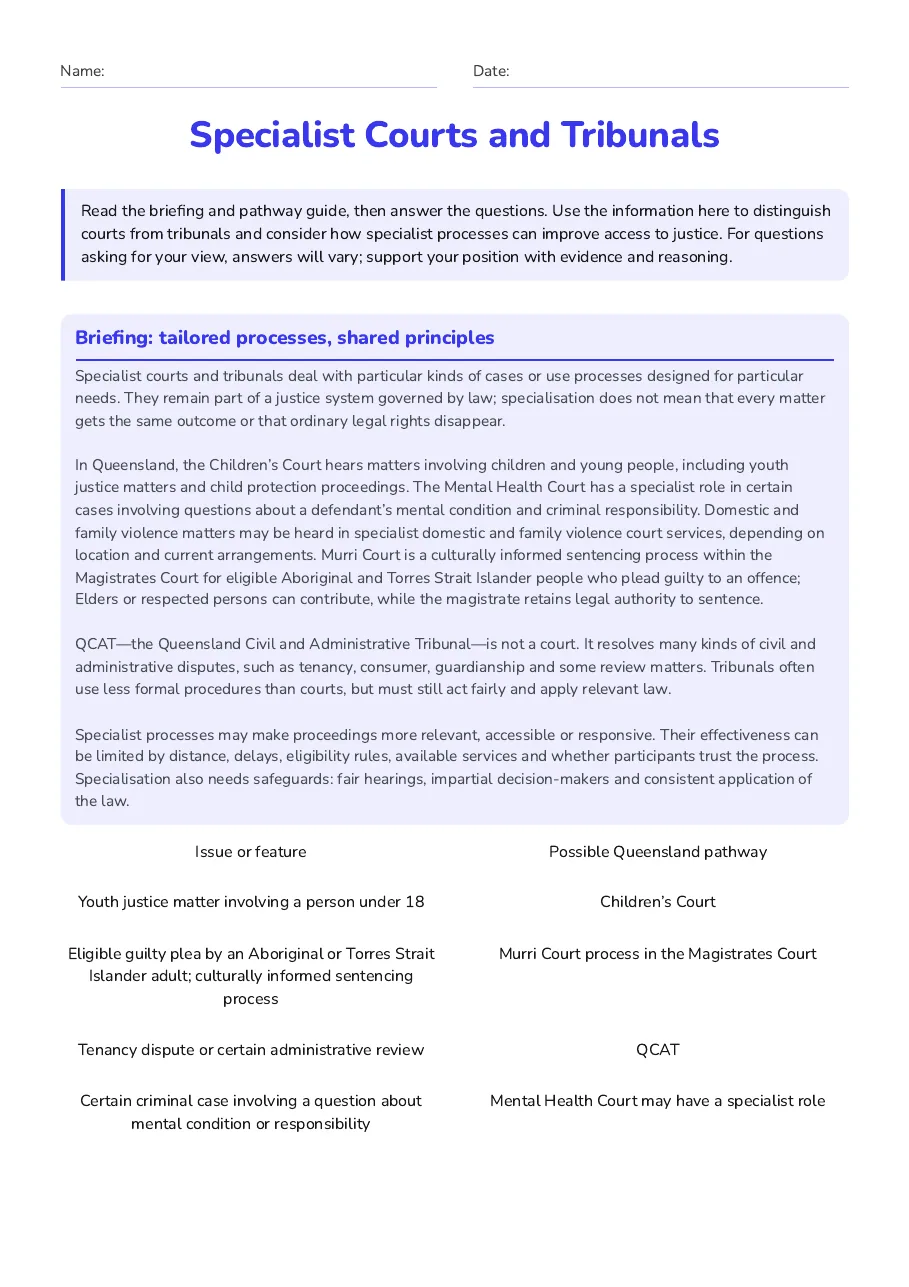
Specialist Courts and Tribunals
Briefing: tailored processes, shared principles
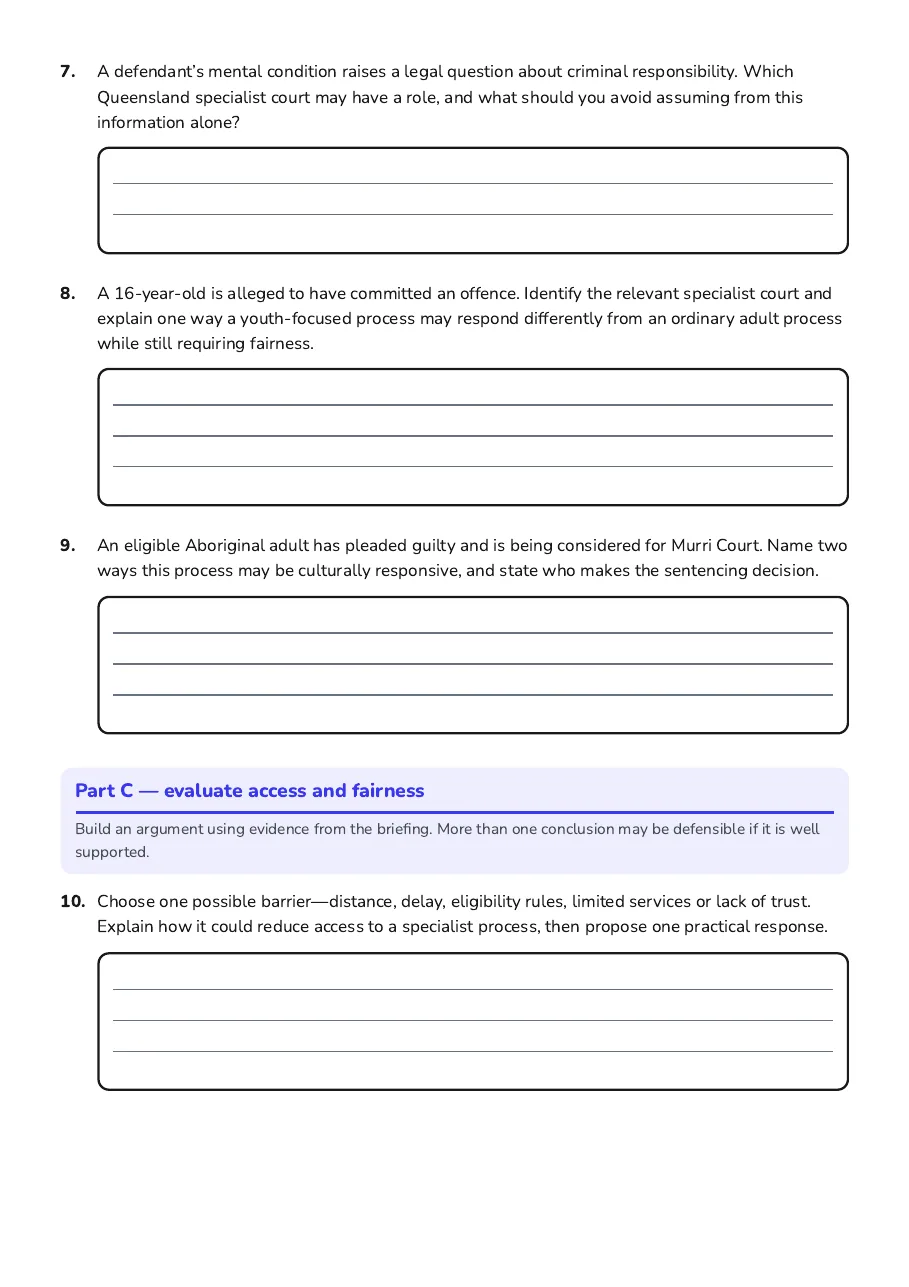
Specialist courts and tribunals deal with particular kinds of cases or use processes designed for particular needs. They remain part of a justice system governed by law; specialisation does not mean that every matter gets the same outcome or that ordinary legal rights disappear. In Queensland, the Children’s Court hears matters involving children and young people, including youth justice matters and child protection proceedings. The Mental Health Court has a specialist role in certain cases involving questions about a defendant’s mental condition and criminal responsibility. Domestic and family violence matters may be heard in specialist domestic and family violence court services, depending on location and current arrangements. Murri Court is a culturally informed sentencing process within the Magistrates Court for eligible Aboriginal and Torres Strait Islander people who plead guilty to an offence; Elders or respected persons can contribute, while the magistrate retains legal authority to sentence. QCAT—the Queensland Civil and Administrative Tribunal—is not a court. It resolves many kinds of civil and administrative disputes, such as tenancy, consumer, guardianship and some review matters. Tribunals often use less formal procedures than courts, but must still act fairly and apply relevant law. Specialist processes may make proceedings more relevant, accessible or responsive. Their effectiveness can be limited by distance, delays, eligibility rules, available services and whether participants trust the process. Specialisation also needs safeguards: fair hearings, impartial decision-makers and consistent application of the law.
Issue or feature
Possible Queensland pathway
Youth justice matter involving a person under 18
Children’s Court
Eligible guilty plea by an Aboriginal or Torres Strait Islander adult; culturally informed sentencing process
Murri Court process in the Magistrates Court
Tenancy dispute or certain administrative review
QCAT
Certain criminal case involving a question about mental condition or responsibility
Mental Health Court may have a specialist role
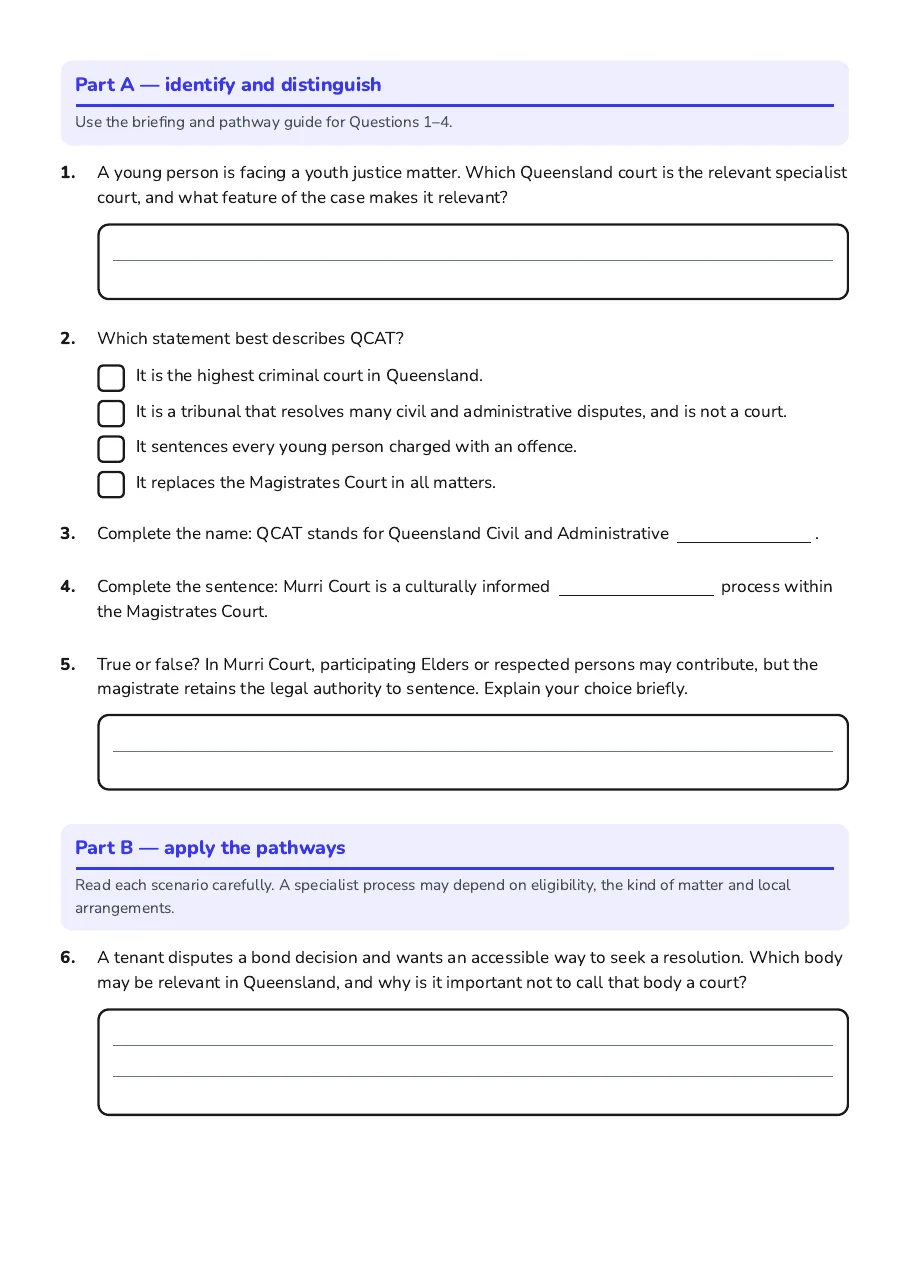
Part A — identify and distinguish
Use the briefing and pathway guide for Questions 1–4.
- It is the highest criminal court in Queensland.
- It is a tribunal that resolves many civil and administrative disputes, and is not a court.
- It sentences every young person charged with an offence.
- It replaces the Magistrates Court in all matters.
Part B — apply the pathways
Read each scenario carefully. A specialist process may depend on eligibility, the kind of matter and local arrangements.
Part C — evaluate access and fairness
Build an argument using evidence from the briefing. More than one conclusion may be defensible if it is well supported.
4 printable pages
Page 1
Page 2
Page 3

Page 4
About This Worksheet
Free in Kuraplan
Sign up free, grab the PDF, and customize it for your class.
Print-Ready
Formatted for standard paper. Clean layout, easy to read.
AI-Generated
Created with Kuraplan's AI, designed for real classroom use.
For Teachers & Parents
Use in classrooms, for homework, tutoring, or homeschool.
Need a custom version of this worksheet?
Kuraplan's AI generates custom worksheets in seconds — differentiated for every learner, aligned to your curriculum.
Generate Custom Worksheets — FreeMore Social Sciences Worksheets
Community Project Planning
Free
Australian Law Reform Fact Sheets
Free
Human Rights Debate Rubric
Free
Australian Referendums Constitutional Process
Free
Media and Law Reform
Free
Australian Constitution Fundamentals
Free
Commonwealth Constitution Overview
Free