ScienceFreePrintable

Taxonomic Ranks Classification

A free science worksheet ready for your classroom. Open in Kuraplan to grab the print-ready PDF, customize it for your students, or generate a fresh version in seconds.
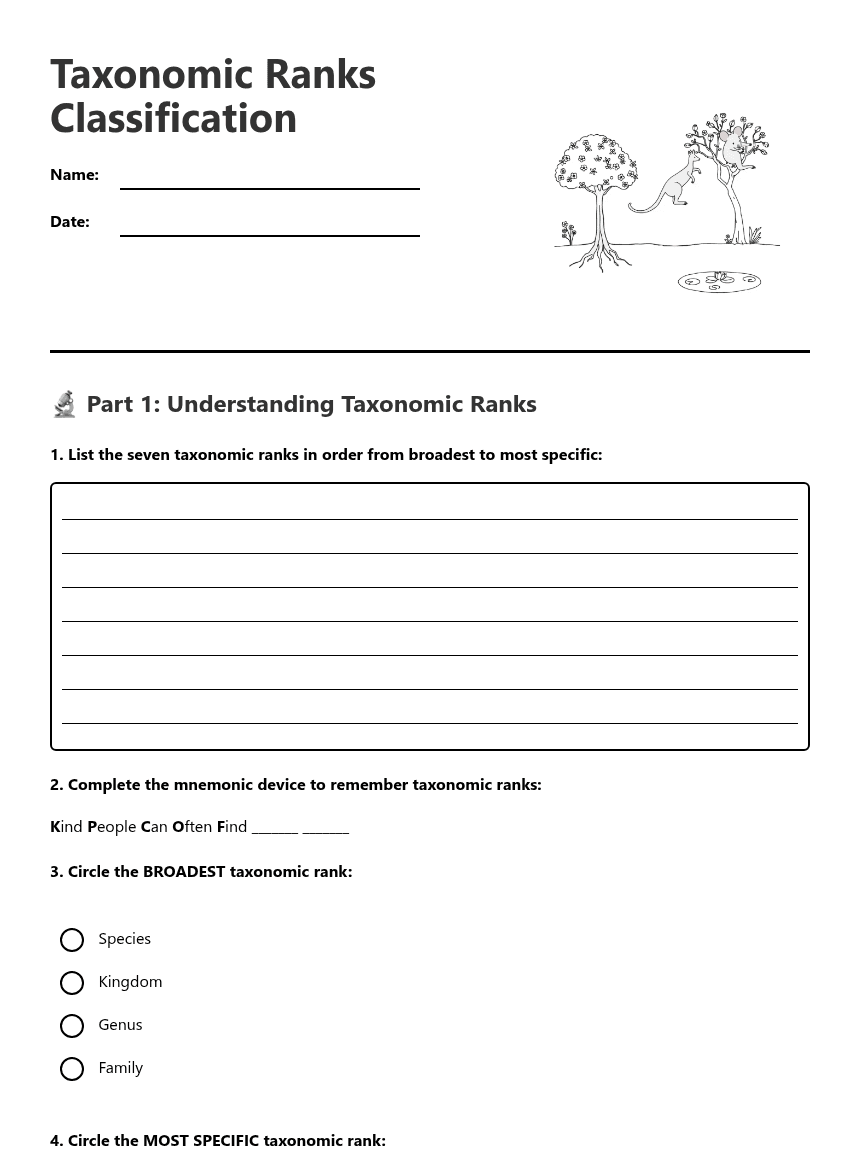
Taxonomic Ranks Classification worksheet preview
Taxonomic Ranks Classification

Taxonomic Ranks Classification

Biological classification hierarchy diagram

🔬 Part 1: Understanding Taxonomic Ranks

1. List the seven taxonomic ranks in order from broadest to most specific:
2. Complete the mnemonic device to remember taxonomic ranks:

Kind People Can Often Find _______ _______

3. Circle the BROADEST taxonomic rank:

Species

Kingdom

Genus

Family

4. Circle the MOST SPECIFIC taxonomic rank:

Phylum

Class

Species

Order

🐕 Part 2: Classifying a Domestic Dog

5. Fill in the blanks for the complete classification of a domestic dog:

Kingdom: _______________

Phylum: _______________

Class: _______________

Order: _______________

Family: _______________

Genus: _______________

Species: _______________ _______________ _______________

6. Why do scientists use the scientific name (Genus + species) instead of just calling it "dog"?

🌿 Part 3: Classification Matching

7. Match each taxonomic rank with its correct description:
1. Kingdom
2. Phylum
3. Class
4. Order
5. Family
6. Genus
7. Species
A. Most specific rank; organisms that can reproduce together
B. Groups organisms by major body plan differences
C. Broadest category (e.g., Animalia, Plantae)
D. Groups similar families together
E. Groups similar classes with common characteristics
F. Groups very similar species together
G. Groups similar genera with shared traits

🧬 Part 4: Multiple Choice Questions

8. Which statement about biological classification is TRUE?

Classification never changes once established

All organisms in the same genus belong to the same species

Classification helps scientists communicate about organisms worldwide

Only animals need to be classified

9. Two organisms that share the same Family will also share the same:

Species and Genus only

Kingdom, Phylum, Class, and Order

Genus and Species only

Nothing else in common

10. Check ALL the reasons why scientists use classification systems:

To organise the diversity of life on Earth

To help identify unknown organisms

To communicate clearly about specific organisms

To understand evolutionary relationships

To make biology more complicated

🎨 Part 5: Create Your Own Classification

11. Draw a simple hierarchical diagram showing how the seven taxonomic ranks are organised from broadest to most specific:
12. Explain how modern technology (like microscopes and DNA analysis) has changed biological classification over time:
13. Choose a familiar Australian animal and research its complete taxonomic classification. Write it below:

Animal chosen: _______________

About This Worksheet

Free in Kuraplan

Sign up free, grab the PDF, and customize it for your class.

Print-Ready

Formatted for standard paper. Clean layout, easy to read.

AI-Generated

Created with Kuraplan's AI, designed for real classroom use.

For Teachers & Parents

Use in classrooms, for homework, tutoring, or homeschool.

Need a custom version of this worksheet?

Kuraplan's AI generates custom worksheets in seconds — differentiated for every learner, aligned to your curriculum.

Generate Custom Worksheets — Free
No credit card Curriculum-aligned Under 60 seconds