Treaty Principles Today
A free social sciences worksheet ready for your classroom. Open in Kuraplan to grab the print-ready PDF, customize it for your students, or generate a fresh version in seconds.
Treaty Principles Today
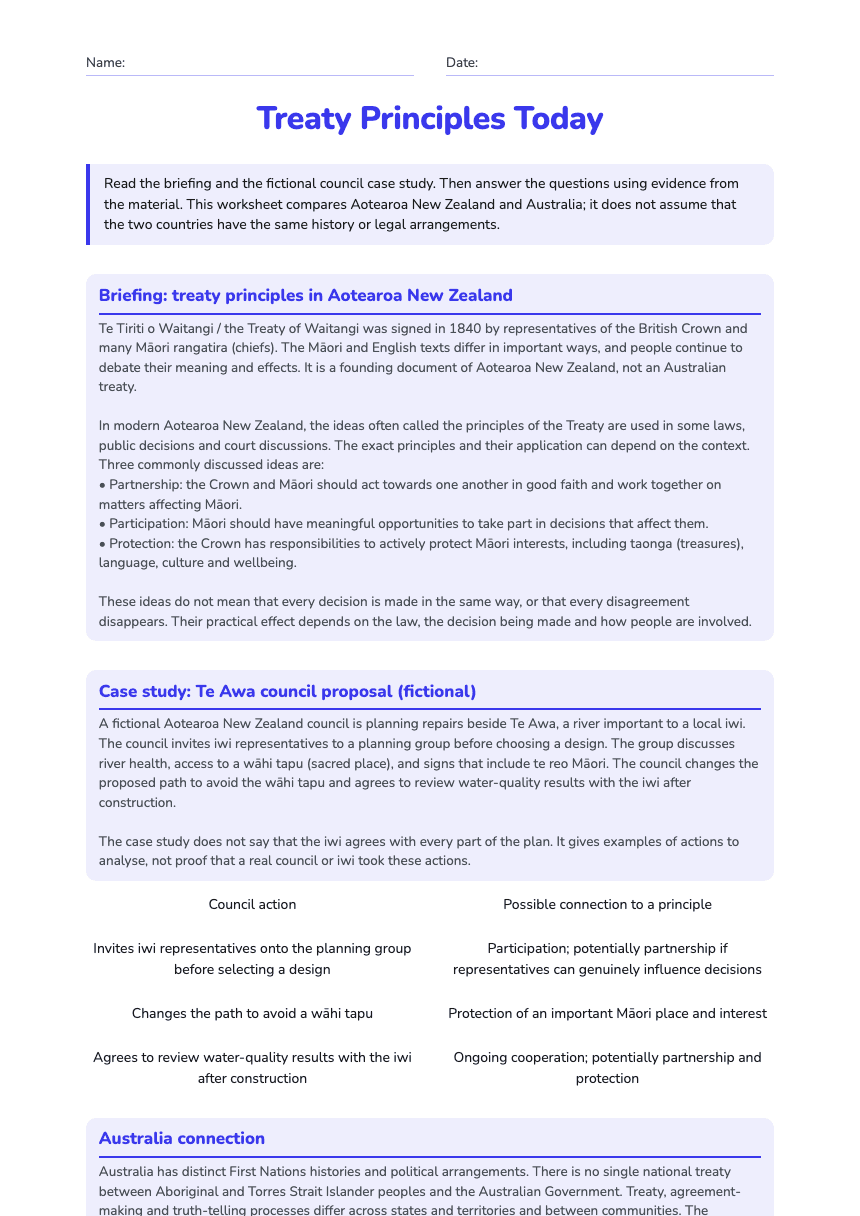
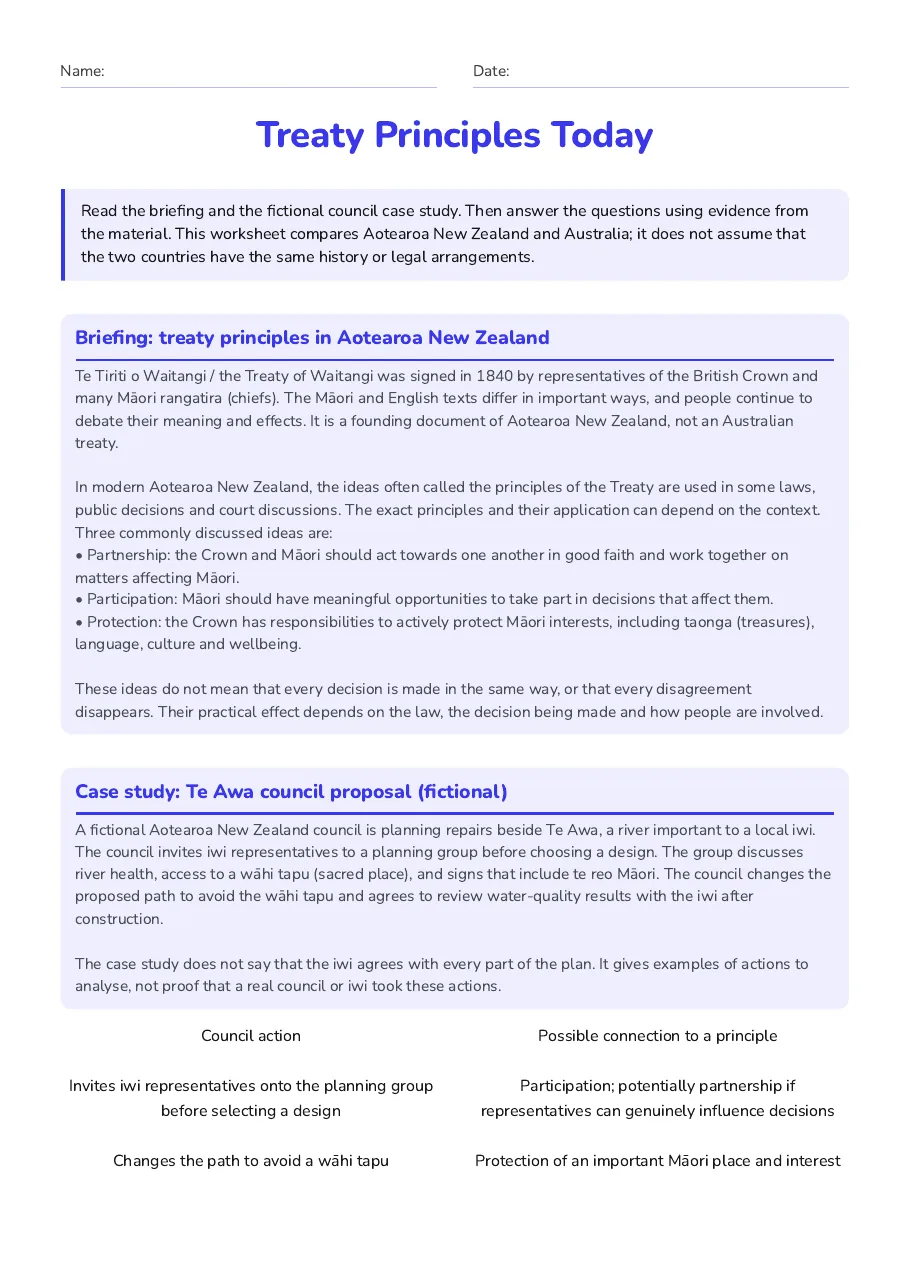
Briefing: treaty principles in Aotearoa New Zealand
Te Tiriti o Waitangi / the Treaty of Waitangi was signed in 1840 by representatives of the British Crown and many Māori rangatira (chiefs). The Māori and English texts differ in important ways, and people continue to debate their meaning and effects. It is a founding document of Aotearoa New Zealand, not an Australian treaty. In modern Aotearoa New Zealand, the ideas often called the principles of the Treaty are used in some laws, public decisions and court discussions. The exact principles and their application can depend on the context. Three commonly discussed ideas are: • Partnership: the Crown and Māori should act towards one another in good faith and work together on matters affecting Māori. • Participation: Māori should have meaningful opportunities to take part in decisions that affect them. • Protection: the Crown has responsibilities to actively protect Māori interests, including taonga (treasures), language, culture and wellbeing. These ideas do not mean that every decision is made in the same way, or that every disagreement disappears. Their practical effect depends on the law, the decision being made and how people are involved.
Case study: Te Awa council proposal (fictional)
A fictional Aotearoa New Zealand council is planning repairs beside Te Awa, a river important to a local iwi. The council invites iwi representatives to a planning group before choosing a design. The group discusses river health, access to a wāhi tapu (sacred place), and signs that include te reo Māori. The council changes the proposed path to avoid the wāhi tapu and agrees to review water-quality results with the iwi after construction. The case study does not say that the iwi agrees with every part of the plan. It gives examples of actions to analyse, not proof that a real council or iwi took these actions.
Council action
Possible connection to a principle
Invites iwi representatives onto the planning group before selecting a design
Participation; potentially partnership if representatives can genuinely influence decisions
Changes the path to avoid a wāhi tapu
Protection of an important Māori place and interest
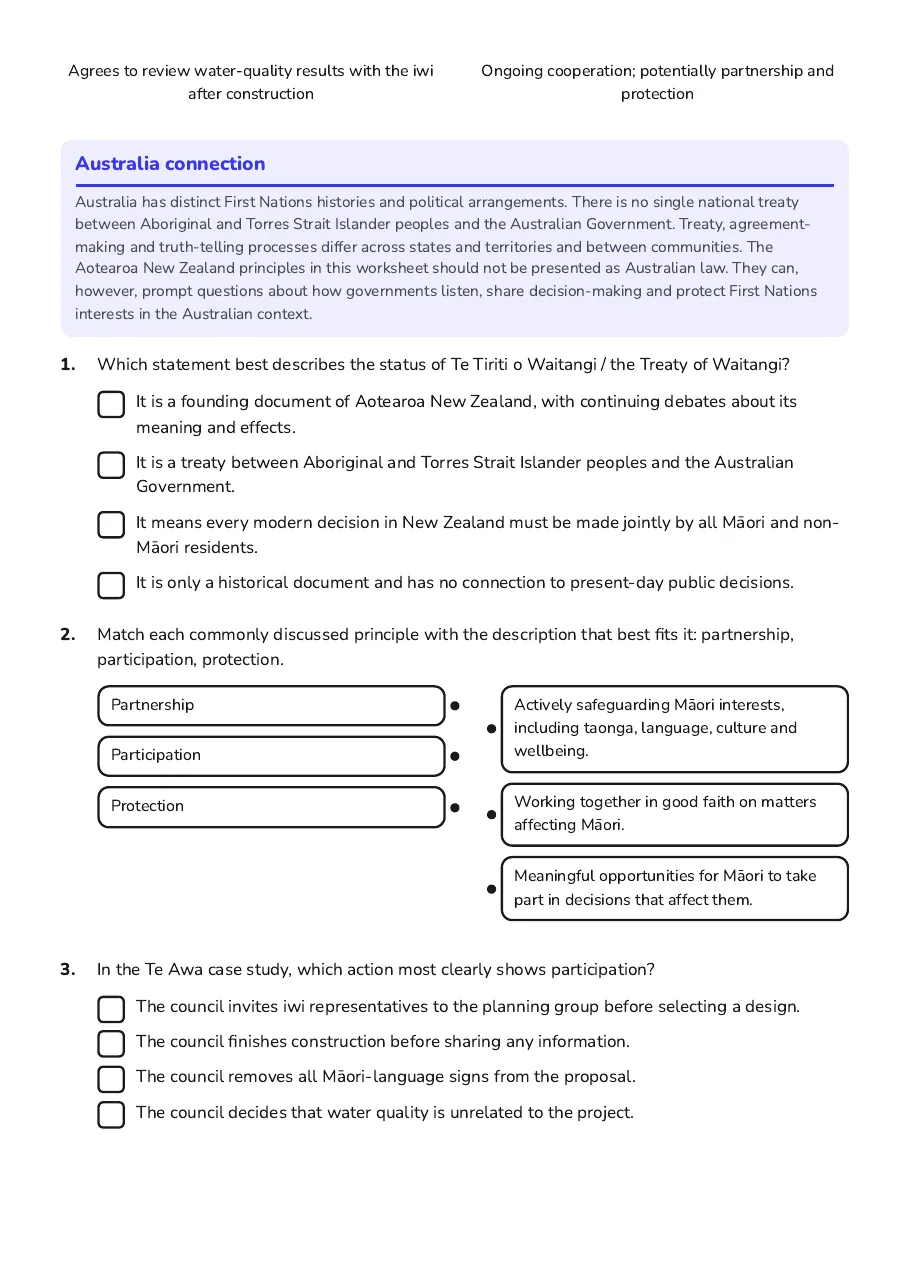
Agrees to review water-quality results with the iwi after construction
Ongoing cooperation; potentially partnership and protection
Australia connection
Australia has distinct First Nations histories and political arrangements. There is no single national treaty between Aboriginal and Torres Strait Islander peoples and the Australian Government. Treaty, agreement-making and truth-telling processes differ across states and territories and between communities. The Aotearoa New Zealand principles in this worksheet should not be presented as Australian law. They can, however, prompt questions about how governments listen, share decision-making and protect First Nations interests in the Australian context.
- It is a founding document of Aotearoa New Zealand, with continuing debates about its meaning and effects.
- It is a treaty between Aboriginal and Torres Strait Islander peoples and the Australian Government.
- It means every modern decision in New Zealand must be made jointly by all Māori and non-Māori residents.
- It is only a historical document and has no connection to present-day public decisions.
- Partnership
- Participation
- Protection
- Actively safeguarding Māori interests, including taonga, language, culture and wellbeing.
- Working together in good faith on matters affecting Māori.
- Meaningful opportunities for Māori to take part in decisions that affect them.
- The council invites iwi representatives to the planning group before selecting a design.
- The council finishes construction before sharing any information.
- The council removes all Māori-language signs from the proposal.
- The council decides that water quality is unrelated to the project.
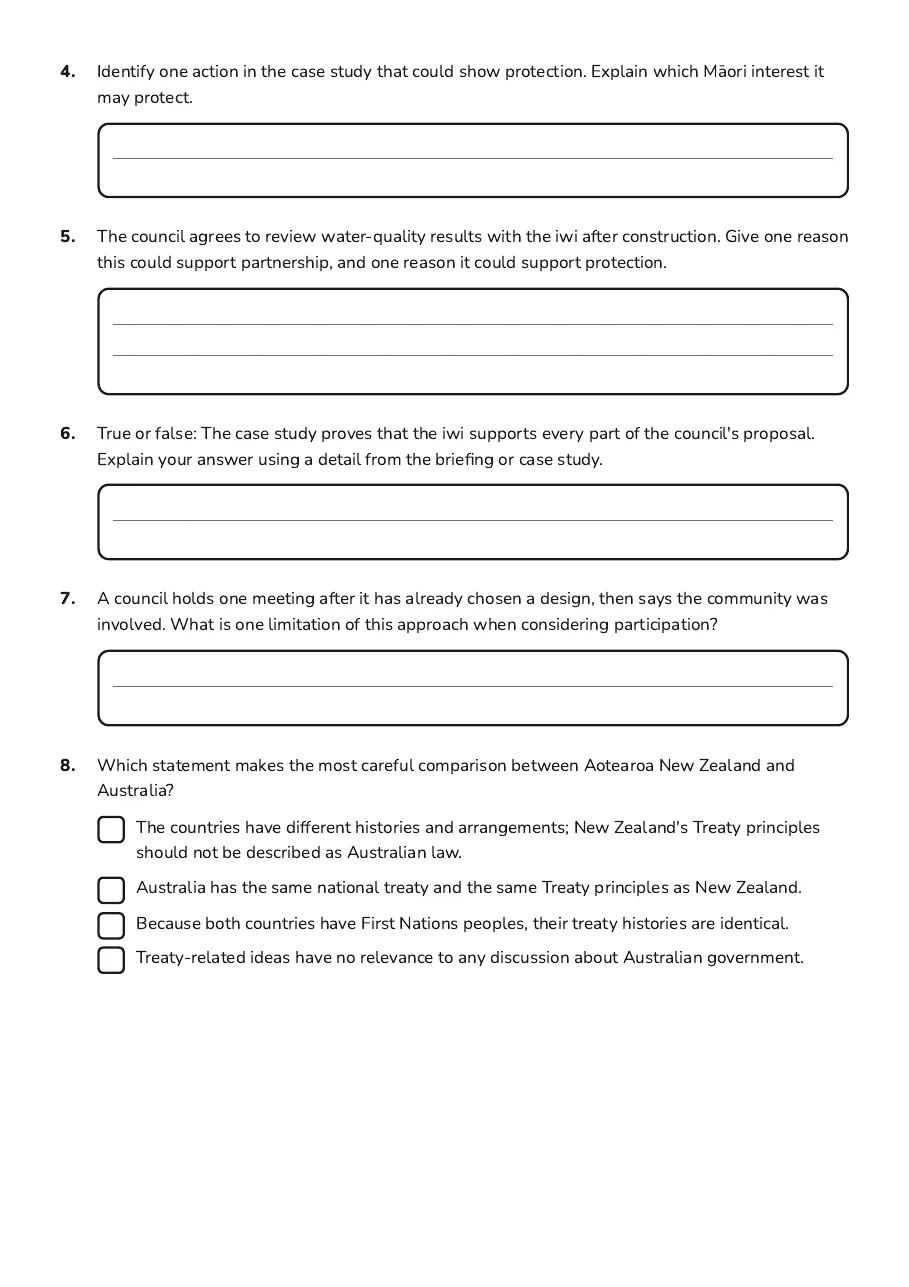
- The countries have different histories and arrangements; New Zealand's Treaty principles should not be described as Australian law.
- Australia has the same national treaty and the same Treaty principles as New Zealand.
- Because both countries have First Nations peoples, their treaty histories are identical.
- Treaty-related ideas have no relevance to any discussion about Australian government.
4 printable pages
Page 1
Page 2
Page 3
Page 4
About This Worksheet
Free in Kuraplan
Sign up free, grab the PDF, and customize it for your class.
Print-Ready
Formatted for standard paper. Clean layout, easy to read.
AI-Generated
Created with Kuraplan's AI, designed for real classroom use.
For Teachers & Parents
Use in classrooms, for homework, tutoring, or homeschool.
Need a custom version of this worksheet?
Kuraplan's AI generates custom worksheets in seconds — differentiated for every learner, aligned to your curriculum.
Generate Custom Worksheets — FreeMore Social Sciences Worksheets
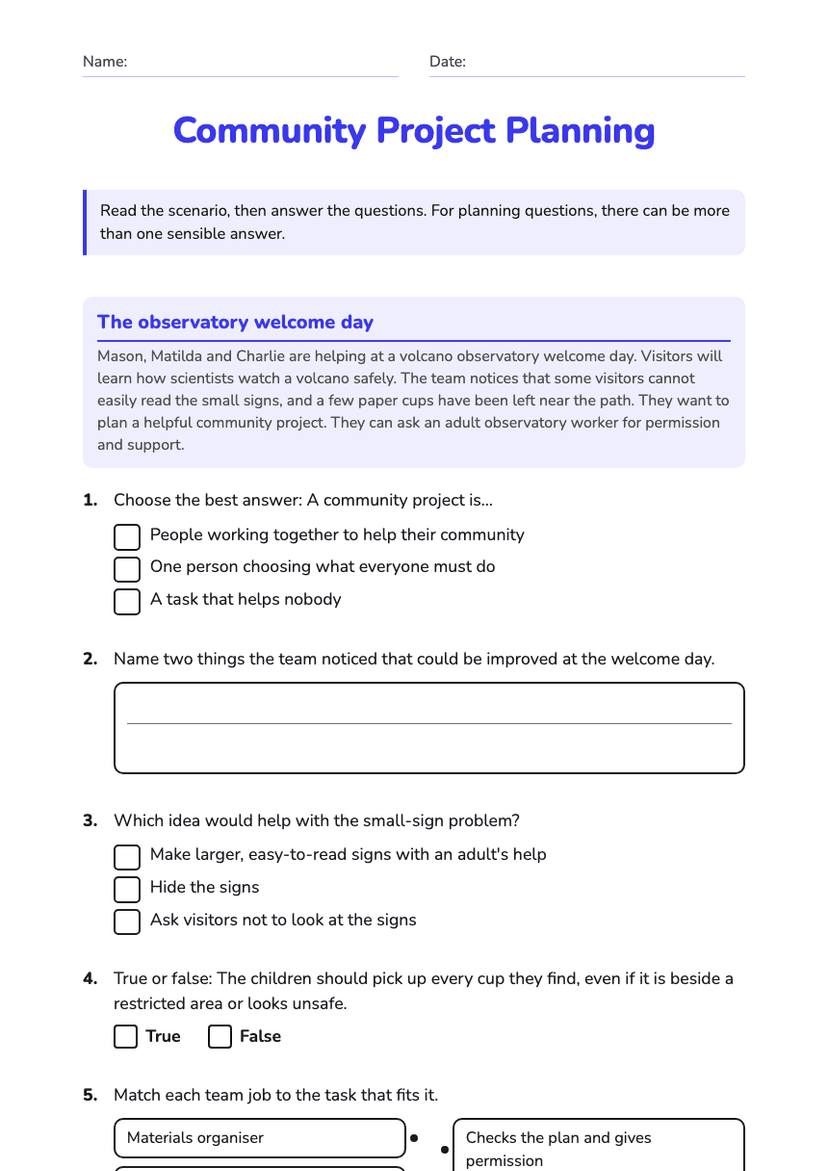
Community Project Planning
Free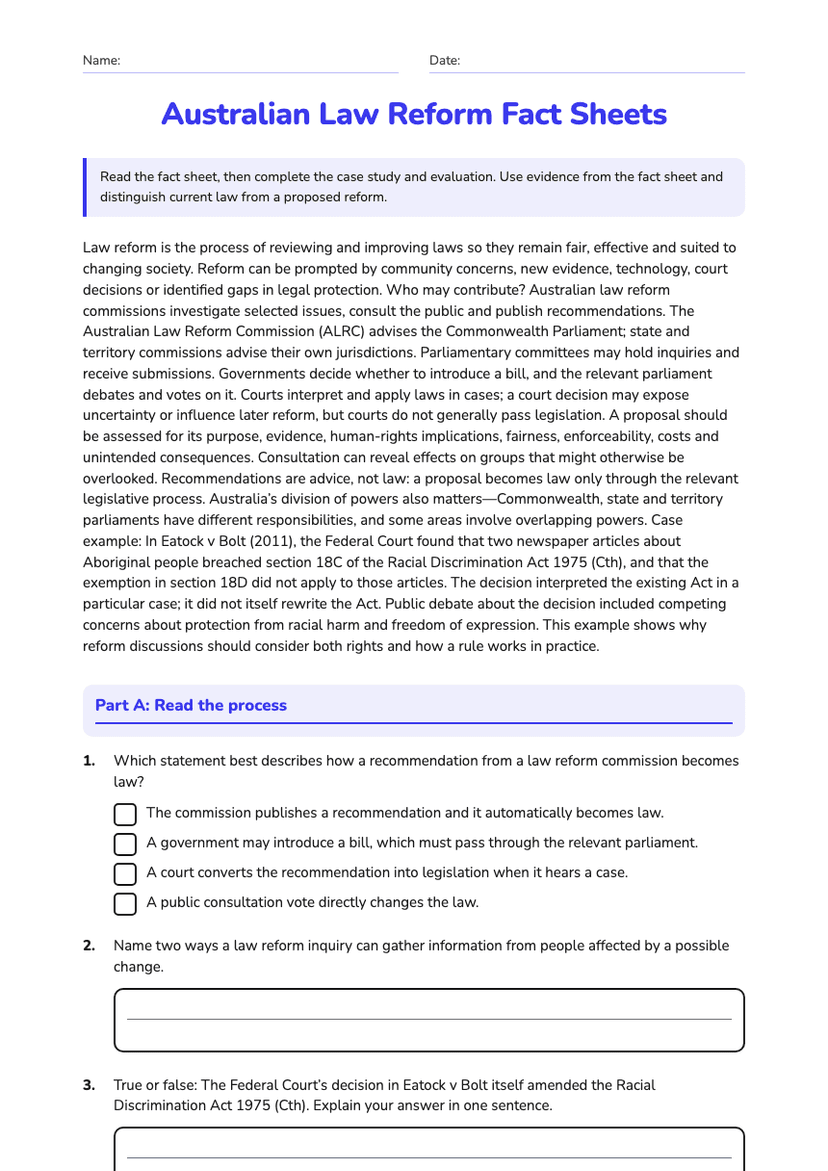
Australian Law Reform Fact Sheets
Free
Human Rights Debate Rubric
Free
Australian Referendums Constitutional Process
Free
Media and Law Reform
Free
Australian Constitution Fundamentals
Free
Commonwealth Constitution Overview
Free