Understanding the Water Cycle
A free science worksheet ready for your classroom. Open in Kuraplan to grab the print-ready PDF, customize it for your students, or generate a fresh version in seconds.
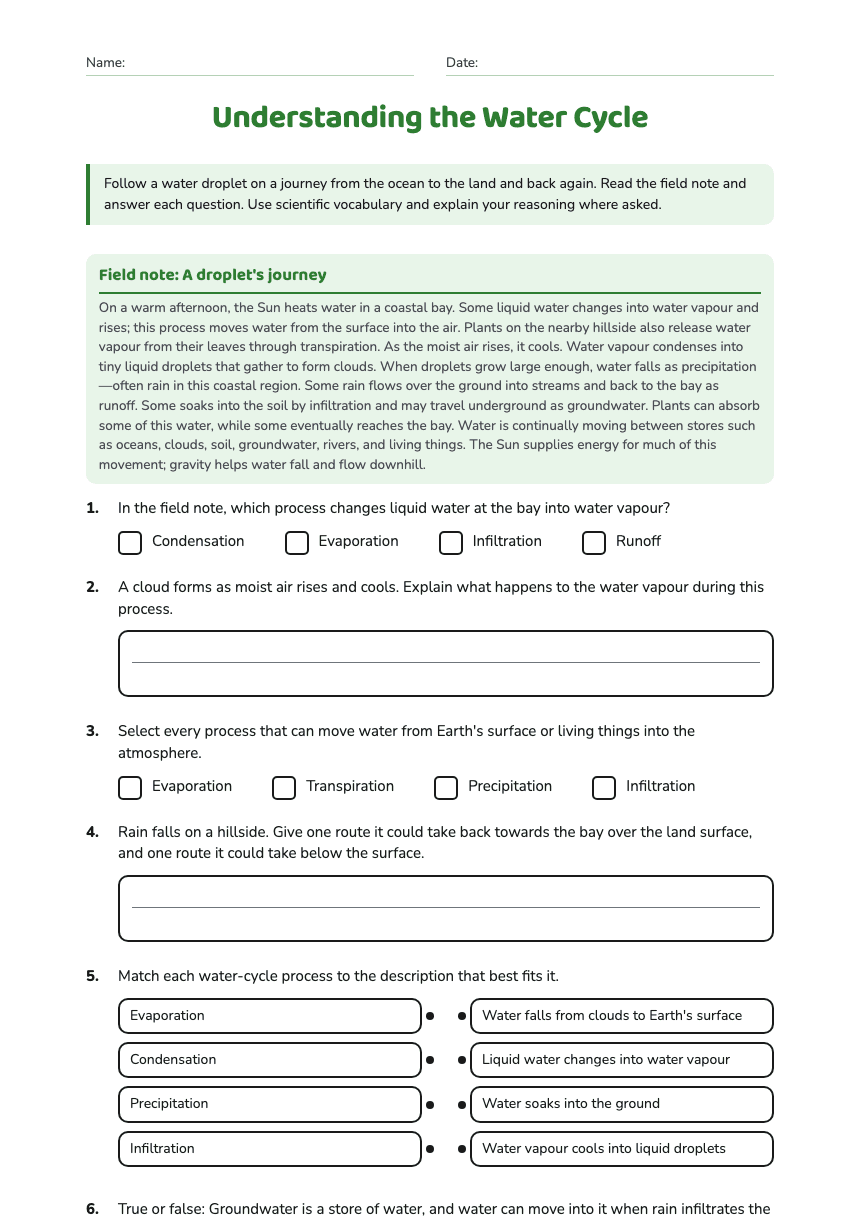
Understanding the Water Cycle
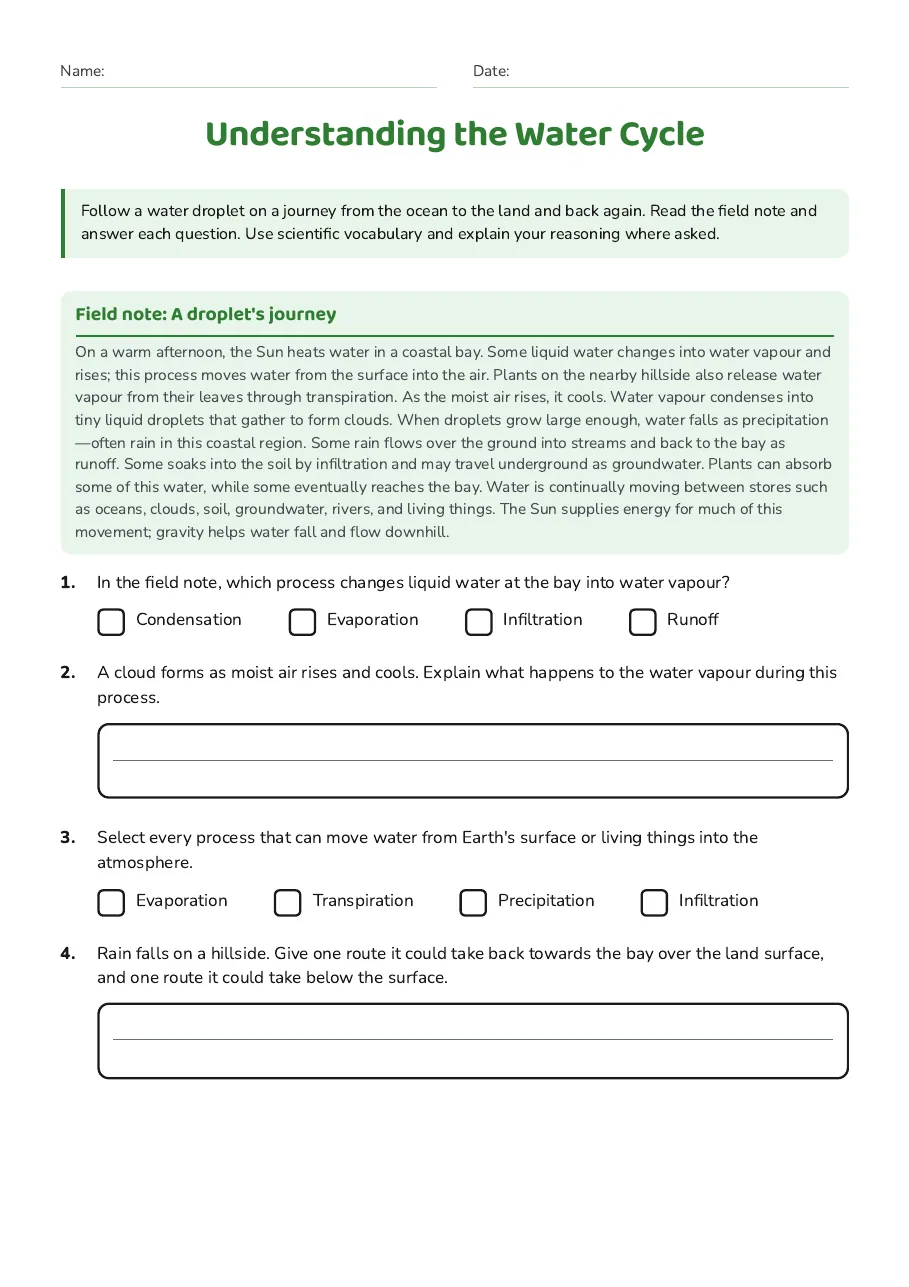
Field note: A droplet's journey
On a warm afternoon, the Sun heats water in a coastal bay. Some liquid water changes into water vapour and rises; this process moves water from the surface into the air. Plants on the nearby hillside also release water vapour from their leaves through transpiration. As the moist air rises, it cools. Water vapour condenses into tiny liquid droplets that gather to form clouds. When droplets grow large enough, water falls as precipitation—often rain in this coastal region. Some rain flows over the ground into streams and back to the bay as runoff. Some soaks into the soil by infiltration and may travel underground as groundwater. Plants can absorb some of this water, while some eventually reaches the bay. Water is continually moving between stores such as oceans, clouds, soil, groundwater, rivers, and living things. The Sun supplies energy for much of this movement; gravity helps water fall and flow downhill.
- Condensation
- Evaporation
- Infiltration
- Runoff
- Evaporation
- Transpiration
- Precipitation
- Infiltration
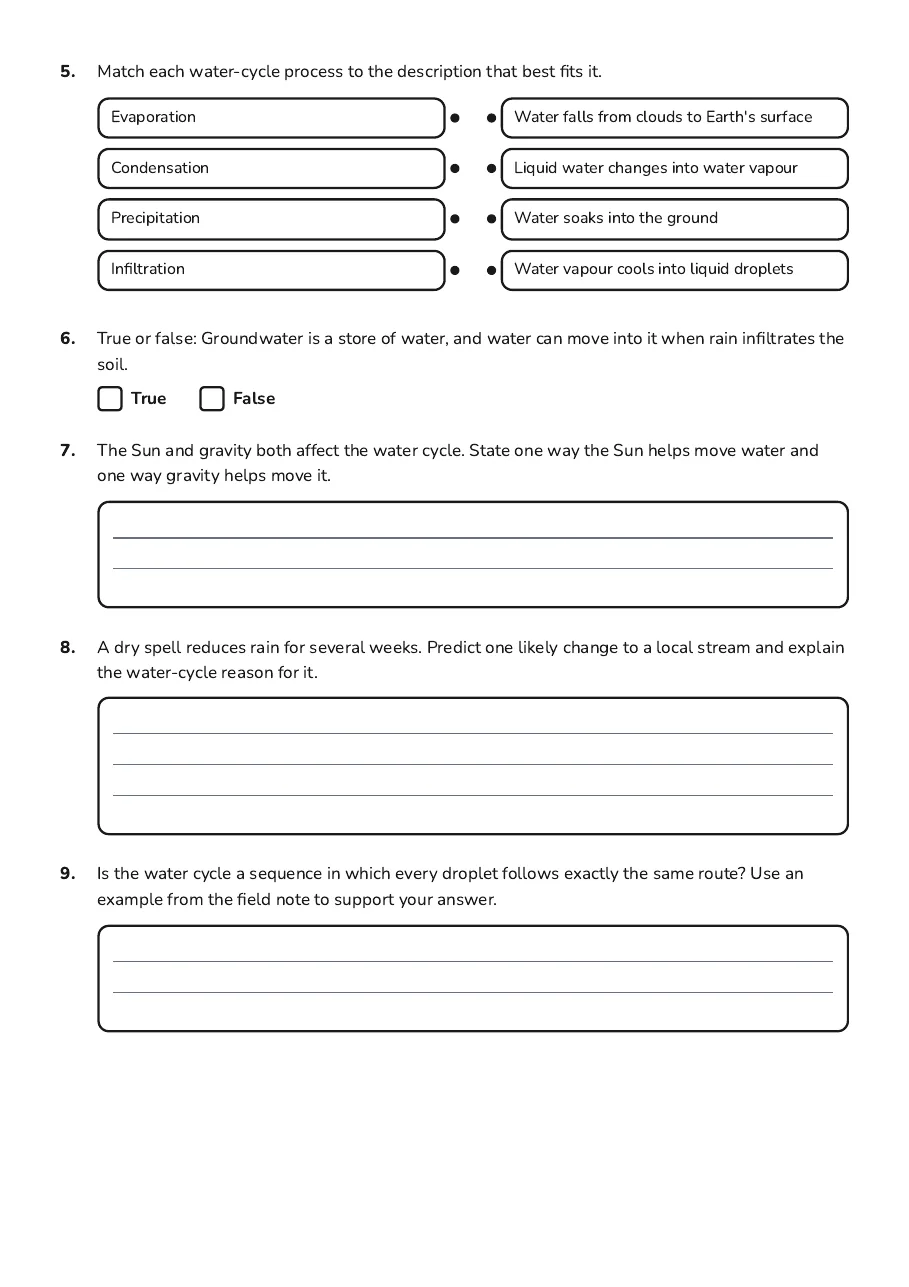
- Evaporation
- Condensation
- Precipitation
- Infiltration
- Water falls from clouds to Earth's surface
- Liquid water changes into water vapour
- Water soaks into the ground
- Water vapour cools into liquid droplets
3 printable pages
Page 1
Page 2

Page 3
About This Worksheet
Free in Kuraplan
Sign up free, grab the PDF, and customize it for your class.
Print-Ready
Formatted for standard paper. Clean layout, easy to read.
AI-Generated
Created with Kuraplan's AI, designed for real classroom use.
For Teachers & Parents
Use in classrooms, for homework, tutoring, or homeschool.
Need a custom version of this worksheet?
Kuraplan's AI generates custom worksheets in seconds — differentiated for every learner, aligned to your curriculum.
Generate Custom Worksheets — Free