You've got twenty-six fourth graders paired up with drafts in hand. Ten minutes later the papers come back covered in "Good job!" and "Nice work!", and not one sentence has changed. The whole exercise cost you a lesson and bought nothing.
That's the normal first attempt. Peer feedback fails for three predictable reasons: students don't know what to look for, they don't know what to say, and they don't know what to do with what they hear. Fix those three and the same class produces comments you can build a revision lesson around.
The eight routines below each attack one of those problems. Some take five minutes and a stack of sticky notes. One runs for three weeks across multiple drafts. All of them are specific enough to run tomorrow morning, and each comes with grade-band adjustments, a prompt you can copy, and the pitfall that catches most classes. If you're writing model texts for students to critique, the TheContentMap guide to draft comments is a good reminder of what a specific comment sounds like.
Pick one. Run it once. Read what students wrote before you decide it doesn't work.
1. Two Stars and a Wish
Start with the routine that needs the least explanation. Students name two things that work in a classmate's piece, then one thing they'd change. The two-to-one ratio is the whole trick: it forces the reviewer to read for quality before hunting for faults, and that order of operations is the habit you want long term.
The routine works best when the wish targets something specific.

A third-grade class sticks two notes on a science lab report naming strengths, then one note asking a question about the data table. A middle school math teacher prints worked examples and has students star two correct steps before wishing for a clearer explanation line. Same structure, different surface.
Grade-band adjustments
- K–2: Skip the writing. Run a three-minute spoken pair share with the teacher scribing the wish onto a sticky note.
- Grades 3–5: One sentence per note, and the star has to point at an exact line.
- Grades 6–8: Stars and wishes go on printed work before submission, not after.
- Grades 9–12: The wish must reference a rubric row, not a personal preference.
The evidence for structured student-to-student evaluation is older than is often assumed. Keith Topping's 1998 review of peer assessment research found positive formative effects on achievement and attitudes, with outcomes "as good as or better than" teacher assessment in several settings, and it framed feedback as a designed cycle rather than an opinion swap.
Prompt to steal: "Two stars: find two sentences doing real work and say what each one does. One wish: name one sentence you'd change and write the change as a question your partner can answer."
The pitfall is the compliment spiral. Without a model, "good job" mutates into "great job" and then "amazing" and the notes get longer while saying less. Show one anonymized sample and write the star yourself twice, once badly and once well, so the class sees the difference between a verdict and an observation.
If you want the stars aimed at something specific, these formative assessment examples show how to tie a routine to a learning objective instead of a general impression. Kuraplan will also generate a peer feedback checklist aligned to the unit's objectives in a couple of minutes, which gives the stars a fixed target.
2. Praise, Question, Polish
A fifth-grade writer hands over a personal narrative and gets back one praise about the opening line, one question about where the story takes place, one polish about the gap between two scenes. A high school history class runs the same three moves on argumentative paragraphs before final drafts, and there the questions land on evidence rather than setting. That is the whole routine: name what's working, ask a genuine question about what the writer meant, suggest one concrete revision.
The middle step does the work. Most routines skip the question and jump from compliment to correction, which turns the reviewer into an editor and the writer into a defendant. Authors who get asked a real question usually find the gap themselves, and that's a more durable lesson than being told.

What the numbers actually support
Peer feedback is worth real instructional time, though it isn't magic. A 2020 meta-analysis of 58 studies covering 134 effect sizes found students who took part in peer assessment performed about 0.291 standard deviations better than students who didn't, a small-to-moderate average effect. A randomized crossover experiment in a large introductory statistics course pointed the same direction: students who completed peer assessment scored higher on unit quizzes, and the gain showed up again on final-exam questions. The effect sizes were small, so treat this routine as one formative layer, not a substitute for your own marking. Giving feedback, not just receiving it, is part of why it works.
Grade-band adjustments
- Grades 2–4: Two moves only. Praise and question. Polish comes later in the year.
- Grades 5–6: All three moves, but the polish must be completable in five minutes.
- Grades 7–9: Written rounds, with the question step done before anyone speaks.
- Grades 10–12: Reviewers must name the rubric criterion their question connects to.
Script for the board: "Don't you think the ending is too sudden?" is a correction wearing a question mark. "What did you want me to feel at the end?" is a question. We only write the second kind.
The pitfall is volume. Students polish six things, the writer fixes one or none. Cap the polish at a single revision and have the author circle the one they'll do, then do it in class while you circulate. The circling matters more than it looks. It converts the feedback from a list into a decision, and it gives you something concrete to check when you pass the desk.
The second trade-off is time. Three moves on every paragraph means fewer paragraphs reviewed per lesson. I'd rather have one paragraph questioned properly than three skimmed with praise.
Kuraplan's AI chat will draft question stems for a specific genre or grade level, so you're not assembling prompts from scratch at 7 a.m.
3. Gallery Walk Feedback
The room does half the teaching. Post every draft, poster, or hypothesis statement on the wall, send small groups around with a comment sheet, and students see six or seven solutions to the same problem in fifteen minutes. Each piece collects notes from several reviewers, so the author gets a spread of perspectives instead of one partner's opinion.
A seventh-grade science class posts hypothesis statements and groups leave one supporting detail and one question at each station. A primary class posts drawings of animal habitats and visitors add one labeled feature they noticed. The physical movement keeps energy up in the last twenty minutes of the day, which is more than most feedback routines manage.
A meta-analysis of 55 studies put the overall effect of peer assessment on achievement at g = 0.31, with a 95% confidence interval of 0.18 to 0.44. That's modest and real. It supports treating peer feedback as a formative layer underneath your own judgement, not a handover of it.
Grade-band adjustments
- K–2: Three stations maximum, adult or buddy scribe at each, one sticker per visit.
- Grades 3–5: Rotation cards with names, two minutes per station, one written comment each.
- Grades 6–8: Different focus question at every station so groups can't reuse the same sentence.
- Grades 9–12: Silent walk first, written response only, discussion after.
One station, one question. "Does the evidence support the claim?" produces usable notes. "What do you think?" produces twenty-six variations of "looks good."
The pitfall is the traffic jam that turns into a chat. Give each group a rotation card with a direction and a timer, and stop the room at the halfway point to name one strong comment aloud. That single move lifts the quality of every comment written after it.
Close with a two-minute reflection where authors write down one comment they'll act on and one they'll ignore, with a reason. That second half matters. Students need practice judging feedback, not just producing it.
Teachers running gallery walks across multiple days can use Kuraplan to build printable comment sheets with focus prompts tied to standards, so every station has a purpose before the first group moves.
4. Tuning Protocol
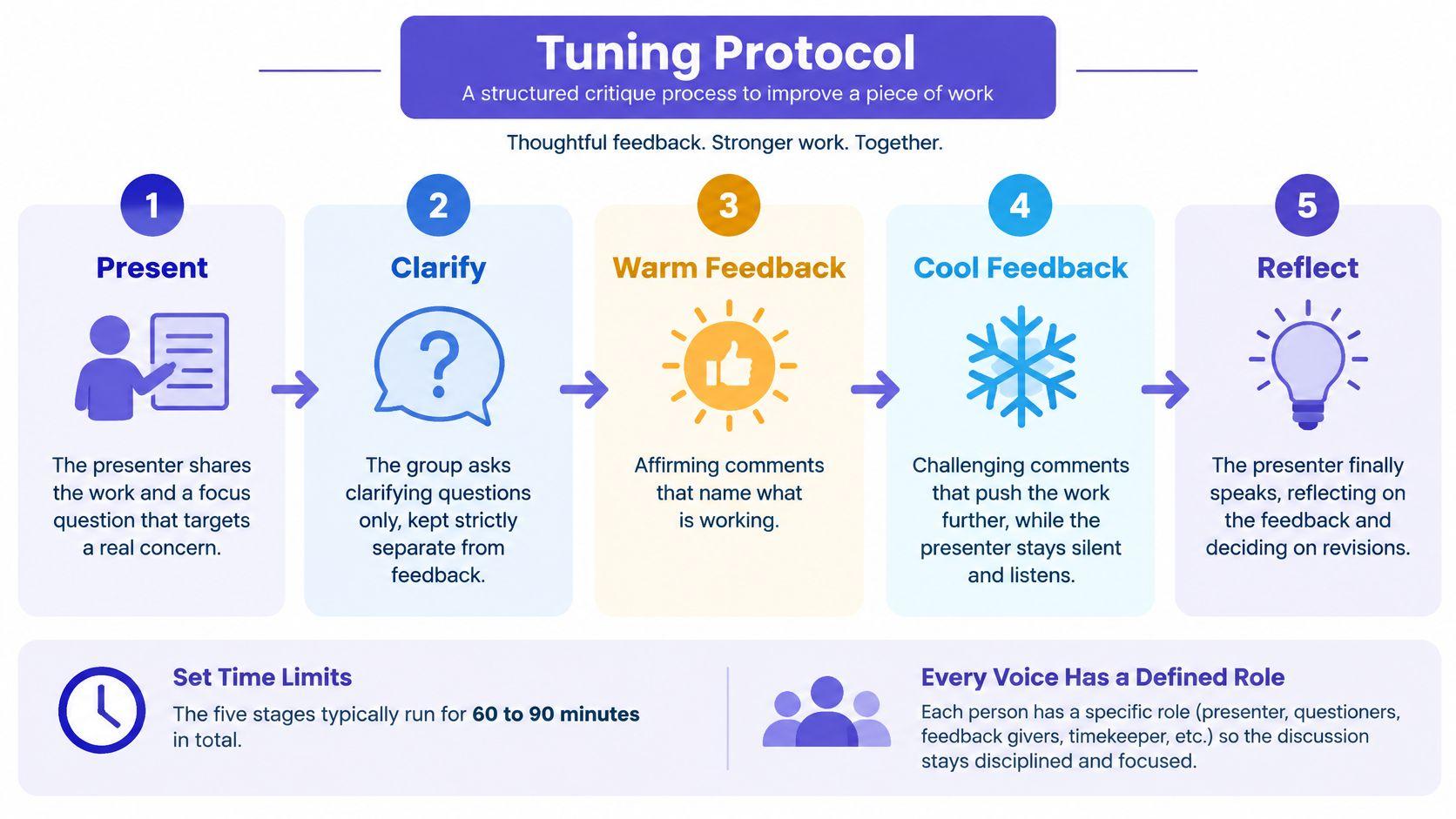
Borrowed from school reform work and still the tightest structure available for critique that stays civil and finishes on time. The presenter describes the work and a focus question. The group asks clarifying questions only. Then warm feedback, cool feedback, and the presenter reflects aloud without defending. Roles and minutes are fixed, and one person keeps them.
Grade-level teams run it on a shared assessment before it reaches students. A high school senior project group runs it on research proposals. The discipline is the product: every voice gets a defined slot and nobody can filibuster.
The boundary that keeps it working
Clarifying questions are for understanding, not for opinion. The moment someone slips a judgement into a clarifying question, the protocol collapses into a normal staff meeting. Post the agenda where everyone can see it.
- Presentation: 4 minutes, focus question stated first
- Clarifying questions: 3 minutes, factual only
- Warm feedback: 5 minutes, specific to the stated question
- Cool feedback: 5 minutes, same constraint
- Presenter reflection: 3 minutes, no defending
- Debrief: 3 minutes on the process, not the content
The pitfall is a focus question like "what do you think?" That gets you a pleasant hour and nothing usable. Coach presenters to write a genuine question with an edge, something like "does this assessment measure the standard, or does it measure neatness?" That question will get answered.
The second failure is defensive presenting. Build the no-defending rule into the reflection step as a structure, not a personality test: the presenter takes notes and says thank you, and responses come in writing the next day.
Ahead of a session, use Kuraplan to draft the unit plan or assessment you'll put on the table. The protocol needs a real draft to work on, and an empty agenda wastes the group's time.
5. Critique and Revise (Austin's Butterfly Method)
Quality comes from repeated specific critique, not one pass. Students present a draft, take targeted feedback against a shared standard, revise, and present again. The method got its classroom reputation from the documentary Austin's Butterfly, which follows fourth-grade students at a Boston-area school critiquing scientific butterfly drawings through several rounds until the work reached a high standard of accuracy. The finished drawings look nothing like the first attempt, and that's the lesson.
A middle school art class can run three rounds on portfolio pieces, each round locked to a different rubric criterion. Round one shape and proportion, round two labels and detail, round three accuracy against the specimen.
Run one criterion per round
Multi-round critique rewards the students who already know how to hear criticism. The gap widens fast in a mixed-ability room, because the benefits of peer feedback depend heavily on a student's prior experience of interpreting and applying critique, as recent work on inclusive peer assessment argues (Assessment & Evaluation in Higher Education). A review of 18 studies on generative AI and collaboration flagged reduced interaction, algorithmic bias, fairness, privacy, transparency, and inaccurate feedback among the recurring risks, while noting the evidence for several is still thin. The design response is the same either way: teach interpretation explicitly, and don't assume access equals benefit.
- Grades 2–3: Two rounds, whole class, same criterion, teacher models every comment.
- Grades 4–6: Three rounds, partners, one criterion each, exemplars shown before round one.
- Grades 7–9: Three rounds with rotating reviewers so no pair owns a piece.
- Grades 10–12: Students choose the criterion for round three and justify the choice.
Copy this log: three columns on one page. Feedback received. Revision I made. Why the new version is better. If a row is empty at the end of the round, the feedback wasn't specific enough to act on.
The pitfall is quitting at round two. Quality often dips before it climbs, and teachers abandon the routine right there. Schedule rounds across separate days, keep each under twenty minutes, and show the exemplars again before round three.
The funniest and most instructive video you'll show all year:
Kuraplan's rubric generation helps you build a separate criterion-based rubric for each round, so round two doesn't turn into round one again.
6. Checklist-Based Peer Review
Some students freeze because they don't know where to start. A checklist solves that with a list of things to confirm rather than an open question to answer. The reviewer ticks whether each element is present, a thesis, a labeled diagram, a topic line, a unit, and marks what's missing. Feedback stays anchored to the learning goal instead of personal taste.
The perception side matters too. The 2025 UK National Student Survey, which polls university students, reported that 78.1% said assessment criteria were clear and 75.2% said assessment feedback helped improve their future work (reported by the Physiological Society). Clear criteria and useful feedback are the two things students notice. A checklist delivers the first and makes the second possible.
A fourth-grade class checks partners' fraction word problems against four items: labels, units, the answer circled, and a written explanation. A high school biology class runs a checklist over lab reports for required sections before submission.
Grade-band adjustments
- K–2: Picture checklist with three icons. Two items only. Teacher reads it aloud.
- Grades 3–5: Four items max, student-friendly wording, posted at eye level.
- Grades 6–8: Add a "not yet" column so reviewers record what's missing rather than just ticking.
- Grades 9–12: Students build one checklist item themselves from the rubric, then swap.
Paste this into your checklist header: "Tick only what you can point to. If you can't find it, write 'not yet' and move on. Then add one sentence your partner can use tomorrow."
The pitfall is box-ticking. Students tick everything in ninety seconds and hand the paper back unchanged. Pair every checklist with one open-ended comment so reviewers have to say something a checkbox can't, and pull three completed checklists at random to check the marks against the work yourself.
Build the criteria in student language and post them where students can see them, then save the wording for next term. These learning intentions and success criteria are a decent scaffold for that wording. Kuraplan will also build checklists straight from standards-aligned objectives, which cuts the setup time on every new unit.
7. Reciprocal Peer Response Pairs
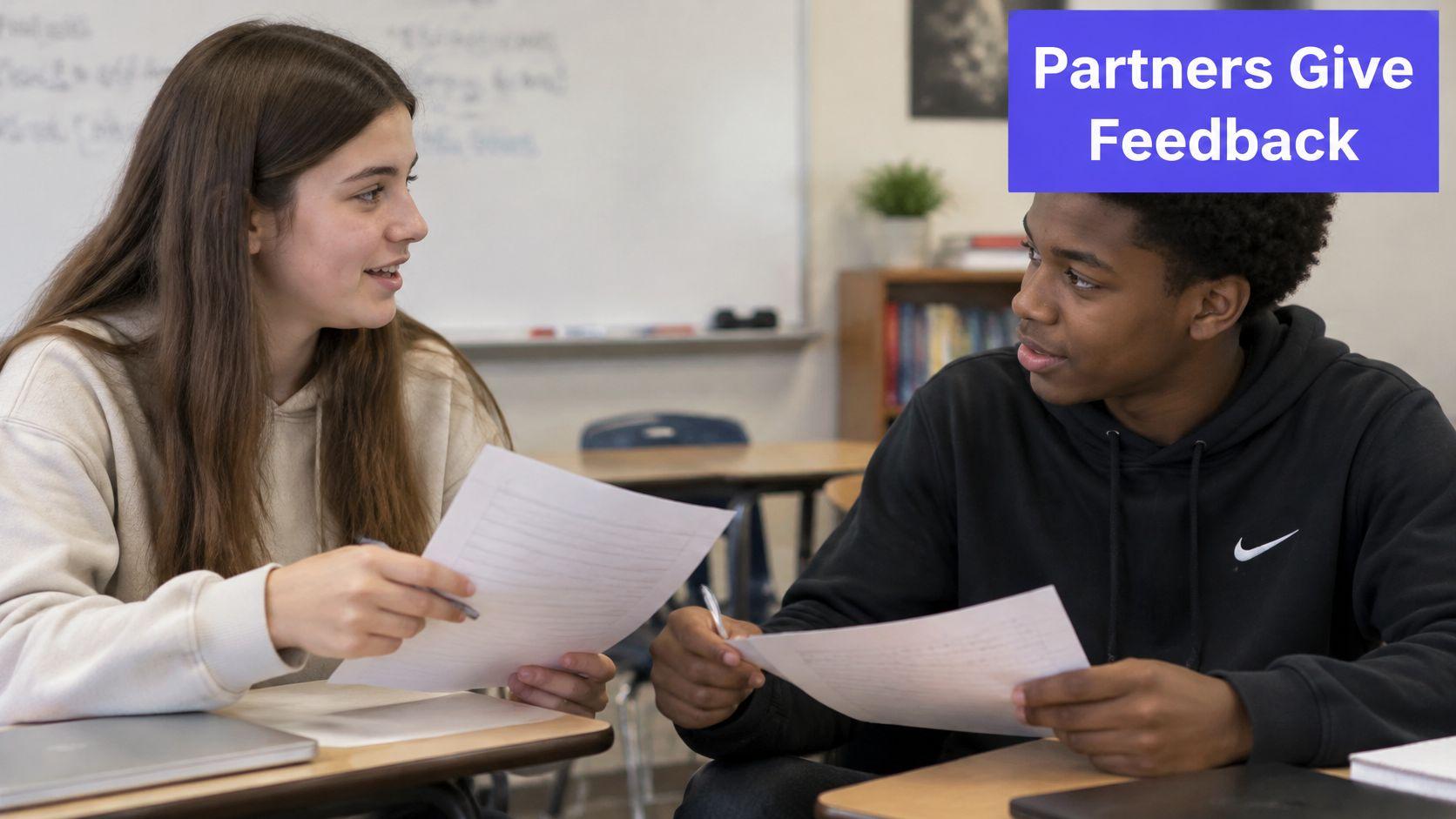
Two students swap work, read, talk for four minutes, then switch roles. Both act as reviewer and author in every exchange, so nobody feels ranked and nobody carries the whole job. It's the routine I'd pick if I could only run one, because it fits inside any lesson and gets better with repetition.
Eighth-grade English students exchange argumentative drafts weekly with two focus questions guiding each conversation. A first-grade class pairs up to read each other's sentences aloud and suggest one word that makes the meaning clearer.
The four-minute structure
- Minute one: silent read, no talking
- Minutes two and three: reviewer speaks, author takes notes without responding
- Minute four: swap roles and repeat
- Last thirty seconds: each author names the one change they'll make
The no-responding rule is the hard part and the reason it works. Authors who defend what they meant lose the chance to find out what a reader understood.
Rotate on a schedule, not on vibes. Keep a simple grid of who has worked with whom, and move students every three weeks. Left alone, pairs settle into comfort and the comments go soft.
Model a full exchange with a volunteer pair before the class tries it, including the awkward bits. Then post two or three focus questions so partners never open with "so, what did you think?" For younger classes, one question is enough.
If you want a structure that pairs cleanly with this one, think-pair-share uses the same rhythm of independent thinking before talk, which makes the exchange faster and less performative.
The pitfall is the friendship pair that only compliments. Rotate deliberately, and listen in on two or three pairs each round rather than hovering at one desk. Kuraplan's 24/7 teaching assistant will generate varied focus prompts across subjects and grade levels if you've run out of angles.
8. Digital Peer Review with Comment Tools
A shared document gives feedback somewhere to live. Students highlight a sentence, attach a question, and the author replies in the same thread. That trail helps you see who commented, what changed, and where the exchange stalled. In a blended class, it is easier to check the quality of feedback than to rely on memory.
The research on format is encouraging. A meta-analysis comparing online and offline peer feedback in higher education found online feedback carried a g = 0.33 advantage, and a sensitivity analysis excluding potentially influential studies produced a similar g = 0.36 (Springer analysis of online peer feedback). Treat that as a reason to design the comment space carefully, not as permission to let students post vague notes.
Build the five-stage workflow
Commenting isn't a workflow. The stages are submit, review against the rubric, provide criterion-linked feedback, author response, resubmission. If the author response stage is missing, the rest is decoration.
- Comment norms: every comment includes a reason and points at a specific line.
- Assigned reviewers: decide pairs in advance, with deadlines, so nobody scrambles.
- Model comments: leave one strong and one weak comment in the document yourself.
- Teacher visibility: check completion rates and comment quality, not just word counts.
For younger students, keep the comment frame short: one strength, one question, one change. For upper grades, require each reviewer to name the criterion they are using and explain how the evidence supports the comment. The trade-off is time. Short comments get posted faster, while criterion-linked comments take longer but give the author something usable.
Then there's AI. A 2026 study of 433 students and 7,670 AI-supported feedback instances found AI assistance pedagogically promising but minimally adopted, an implementation gap rather than a tooling gap (Computers & Education study). Peer review is a learnable skill, not an inefficient step to automate away.
The test of a digital review isn't how many comments the document collected. It's how many revisions the author made before the deadline.
The pitfall is polished noise. Students paste in fluent AI comments that sound authoritative and change nothing. Require the author to reply to each comment with what they changed, and grade the revision, not the comment thread.
Kuraplan can draft review rubrics and comment prompts that teachers can edit before sharing them with students.
How the eight peer feedback strategies compare on format, time, and best use
| Item | Feedback Format | Time Needed | Best For |
|---|---|---|---|
| Two Stars and a Wish | Written or spoken: two strengths and one suggestion | 5–10 minutes | Encouraging, simple feedback, especially for younger learners |
| Praise, Question, Polish (PQP) | Praise, genuine question, and one revision suggestion | 10–15 minutes | Writing workshops and focused peer response |
| Gallery Walk Feedback | Written comments at rotating work displays | 20–40 minutes | Seeing multiple approaches and gathering perspectives |
| Tuning Protocol | Facilitated stages: presentation, clarification, warm and cool feedback, reflection | 60–90 minutes | In-depth critique of projects, plans, or assessments |
| Critique and Revise (Austin's Butterfly Method) | Multiple rounds of specific, standards-based critique and revision | Several class periods | Improving work against clear quality standards |
| Checklist-Based Peer Review | Criteria-based checklist with brief comments | 5–15 minutes | Checking required elements against clear success criteria |
| Reciprocal Peer Response Pairs | Face-to-face exchange with partners alternating reviewer and author roles | 5–10 minutes per exchange | Regular, low-stakes feedback practice |
| Digital Peer Review with Comment Tools | Comments and threaded replies anchored to work in a digital platform | 15–30 minutes | Remote or hybrid feedback with a saved comment record |
Use the time column as a planning range, not a promise. Setup, the number of rotations, and the quality of the comment prompt all change the clock. Gallery walks eat time through movement and transition, even when the comments themselves are brief. Digital review can look quick, then stretch when students argue in threads or wait for replies.
The format column matters just as much. Spoken routines build confidence and speed, but they can fade unless the author records one action. Written routines leave evidence, which helps when you need to check whether feedback led to revision. Checklist review is fast and clean, yet it can produce tick-box comments if the criteria are vague. Tuning and critique offer depth, but they cost class time and need firm facilitation.
For grade-band adjustments, younger learners usually need sentence stems, one criterion, and a short reply. Older students can handle two or three criteria, author questions, and a required revision note. The pitfall is the same across levels: students comment on taste instead of the work. Keep the prompt tied to a visible line, section, or success criterion, and the routine stays usable the next morning.
Start With One Routine Before Friday
Pick the strategy that matches the problem in front of you, not the one that sounds best on a planning day. If students write vague praise, start with Two Stars and a Wish and model a specific star yourself, badly first. If drafts barely change between versions, run Critique and Revise for one unit and force a second look. If half the class stares at a partner's paper saying nothing, hand them a checklist.
Run the routine once and read what students wrote before you scale anything. The comments are your data. If most say "good job", the prompt was too open. If most say nothing, the criteria weren't visible. If students wrote something specific and the author still didn't revise, the missing piece is time, and that's a scheduling fix rather than a feedback fix.
Two things are worth holding onto as you build this into your year. First, peer feedback sits underneath teacher feedback, not in place of it. The overall effects are modest and positive, which is exactly what you'd expect from a formative layer, not from a replacement. Keep your judgement for anything high-stakes, disputed, or tied to a standard that needs subject expertise.
Second, measure the right thing. A pilot that counts participation tells you nothing. Track pre and post work quality, whether reviewers' marks match yours, and how much revision happened. That's the evidence worth bringing to a department meeting.
Three weeks of one routine beats eight routines run once each. Students get better at feedback the same way they get better at writing: with repetition, models, and someone telling them plainly when the feedback was too vague to use.
Kuraplan can draft the checklists, rubrics, and focus prompts so setup takes minutes rather than a Sunday afternoon, and every output stays fully editable so you can fit it to your students and your own teaching style. Plan the routine once, then spend your time on the part that needs you, which is standing next to a pair of eleven-year-olds while they work out what a sentence needs.
Peer feedback routines live or die on the materials around them, and that's the part Kuraplan handles: rubric-aligned feedback forms, sentence starters for students who freeze, and structured review rounds you can print or share in minutes, all editable so you can adjust the wording for your grade. Start with one routine this week and let Kuraplan build the checklist or focus prompts to match it. Visit Kuraplan to see how it fits your next unit.