ScienceFreePrintable

Chemistry Reaction Types Review

A free science worksheet ready for your classroom. Open in Kuraplan to grab the print-ready PDF, customize it for your students, or generate a fresh version in seconds.
Chemistry Reaction Types Review worksheet preview
Name:Date:

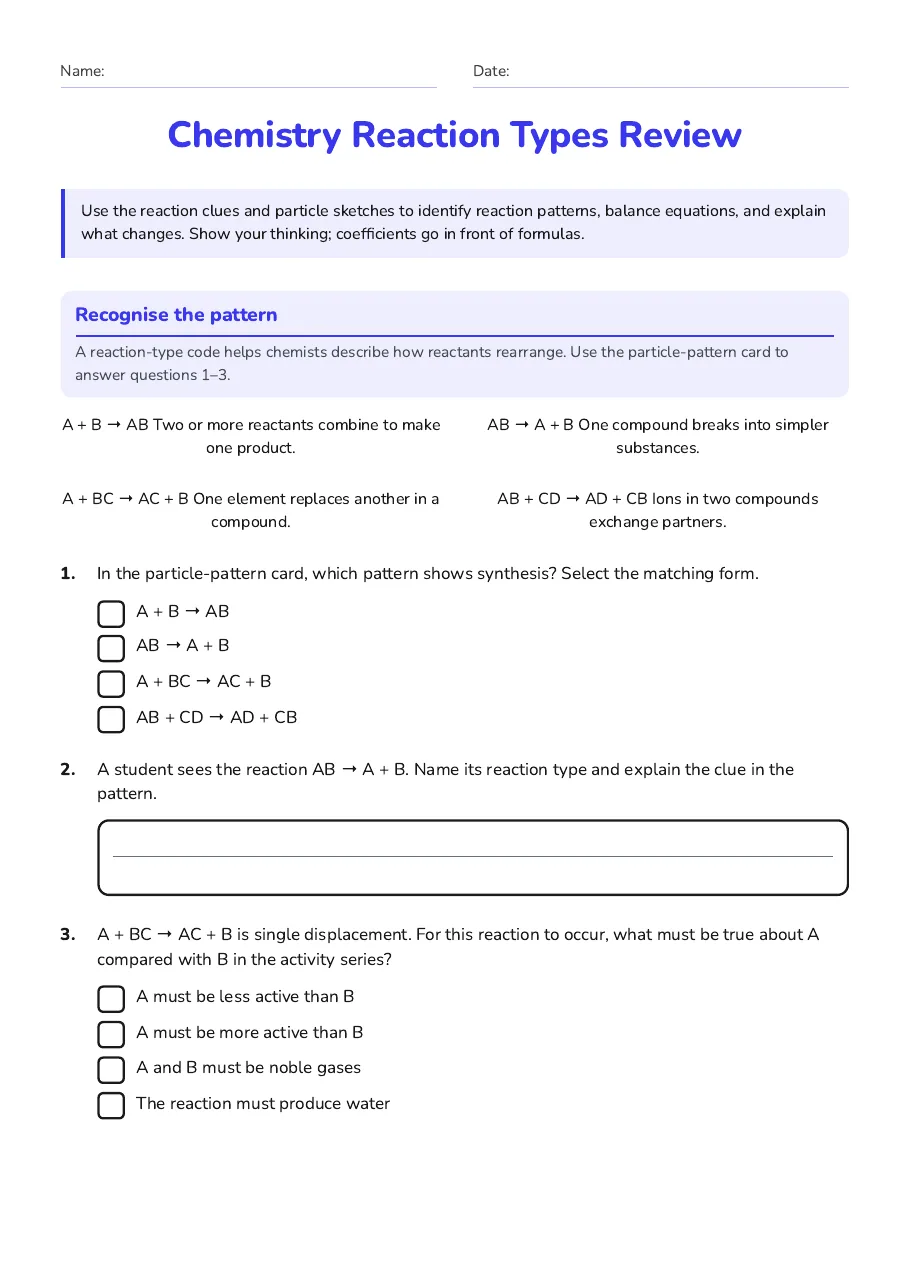
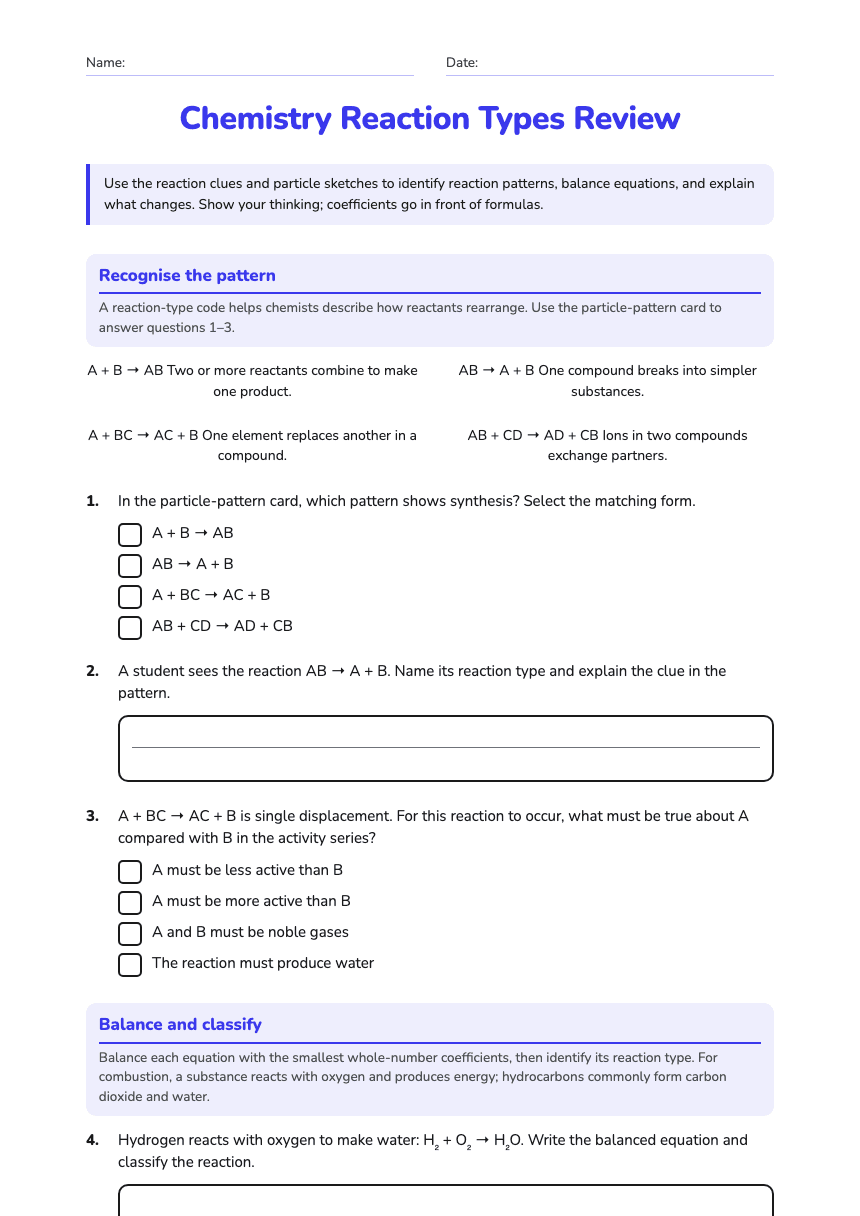
Chemistry Reaction Types Review

Use the reaction clues and particle sketches to identify reaction patterns, balance equations, and explain what changes. Show your thinking; coefficients go in front of formulas.

Recognise the pattern

A reaction-type code helps chemists describe how reactants rearrange. Use the particle-pattern card to answer questions 1–3.

A + B → AB Two or more reactants combine to make one product.

AB → A + B One compound breaks into simpler substances.

A + BC → AC + B One element replaces another in a compound.

AB + CD → AD + CB Ions in two compounds exchange partners.

1.In the particle-pattern card, which pattern shows synthesis? Select the matching form.
  • A + B → AB
  • AB → A + B
  • A + BC → AC + B
  • AB + CD → AD + CB
2.A student sees the reaction AB → A + B. Name its reaction type and explain the clue in the pattern.
3.A + BC → AC + B is single displacement. For this reaction to occur, what must be true about A compared with B in the activity series?
  • A must be less active than B
  • A must be more active than B
  • A and B must be noble gases
  • The reaction must produce water

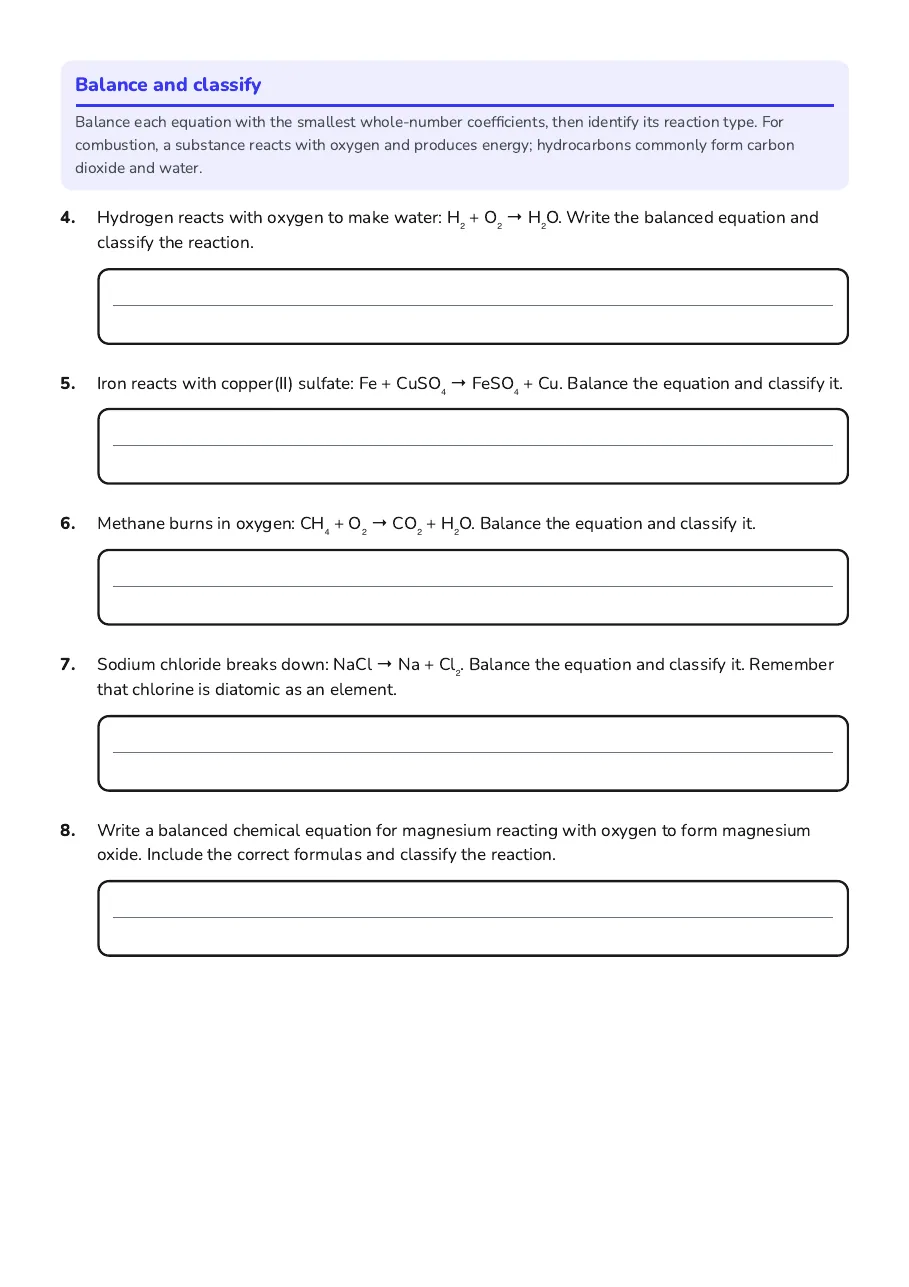
Balance and classify

Balance each equation with the smallest whole-number coefficients, then identify its reaction type. For combustion, a substance reacts with oxygen and produces energy; hydrocarbons commonly form carbon dioxide and water.

4.Hydrogen reacts with oxygen to make water: H₂ + O₂ → H₂O. Write the balanced equation and classify the reaction.
5.Iron reacts with copper(II) sulfate: Fe + CuSO₄ → FeSO₄ + Cu. Balance the equation and classify it.
6.Methane burns in oxygen: CH₄ + O₂ → CO₂ + H₂O. Balance the equation and classify it.
7.Sodium chloride breaks down: NaCl → Na + Cl₂. Balance the equation and classify it. Remember that chlorine is diatomic as an element.
8.Write a balanced chemical equation for magnesium reacting with oxygen to form magnesium oxide. Include the correct formulas and classify the reaction.

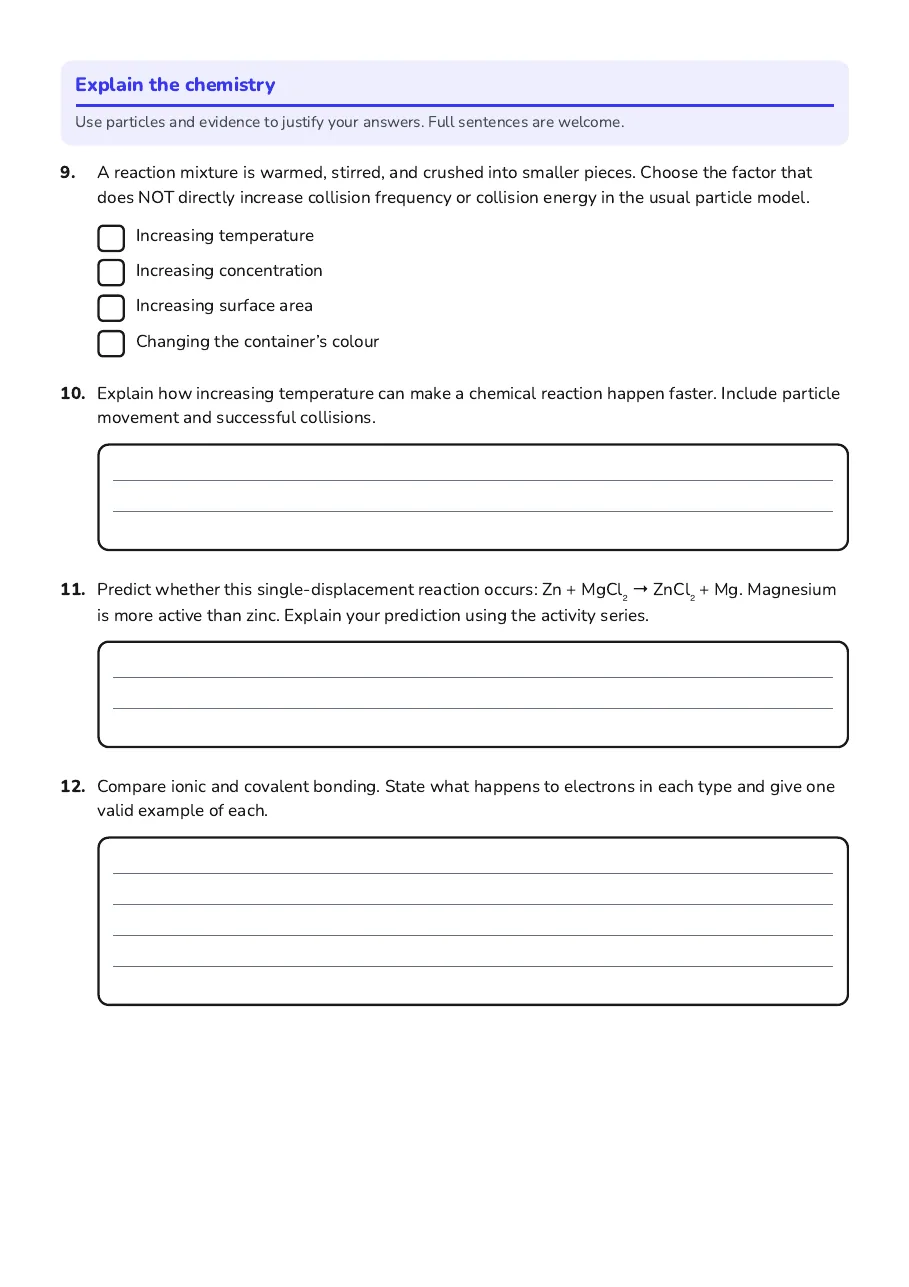
Explain the chemistry

Use particles and evidence to justify your answers. Full sentences are welcome.

9.A reaction mixture is warmed, stirred, and crushed into smaller pieces. Choose the factor that does NOT directly increase collision frequency or collision energy in the usual particle model.
  • Increasing temperature
  • Increasing concentration
  • Increasing surface area
  • Changing the container’s colour
10.Explain how increasing temperature can make a chemical reaction happen faster. Include particle movement and successful collisions.
11.Predict whether this single-displacement reaction occurs: Zn + MgCl₂ → ZnCl₂ + Mg. Magnesium is more active than zinc. Explain your prediction using the activity series.
12.Compare ionic and covalent bonding. State what happens to electrons in each type and give one valid example of each.

3 printable pages

  • Chemistry Reaction Types Review, page 1 of 3: Recognise the pattern

    Page 1

  • Chemistry Reaction Types Review, page 2 of 3: Balance and classify

    Page 2

  • Chemistry Reaction Types Review, page 3 of 3: Explain the chemistry

    Page 3

About This Worksheet

Free in Kuraplan

Sign up free, grab the PDF, and customize it for your class.

Print-Ready

Formatted for standard paper. Clean layout, easy to read.

AI-Generated

Created with Kuraplan's AI, designed for real classroom use.

For Teachers & Parents

Use in classrooms, for homework, tutoring, or homeschool.

Need a custom version of this worksheet?

Kuraplan's AI generates custom worksheets in seconds — differentiated for every learner, aligned to your curriculum.

Generate Custom Worksheets — Free
No credit card Curriculum-aligned Under 60 seconds