ScienceFreePrintable

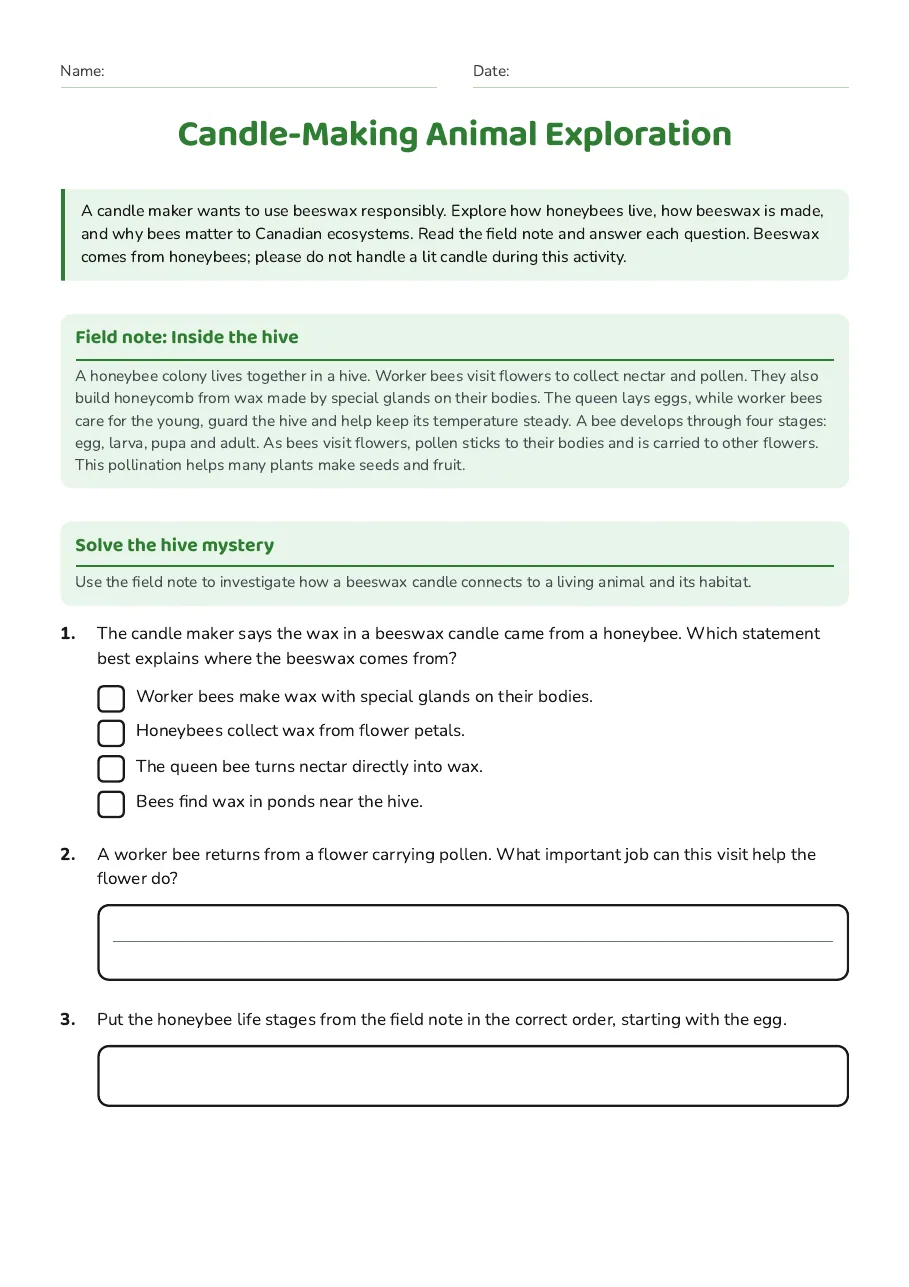
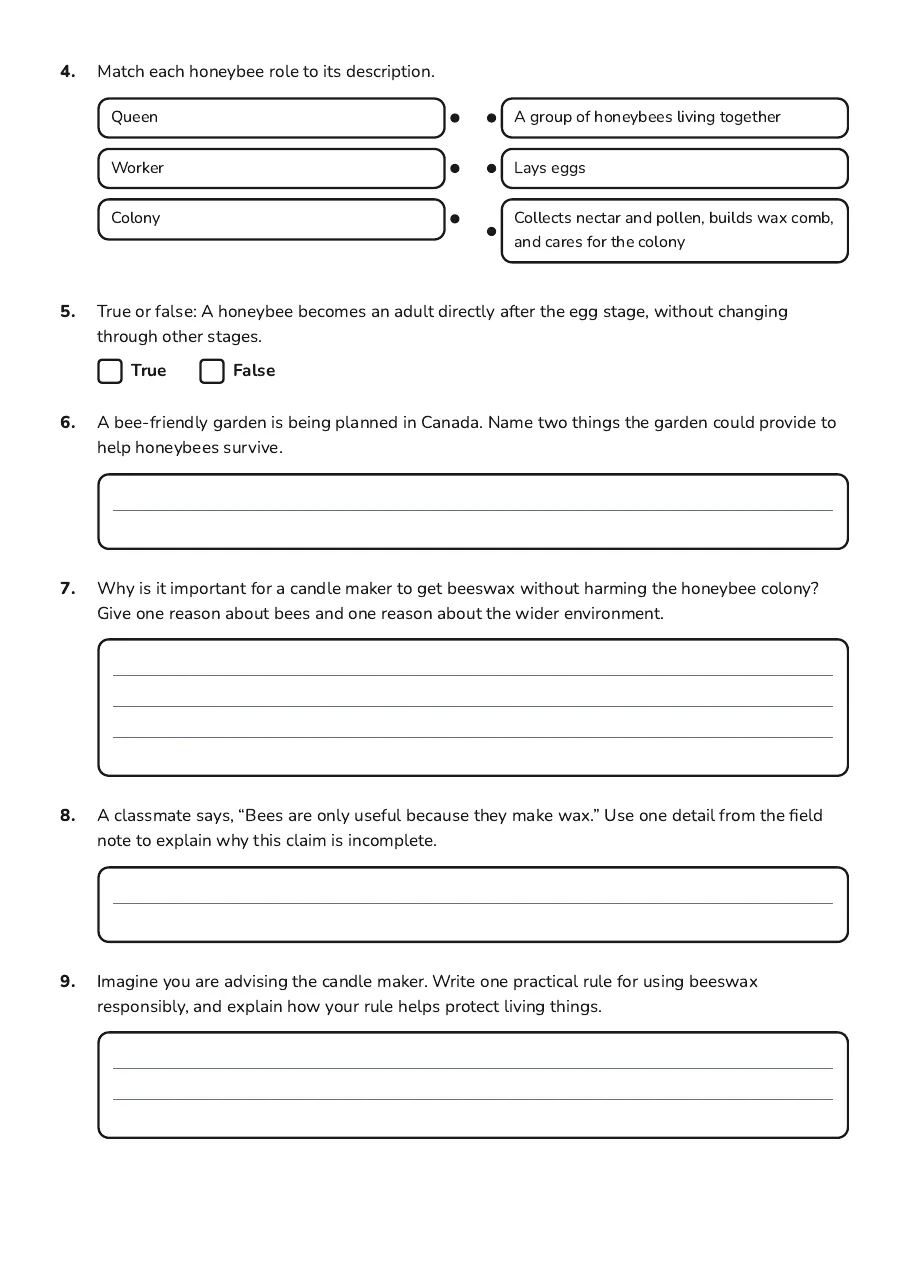
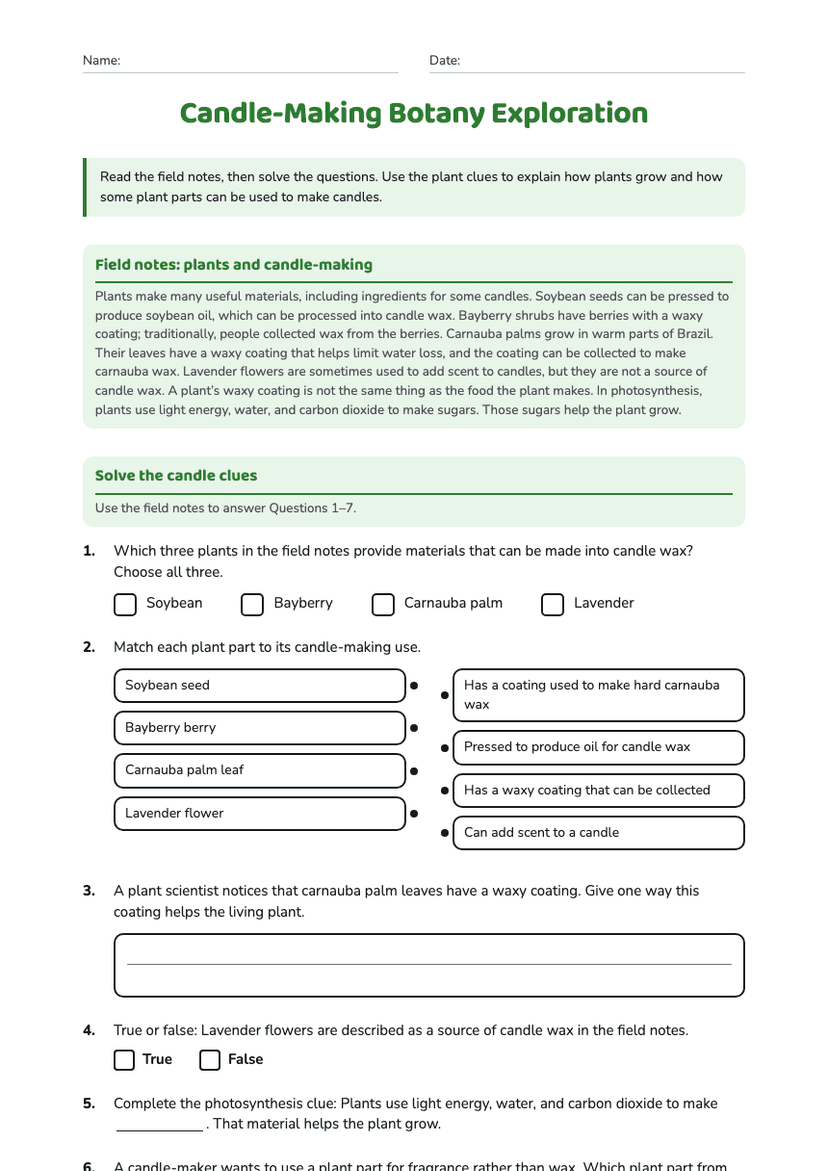
Candle-Making Animal Exploration

A free science worksheet ready for your classroom. Open in Kuraplan to grab the print-ready PDF, customize it for your students, or generate a fresh version in seconds.
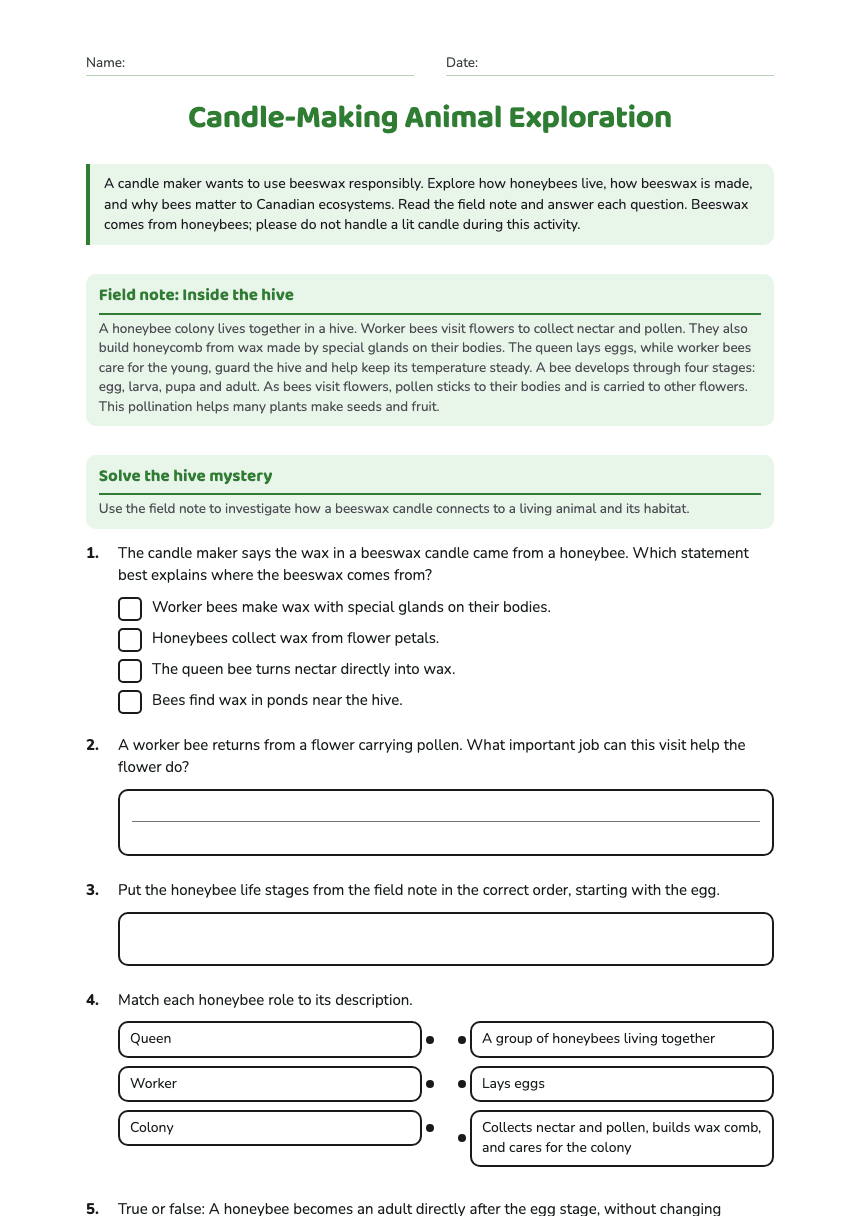
Candle-Making Animal Exploration worksheet preview

Candle-Making Animal Exploration

A Montessori Zoology Journey — Themed Around "A Candle"

Honeybee and candle illustration

🕯️ Direction Card — Read Before You Begin

Materials needed: This worksheet, a pencil, coloured pencils, and your Montessori zoology cards (if available).

Instructions: Work through each section carefully. Read every question fully before answering. If you finish early, try the Extension Activities in Part 3. If you need support, look for the 🌟 tip boxes — they will help guide your thinking.

Control of Error: When you have finished, ask your teacher for the Answer Key Card kept in the zoology tray. Check your own work and place a small dot beside any answers you would like to revisit.

🌟 Differentiation Tip (Support): If a question feels tricky, skip it and come back. You may also use your animal picture cards or the classroom nature books to help you.

🐝 Part 1: Candle-Making Animals — Multiple Choice & Matching

Many candles are made from beeswax, which comes from honeybees. Let's explore the animals connected to candle-making and their world!

1. Which animal produces beeswax, the natural material used to make candles?

Butterfly

Honeybee

Wasp

Ant

2. Honeybees live together in a large group. What is this group called?

A flock

A pack

A colony

A herd

3. Select ALL the jobs that worker bees do inside the hive. (Check all that apply.)

Collect nectar from flowers

Build honeycomb cells from wax

Lay all the eggs for the colony

Guard the entrance to the hive

Fan the hive to keep it cool

4. Match each candle-related animal to its correct habitat. Draw a line from each animal to its home.
Honeybee
Sperm Whale (spermaceti wax)
Bayberry Shrub Moth
Ocean / Deep Sea
Meadows & Gardens
Coastal Shrublands

🌟 Differentiation Tip (Support): For question 4, look up "spermaceti" in your classroom dictionary or ask your guide what it means before matching.

Control of Error — Part 1: Check your matching answers using the Zoology Animal Habitat Cards in the candle-making tray. The back of each card shows the correct habitat.

🔬 Part 2: Life Cycle & Habitat — Short Answer

5. A honeybee goes through complete metamorphosis. List the four stages of the honeybee life cycle in order.
6. Describe the habitat where honeybees prefer to build their hives. Include at least two features of the habitat in your answer.
7. Why are honeybees important to the environment beyond making wax? Write one or two sentences.
8. The temperature inside a beehive is kept at about 35°C. Why do you think bees work hard to maintain this temperature?
9. Draw and label the four stages of the honeybee life cycle in the box below.

🌟 Differentiation Tip (Support): For questions 5 and 9, you may use your Montessori life cycle puzzle cards as a reference before drawing from memory.

Control of Error — Part 2: The Honeybee Life Cycle Control Card (laminated, found in the science tray) shows the correct sequence and labels. Compare your drawing and written answers to the control card when finished.

⭐ Part 3: Extension Activities for Advanced Learners

Have you finished Parts 1 and 2? Try one or more of these challenges!

Extension A — Research & Compare: Beeswax candles and paraffin (petroleum-based) candles are both common in Canada. What are two environmental reasons why beeswax candles may be a better choice? Use evidence from what you know about bees and ecosystems.
Extension B — Design a Habitat: Imagine you are setting up a bee-friendly garden in your schoolyard in Canada. In the space below, sketch and label your garden design. Include at least three plants that bloom at different times of year to support bees from May through September.
Extension C — Zoology Connection: Historically, sperm whales were hunted for spermaceti, a waxy substance used in candles. This practice is now banned in Canada. In 2–3 sentences, explain how protecting whale populations connects to the health of the ocean ecosystem.

Control of Error — Extension Activities: Extension activities are open-ended. When complete, share your responses with your guide during a one-on-one check-in. Your guide will use the Extension Discussion Card (kept in the teacher's tray) to ask you two follow-up questions about your thinking. There is no single correct answer — your reasoning and evidence matter most!

🌟 Differentiation Tip (Challenge): For Extension C, look up the Canadian Species at Risk Act and see if the sperm whale is listed. Add this detail to your response!

About This Worksheet

Free in Kuraplan

Sign up free, grab the PDF, and customize it for your class.

Print-Ready

Formatted for standard paper. Clean layout, easy to read.

AI-Generated

Created with Kuraplan's AI, designed for real classroom use.

For Teachers & Parents

Use in classrooms, for homework, tutoring, or homeschool.

Need a custom version of this worksheet?

Kuraplan's AI generates custom worksheets in seconds — differentiated for every learner, aligned to your curriculum.

Generate Custom Worksheets — Free
No credit card Curriculum-aligned Under 60 seconds