ScienceFreePrintable

Sound and Vibrations Exploration

A free science worksheet ready for your classroom. Open in Kuraplan to grab the print-ready PDF, customize it for your students, or generate a fresh version in seconds.
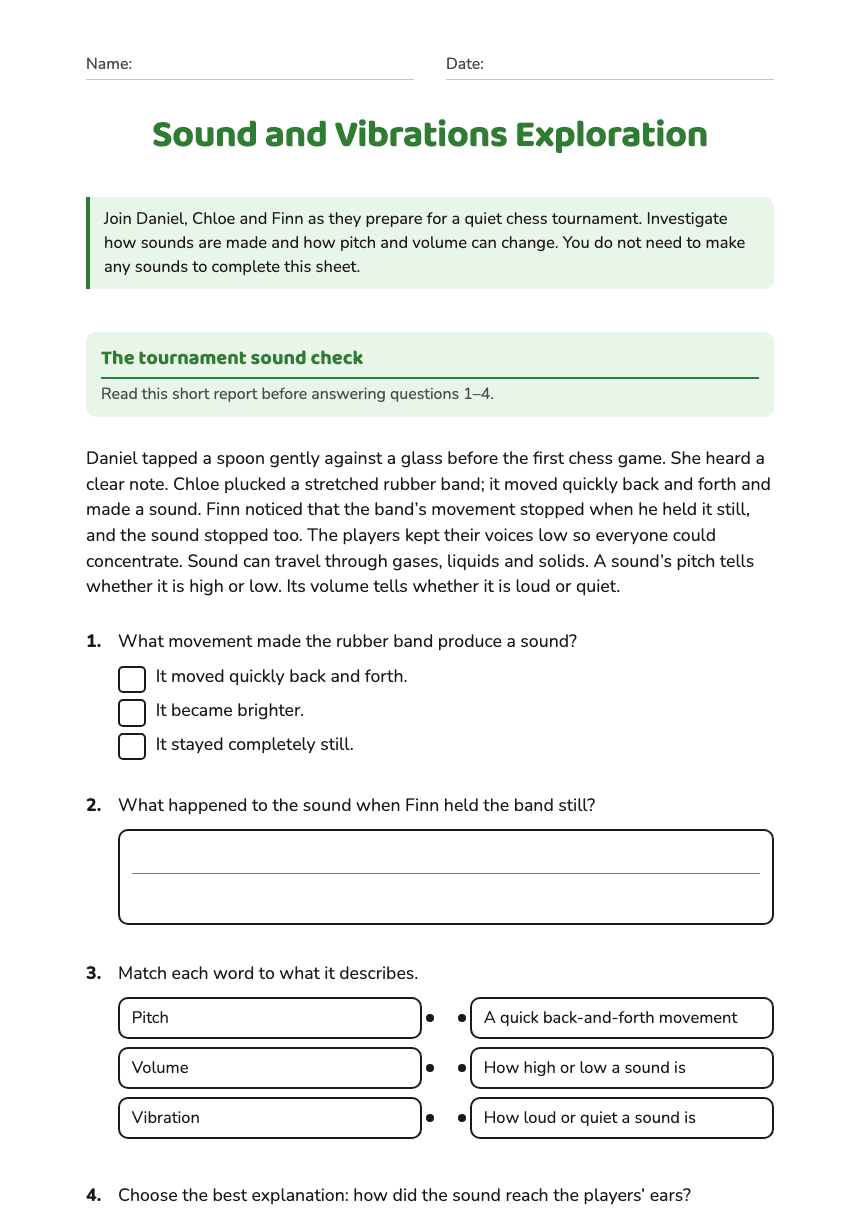
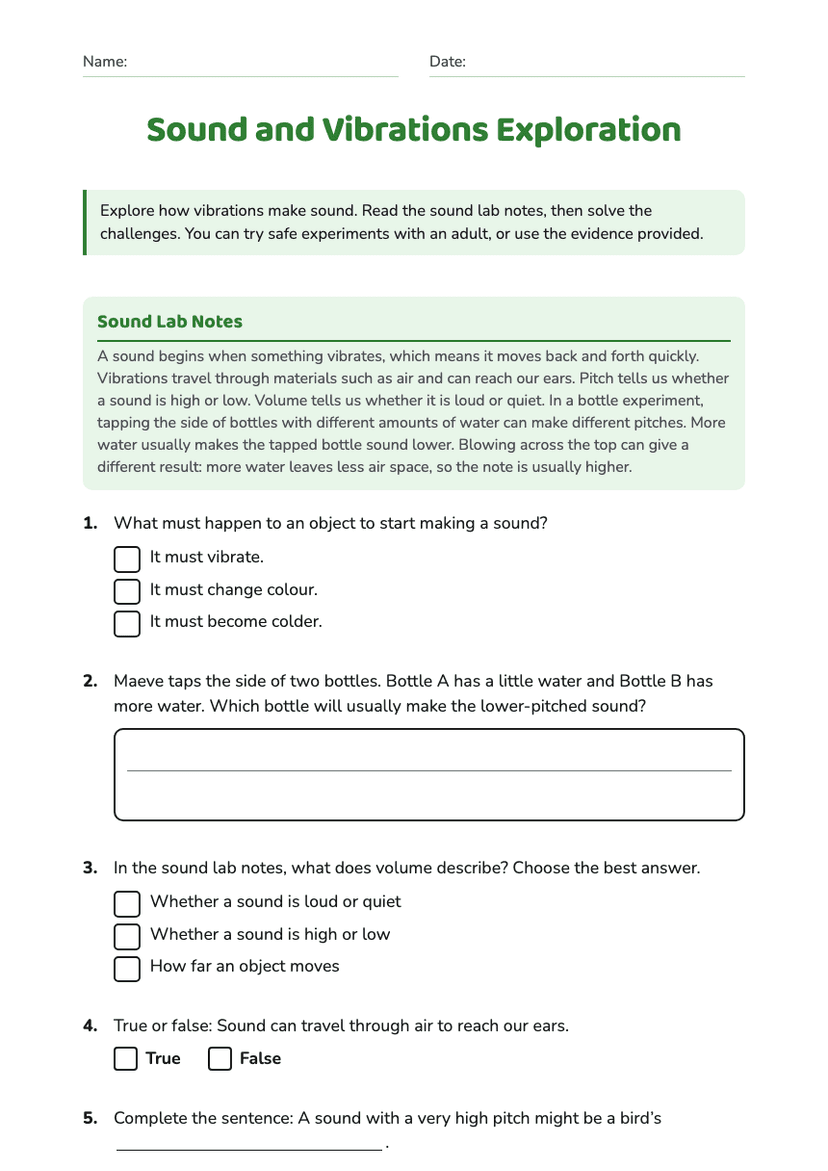
Sound and Vibrations Exploration worksheet preview
Name:Date:

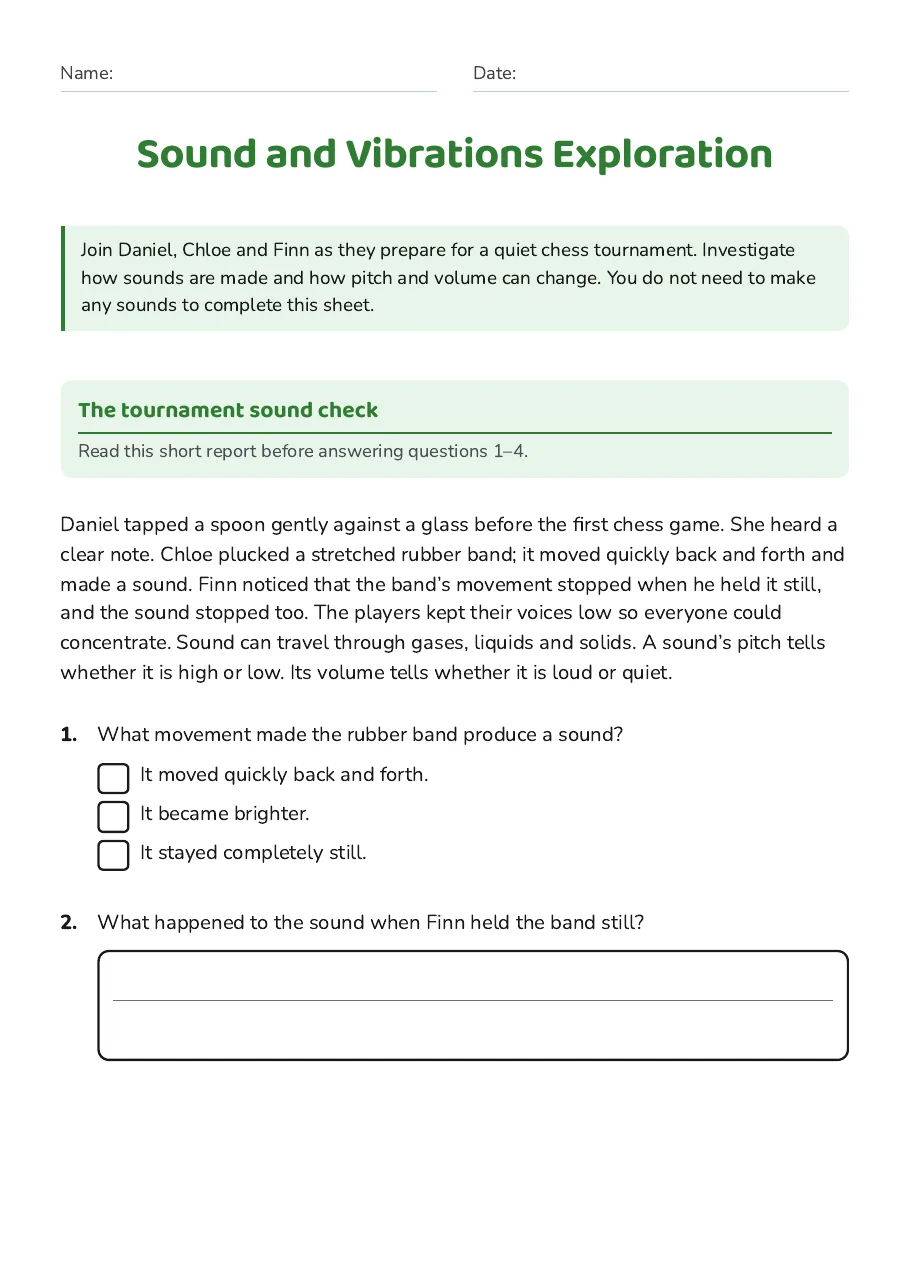
Sound and Vibrations Exploration

Join Daniel, Chloe and Finn as they prepare for a quiet chess tournament. Investigate how sounds are made and how pitch and volume can change. You do not need to make any sounds to complete this sheet.

The tournament sound check

Read this short report before answering questions 1–4.

Daniel tapped a spoon gently against a glass before the first chess game. She heard a clear note. Chloe plucked a stretched rubber band; it moved quickly back and forth and made a sound. Finn noticed that the band’s movement stopped when he held it still, and the sound stopped too. The players kept their voices low so everyone could concentrate. Sound can travel through gases, liquids and solids. A sound’s pitch tells whether it is high or low. Its volume tells whether it is loud or quiet.
1.What movement made the rubber band produce a sound?
  • It moved quickly back and forth.
  • It became brighter.
  • It stayed completely still.
2.What happened to the sound when Finn held the band still?
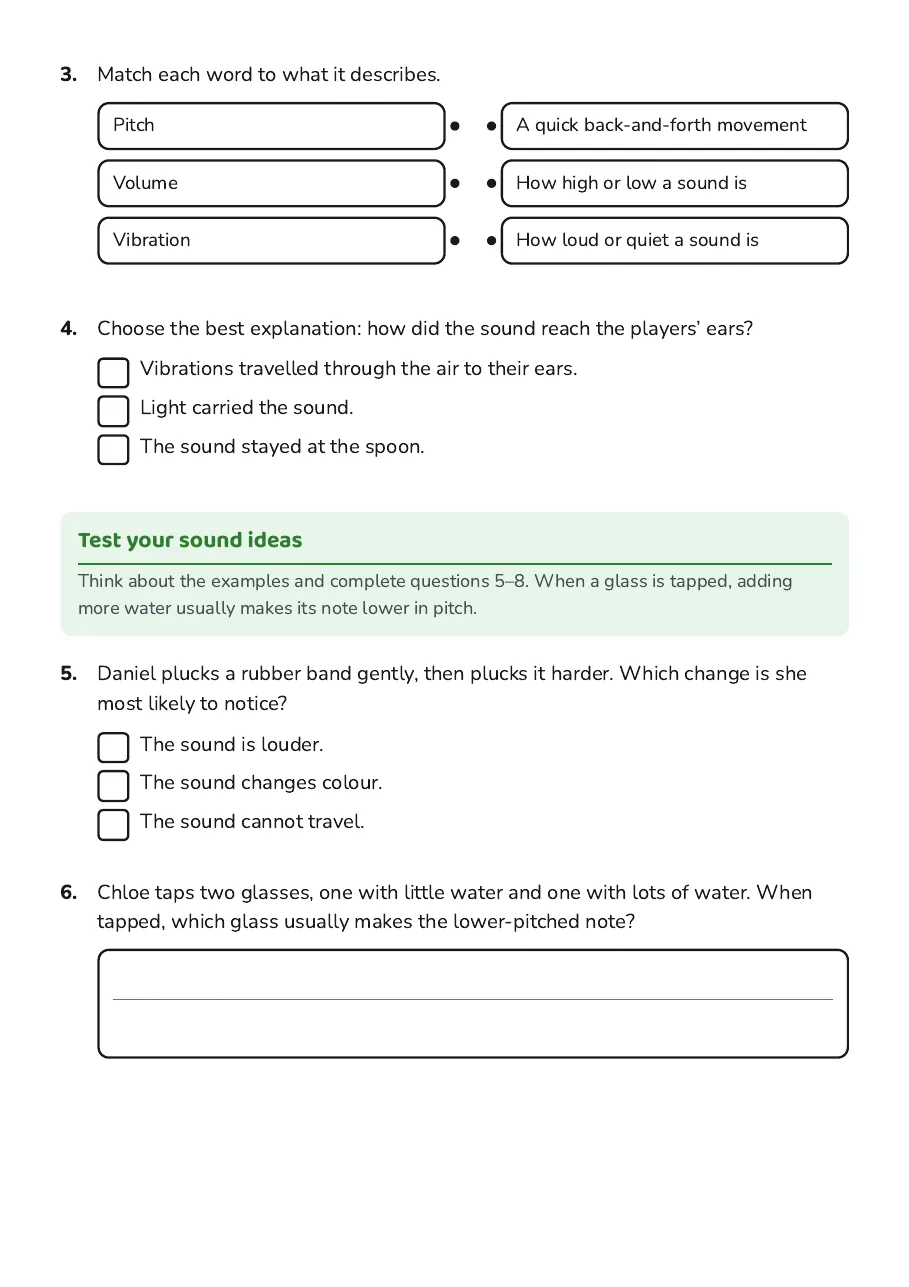
3.Match each word to what it describes.
  • Pitch
  • Volume
  • Vibration
  • A quick back-and-forth movement
  • How high or low a sound is
  • How loud or quiet a sound is
4.Choose the best explanation: how did the sound reach the players’ ears?
  • Vibrations travelled through the air to their ears.
  • Light carried the sound.
  • The sound stayed at the spoon.

Test your sound ideas

Think about the examples and complete questions 5–8. When a glass is tapped, adding more water usually makes its note lower in pitch.

5.Daniel plucks a rubber band gently, then plucks it harder. Which change is she most likely to notice?
  • The sound is louder.
  • The sound changes colour.
  • The sound cannot travel.
6.Chloe taps two glasses, one with little water and one with lots of water. When tapped, which glass usually makes the lower-pitched note?
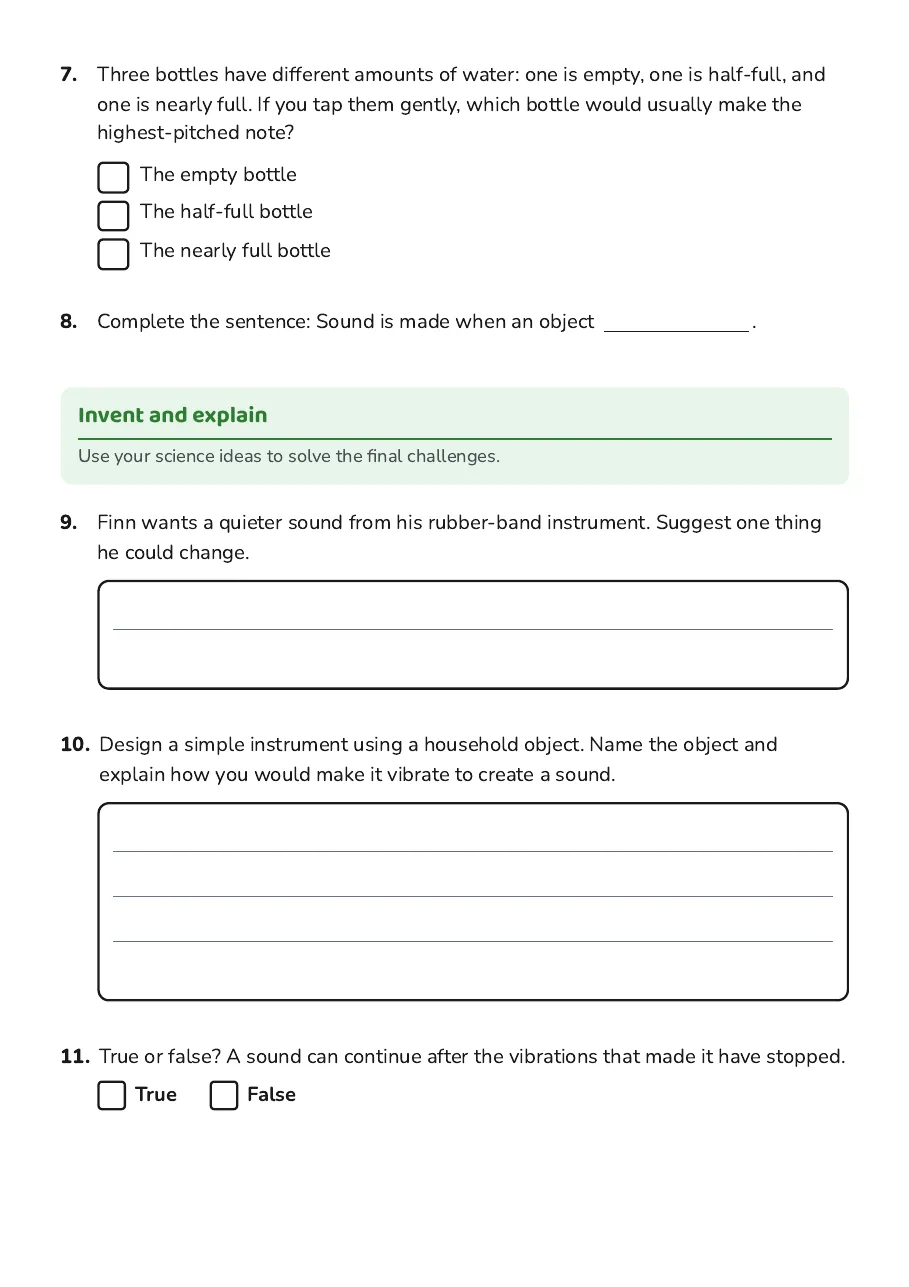
7.Three bottles have different amounts of water: one is empty, one is half-full, and one is nearly full. If you tap them gently, which bottle would usually make the highest-pitched note?
  • The empty bottle
  • The half-full bottle
  • The nearly full bottle
8.Complete the sentence: Sound is made when an object .

Invent and explain

Use your science ideas to solve the final challenges.

9.Finn wants a quieter sound from his rubber-band instrument. Suggest one thing he could change.
10.Design a simple instrument using a household object. Name the object and explain how you would make it vibrate to create a sound.
11.True or false? A sound can continue after the vibrations that made it have stopped.
TrueFalse

3 printable pages

  • Sound and vibrations investigation for a chess tournament, with a vibrating rubber band, spoon and water-filled bottles.

    Page 1

  • Short reading passage about sounds and vibrations, followed by questions on pitch, volume and sound travelling through air.

    Page 2

  • Bottle water-level investigation and questions about how vibration, pitch and volume change.

    Page 3

About This Worksheet

Free in Kuraplan

Sign up free, grab the PDF, and customize it for your class.

Print-Ready

Formatted for standard paper. Clean layout, easy to read.

AI-Generated

Created with Kuraplan's AI, designed for real classroom use.

For Teachers & Parents

Use in classrooms, for homework, tutoring, or homeschool.

Need a custom version of this worksheet?

Kuraplan's AI generates custom worksheets in seconds — differentiated for every learner, aligned to your curriculum.

Generate Custom Worksheets — Free
No credit card Curriculum-aligned Under 60 seconds