The bears are on the table, children are arriving, and yesterday's counting notes are still on a sticky note beside your coffee. You know what you want to teach. What you need is a page that tells you how to start, who needs help, and what to notice before everyone moves to the next activity.
A useful kindergarten lesson plan template should do that without becoming another evening's work. Keep the page short enough for a clipboard, but specific enough that you don't have to reconstruct your thinking while helping a child open a glue stick.
Filling In the Template Field by Field
Use this table as your one-page starting structure. For a familiar lesson, aim to fill it in during a short planning session, perhaps about 15 minutes, rather than writing a script for everything you might say.
Kindergarten lesson plan template fields
| Field | What to write | Kindergarten example |
|---|---|---|
| Standard or domain | The early-learning standard or domain the lesson supports | Number sense: counting objects to 10 |
| Child-friendly objective | One or two observable goals in plain language | Counts 5 bears and says how many |
| Prior-knowledge check | What children already do, from observation or a quick check | Counts to 5 with objects, not yet to 10 |
| Materials | Everything laid out before the lesson starts | Ten bears, two cups, a ten-frame card |
| Launch and modelling | How you open in two or three minutes | Count the first cup aloud while children watch |
| Guided practice or play application | Where the skill appears in centres or play | Shop role-play with price tags |
| Differentiation | One entry point, one support and one extension | Three bears to start, a ten-frame for support, a pattern challenge for extension |
| Teacher prompts | Two or three open questions | How do you know there are seven? |
| Formative check | The evidence you will record | Counts one-to-one: yes, no or partly |
| Next step | Reteach, practise or extend | Reteach with ten-frames next morning |
Fill the thinking fields before the labels
The order matters. The E4Kids framework treats assessment as a basis for planning environments and teaching strategies that scaffold and extend learning. Start with the children, not the activity catalogue.
- Prior knowledge. Record a brief observation or quick check from yesterday. For example: counts to 5 with objects, not yet to 10. Avoid broad labels such as low group.
- Child-friendly objective. Write something you can see or hear: counts 5 bears and says how many. Make a bear craft describes a task, not the learning.
- Launch and modelling. Give the exact opening action: count the first cup aloud while children watch. Put materials nearby on the page so preparation doesn't become guesswork.
- Guided practice or play. Name where children will use the skill. A shop with price tags gives counting a purpose beyond repeating your demonstration.
- Differentiation. Choose an entry point, a support and an extension. Keep these usable, not a paragraph listing every child.
- Teacher prompts. Prepare questions worth asking: How do you know there are seven? What could help you check?
- Formative check and next step. Decide what evidence would lead you to reteach, practise or extend. Leave room to write the actual outcome beside the intention.
- Standard or domain. Add the relevant alignment last, checking that the objective fits your required curriculum.
New York's kindergarten standards guidance distinguishes standards from curriculum, assessment and teaching strategies. Children can share a learning goal without needing identical routes to it.
Practical rule: A substitute should be able to find the materials, begin the lesson and recognise the intended learning without asking you to explain the page.
A Finished Page for Counting Bears
Say you're planning a 20-minute number-sense lesson for a small kindergarten group. The following is a hypothetical completed page, including the observations that shaped it.
| Field | Completed plan |
|---|---|
| Subject and time | Number sense, kindergarten, 20 minutes within the maths block |
| Standard or domain | Number sense: counting objects to 10 |
| Child-friendly objective | Counts 5 bears and says how many |
| Prior knowledge | Of six children, three count to 5 with objects, two lose count after 3, and one counts reliably to 10 |
| Materials | Ten bears, two cups and a ten-frame card for each pair; shop price tags |
| Launch | Count the first cup aloud while children watch. Ask them to count the second cup |
| Guided practice | Run a shop role-play where children sell bears in groups of five |
| Entry point and support | Start the children who lose count with three bears. Offer a ten-frame to organise the objects |
| Extension | Build a pattern with the same counters, then count the bears used |
| Teacher prompt | How do you know there are seven? Use this when a child explores a larger collection |
| Formative check | Record one-to-one counting as yes, no or partly for each child during shop play |
| Next step after teaching | Reteach with ten-frames tomorrow for the two children marked no. Extend to comparing quantities for the rest, retaining support where needed |
What changed because of the observation
The children who lose count after three don't begin with ten scattered bears. They begin with a manageable collection and a clear place to put each counted object. The shared goal remains visible, but the starting task changes.
The extension also needs a little care. Making a pattern offers additional challenge, but it doesn't replace checking whether the child can count the collection and state the total.
For fresh play contexts, Playz's step-by-step guides for early childhood teachers can help you choose a classroom activity. Bring that idea back to the page by specifying what children will do, what you'll ask, and what would count as evidence.
Time Blocks That Fit a Real Kindergarten Day
Across the 124 largest U.S. school districts, the reported average elementary-teacher planning time was 45 minutes per day, according to a Virginia legislative study covering the 2019–2020 school year, which also found that nearly all responding Virginia divisions scheduled at least 2.5 hours per week. That's a reason to keep routine formatting out of your daily planning.
A template that needs an hour of rewriting each day is likely to be abandoned by Thursday. Keep recurring headings, routines and materials lists in place, then change the instructional decisions.
Treat the teaching day as a time budget
In kindergarten classrooms in a large urban district, teachers averaged 85 minutes daily on literacy and 57 minutes on mathematics, a combined 142 minutes, according to the classroom time-use study. Those are observations from that setting, not a timetable every school should copy.
Use your school's actual schedule to enter the remaining blocks. Don't borrow an average for lunch, outdoor play or specialist teaching when your own timetable gives you the answer.
- Literacy: Enter planned minutes and the learning objective, including where small-group work sits.
- Mathematics: Name the number-sense goal and distinguish the launch from practice.
- Play and centres: Reserve time for children to settle into the activity and for you to collect guided-play evidence.
- Transitions and routines: Record minutes, rather than inventing an academic objective for every movement around the room.
- Social-emotional learning: Include an observation focus, such as joining a group or negotiating a turn.
- Specialist sessions: Record the time and who leads, including any handover.
Use the class schedule maker to lay out those blocks, then check the total against the length of your school day. Count arrival, meals, tidying and dismissal too, not just the sessions that look like instruction.
If the planned minutes don't fit the day, change the plan before children arrive, not while you're trying to finish the maths launch.
Keep a planned and actual finish time beside any block that regularly overruns. That gives you something concrete to adjust: shorten the opening explanation, prepare materials differently, or move an extension to tomorrow.
Turning Play into Evidence You Can Use
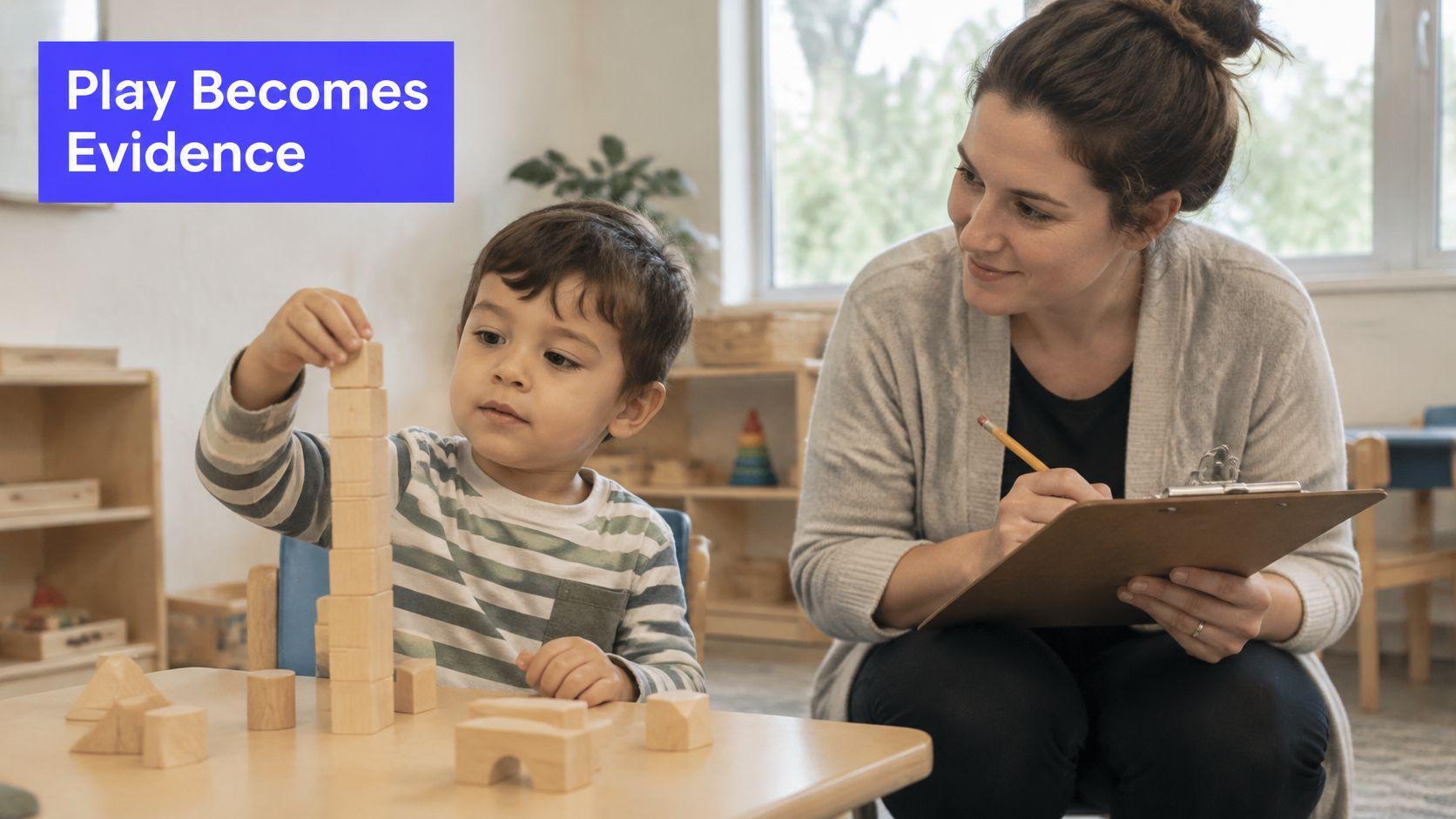
You've just watched a child build a block tower. A box labelled assessment doesn't tell you whether to record careful balancing, positional language, counting, or collaboration. Choose the observable indicator before you begin watching.
A building area can offer plenty to notice, but your note should match the lesson's focus.
Record the interaction, not just the activity
Separate free play, where children choose the direction, from guided play, where you arrange a learning opportunity and support it through interaction while preserving choices. Both can produce useful observations, but a guided-play plan should name your intended contribution.
For the dramatic-play shop, prepare this compact note structure:
- Indicator: Touches or moves each coin once while counting.
- Teacher prompt: How could you check whether you have enough?
- Child language or behaviour: Says that the price is two dollars and another coin is needed; moves coins while counting.
- Quick record: Counts coins aloud, says total. Add yes, no or partly beside the relevant indicator.
The child's statement alone doesn't establish one-to-one counting. You need to see the matching action too. UNICEF's formative-assessment guidance recommends using multiple methods, including observations and interactions, then analysing what children know, can do and still need to learn.
Keep the evidence claims proportionate: the Institute of Education Sciences evidence review reports no established strong or moderate evidence for any single play-based approach, while promising evidence suggests teacher-directed or mutually directed play may better support emergent literacy than entirely child-directed play. That's a reason to document adult interaction, not write play in the activity box.
Use the following video alongside your planning notes, keeping your observation focus in view.
Choose an in-lesson check from these formative assessment examples, then add a separate unit checkpoint. NAEYC's assessment guidance distinguishes formative progress checks from summative assessment at the end of an experience or period. A short unit summary can make progress visible to families and colleagues without turning every play session into a test.
Adapting the Template for Mixed Abilities
Differentiation isn't a finishing touch. If you complete the whole lesson and then ask how everyone can participate, you may discover that the materials, instructions and response format all need changing.
A 2026 survey of 459 pre-primary educators found that more than 85% identified increased workload, difficulty dividing attention and shortages of support staff as major pressures, while 58.9% felt confident designing activities for children with differing abilities, according to the Education University of Hong Kong survey announcement. The practical response is to make access visible in the planning fields, rather than hiding it in a final box.
Mixed-ability needs and template fields
| Child need | Template field | Quick adaptation |
|---|---|---|
| Limited language | Communication supports | Picture cards for the key words |
| Developmental level below the objective | Entry point | Three objects instead of ten |
| Attention or sensory needs | Movement or sensory option | Standing place or fidget tool |
| Needs adult help to start | Adult-assistance note | Seat near the teacher for the launch |
| Ready for more | Extension prompt | Build a pattern with the same counters |
| Shows learning another way | Alternative demonstration | Draw, speak or sort instead of writing |
Plan access and teacher attention together
Keep a universal core activity, such as serving customers in the shop. Then choose the adjustments that let children enter it: a picture showing the requested quantity, a smaller collection, or a tray that keeps counters within reach.
Quick adaptations should be quick to prepare, ideally something you can add in under a minute when the materials are available. They should also suit the child. A fidget tool isn't automatically helpful, and a standing place shouldn't separate a child from the shared experience.
For more ways to match support to the task, consult these differentiation teaching strategies. Preserve the intended skill when changing the response format: a child can demonstrate quantity by placing counters without having to write a numeral.
Attention plan: Name who needs help getting started, what classmates can do independently, and which materials must be ready before the launch.
In a hypothetical lesson, you might check in with two or three children first while peers take turns as shopkeeper and customer. Prepare picture cards and portioned counter trays the night before. Built-in access takes a few minutes at the planning table; last-minute adaptation takes your attention away from children during the opening.
Save Your Template and Run One Week
Copy the field list into a document you already use, and pilot it with a single lesson this week. Don't redesign your whole planning system before you know whether the page helps you teach.
Review that first lesson three days later. Keep the original notes, including crossings-out and unexpected responses, because a polished version can hide what needed changing.
Ask questions that improve tomorrow's lesson
- Did prior knowledge change the teaching? Look for a different starting task, grouping choice or level of support, not just a completed box.
- Did the evidence identify a next step? A note such as enjoyed the shop doesn't tell you what to teach next. A description of the counting error does.
- Did the planned minutes fit the day? Check whether you allowed time for materials, movement and clearing away, rather than blaming yourself for an impossible schedule.
Use one template per subject for the first two weeks, then combine the fields you used into a clipboard page. Keep required school documentation, but remove duplicated writing from your working copy.
If you already plan in Kuraplan, paste the field list in as a starting structure, then adjust the objective, prompts and differentiation for your class instead of rebuilding the page. Every plan and worksheet is editable, so the draft doesn't have to dictate your teaching.
Leave enough space to make notes while children are still in the room. The sign of a useful template isn't a beautifully completed page on Sunday night. It's a page you can pick up tomorrow morning and use to make a better decision.
Kuraplan offers free worksheets, printables, teaching guides, a lesson plan template and an AI policy template. Visit Kuraplan to choose a starting resource, then adapt the counting-bears fields to the children you're teaching this week.