ScienceFreePrintable
Balancing Chemical Equations Activity
A free science worksheet ready for your classroom. Open in Kuraplan to grab the print-ready PDF, customize it for your students, or generate a fresh version in seconds.
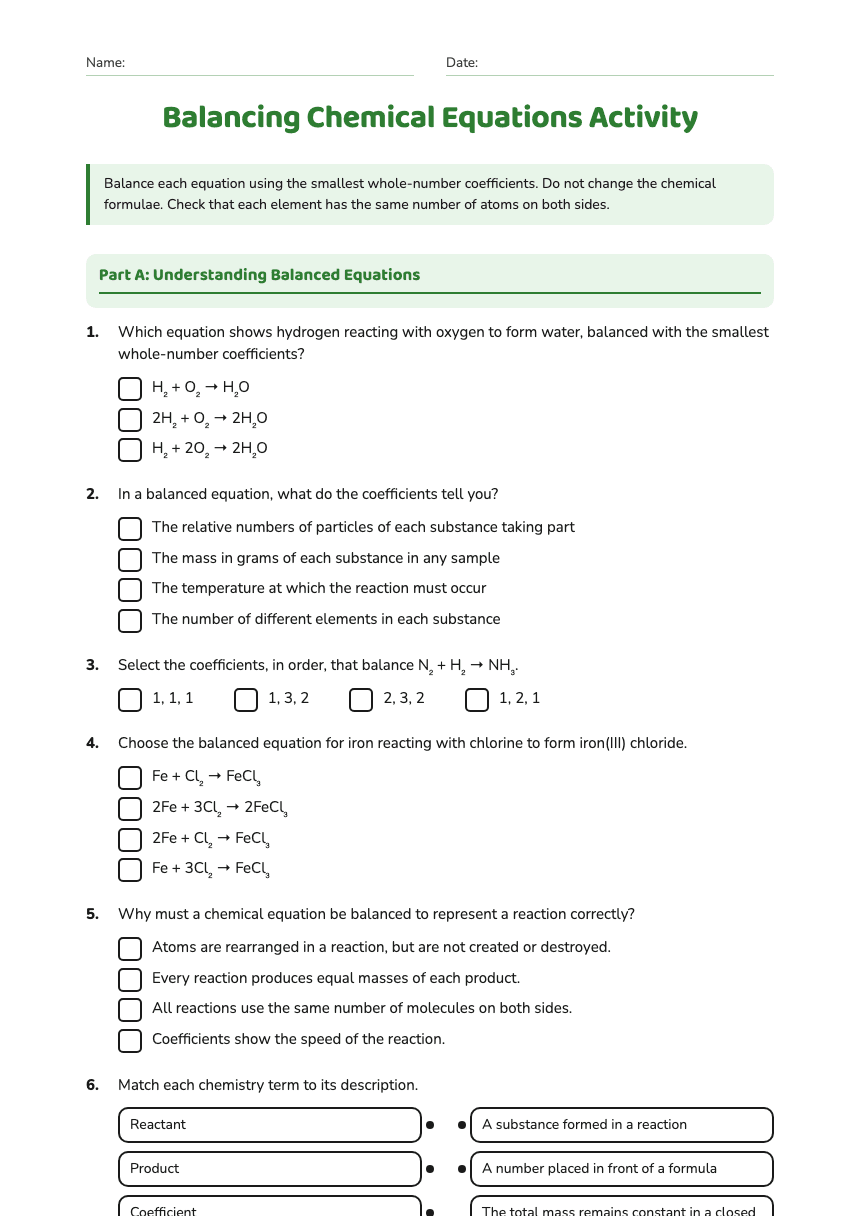
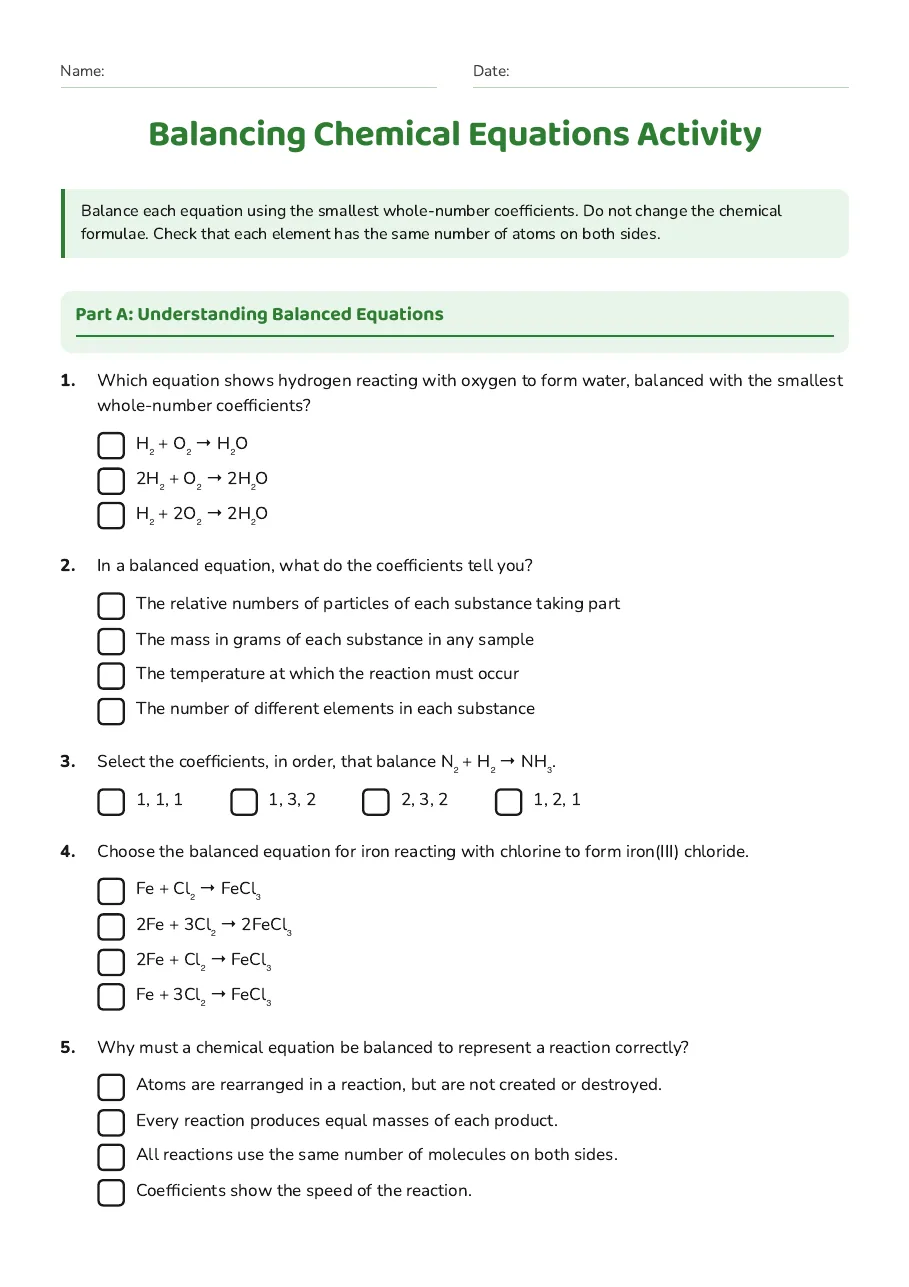
Name:Date:
Balancing Chemical Equations Activity
Balance each equation using the smallest whole-number coefficients. Do not change the chemical formulae. Check that each element has the same number of atoms on both sides.
Part A: Understanding Balanced Equations
1.Which equation shows hydrogen reacting with oxygen to form water, balanced with the smallest whole-number coefficients?
- H₂ + O₂ → H₂O
- 2H₂ + O₂ → 2H₂O
- H₂ + 2O₂ → 2H₂O
2.In a balanced equation, what do the coefficients tell you?
- The relative numbers of particles of each substance taking part
- The mass in grams of each substance in any sample
- The temperature at which the reaction must occur
- The number of different elements in each substance
3.Select the coefficients, in order, that balance N₂ + H₂ → NH₃.
- 1, 1, 1
- 1, 3, 2
- 2, 3, 2
- 1, 2, 1
4.Choose the balanced equation for iron reacting with chlorine to form iron(III) chloride.
- Fe + Cl₂ → FeCl₃
- 2Fe + 3Cl₂ → 2FeCl₃
- 2Fe + Cl₂ → FeCl₃
- Fe + 3Cl₂ → FeCl₃
5.Why must a chemical equation be balanced to represent a reaction correctly?
- Atoms are rearranged in a reaction, but are not created or destroyed.
- Every reaction produces equal masses of each product.
- All reactions use the same number of molecules on both sides.
- Coefficients show the speed of the reaction.
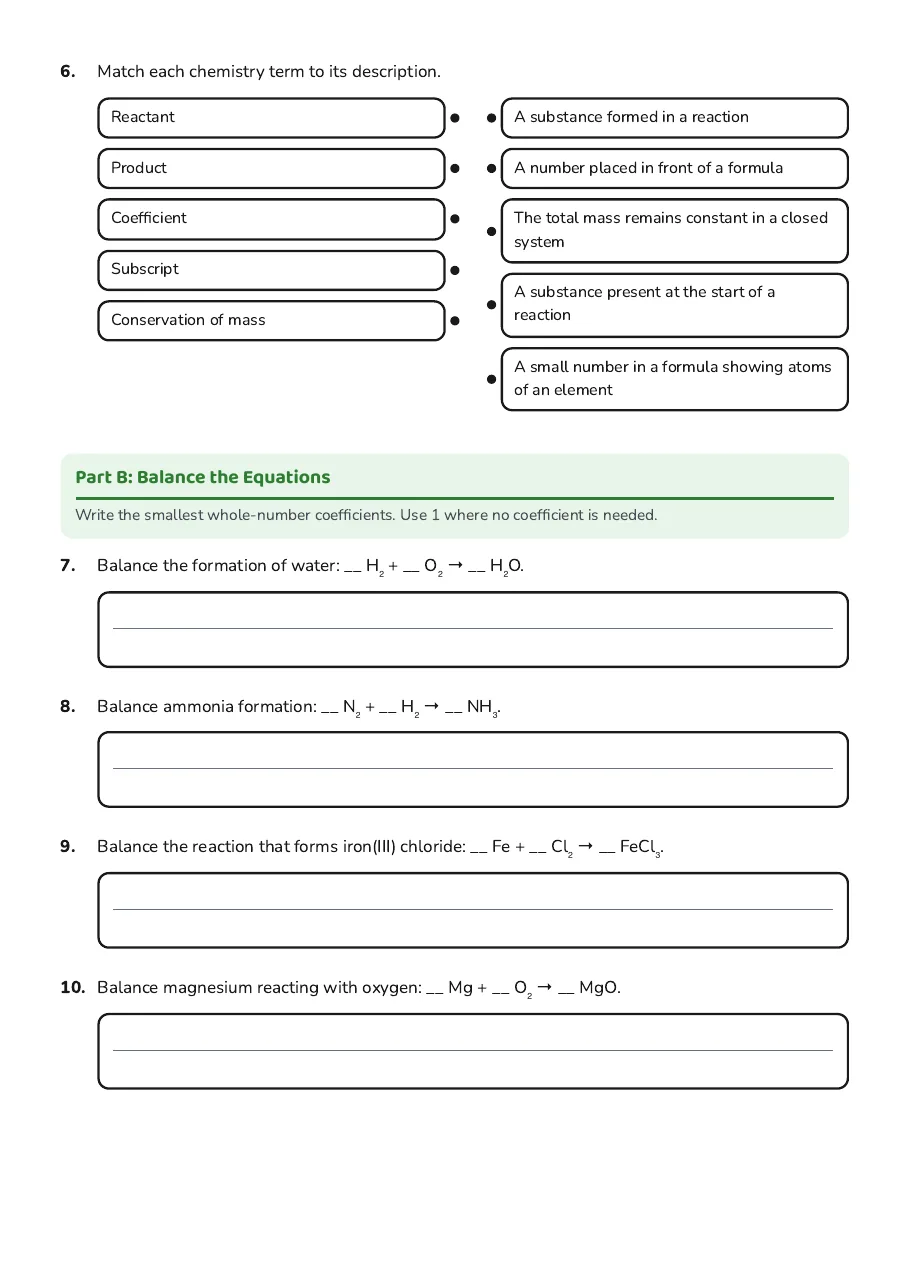
6.Match each chemistry term to its description.
- Reactant
- Product
- Coefficient
- Subscript
- Conservation of mass
- A substance formed in a reaction
- A number placed in front of a formula
- The total mass remains constant in a closed system
- A substance present at the start of a reaction
- A small number in a formula showing atoms of an element
Part B: Balance the Equations
Write the smallest whole-number coefficients. Use 1 where no coefficient is needed.
7.Balance the formation of water: __ H₂ + __ O₂ → __ H₂O.
8.Balance ammonia formation: __ N₂ + __ H₂ → __ NH₃.
9.Balance the reaction that forms iron(III) chloride: __ Fe + __ Cl₂ → __ FeCl₃.
10.Balance magnesium reacting with oxygen: __ Mg + __ O₂ → __ MgO.
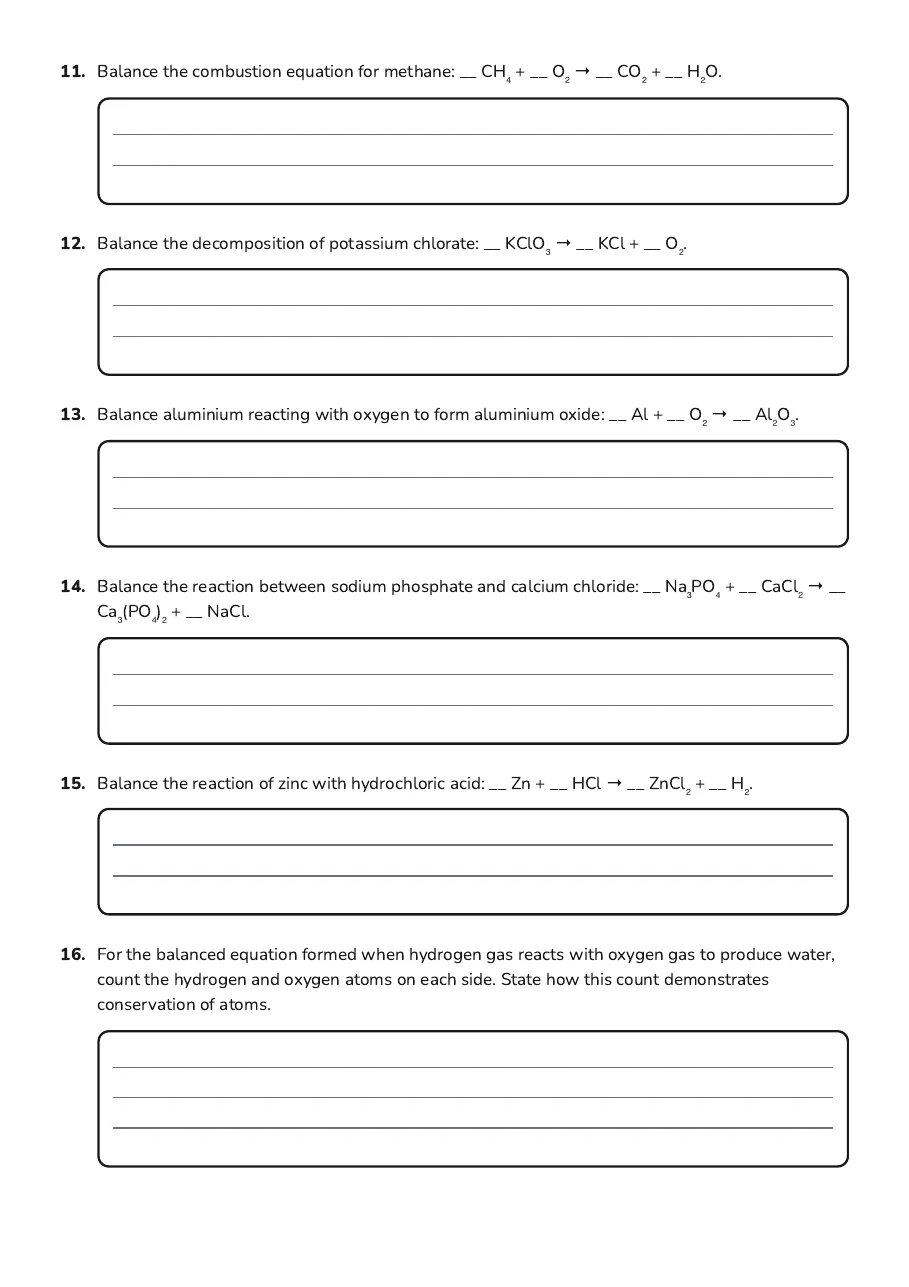
11.Balance the combustion equation for methane: __ CH₄ + __ O₂ → __ CO₂ + __ H₂O.
12.Balance the decomposition of potassium chlorate: __ KClO₃ → __ KCl + __ O₂.
13.Balance aluminium reacting with oxygen to form aluminium oxide: __ Al + __ O₂ → __ Al₂O₃.
14.Balance the reaction between sodium phosphate and calcium chloride: __ Na₃PO₄ + __ CaCl₂ → __ Ca₃(PO₄)₂ + __ NaCl.
15.Balance the reaction of zinc with hydrochloric acid: __ Zn + __ HCl → __ ZnCl₂ + __ H₂.
16.For the balanced equation formed when hydrogen gas reacts with oxygen gas to produce water, count the hydrogen and oxygen atoms on each side. State how this count demonstrates conservation of atoms.
3 printable pages
Page 1
Page 2
Page 3
About This Worksheet
Free in Kuraplan
Sign up free, grab the PDF, and customize it for your class.
Print-Ready
Formatted for standard paper. Clean layout, easy to read.
AI-Generated
Created with Kuraplan's AI, designed for real classroom use.
For Teachers & Parents
Use in classrooms, for homework, tutoring, or homeschool.
Need a custom version of this worksheet?
Kuraplan's AI generates custom worksheets in seconds — differentiated for every learner, aligned to your curriculum.
Generate Custom Worksheets — Free No credit card Curriculum-aligned Under 60 seconds
More Science Worksheets
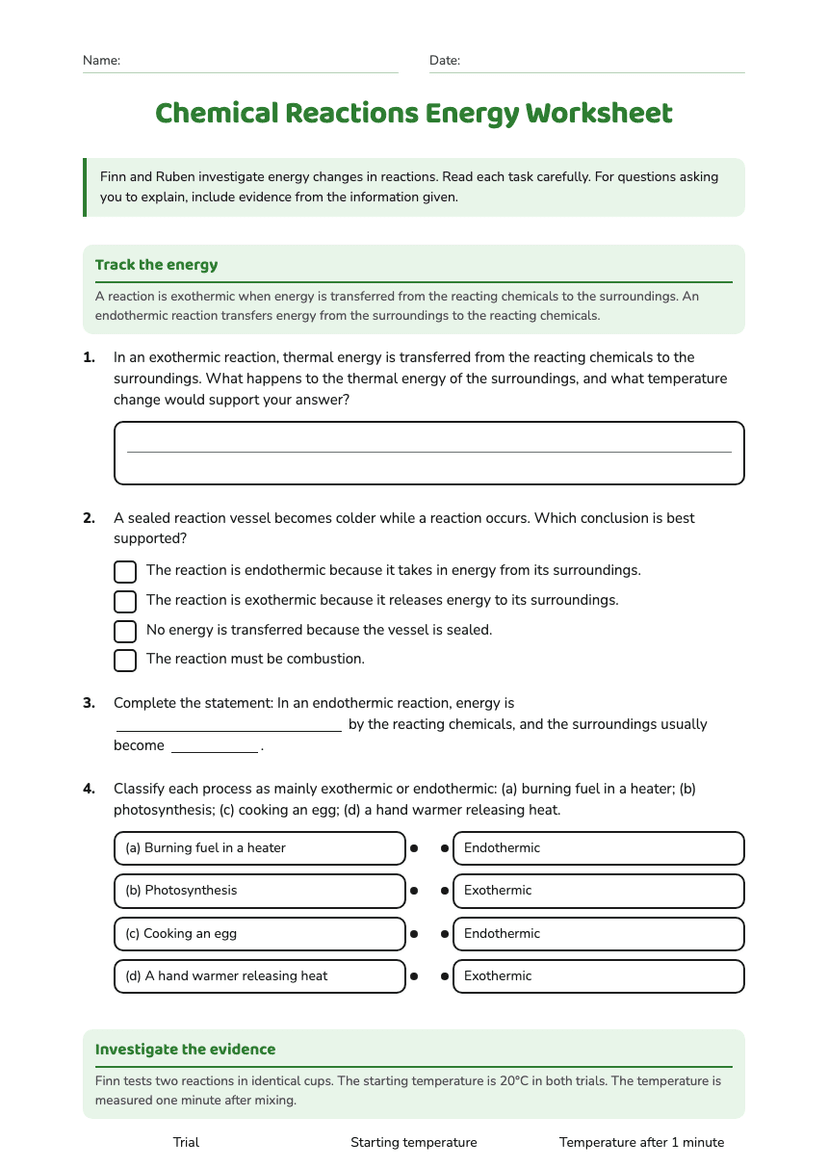
Chemical Reactions Energy Worksheet
Free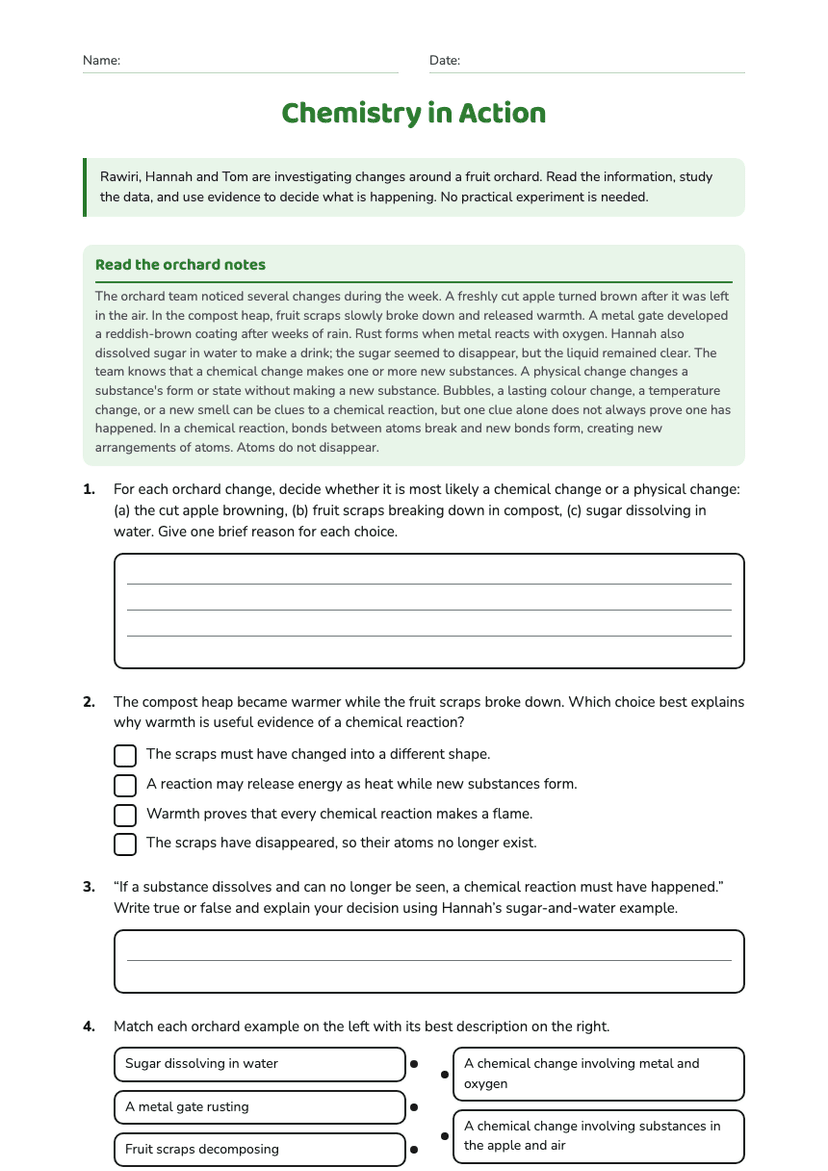
Year 7
Chemistry in Action
Free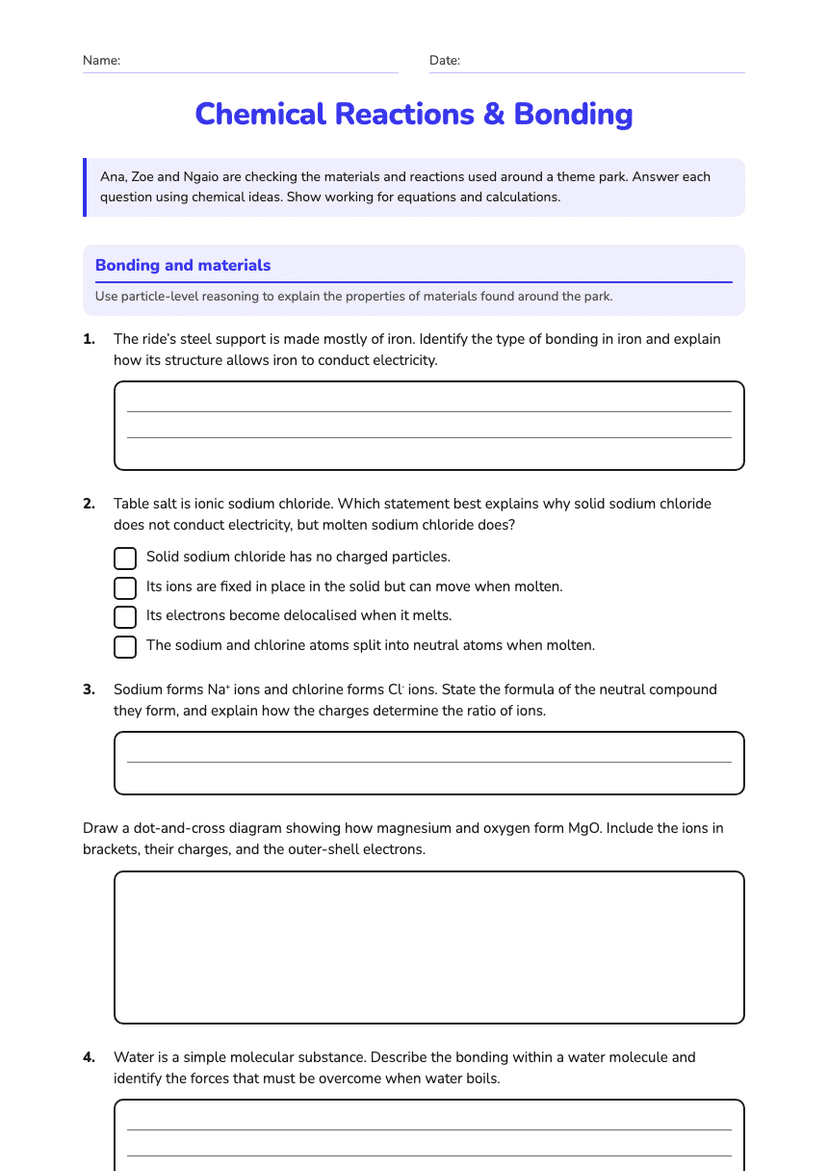
Year 11
Chemical Reactions & Bonding
Free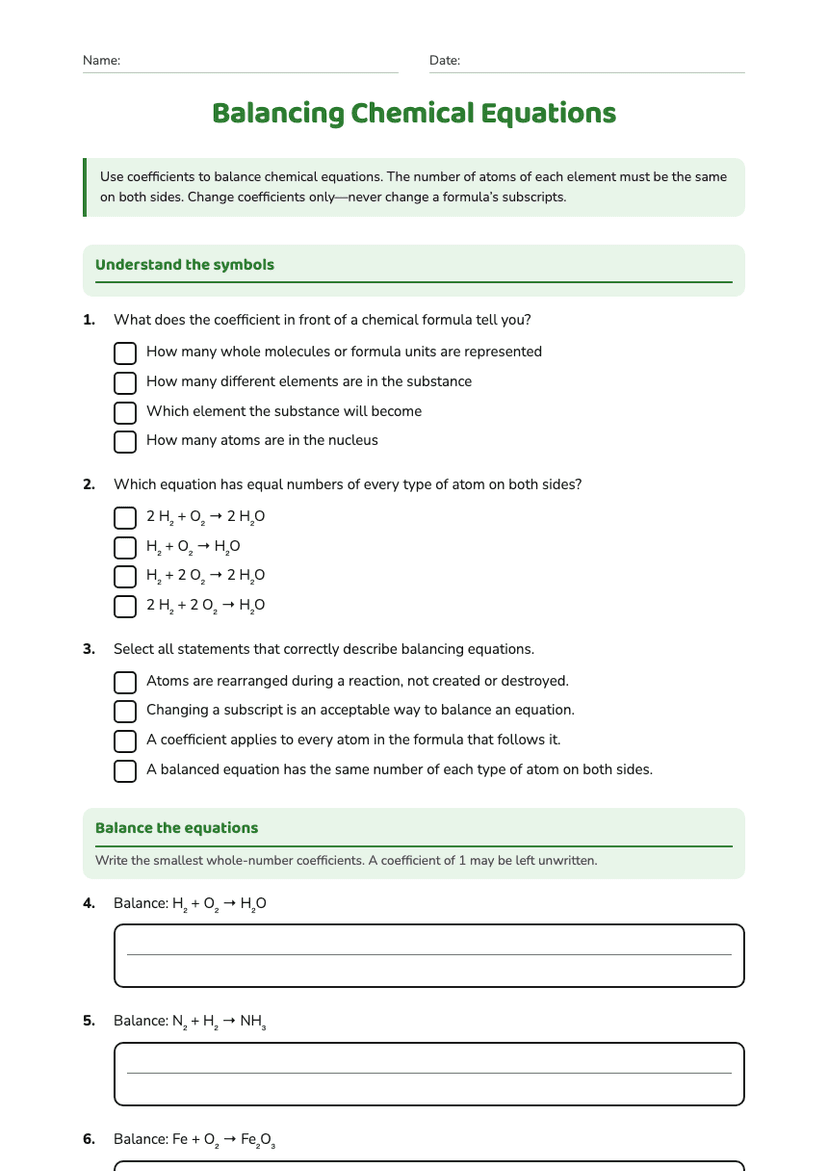
Year 7–8
Balancing Chemical Equations
Free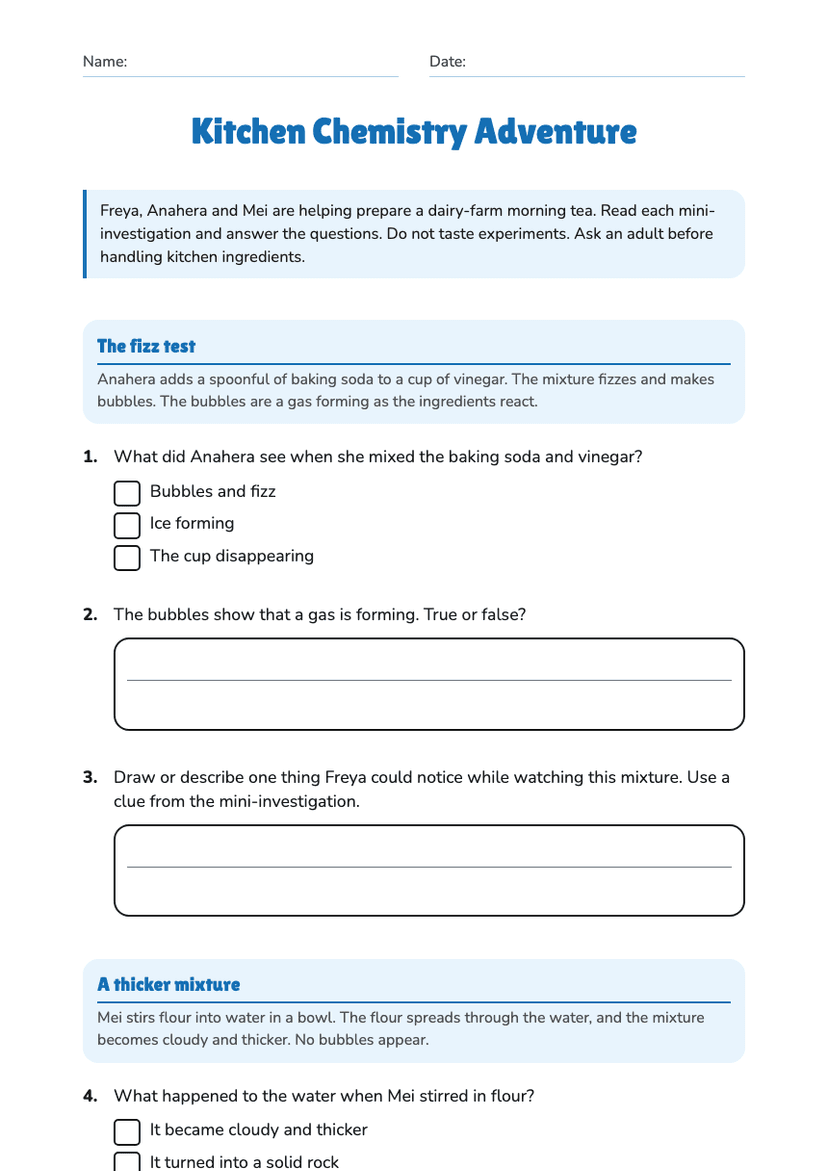
Year 2
Kitchen Chemistry Adventure
Free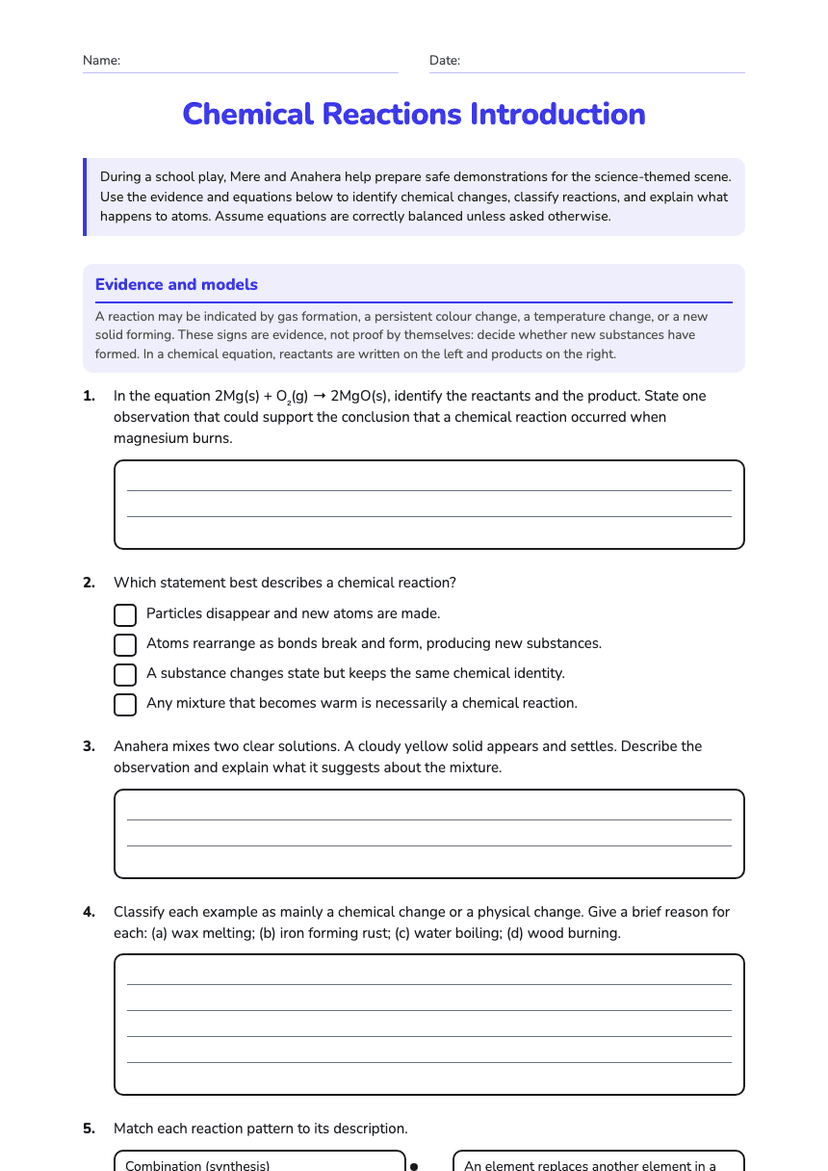
Year 11
Chemical Reactions Introduction
Free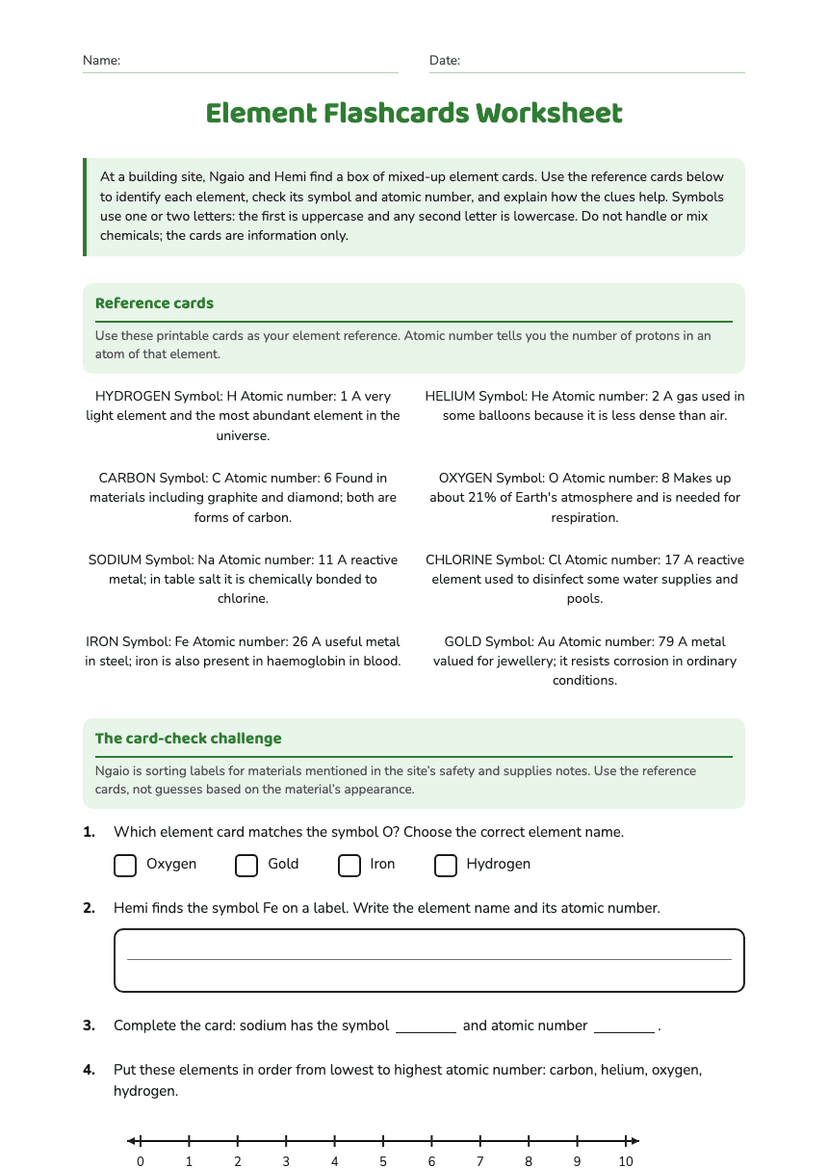
Year 9
Element Flashcards Worksheet
Free
Year 7–8