HealthFreePrintable

Budget Meal Planning Guide

A free health worksheet ready for your classroom. Open in Kuraplan to grab the print-ready PDF, customize it for your students, or generate a fresh version in seconds.
Budget Meal Planning Guide worksheet preview
Name:Date:

Budget Meal Planning Guide

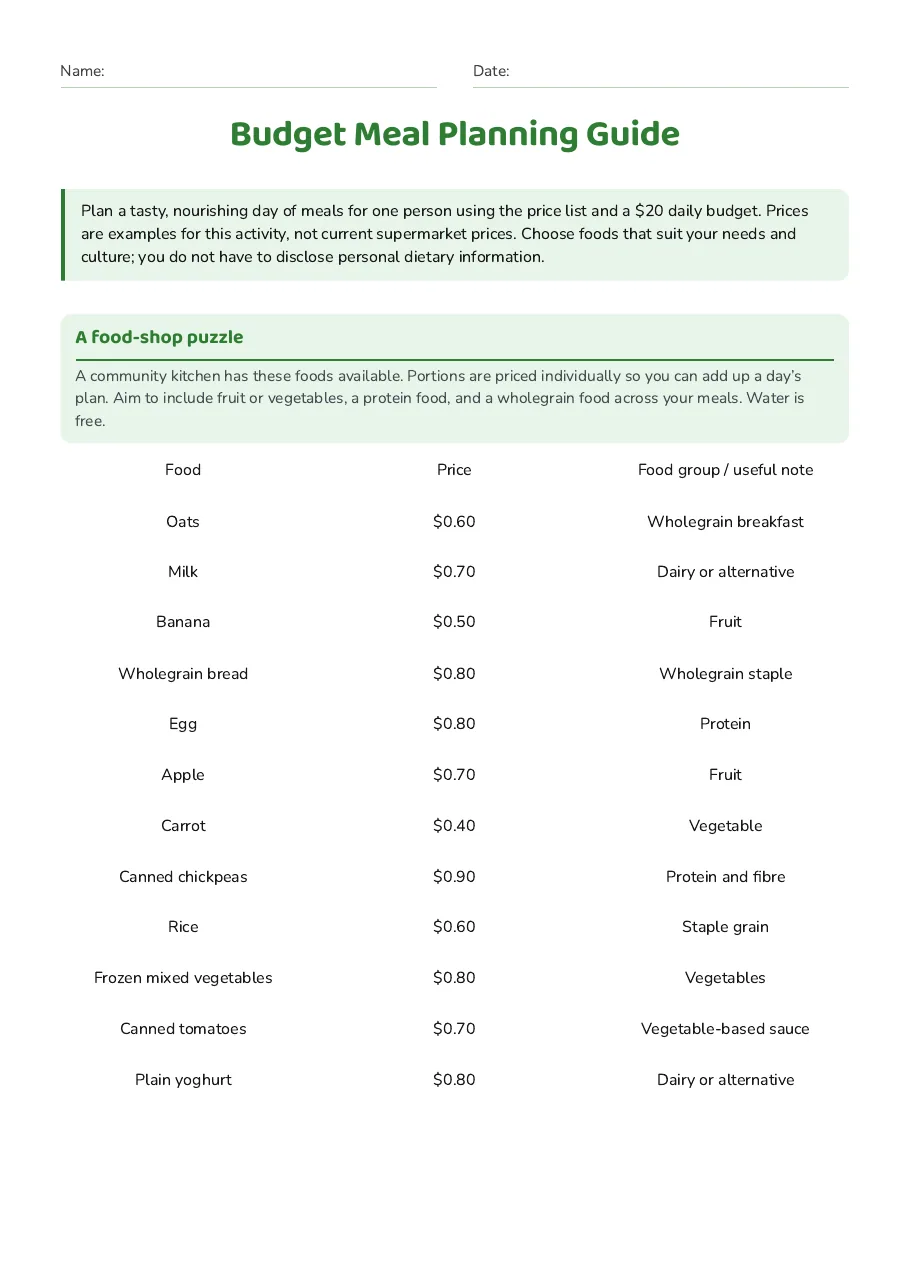
Plan a tasty, nourishing day of meals for one person using the price list and a $20 daily budget. Prices are examples for this activity, not current supermarket prices. Choose foods that suit your needs and culture; you do not have to disclose personal dietary information.

A food-shop puzzle

A community kitchen has these foods available. Portions are priced individually so you can add up a day’s plan. Aim to include fruit or vegetables, a protein food, and a wholegrain food across your meals. Water is free.

Food

Price

Food group / useful note

Oats

$0.60

Wholegrain breakfast

Milk

$0.70

Dairy or alternative

Banana

$0.50

Fruit

Wholegrain bread

$0.80

Wholegrain staple

Egg

$0.80

Protein

Apple

$0.70

Fruit

Carrot

$0.40

Vegetable

Canned chickpeas

$0.90

Protein and fibre

Rice

$0.60

Staple grain

Frozen mixed vegetables

$0.80

Vegetables

Canned tomatoes

$0.70

Vegetable-based sauce

Plain yoghurt

$0.80

Dairy or alternative

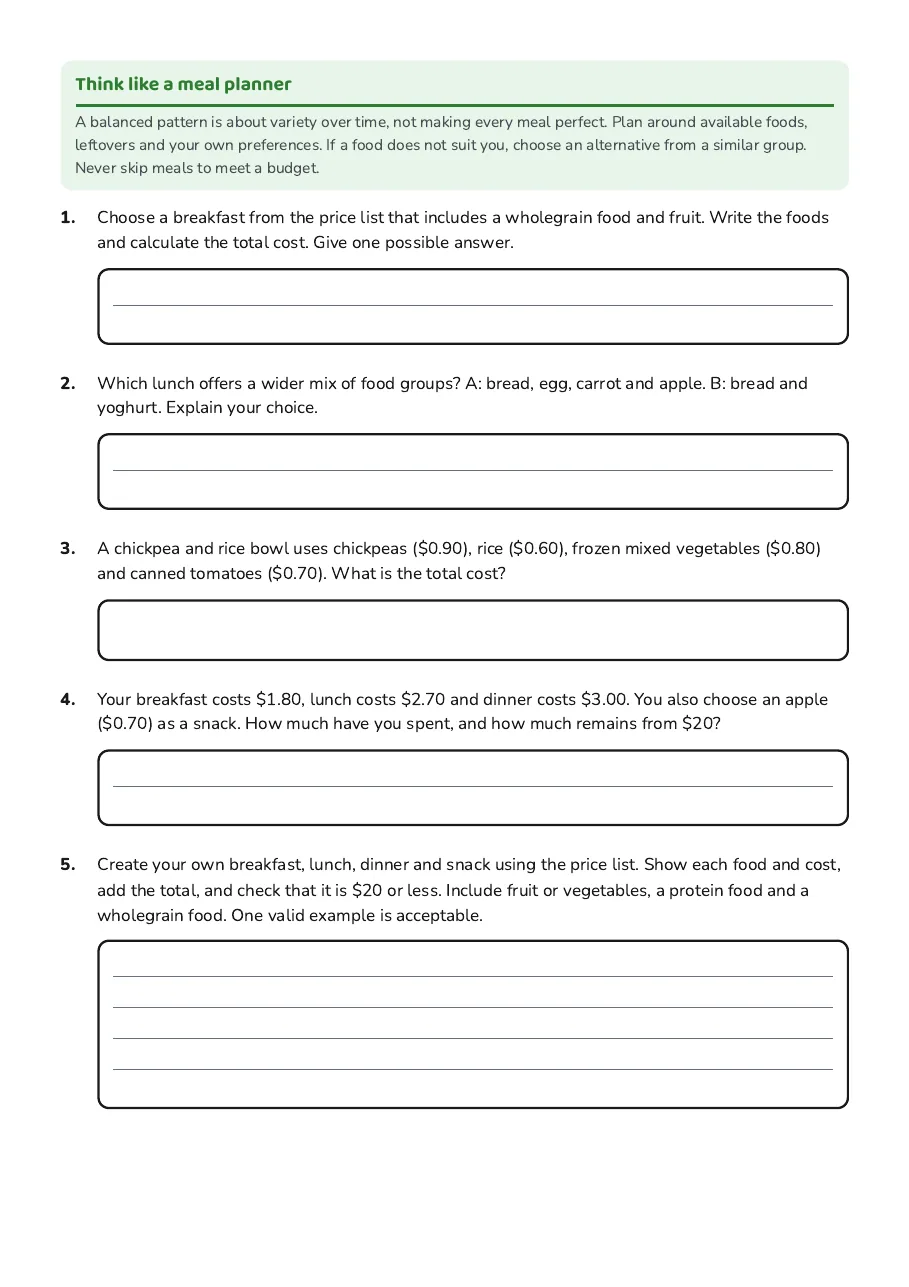
Think like a meal planner

A balanced pattern is about variety over time, not making every meal perfect. Plan around available foods, leftovers and your own preferences. If a food does not suit you, choose an alternative from a similar group. Never skip meals to meet a budget.

1.Choose a breakfast from the price list that includes a wholegrain food and fruit. Write the foods and calculate the total cost. Give one possible answer.
2.Which lunch offers a wider mix of food groups? A: bread, egg, carrot and apple. B: bread and yoghurt. Explain your choice.
3.A chickpea and rice bowl uses chickpeas ($0.90), rice ($0.60), frozen mixed vegetables ($0.80) and canned tomatoes ($0.70). What is the total cost?
4.Your breakfast costs $1.80, lunch costs $2.70 and dinner costs $3.00. You also choose an apple ($0.70) as a snack. How much have you spent, and how much remains from $20?
5.Create your own breakfast, lunch, dinner and snack using the price list. Show each food and cost, add the total, and check that it is $20 or less. Include fruit or vegetables, a protein food and a wholegrain food. One valid example is acceptable.
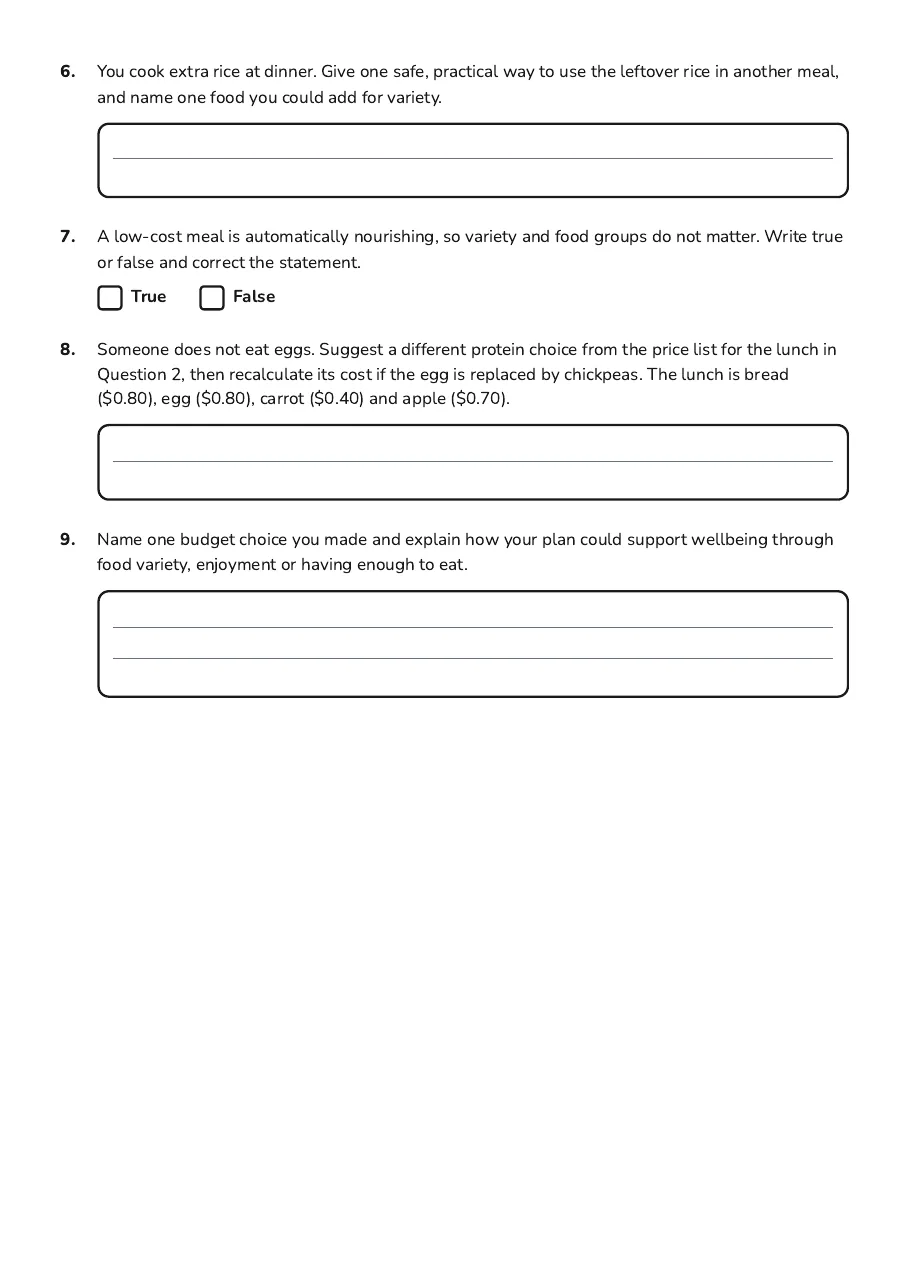
6.You cook extra rice at dinner. Give one safe, practical way to use the leftover rice in another meal, and name one food you could add for variety.
7.A low-cost meal is automatically nourishing, so variety and food groups do not matter. Write true or false and correct the statement.
TrueFalse
8.Someone does not eat eggs. Suggest a different protein choice from the price list for the lunch in Question 2, then recalculate its cost if the egg is replaced by chickpeas. The lunch is bread ($0.80), egg ($0.80), carrot ($0.40) and apple ($0.70).
9.Name one budget choice you made and explain how your plan could support wellbeing through food variety, enjoyment or having enough to eat.

3 printable pages

  • Budget Meal Planning Guide, page 1 of 3: A food-shop puzzle

    Page 1

  • Budget Meal Planning Guide, page 2 of 3: Think like a meal planner

    Page 2

  • Budget Meal Planning Guide, page 3 of 3: 6. You cook extra rice at dinner. Give one safe, practical way to use the leftover rice…

    Page 3

About This Worksheet

Free in Kuraplan

Sign up free, grab the PDF, and customize it for your class.

Print-Ready

Formatted for standard paper. Clean layout, easy to read.

AI-Generated

Created with Kuraplan's AI, designed for real classroom use.

For Teachers & Parents

Use in classrooms, for homework, tutoring, or homeschool.

Need a custom version of this worksheet?

Kuraplan's AI generates custom worksheets in seconds — differentiated for every learner, aligned to your curriculum.

Generate Custom Worksheets — Free
No credit card Curriculum-aligned Under 60 seconds