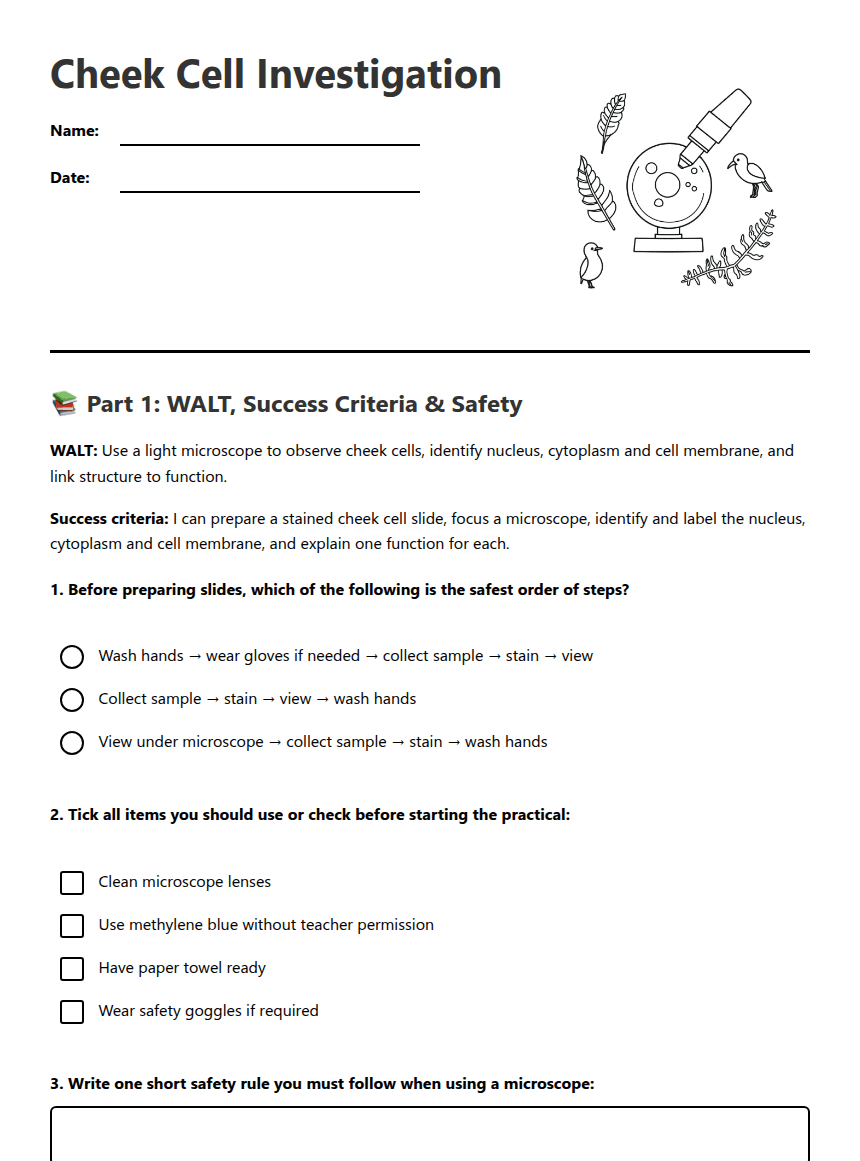
Cheek Cell Investigation
A free science worksheet ready for your classroom. Open in Kuraplan to grab the print-ready PDF, customize it for your students, or generate a fresh version in seconds.
Cheek Cell Investigation

📚 Part 1: WALT, Success Criteria & Safety
WALT: Use a light microscope to observe cheek cells, identify nucleus, cytoplasm and cell membrane, and link structure to function.
Success criteria: I can prepare a stained cheek cell slide, focus a microscope, identify and label the nucleus, cytoplasm and cell membrane, and explain one function for each.
🔬 Part 2: Observation, Identification & Reflection
Nucleus: ____________________________
Cell membrane: ______________________
Cytoplasm: __________________________
a) Nucleus:
b) Cell membrane:
Learned: ____________________________
Question: ____________________________
📝 Teacher notes & Differentiation
Differentiation: Provide step-by-step visual instructions or a demonstration video for students needing extra support. Offer pre-drawn cell outlines or stencils for students with fine motor challenges. Pair students for peer assistance.
Dyslexia-friendly options: Use printed dyslexia-friendly sheets (larger spacing and simple font), read instructions aloud, and give sentence starters for writing functions (e.g., "The nucleus controls..." ).
Extension ideas: Use higher magnification to look for a nucleolus, or compare stained cheek cells with prepared onion skin (plant) slides and record differences.
About This Worksheet
Free in Kuraplan
Sign up free, grab the PDF, and customize it for your class.
Print-Ready
Formatted for standard paper. Clean layout, easy to read.
AI-Generated
Created with Kuraplan's AI, designed for real classroom use.
For Teachers & Parents
Use in classrooms, for homework, tutoring, or homeschool.
Need a custom version of this worksheet?
Kuraplan's AI generates custom worksheets in seconds — differentiated for every learner, aligned to your curriculum.
Generate Custom Worksheets — FreeMore Science Worksheets

Glitter Trace Evidence Worksheet
Free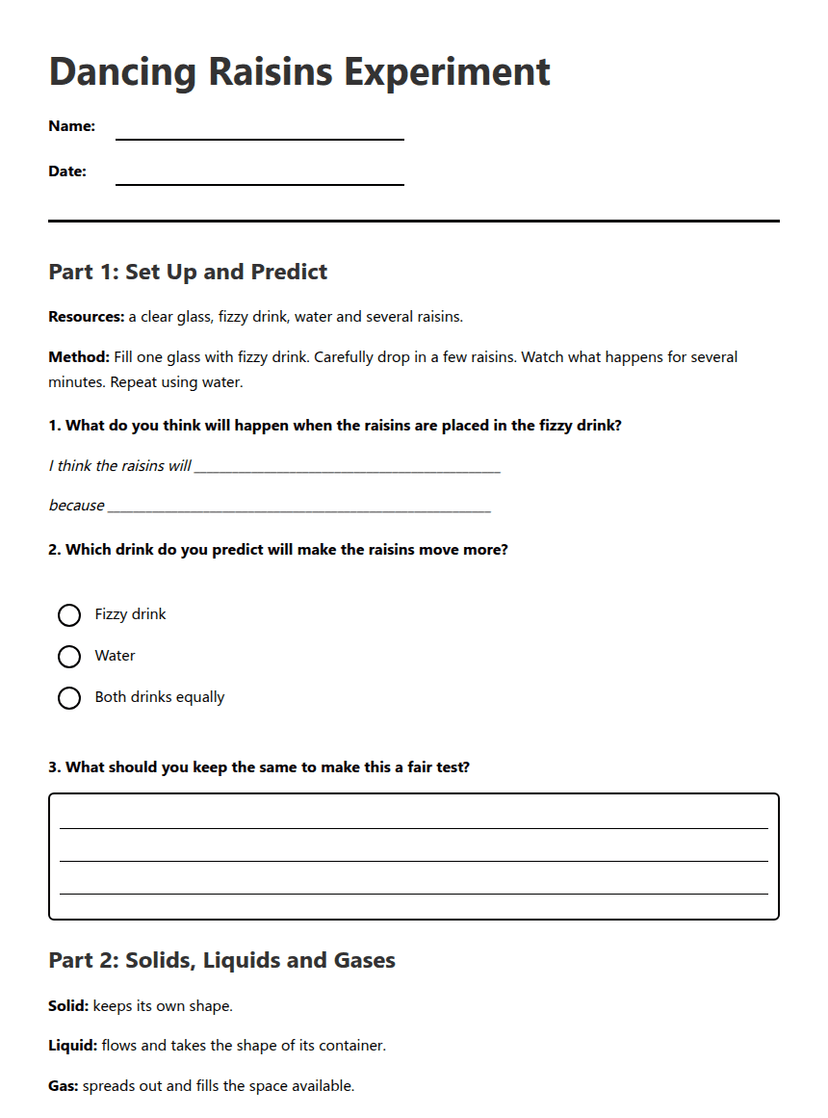
Dancing Raisins Experiment
Free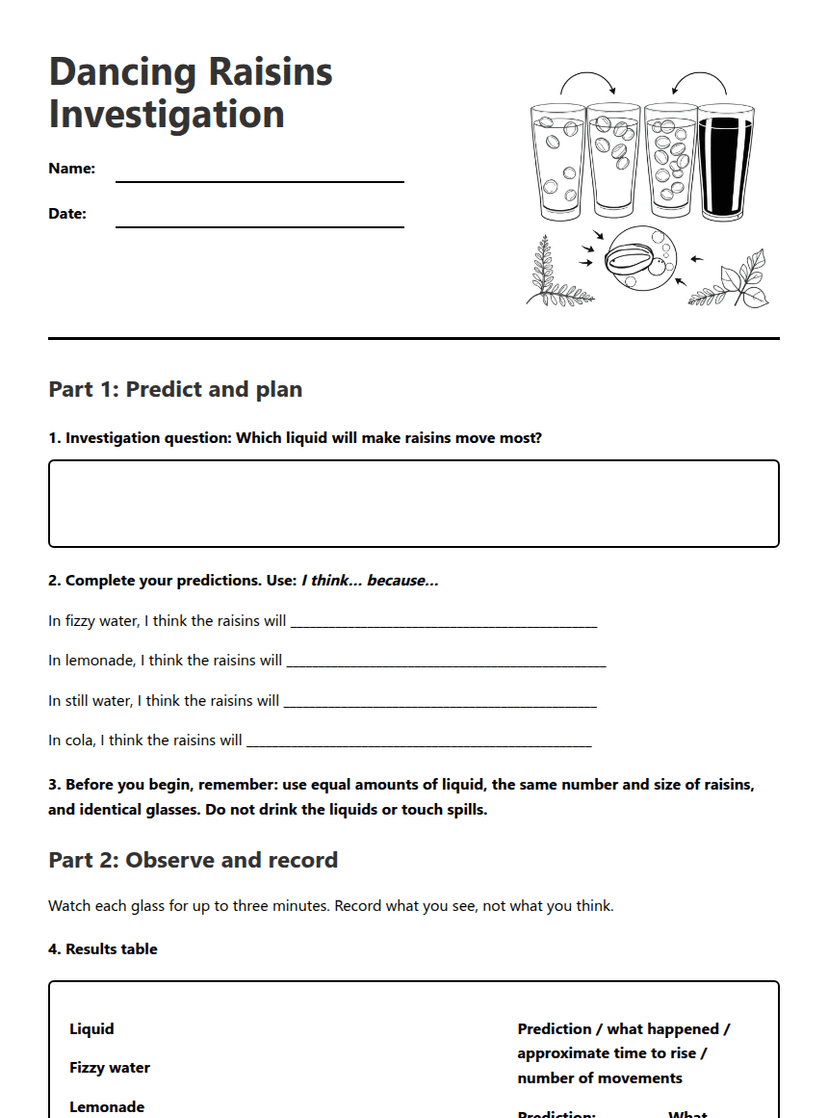
Dancing Raisins Investigation
Free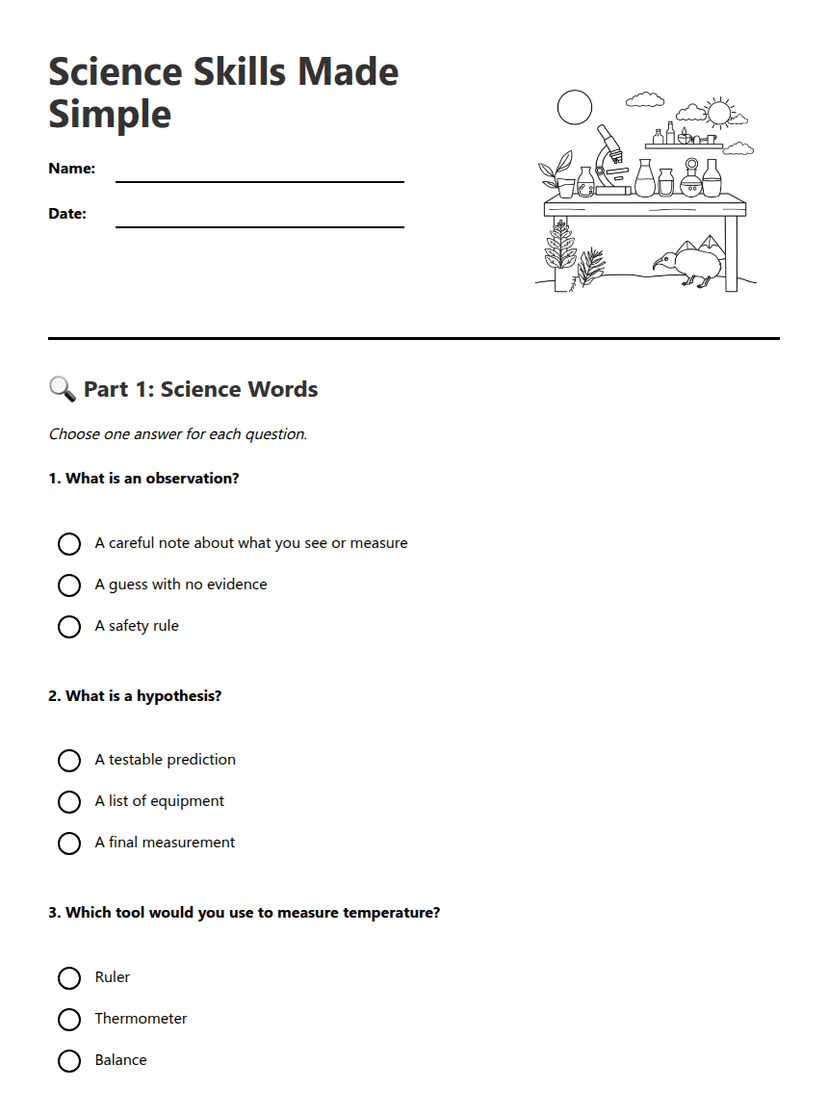
Science Skills Made Simple
Free
Microscope Parts Labeling Worksheet
Free
The Microscope Basics
Free
Ginger Bug Observation Worksheet
Free