ScienceFreePrintable

Chemical Reactions Review

A free science worksheet ready for your classroom. Open in Kuraplan to grab the print-ready PDF, customize it for your students, or generate a fresh version in seconds.
Chemical Reactions Review worksheet preview
Name:Date:

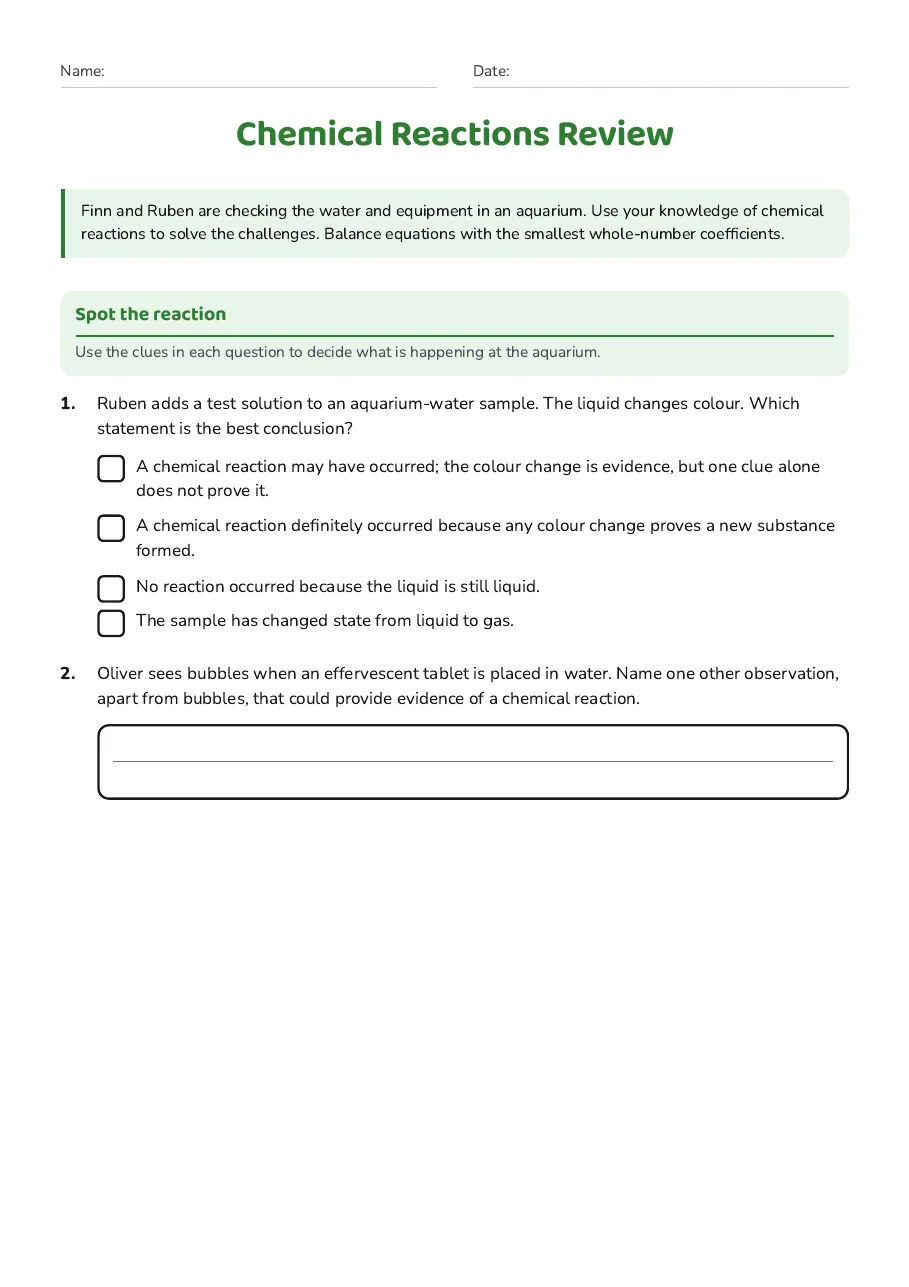
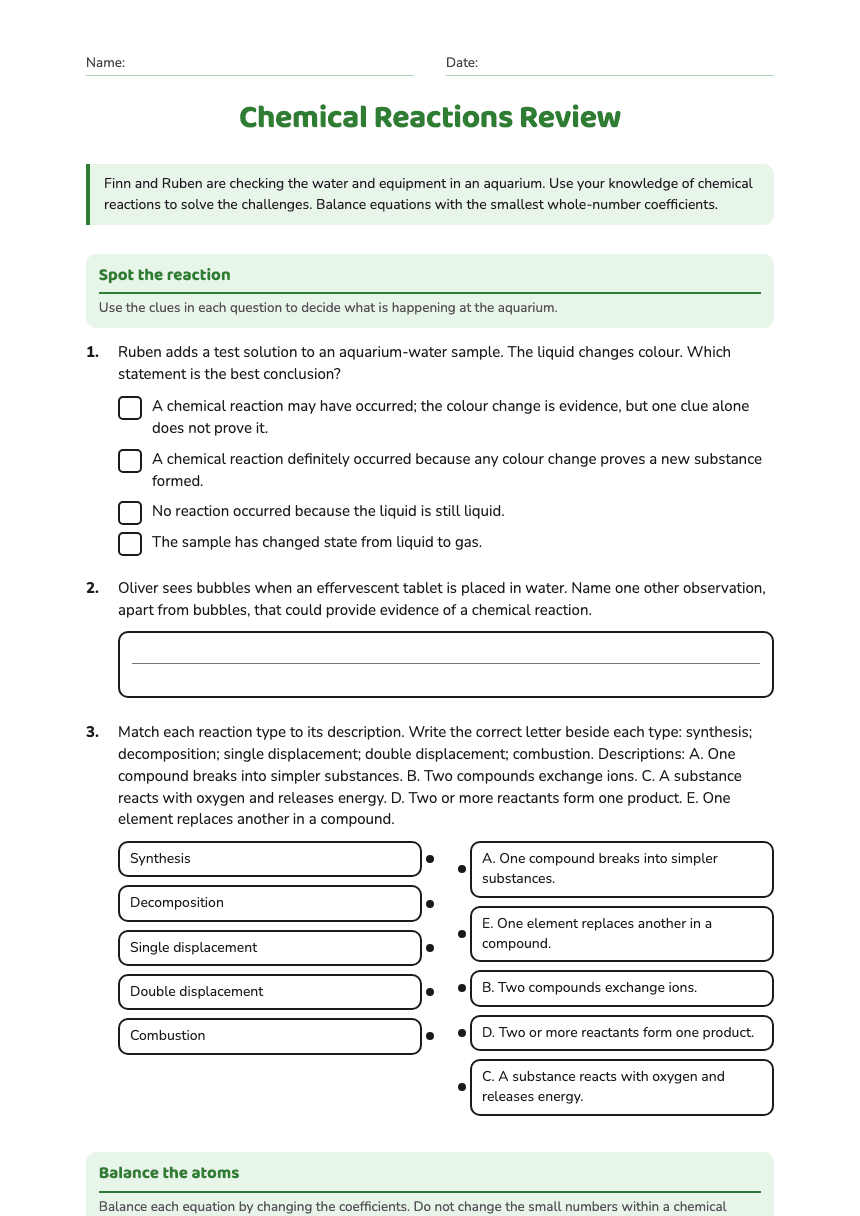
Chemical Reactions Review

Finn and Ruben are checking the water and equipment in an aquarium. Use your knowledge of chemical reactions to solve the challenges. Balance equations with the smallest whole-number coefficients.

Spot the reaction

Use the clues in each question to decide what is happening at the aquarium.

1.Ruben adds a test solution to an aquarium-water sample. The liquid changes colour. Which statement is the best conclusion?
  • A chemical reaction may have occurred; the colour change is evidence, but one clue alone does not prove it.
  • A chemical reaction definitely occurred because any colour change proves a new substance formed.
  • No reaction occurred because the liquid is still liquid.
  • The sample has changed state from liquid to gas.
2.Oliver sees bubbles when an effervescent tablet is placed in water. Name one other observation, apart from bubbles, that could provide evidence of a chemical reaction.
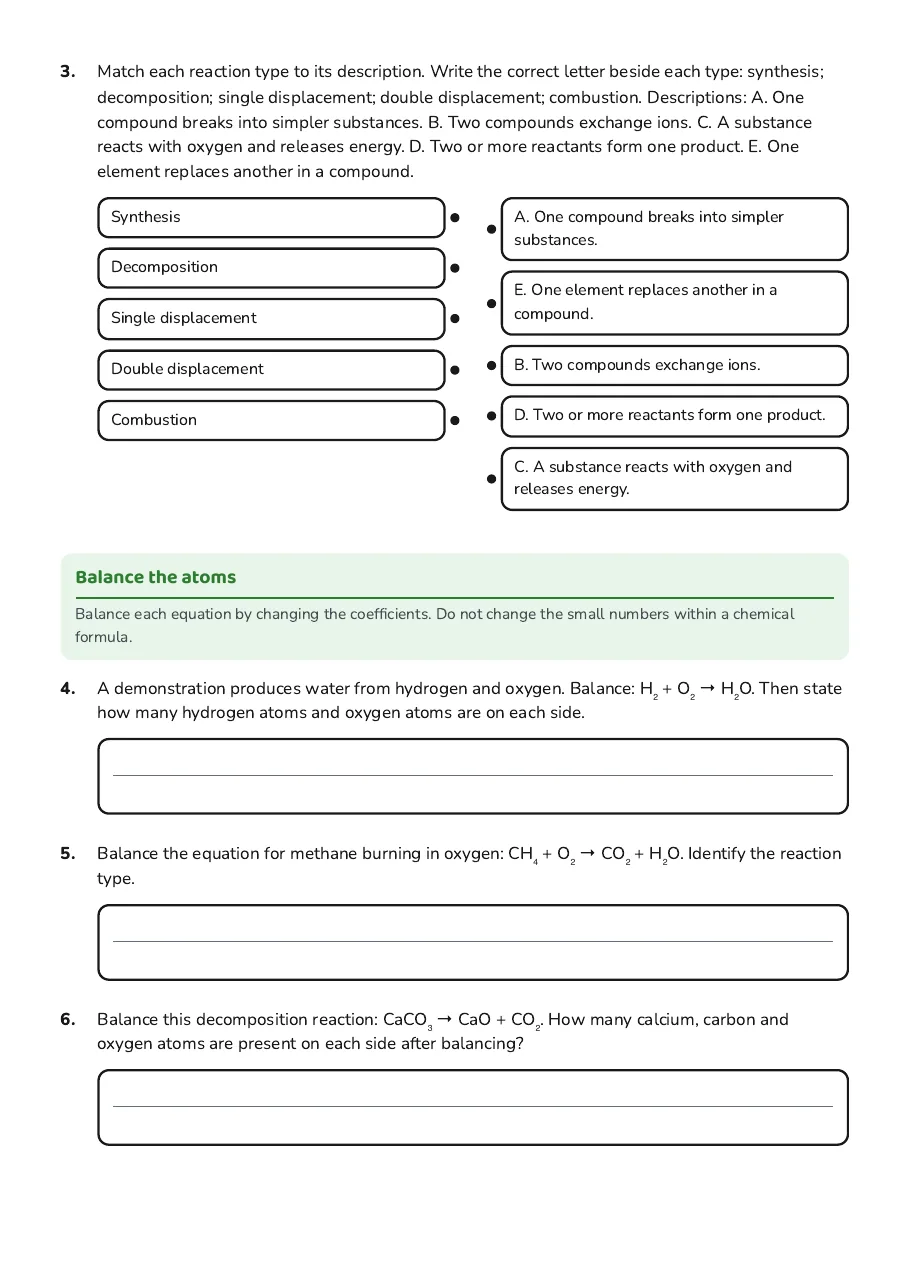
3.Match each reaction type to its description. Write the correct letter beside each type: synthesis; decomposition; single displacement; double displacement; combustion. Descriptions: A. One compound breaks into simpler substances. B. Two compounds exchange ions. C. A substance reacts with oxygen and releases energy. D. Two or more reactants form one product. E. One element replaces another in a compound.
  • Synthesis
  • Decomposition
  • Single displacement
  • Double displacement
  • Combustion
  • A. One compound breaks into simpler substances.
  • E. One element replaces another in a compound.
  • B. Two compounds exchange ions.
  • D. Two or more reactants form one product.
  • C. A substance reacts with oxygen and releases energy.

Balance the atoms

Balance each equation by changing the coefficients. Do not change the small numbers within a chemical formula.

4.A demonstration produces water from hydrogen and oxygen. Balance: H₂ + O₂ → H₂O. Then state how many hydrogen atoms and oxygen atoms are on each side.
5.Balance the equation for methane burning in oxygen: CH₄ + O₂ → CO₂ + H₂O. Identify the reaction type.
6.Balance this decomposition reaction: CaCO₃ → CaO + CO₂. How many calcium, carbon and oxygen atoms are present on each side after balancing?

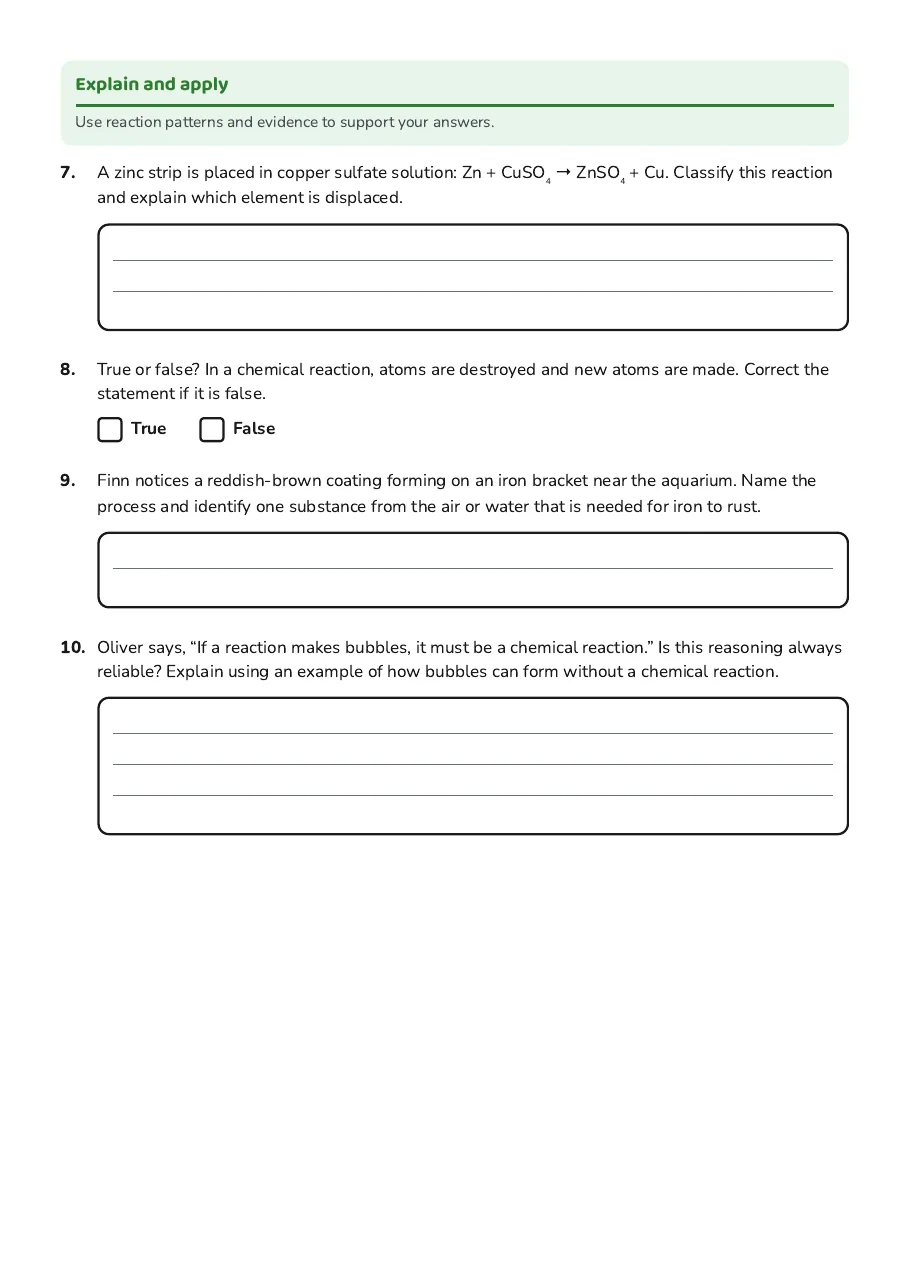
Explain and apply

Use reaction patterns and evidence to support your answers.

7.A zinc strip is placed in copper sulfate solution: Zn + CuSO₄ → ZnSO₄ + Cu. Classify this reaction and explain which element is displaced.
8.True or false? In a chemical reaction, atoms are destroyed and new atoms are made. Correct the statement if it is false.
TrueFalse
9.Finn notices a reddish-brown coating forming on an iron bracket near the aquarium. Name the process and identify one substance from the air or water that is needed for iron to rust.
10.Oliver says, “If a reaction makes bubbles, it must be a chemical reaction.” Is this reasoning always reliable? Explain using an example of how bubbles can form without a chemical reaction.

3 printable pages

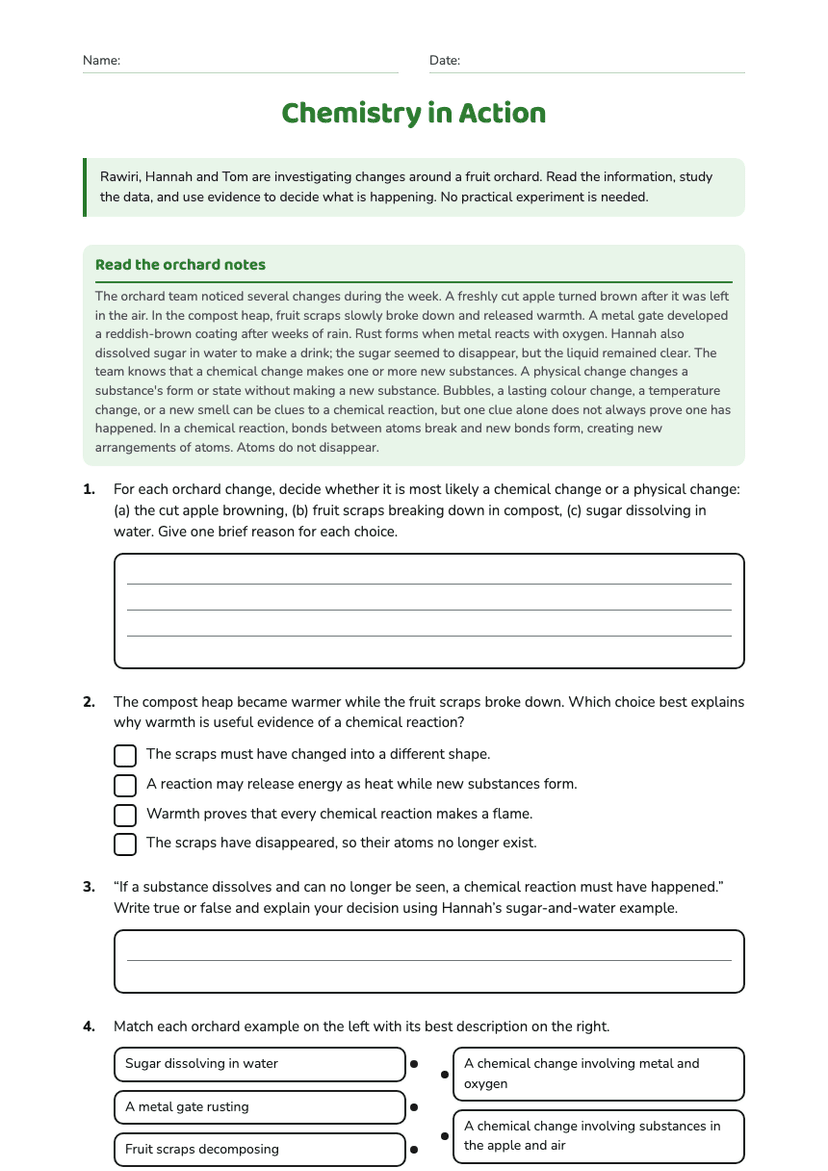
  • Chemical Reactions Review, page 1 of 3: Spot the reaction

    Page 1

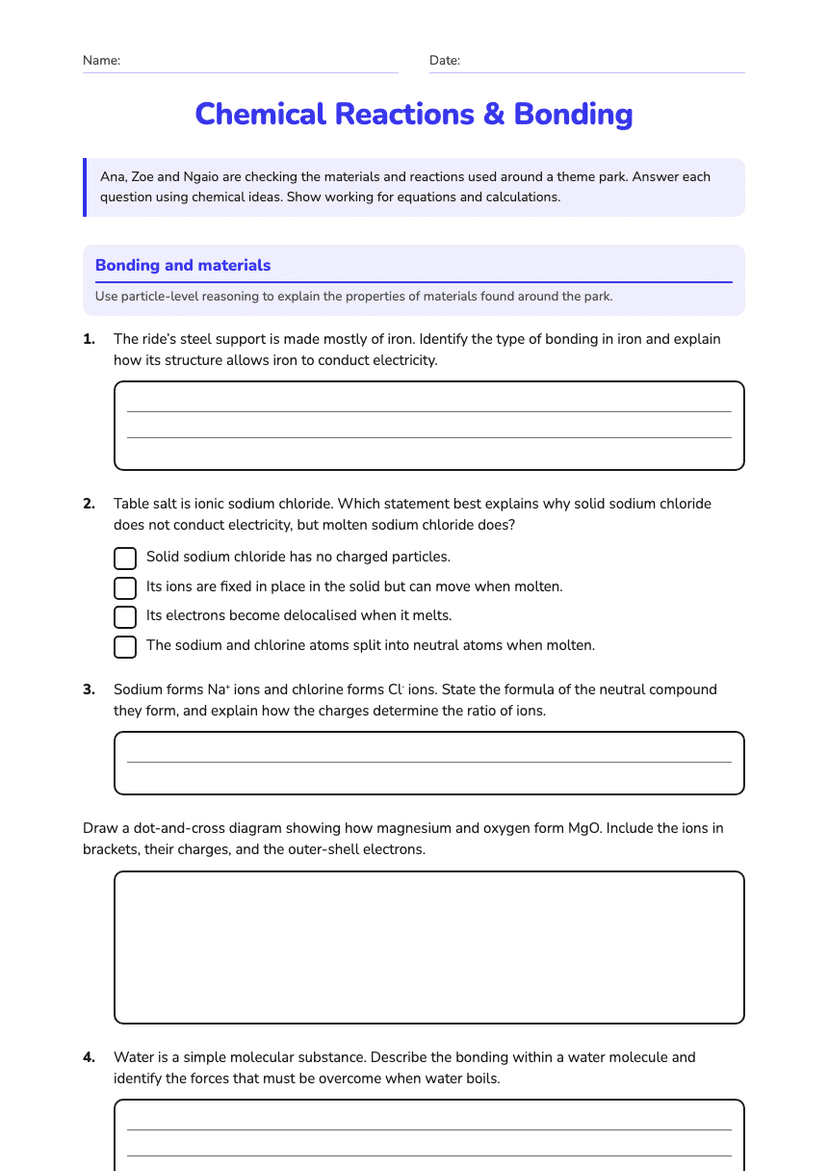
  • Chemical Reactions Review, page 2 of 3: Balance the atoms

    Page 2

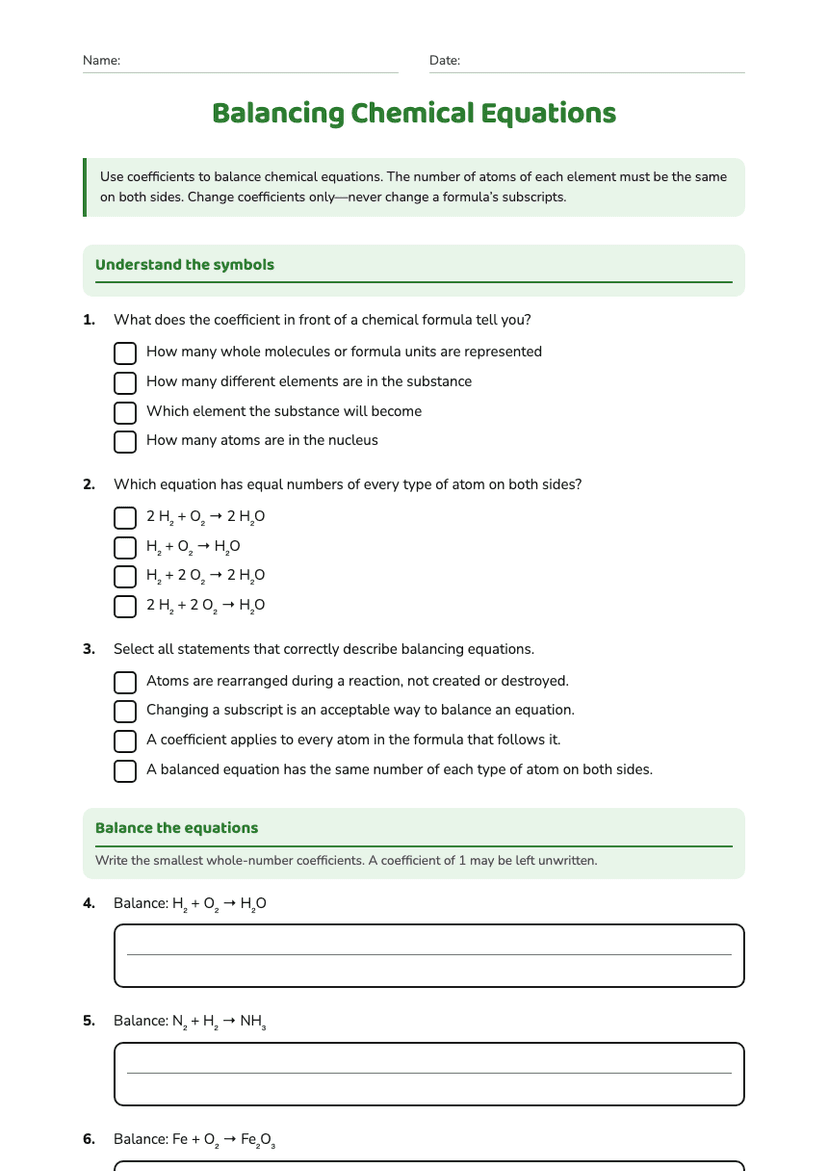
  • Chemical Reactions Review, page 3 of 3: Explain and apply

    Page 3

About This Worksheet

Free in Kuraplan

Sign up free, grab the PDF, and customize it for your class.

Print-Ready

Formatted for standard paper. Clean layout, easy to read.

AI-Generated

Created with Kuraplan's AI, designed for real classroom use.

For Teachers & Parents

Use in classrooms, for homework, tutoring, or homeschool.

Need a custom version of this worksheet?

Kuraplan's AI generates custom worksheets in seconds — differentiated for every learner, aligned to your curriculum.

Generate Custom Worksheets — Free
No credit card Curriculum-aligned Under 60 seconds