ScienceFreePrintable

Thermal Conductivity Investigation

A free science worksheet ready for your classroom. Open in Kuraplan to grab the print-ready PDF, customize it for your students, or generate a fresh version in seconds.
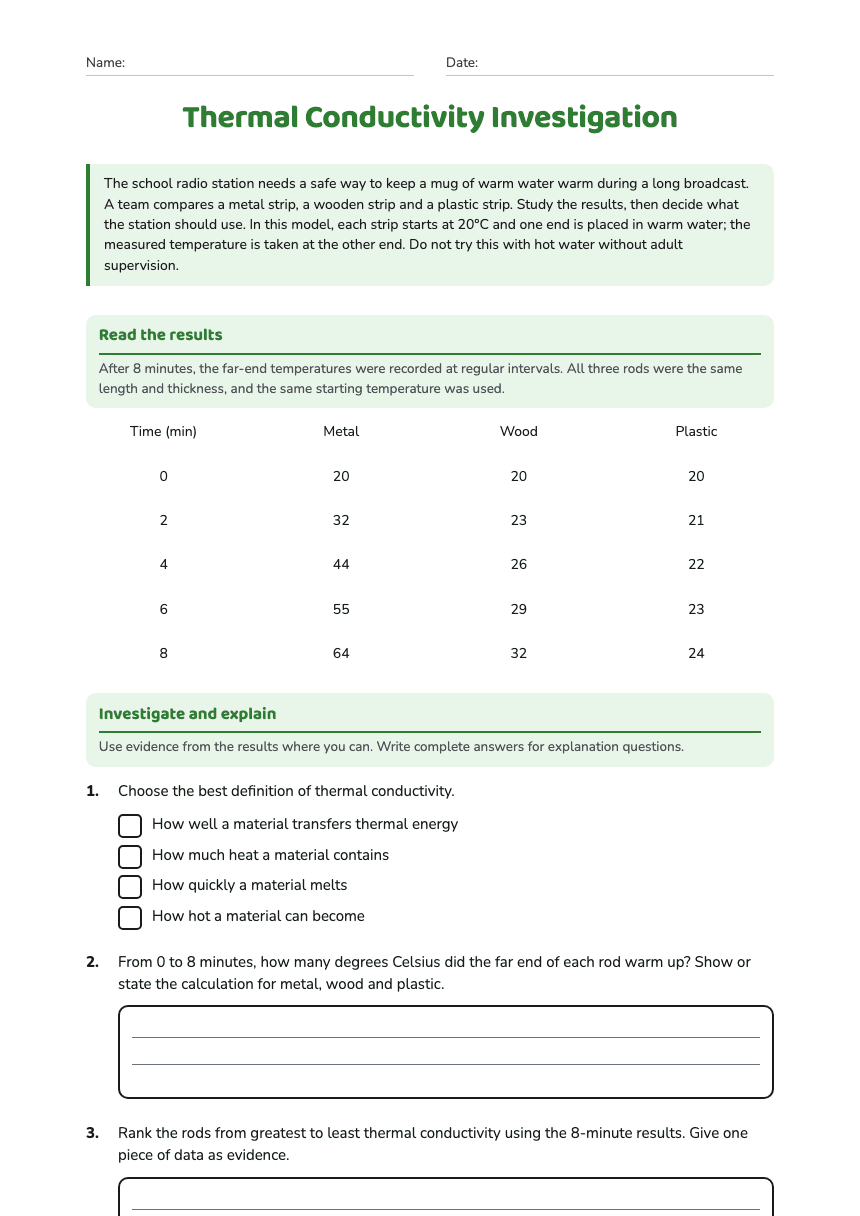
Thermal Conductivity Investigation worksheet preview
Name:Date:

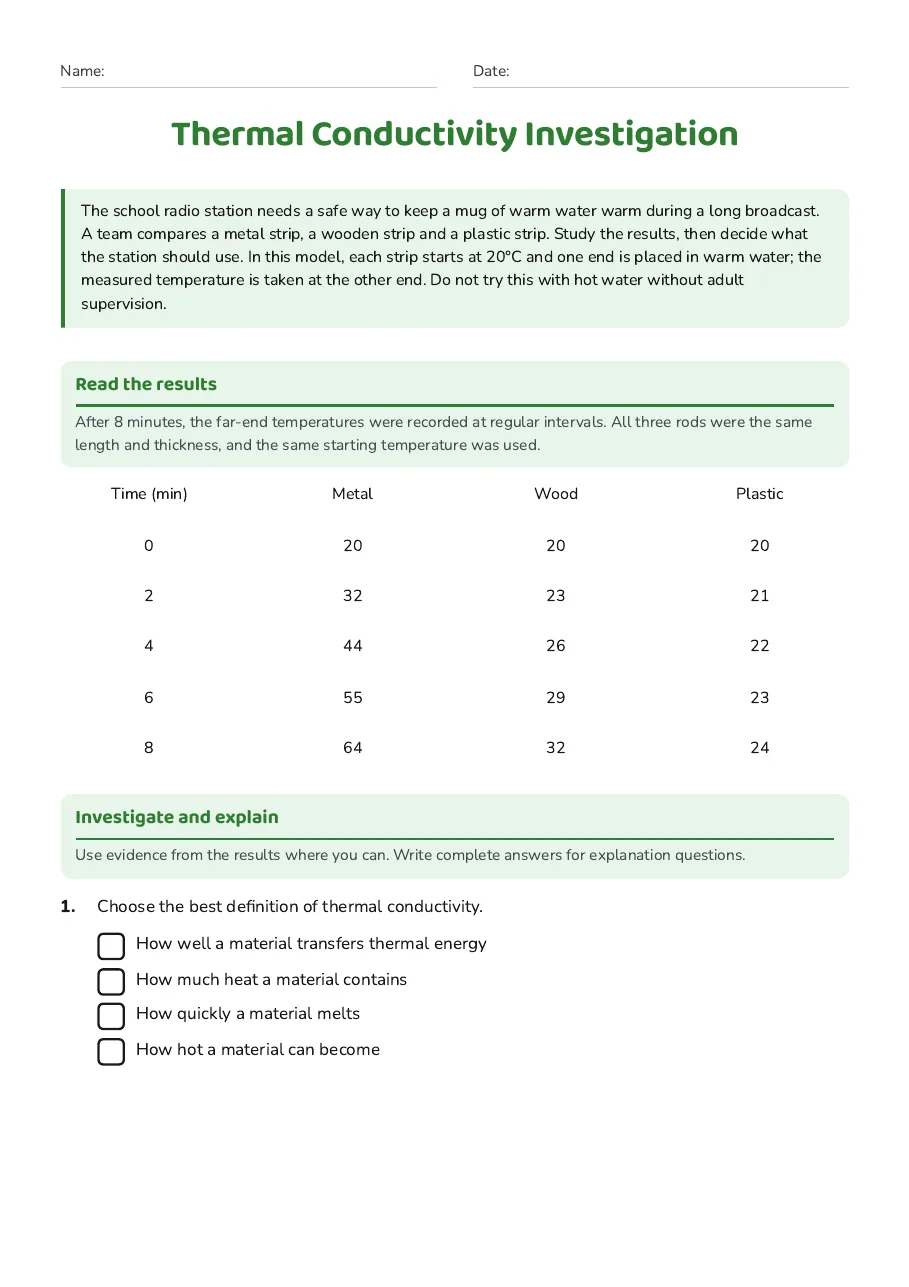
Thermal Conductivity Investigation

The school radio station needs a safe way to keep a mug of warm water warm during a long broadcast. A team compares a metal strip, a wooden strip and a plastic strip. Study the results, then decide what the station should use. In this model, each strip starts at 20°C and one end is placed in warm water; the measured temperature is taken at the other end. Do not try this with hot water without adult supervision.

Read the results

After 8 minutes, the far-end temperatures were recorded at regular intervals. All three rods were the same length and thickness, and the same starting temperature was used.

Time (min)

Metal

Wood

Plastic

0

20

20

20

2

32

23

21

4

44

26

22

6

55

29

23

8

64

32

24

Investigate and explain

Use evidence from the results where you can. Write complete answers for explanation questions.

1.Choose the best definition of thermal conductivity.
  • How well a material transfers thermal energy
  • How much heat a material contains
  • How quickly a material melts
  • How hot a material can become
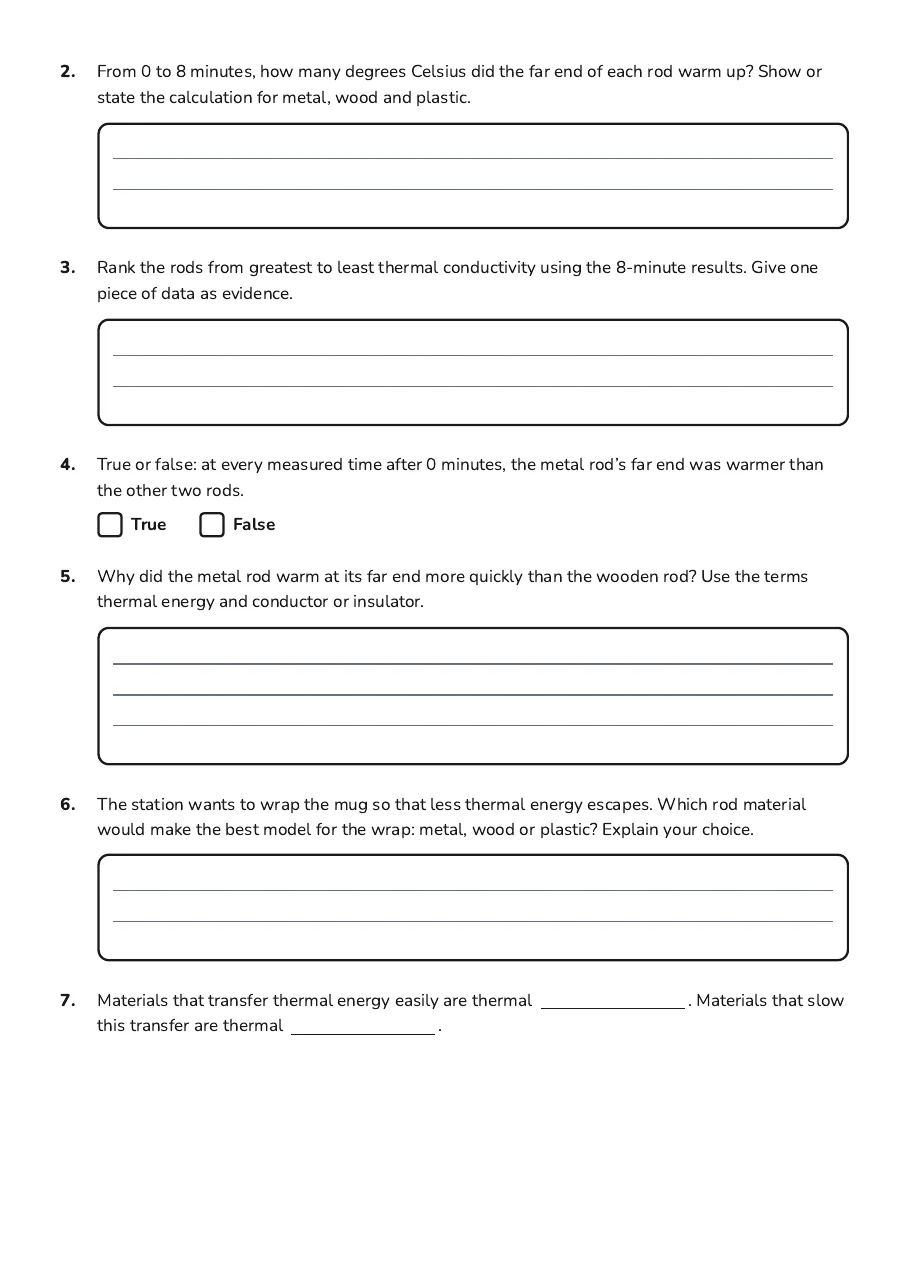
2.From 0 to 8 minutes, how many degrees Celsius did the far end of each rod warm up? Show or state the calculation for metal, wood and plastic.
3.Rank the rods from greatest to least thermal conductivity using the 8-minute results. Give one piece of data as evidence.
4.True or false: at every measured time after 0 minutes, the metal rod’s far end was warmer than the other two rods.
TrueFalse
5.Why did the metal rod warm at its far end more quickly than the wooden rod? Use the terms thermal energy and conductor or insulator.
6.The station wants to wrap the mug so that less thermal energy escapes. Which rod material would make the best model for the wrap: metal, wood or plastic? Explain your choice.
7.Materials that transfer thermal energy easily are thermal . Materials that slow this transfer are thermal .
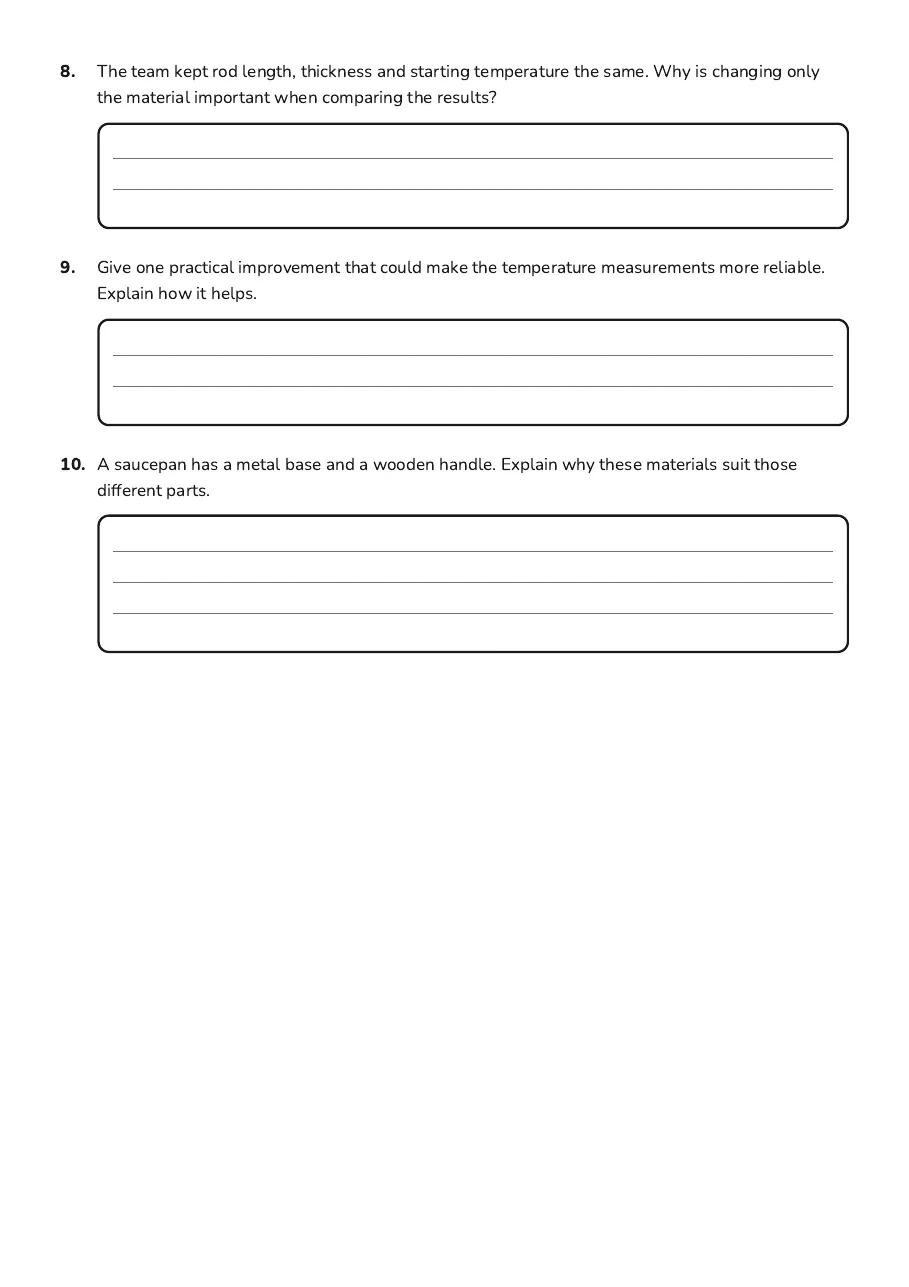
8.The team kept rod length, thickness and starting temperature the same. Why is changing only the material important when comparing the results?
9.Give one practical improvement that could make the temperature measurements more reliable. Explain how it helps.
10.A saucepan has a metal base and a wooden handle. Explain why these materials suit those different parts.

3 printable pages

  • Thermal Conductivity Investigation, page 1 of 3: Read the results, Investigate and explain

    Page 1

  • Thermal Conductivity Investigation, page 2 of 3: 2. From 0 to 8 minutes, how many degrees Celsius did the far end of each rod warm up?…

    Page 2

  • Thermal Conductivity Investigation, page 3 of 3: 8. The team kept rod length, thickness and starting temperature the same. Why is changing…

    Page 3

About This Worksheet

Free in Kuraplan

Sign up free, grab the PDF, and customize it for your class.

Print-Ready

Formatted for standard paper. Clean layout, easy to read.

AI-Generated

Created with Kuraplan's AI, designed for real classroom use.

For Teachers & Parents

Use in classrooms, for homework, tutoring, or homeschool.

Need a custom version of this worksheet?

Kuraplan's AI generates custom worksheets in seconds — differentiated for every learner, aligned to your curriculum.

Generate Custom Worksheets — Free
No credit card Curriculum-aligned Under 60 seconds