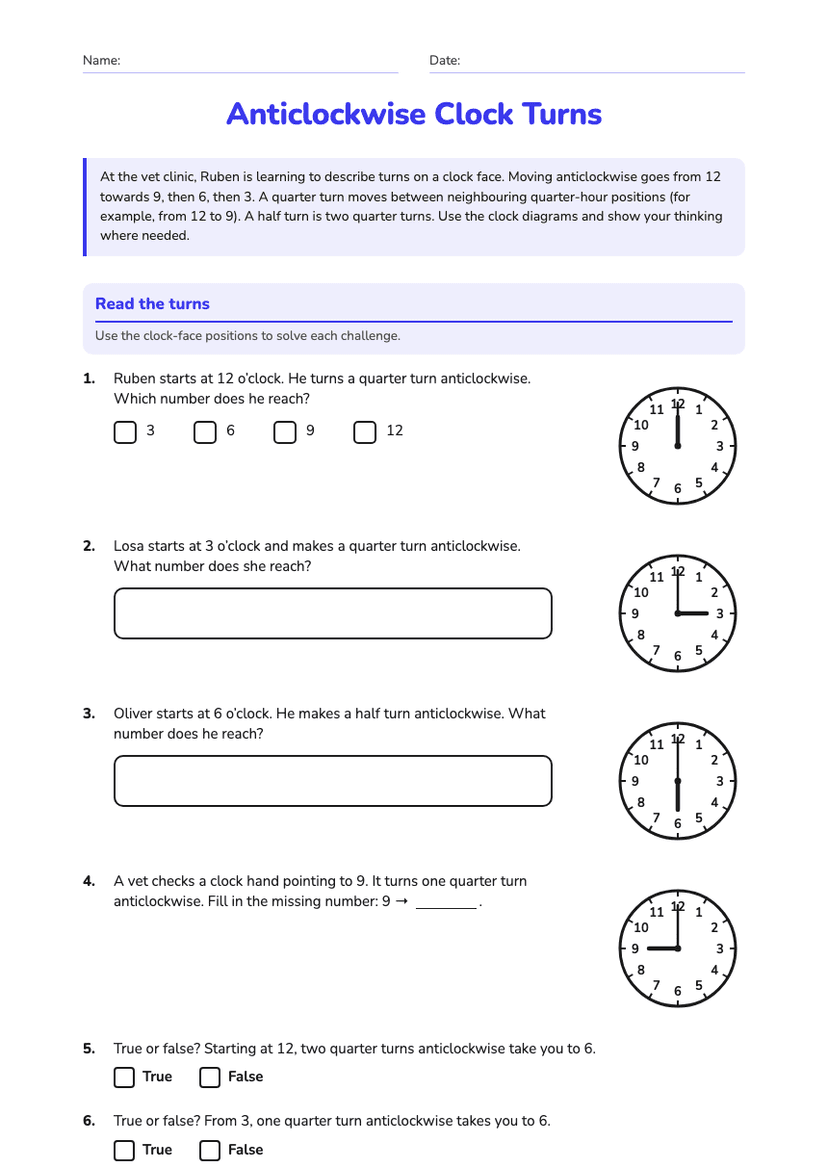
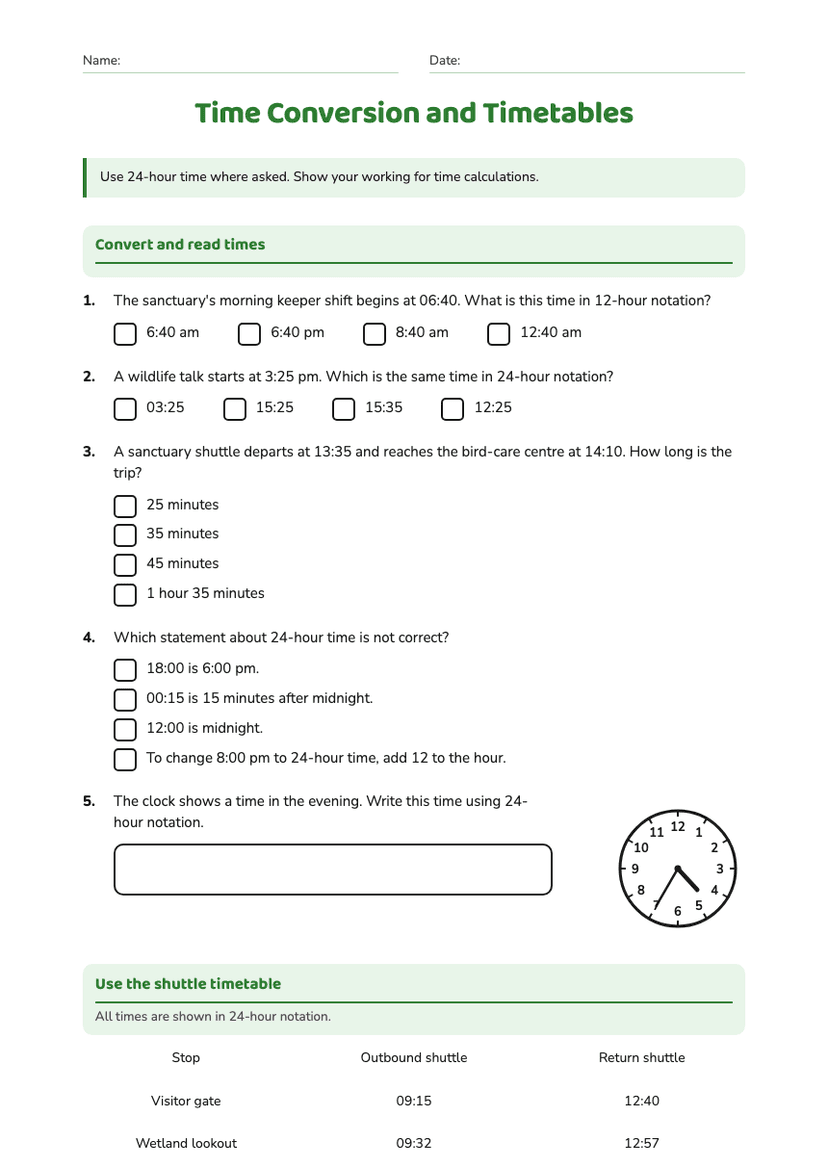
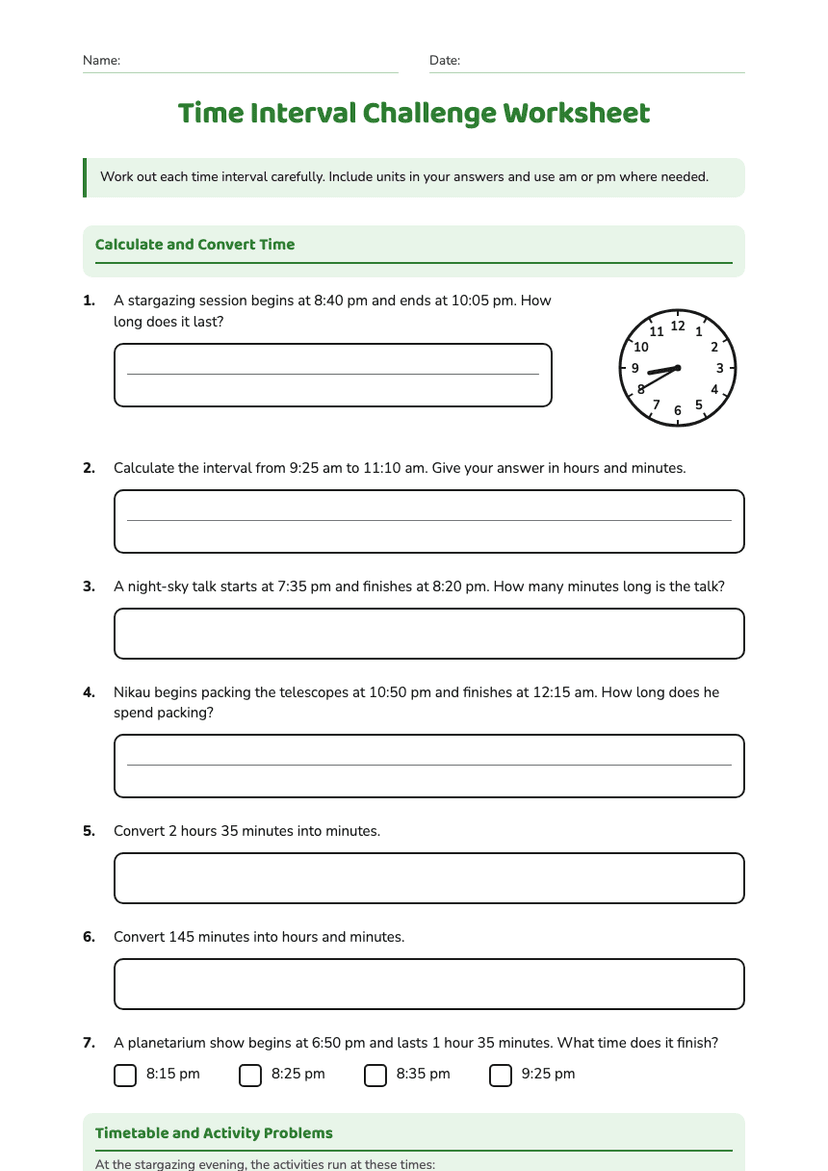
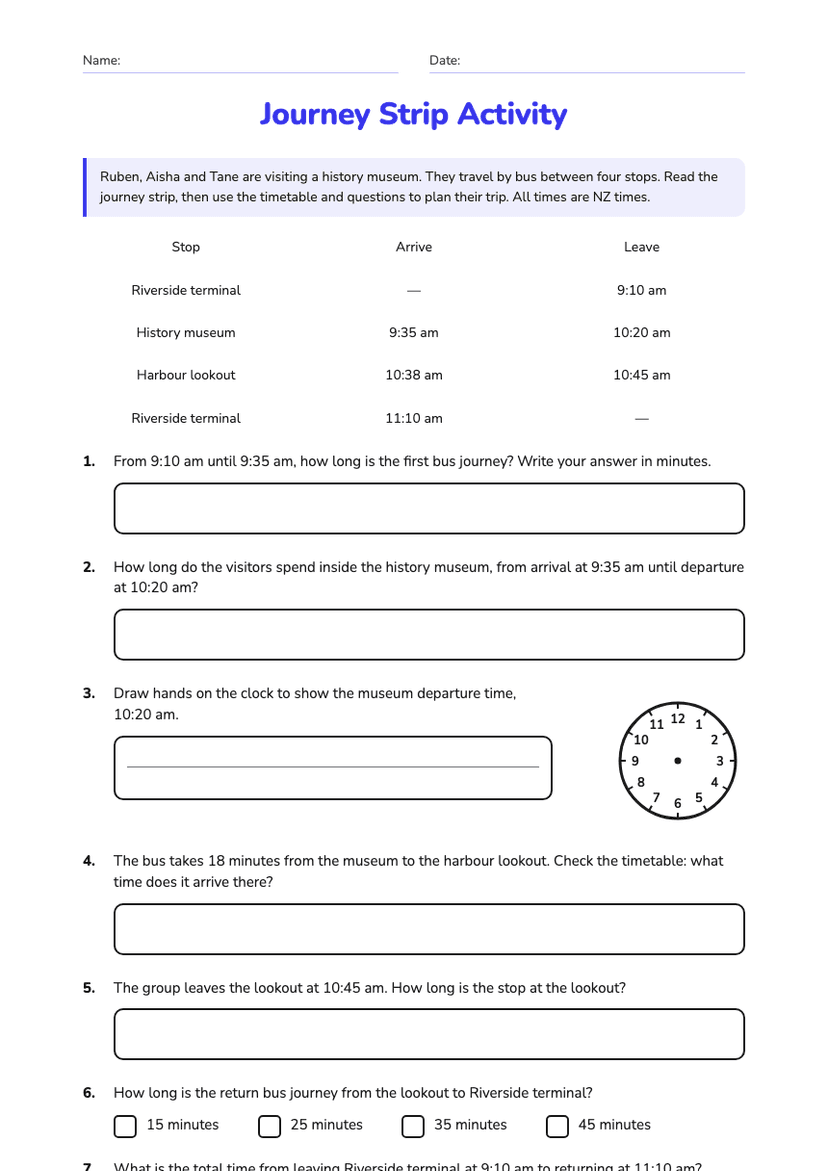
MathsFreePrintable
Clock Parts and Functions
A free maths worksheet ready for your classroom. Open in Kuraplan to grab the print-ready PDF, customize it for your students, or generate a fresh version in seconds.
Name:Date:
Clock Parts and Functions
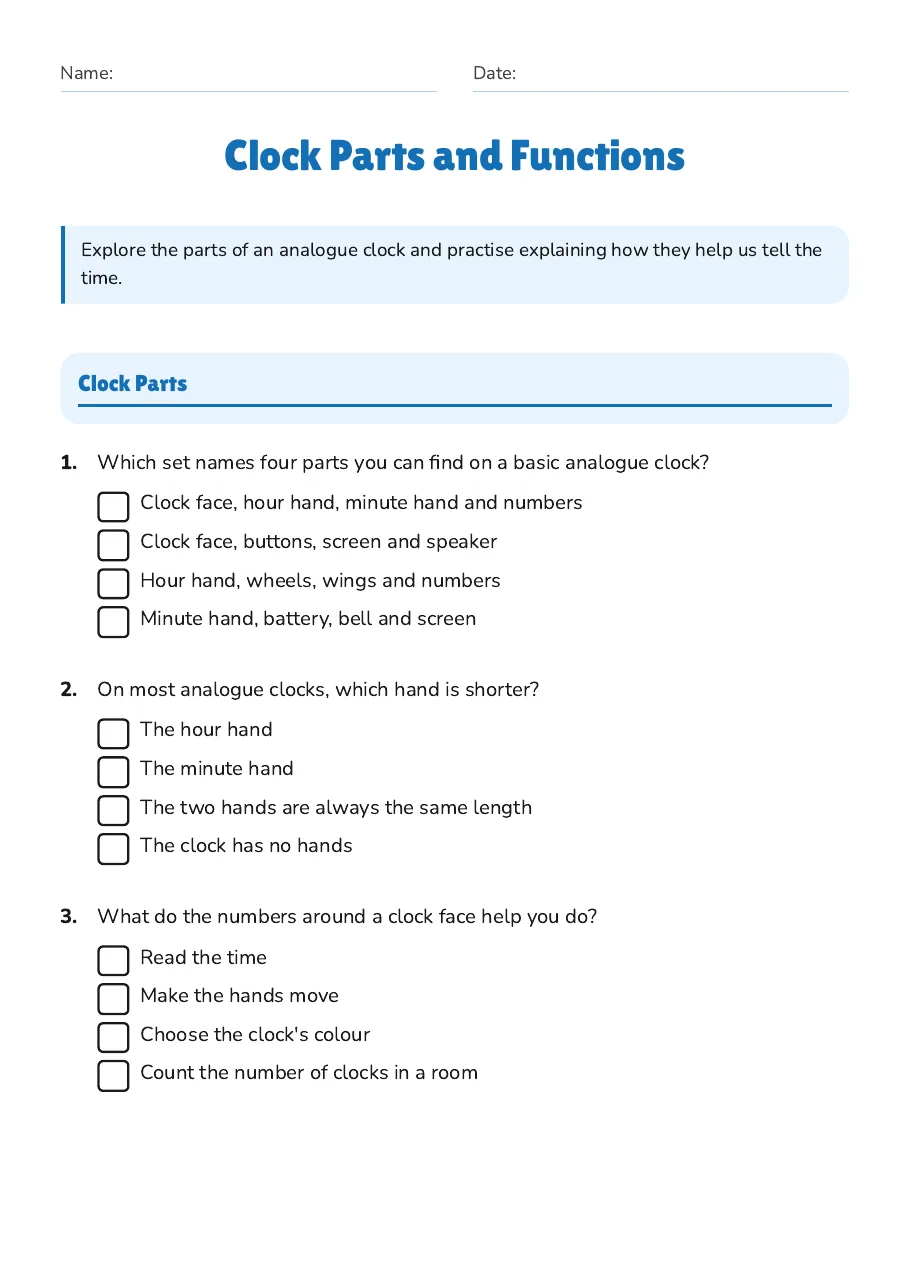
Explore the parts of an analogue clock and practise explaining how they help us tell the time.
Clock Parts
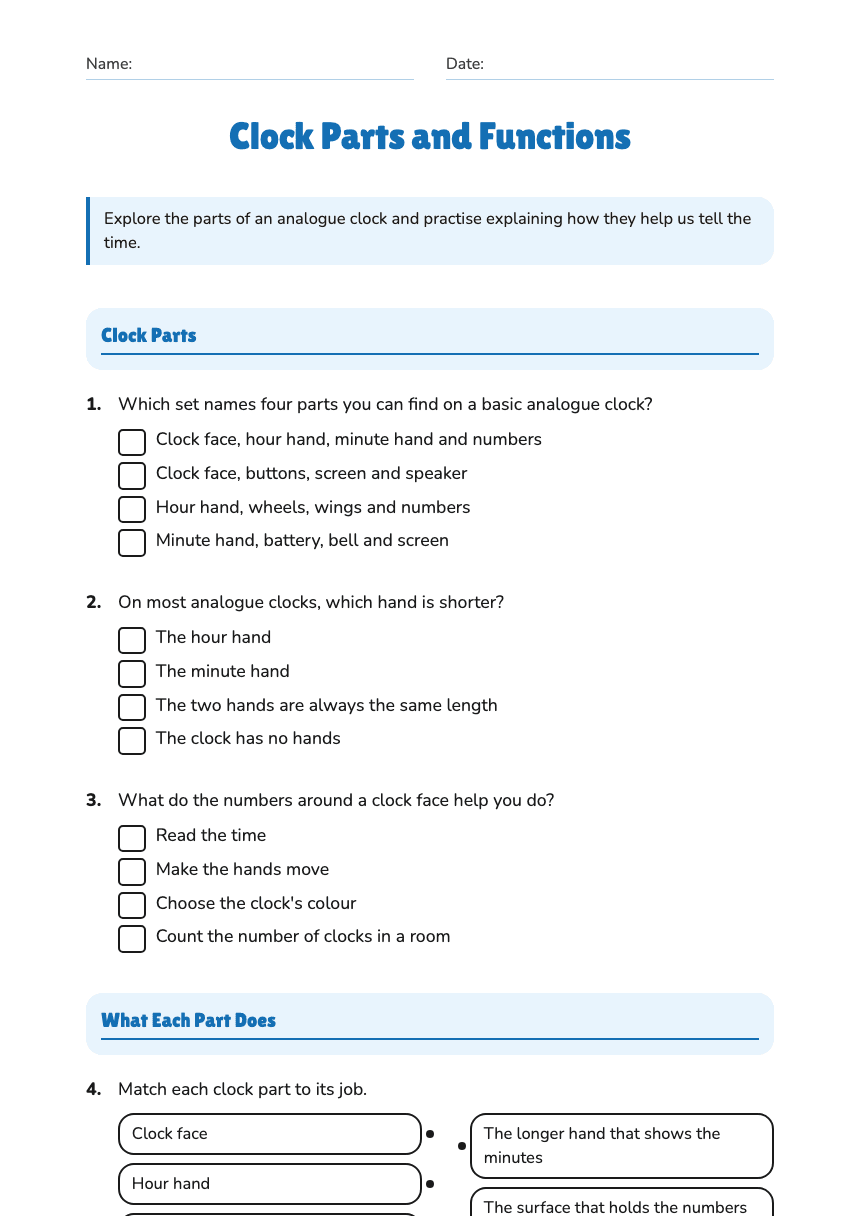
1.Which set names four parts you can find on a basic analogue clock?
- Clock face, hour hand, minute hand and numbers
- Clock face, buttons, screen and speaker
- Hour hand, wheels, wings and numbers
- Minute hand, battery, bell and screen
2.On most analogue clocks, which hand is shorter?
- The hour hand
- The minute hand
- The two hands are always the same length
- The clock has no hands
3.What do the numbers around a clock face help you do?
- Read the time
- Make the hands move
- Choose the clock's colour
- Count the number of clocks in a room
What Each Part Does
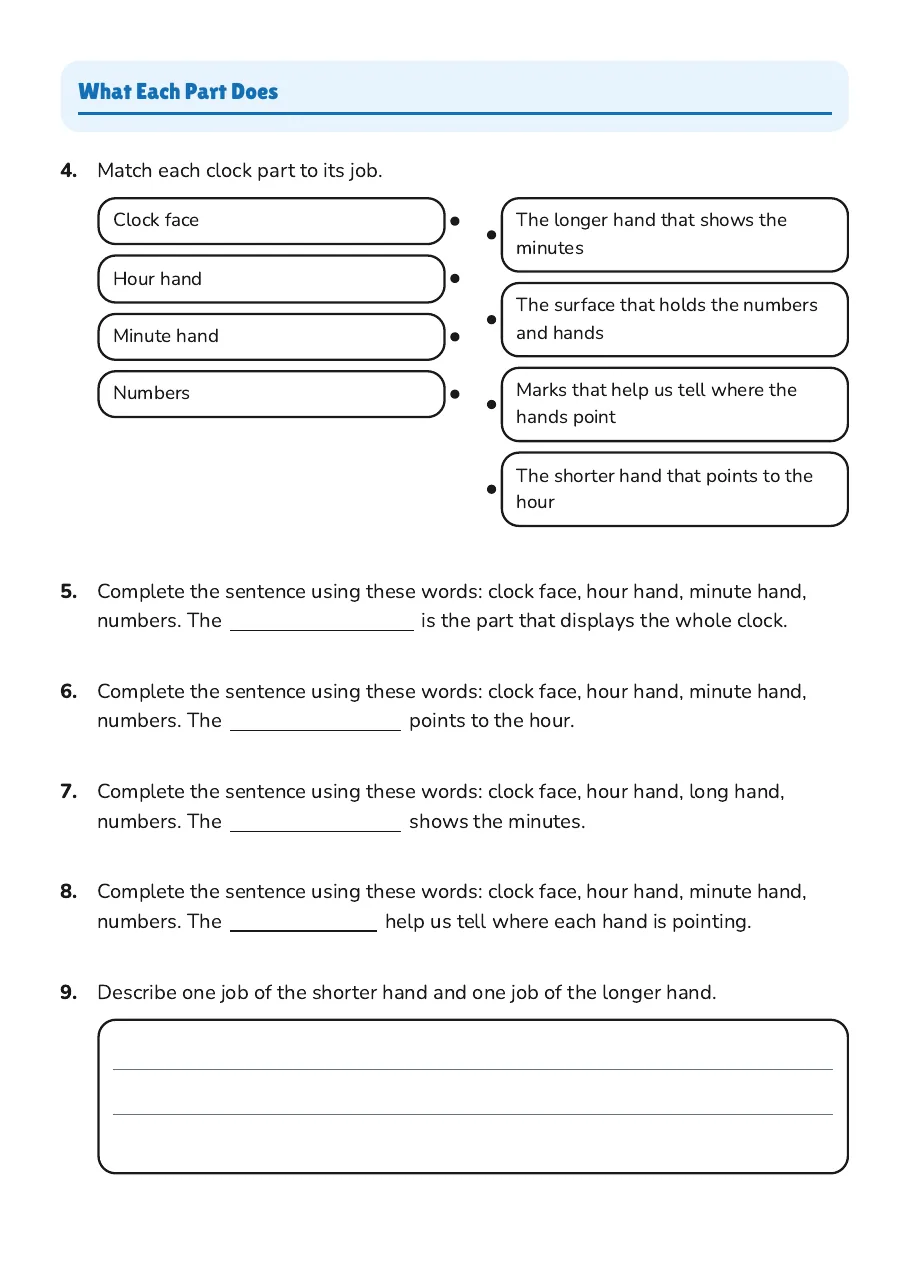
4.Match each clock part to its job.
- Clock face
- Hour hand
- Minute hand
- Numbers
- The longer hand that shows the minutes
- The surface that holds the numbers and hands
- Marks that help us tell where the hands point
- The shorter hand that points to the hour
5.Complete the sentence using these words: clock face, hour hand, minute hand, numbers. The is the part that displays the whole clock.
6.Complete the sentence using these words: clock face, hour hand, minute hand, numbers. The points to the hour.
7.Complete the sentence using these words: clock face, hour hand, long hand, numbers. The shows the minutes.
8.Complete the sentence using these words: clock face, hour hand, minute hand, numbers. The help us tell where each hand is pointing.
9.Describe one job of the shorter hand and one job of the longer hand.
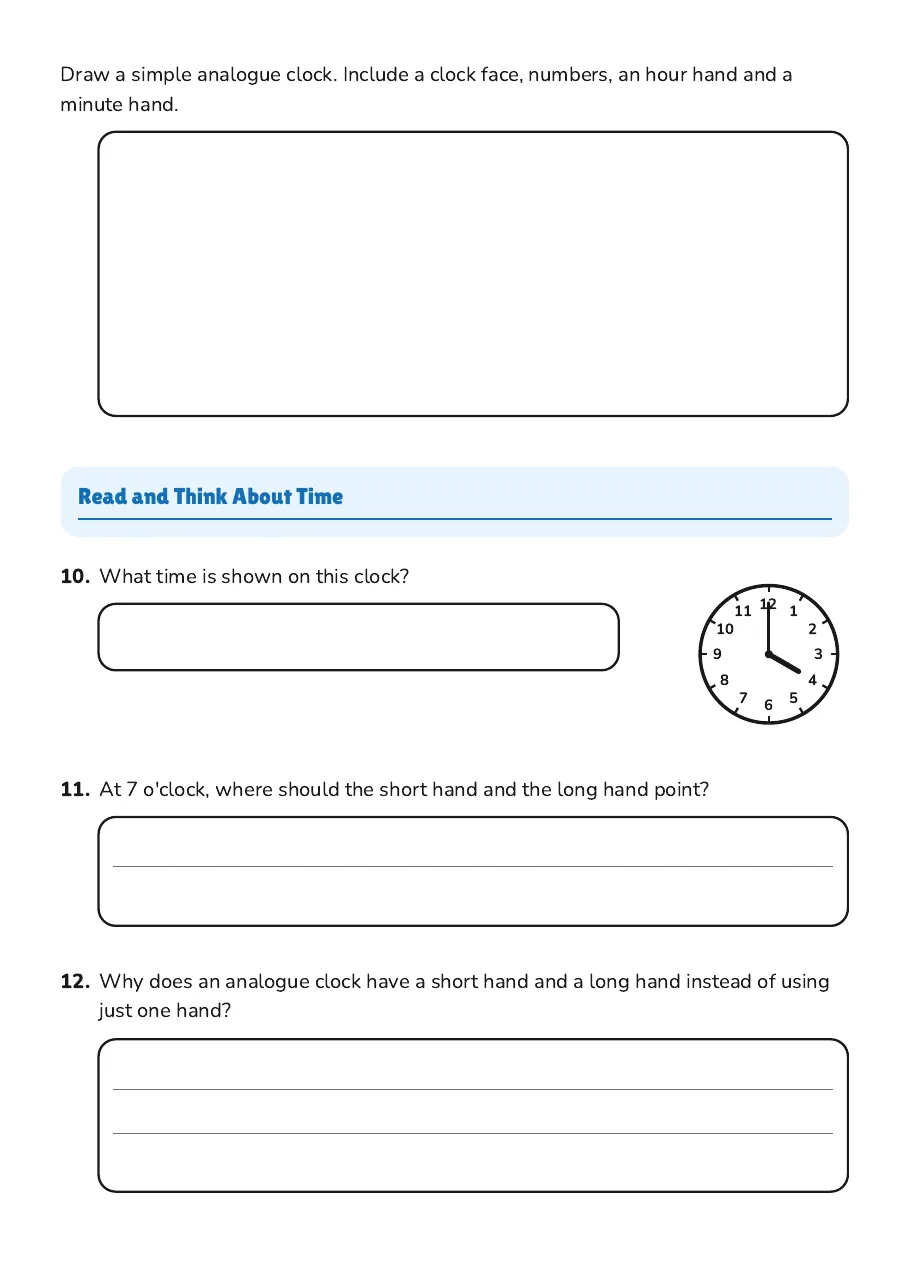
Draw a simple analogue clock. Include a clock face, numbers, an hour hand and a minute hand.
Read and Think About Time
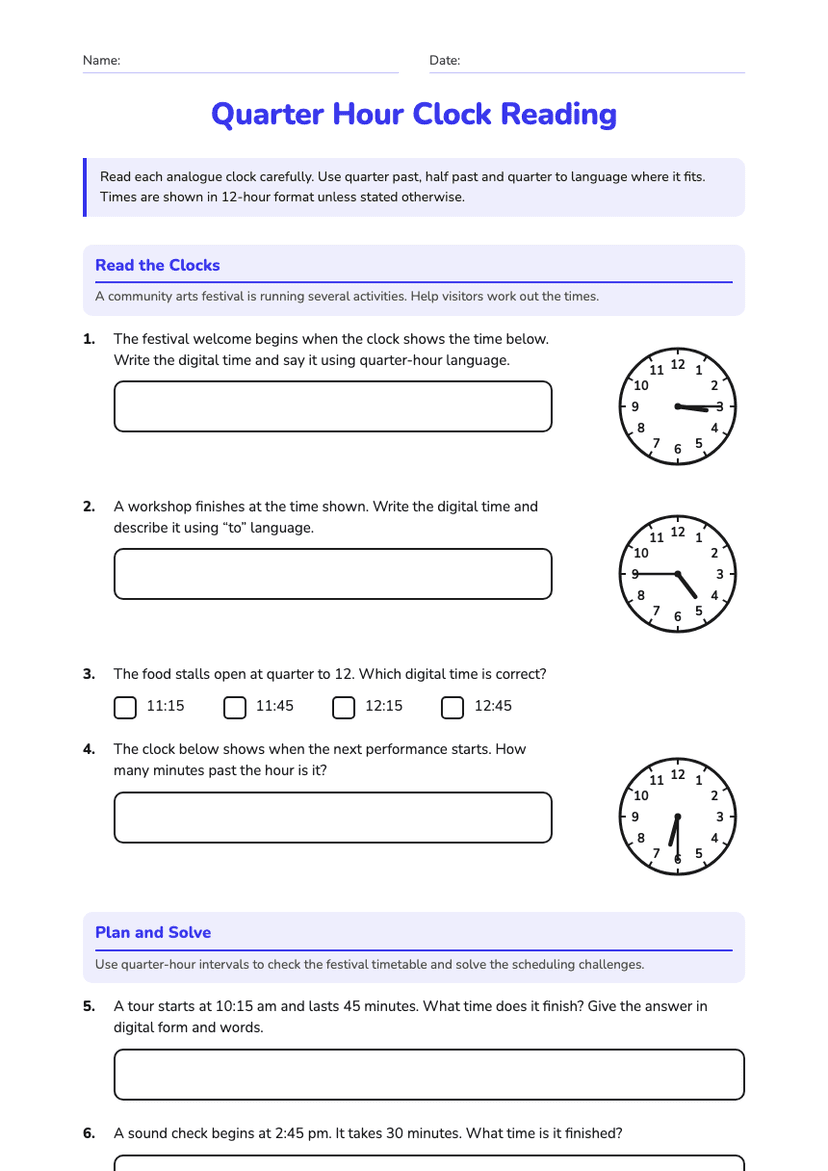
10.What time is shown on this clock?
11.At 7 o'clock, where should the short hand and the long hand point?
12.Why does an analogue clock have a short hand and a long hand instead of using just one hand?
13.Name three places where someone might see an analogue clock.
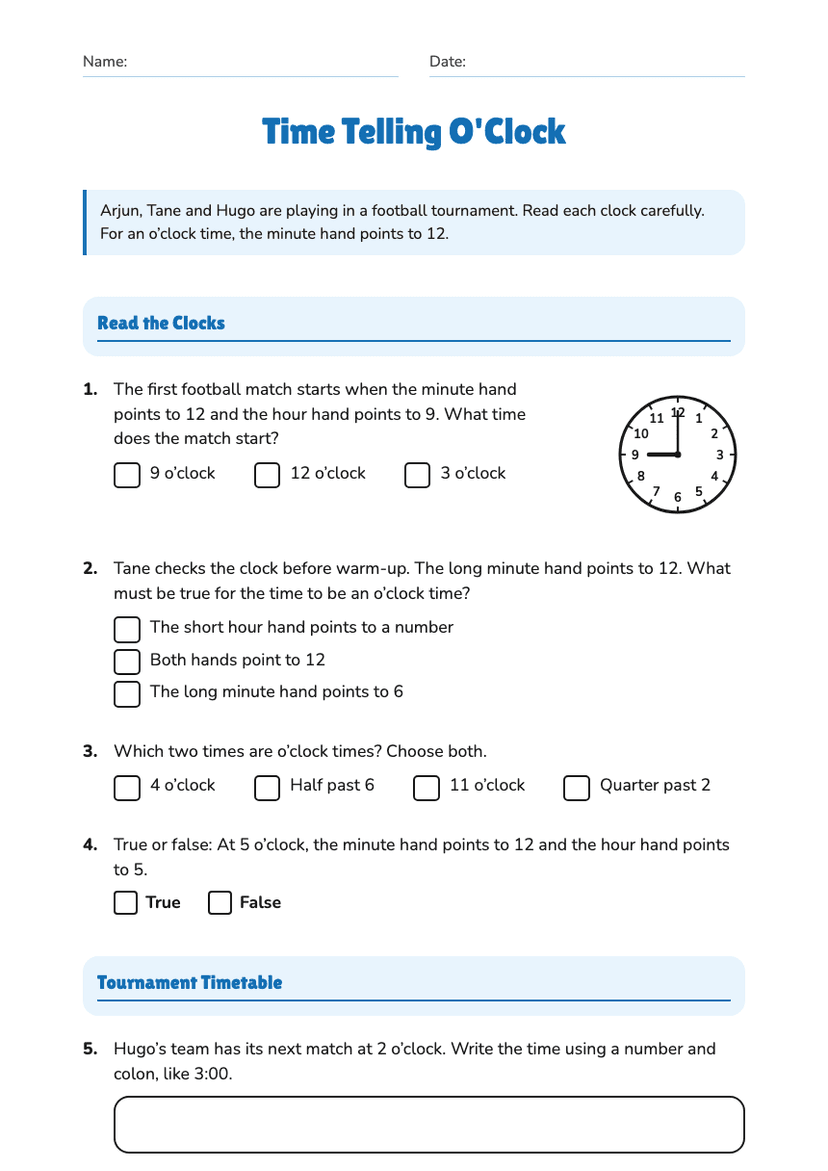
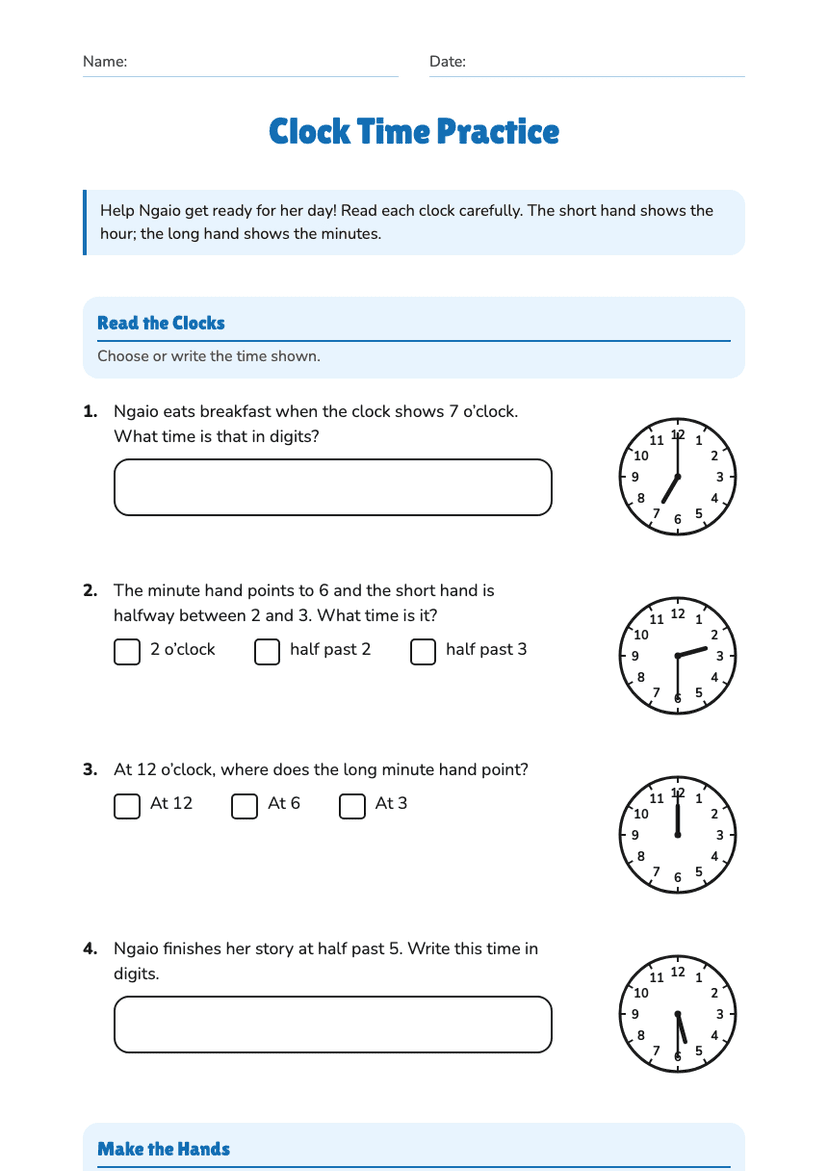
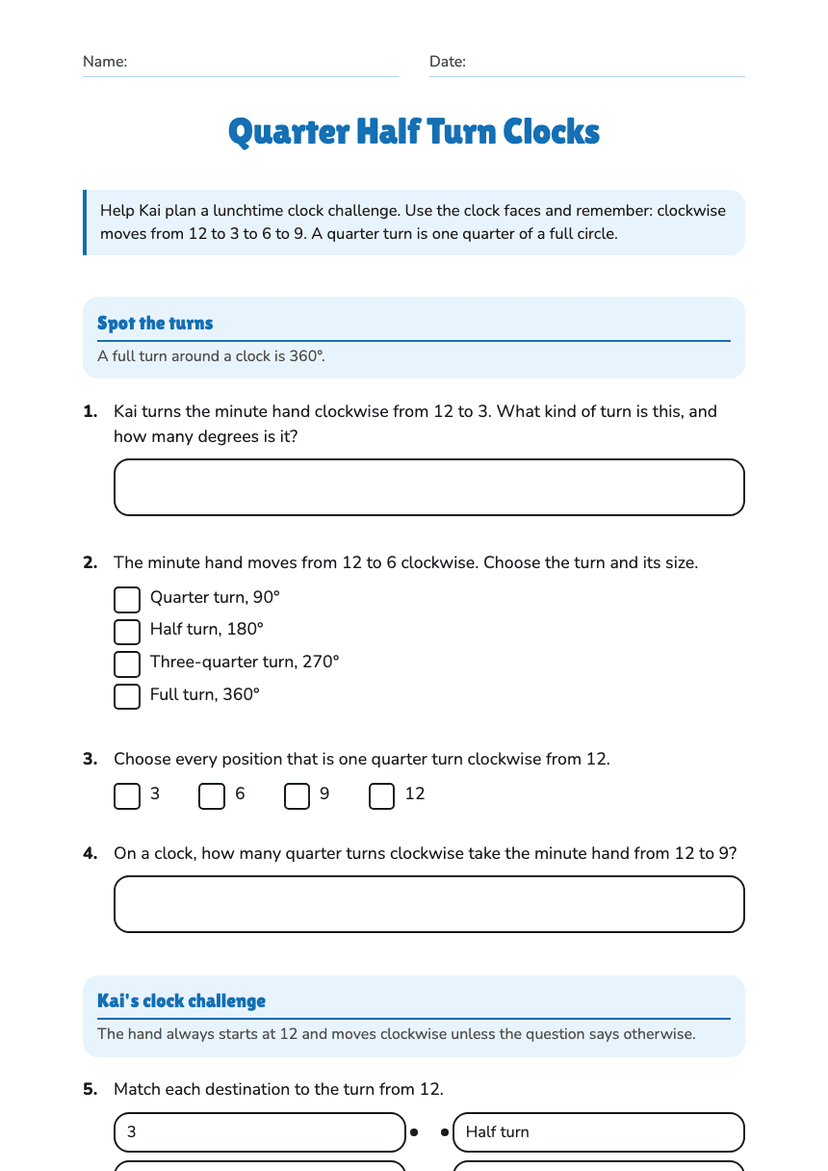
4 printable pages
Page 1
Page 2
Page 3

Page 4
About This Worksheet
Free in Kuraplan
Sign up free, grab the PDF, and customize it for your class.
Print-Ready
Formatted for standard paper. Clean layout, easy to read.
AI-Generated
Created with Kuraplan's AI, designed for real classroom use.
For Teachers & Parents
Use in classrooms, for homework, tutoring, or homeschool.
Need a custom version of this worksheet?
Kuraplan's AI generates custom worksheets in seconds — differentiated for every learner, aligned to your curriculum.
Generate Custom Worksheets — Free No credit card Curriculum-aligned Under 60 seconds