Social SciencesFreePrintable

Comparing Historical Epidemics

A free social sciences worksheet ready for your classroom. Open in Kuraplan to grab the print-ready PDF, customize it for your students, or generate a fresh version in seconds.
Comparing Historical Epidemics worksheet preview
Name:Date:

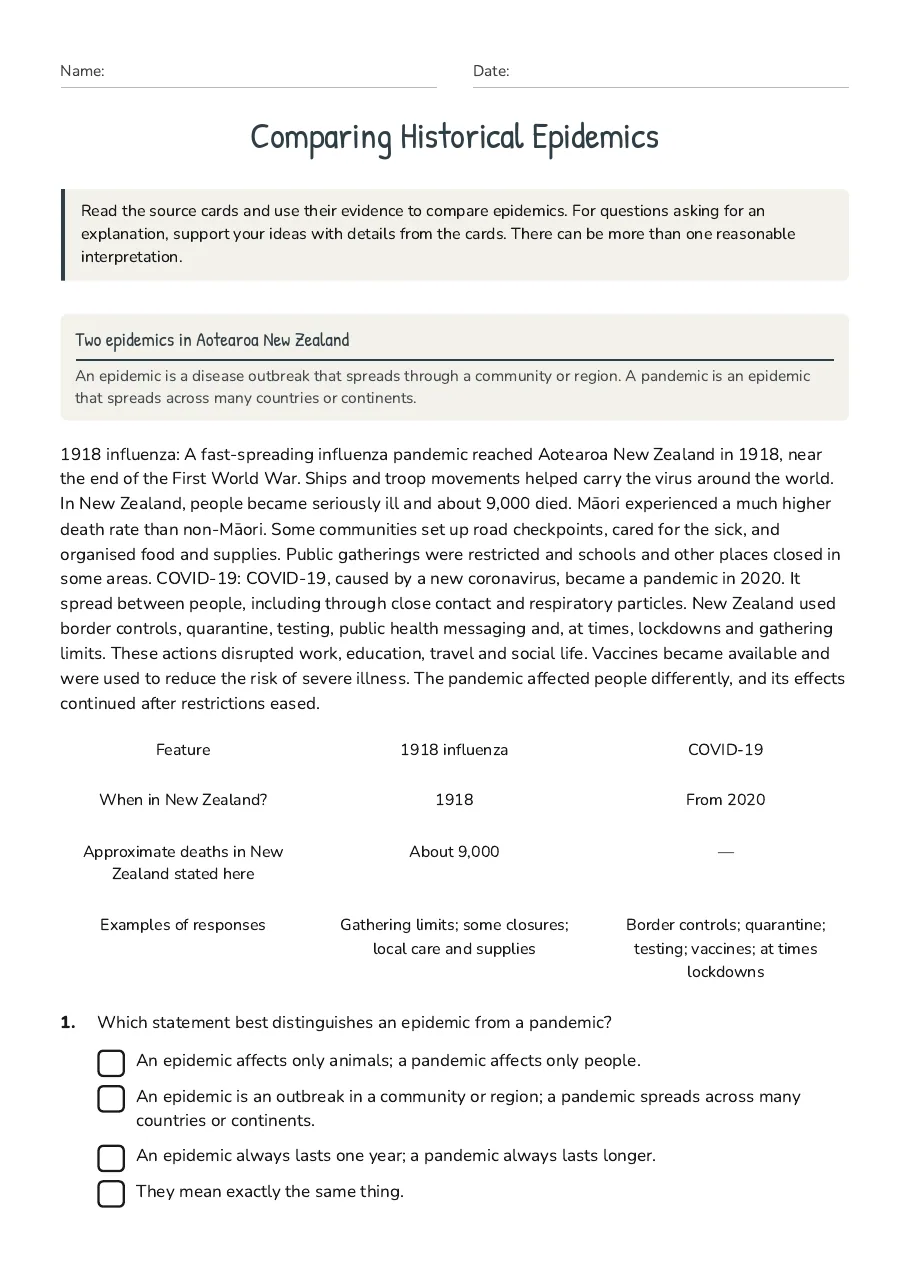
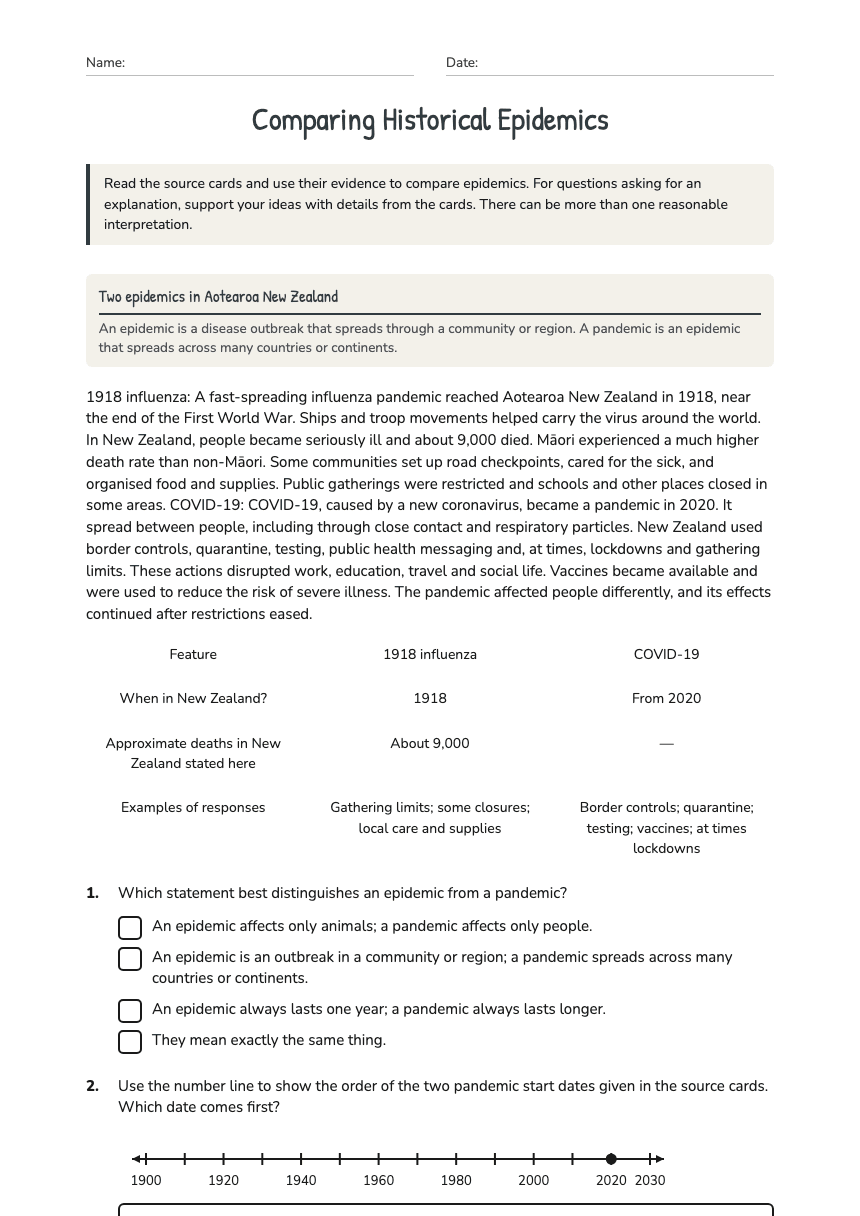
Comparing Historical Epidemics

Read the source cards and use their evidence to compare epidemics. For questions asking for an explanation, support your ideas with details from the cards. There can be more than one reasonable interpretation.

Two epidemics in Aotearoa New Zealand

An epidemic is a disease outbreak that spreads through a community or region. A pandemic is an epidemic that spreads across many countries or continents.

1918 influenza: A fast-spreading influenza pandemic reached Aotearoa New Zealand in 1918, near the end of the First World War. Ships and troop movements helped carry the virus around the world. In New Zealand, people became seriously ill and about 9,000 died. Māori experienced a much higher death rate than non-Māori. Some communities set up road checkpoints, cared for the sick, and organised food and supplies. Public gatherings were restricted and schools and other places closed in some areas. COVID-19: COVID-19, caused by a new coronavirus, became a pandemic in 2020. It spread between people, including through close contact and respiratory particles. New Zealand used border controls, quarantine, testing, public health messaging and, at times, lockdowns and gathering limits. These actions disrupted work, education, travel and social life. Vaccines became available and were used to reduce the risk of severe illness. The pandemic affected people differently, and its effects continued after restrictions eased.

Feature

1918 influenza

COVID-19

When in New Zealand?

1918

From 2020

Approximate deaths in New Zealand stated here

About 9,000

—

Examples of responses

Gathering limits; some closures; local care and supplies

Border controls; quarantine; testing; vaccines; at times lockdowns

1.Which statement best distinguishes an epidemic from a pandemic?
  • An epidemic affects only animals; a pandemic affects only people.
  • An epidemic is an outbreak in a community or region; a pandemic spreads across many countries or continents.
  • An epidemic always lasts one year; a pandemic always lasts longer.
  • They mean exactly the same thing.
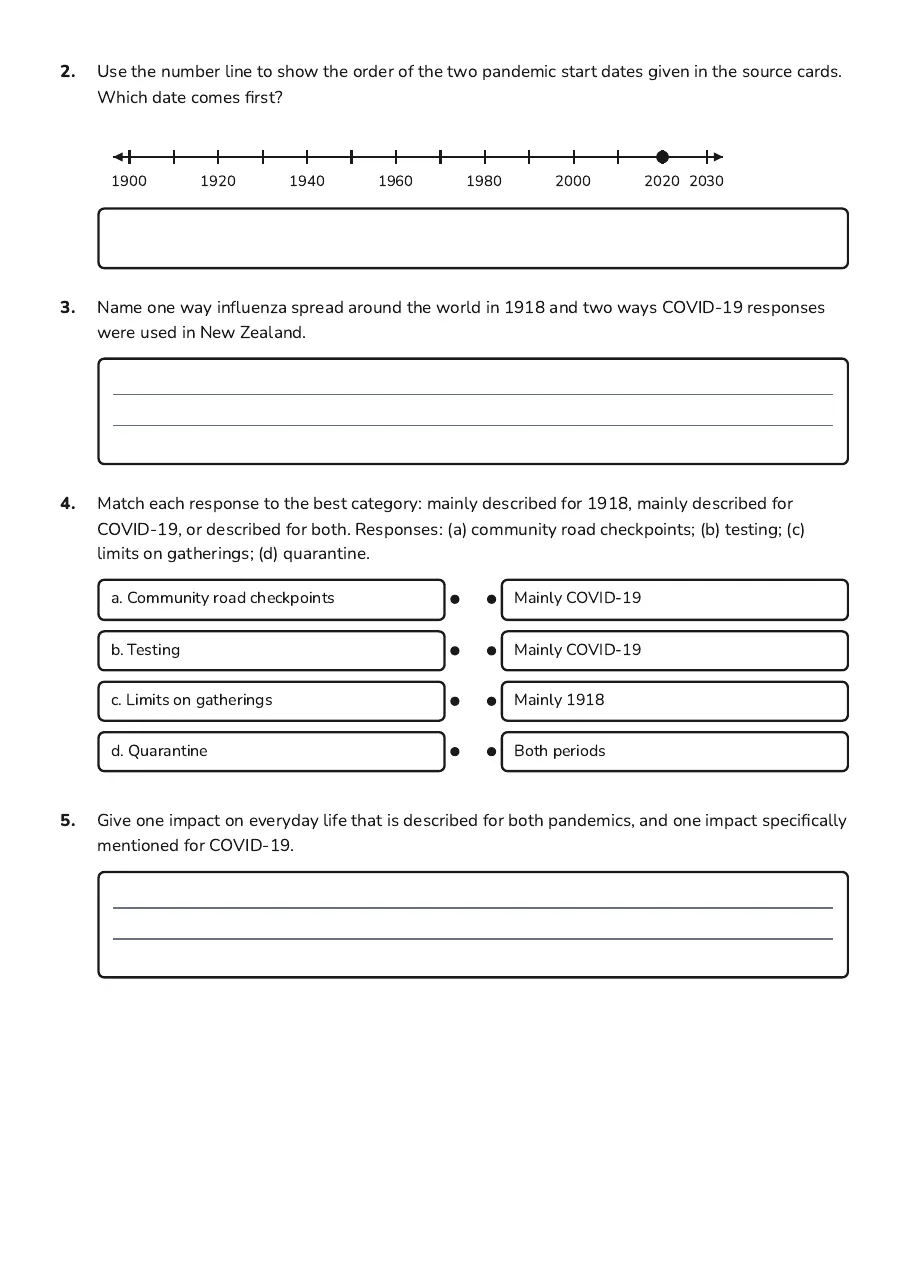
2.Use the number line to show the order of the two pandemic start dates given in the source cards. Which date comes first?
19001920194019601980200020202030
3.Name one way influenza spread around the world in 1918 and two ways COVID-19 responses were used in New Zealand.
4.Match each response to the best category: mainly described for 1918, mainly described for COVID-19, or described for both. Responses: (a) community road checkpoints; (b) testing; (c) limits on gatherings; (d) quarantine.
  • a. Community road checkpoints
  • b. Testing
  • c. Limits on gatherings
  • d. Quarantine
  • Mainly COVID-19
  • Mainly COVID-19
  • Mainly 1918
  • Both periods
5.Give one impact on everyday life that is described for both pandemics, and one impact specifically mentioned for COVID-19.
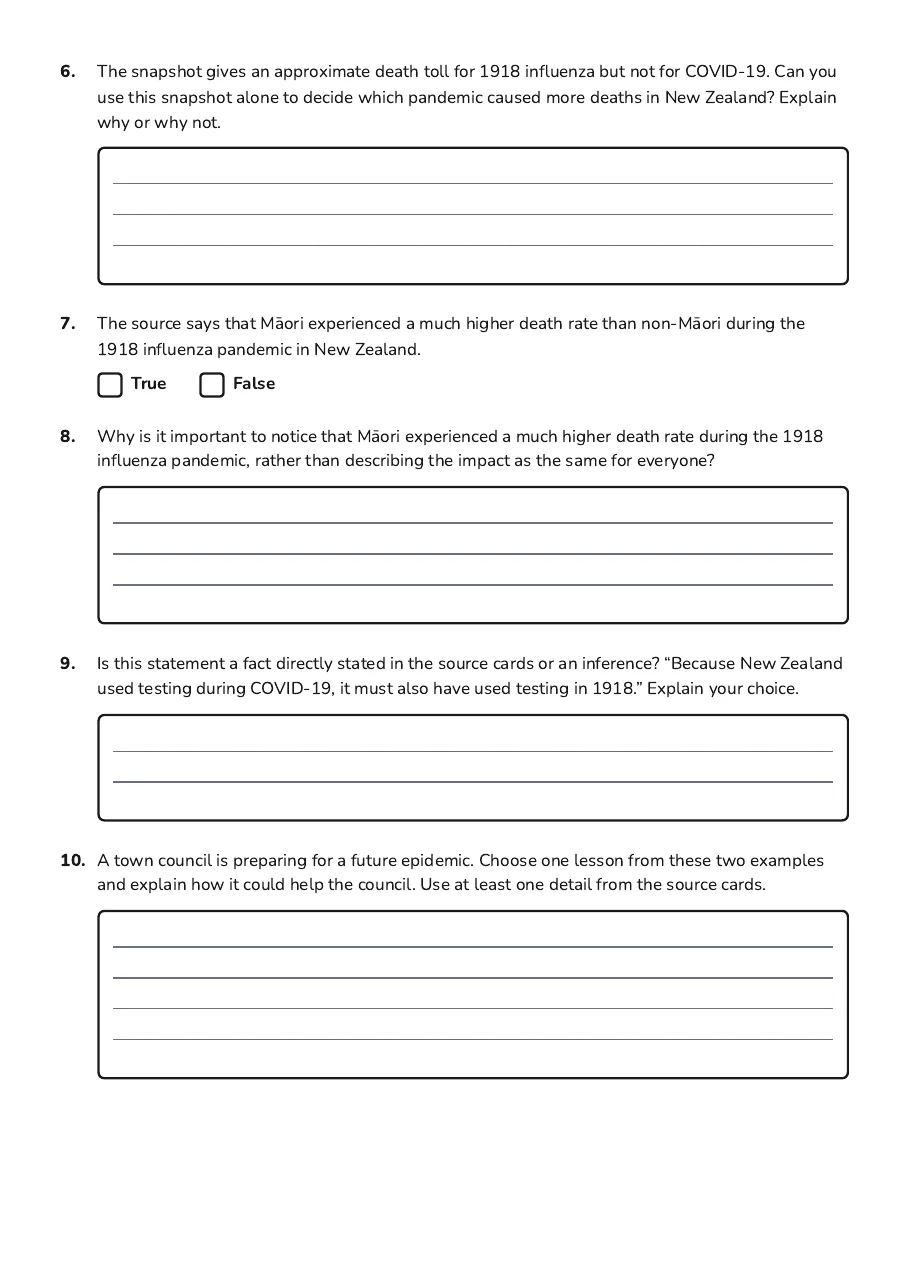
6.The snapshot gives an approximate death toll for 1918 influenza but not for COVID-19. Can you use this snapshot alone to decide which pandemic caused more deaths in New Zealand? Explain why or why not.
7.The source says that Māori experienced a much higher death rate than non-Māori during the 1918 influenza pandemic in New Zealand.
TrueFalse
8.Why is it important to notice that Māori experienced a much higher death rate during the 1918 influenza pandemic, rather than describing the impact as the same for everyone?
9.Is this statement a fact directly stated in the source cards or an inference? “Because New Zealand used testing during COVID-19, it must also have used testing in 1918.” Explain your choice.
10.A town council is preparing for a future epidemic. Choose one lesson from these two examples and explain how it could help the council. Use at least one detail from the source cards.

3 printable pages

  • Comparing Historical Epidemics, page 1 of 3: Two epidemics in Aotearoa New Zealand

    Page 1

  • Comparing Historical Epidemics, page 2 of 3: 2. Use the number line to show the order of the two pandemic start dates given in the…

    Page 2

  • Comparing Historical Epidemics, page 3 of 3: 6. The snapshot gives an approximate death toll for 1918 influenza but not for COVID-19.…

    Page 3

About This Worksheet

Free in Kuraplan

Sign up free, grab the PDF, and customize it for your class.

Print-Ready

Formatted for standard paper. Clean layout, easy to read.

AI-Generated

Created with Kuraplan's AI, designed for real classroom use.

For Teachers & Parents

Use in classrooms, for homework, tutoring, or homeschool.

Need a custom version of this worksheet?

Kuraplan's AI generates custom worksheets in seconds — differentiated for every learner, aligned to your curriculum.

Generate Custom Worksheets — Free
No credit card Curriculum-aligned Under 60 seconds