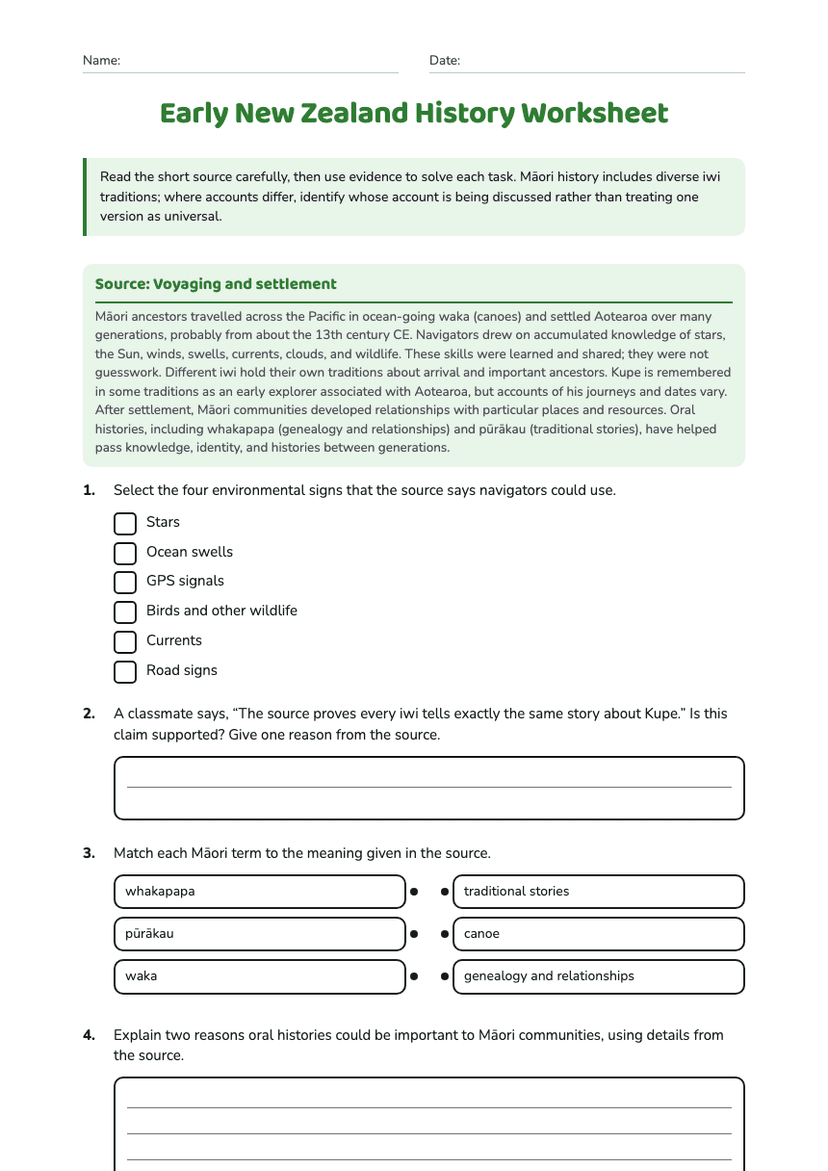
Pākaitore Historical Context
A free social sciences worksheet ready for your classroom. Open in Kuraplan to grab the print-ready PDF, customize it for your students, or generate a fresh version in seconds.
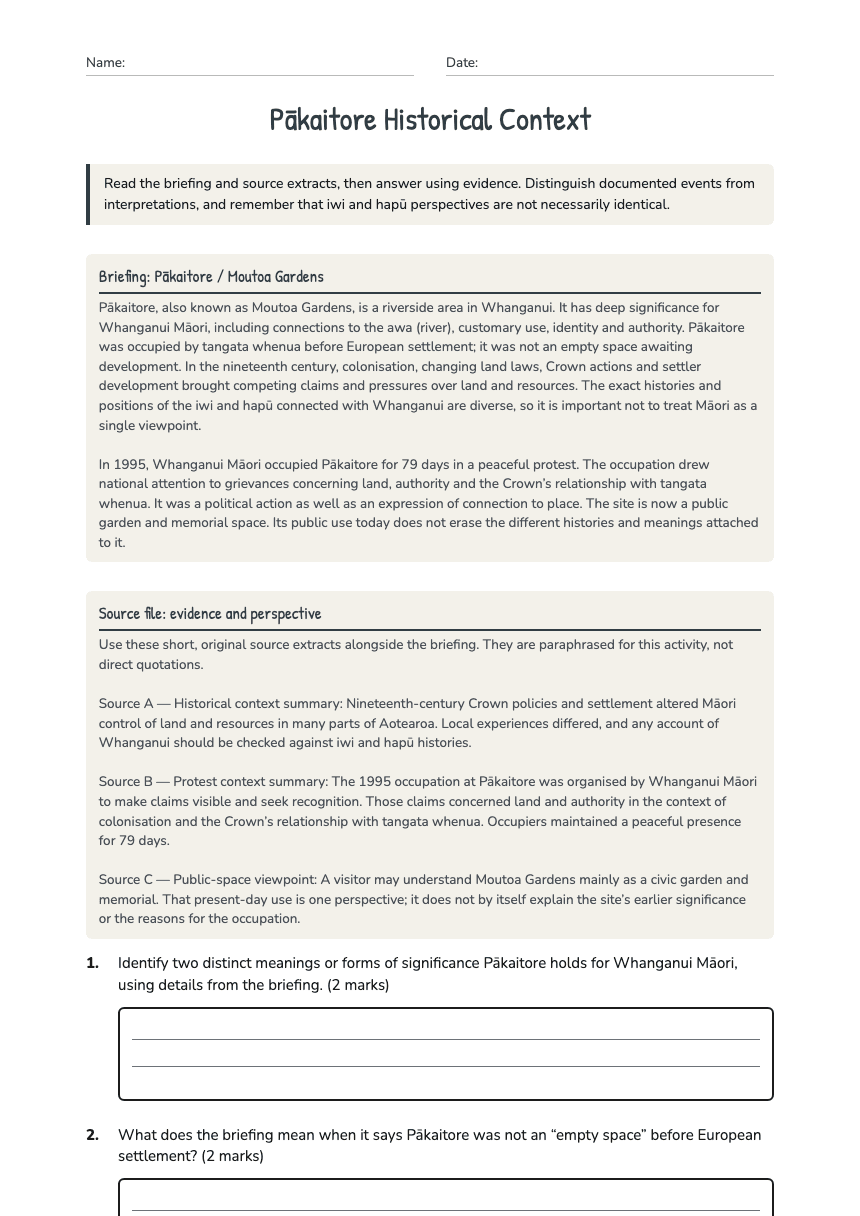
Pākaitore Historical Context
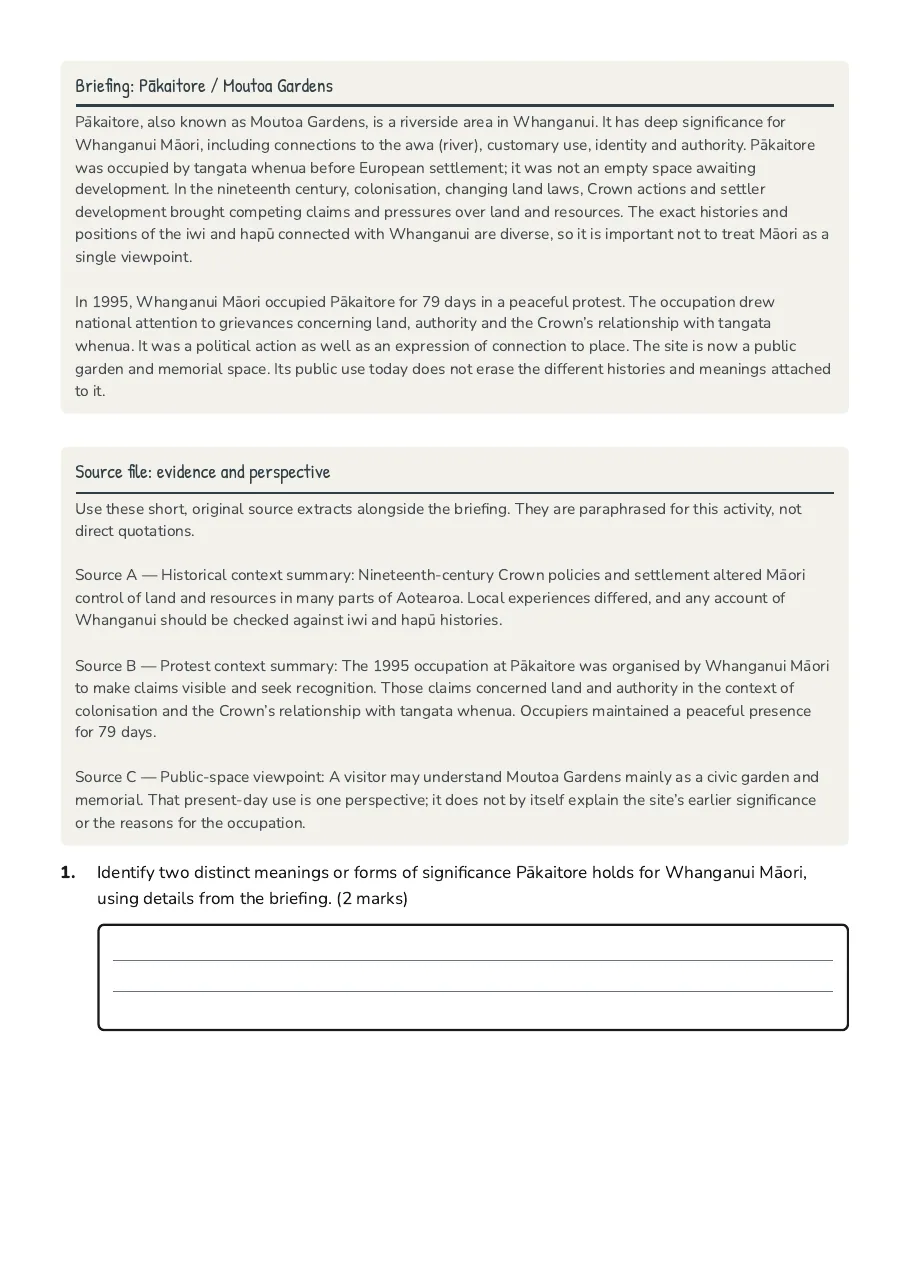
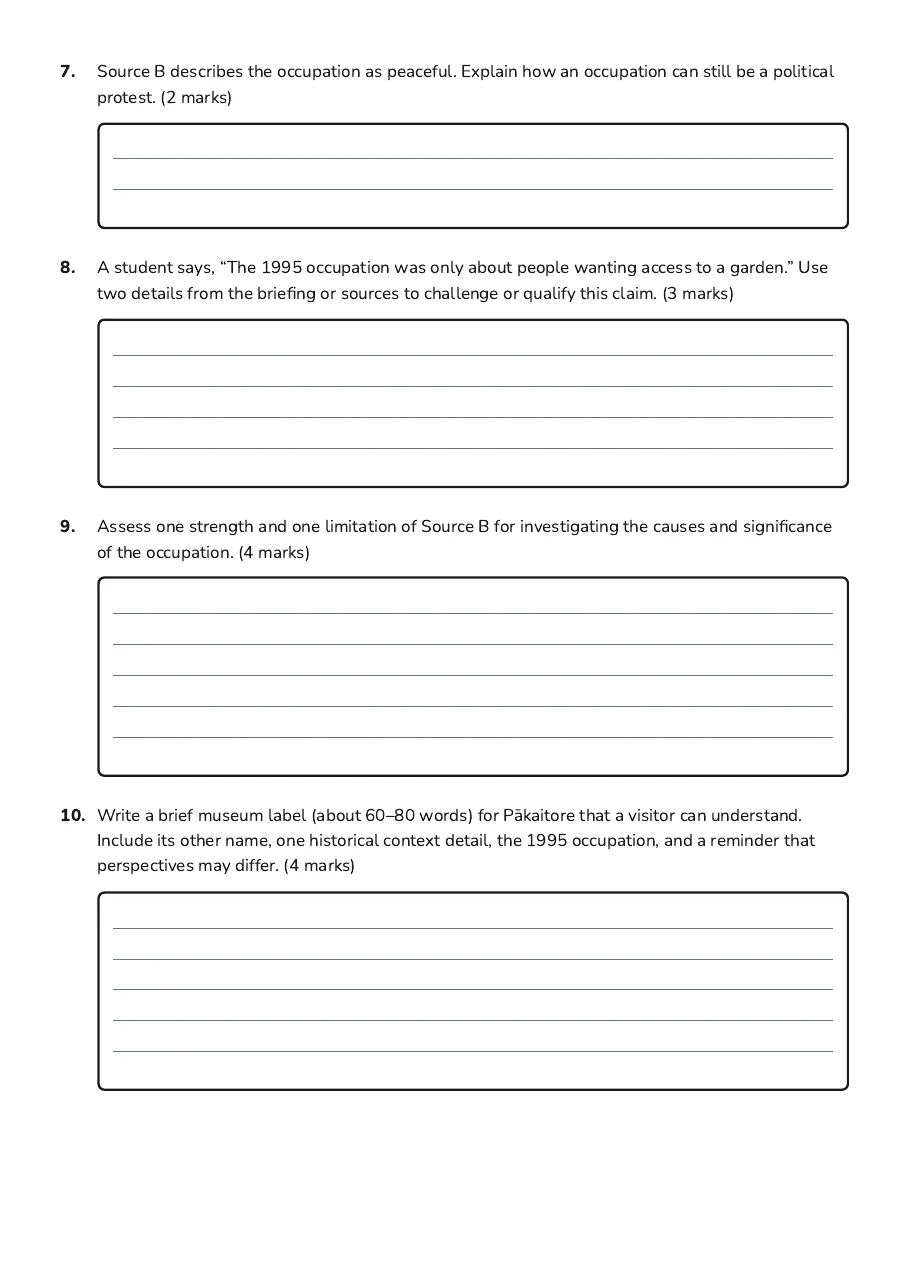
Briefing: Pākaitore / Moutoa Gardens
Pākaitore, also known as Moutoa Gardens, is a riverside area in Whanganui. It has deep significance for Whanganui Māori, including connections to the awa (river), customary use, identity and authority. Pākaitore was occupied by tangata whenua before European settlement; it was not an empty space awaiting development. In the nineteenth century, colonisation, changing land laws, Crown actions and settler development brought competing claims and pressures over land and resources. The exact histories and positions of the iwi and hapū connected with Whanganui are diverse, so it is important not to treat Māori as a single viewpoint. In 1995, Whanganui Māori occupied Pākaitore for 79 days in a peaceful protest. The occupation drew national attention to grievances concerning land, authority and the Crown’s relationship with tangata whenua. It was a political action as well as an expression of connection to place. The site is now a public garden and memorial space. Its public use today does not erase the different histories and meanings attached to it.
Source file: evidence and perspective
Use these short, original source extracts alongside the briefing. They are paraphrased for this activity, not direct quotations. Source A — Historical context summary: Nineteenth-century Crown policies and settlement altered Māori control of land and resources in many parts of Aotearoa. Local experiences differed, and any account of Whanganui should be checked against iwi and hapū histories. Source B — Protest context summary: The 1995 occupation at Pākaitore was organised by Whanganui Māori to make claims visible and seek recognition. Those claims concerned land and authority in the context of colonisation and the Crown’s relationship with tangata whenua. Occupiers maintained a peaceful presence for 79 days. Source C — Public-space viewpoint: A visitor may understand Moutoa Gardens mainly as a civic garden and memorial. That present-day use is one perspective; it does not by itself explain the site’s earlier significance or the reasons for the occupation.
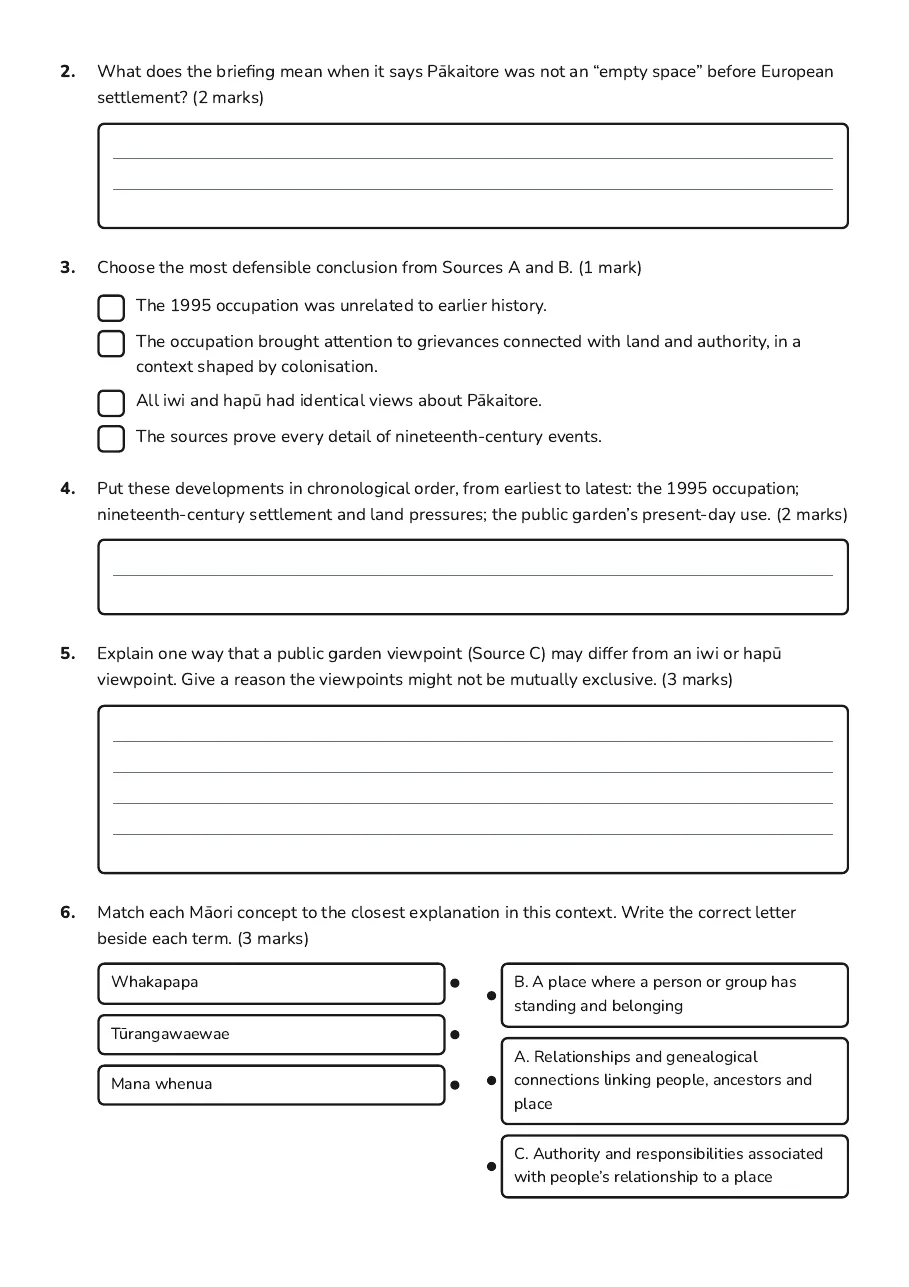
- The 1995 occupation was unrelated to earlier history.
- The occupation brought attention to grievances connected with land and authority, in a context shaped by colonisation.
- All iwi and hapū had identical views about Pākaitore.
- The sources prove every detail of nineteenth-century events.
- Whakapapa
- Tūrangawaewae
- Mana whenua
- B. A place where a person or group has standing and belonging
- A. Relationships and genealogical connections linking people, ancestors and place
- C. Authority and responsibilities associated with people’s relationship to a place
4 printable pages

Page 1
Page 2
Page 3
Page 4
About This Worksheet
Free in Kuraplan
Sign up free, grab the PDF, and customize it for your class.
Print-Ready
Formatted for standard paper. Clean layout, easy to read.
AI-Generated
Created with Kuraplan's AI, designed for real classroom use.
For Teachers & Parents
Use in classrooms, for homework, tutoring, or homeschool.
Need a custom version of this worksheet?
Kuraplan's AI generates custom worksheets in seconds — differentiated for every learner, aligned to your curriculum.
Generate Custom Worksheets — FreeMore Social Sciences Worksheets
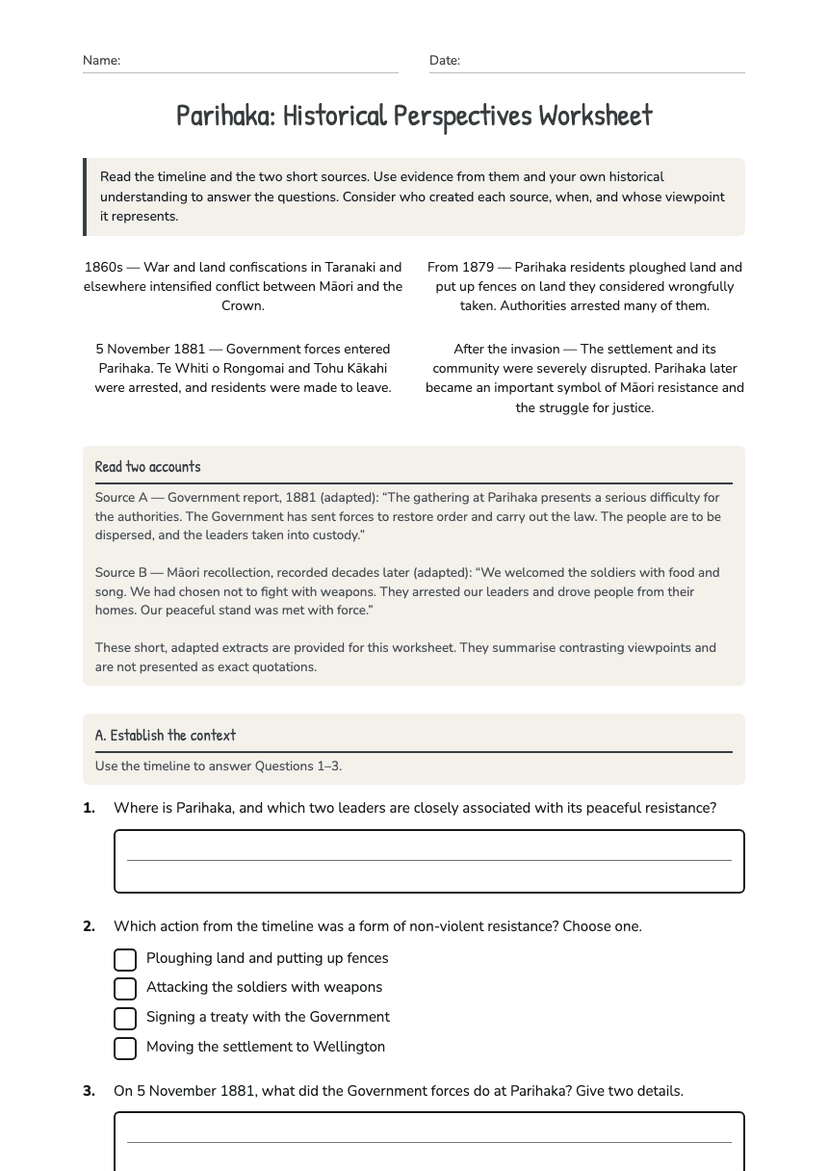
Parihaka: Historical Perspectives Worksheet
Free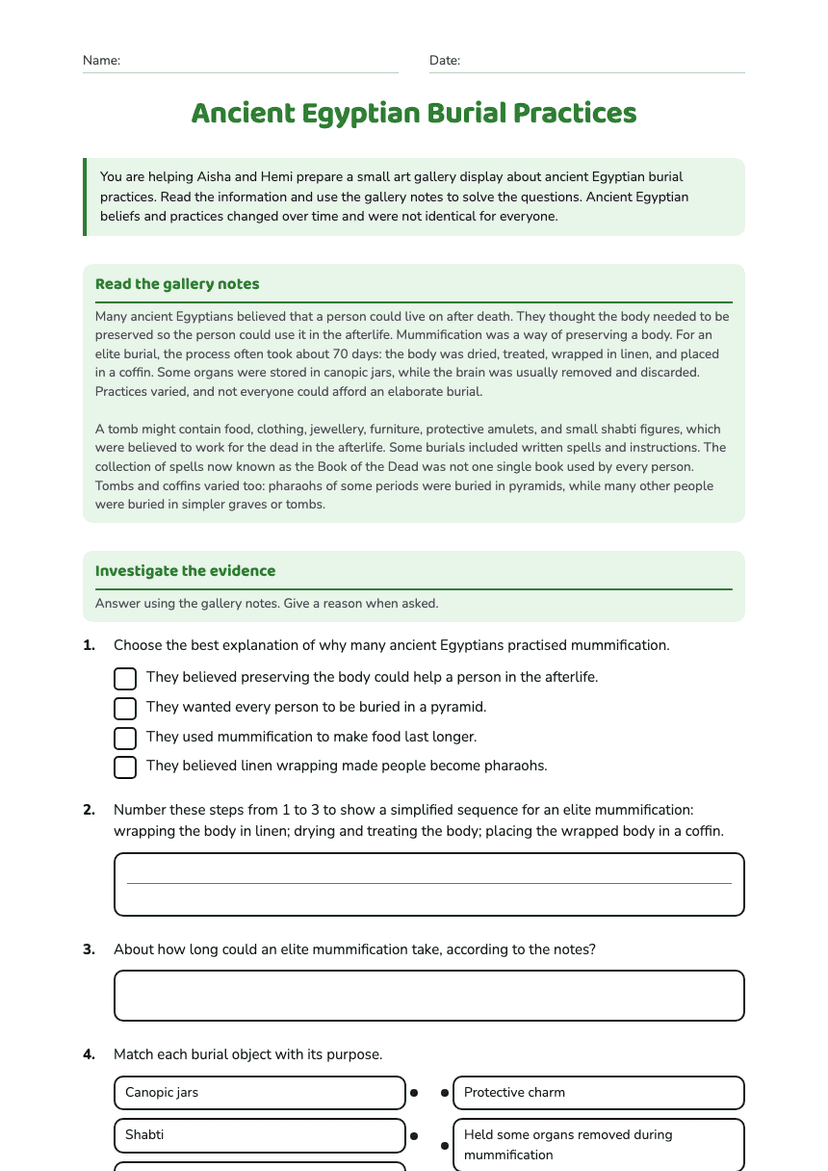
Ancient Egyptian Burial Practices
Free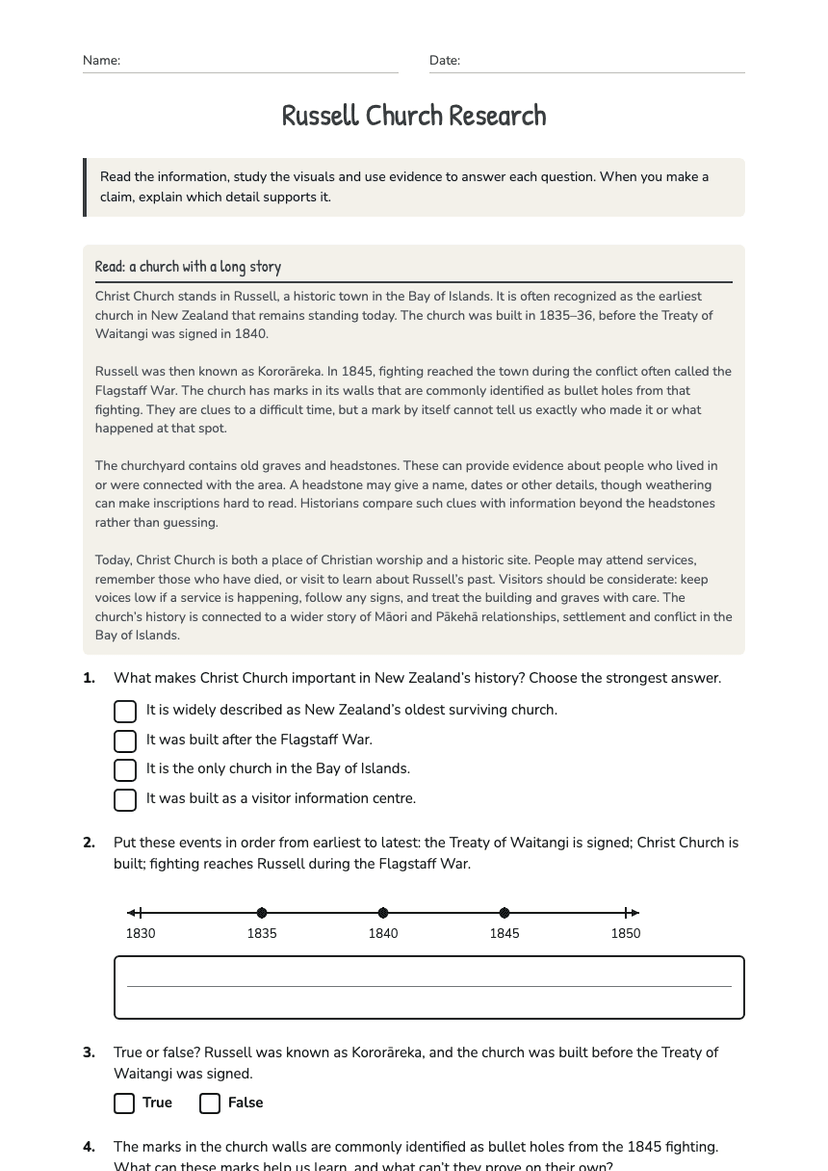
Russell Church Research
Free
New Zealand's Shaping History
Free
Te Aute Historical Insights
Free
World War II: Causes
Free
Traditional and Modern Voyaging
Free