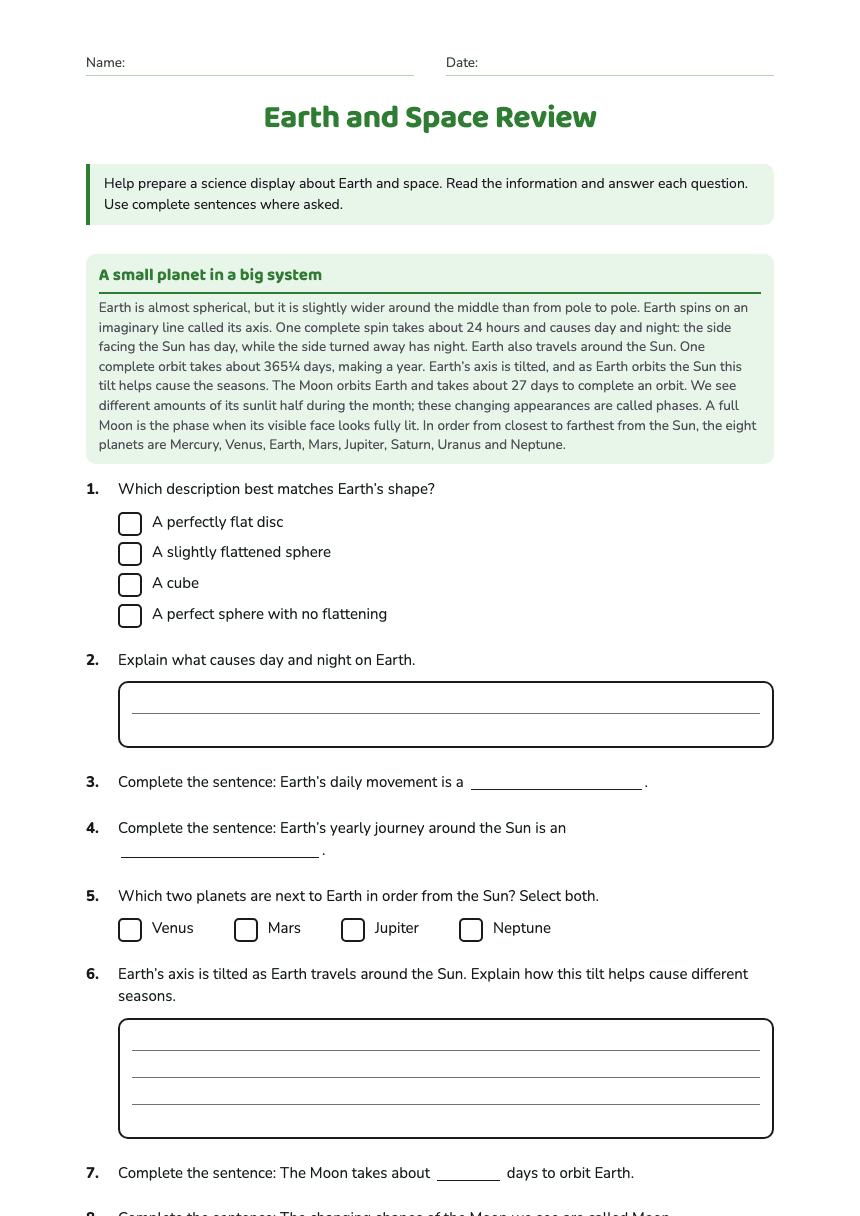
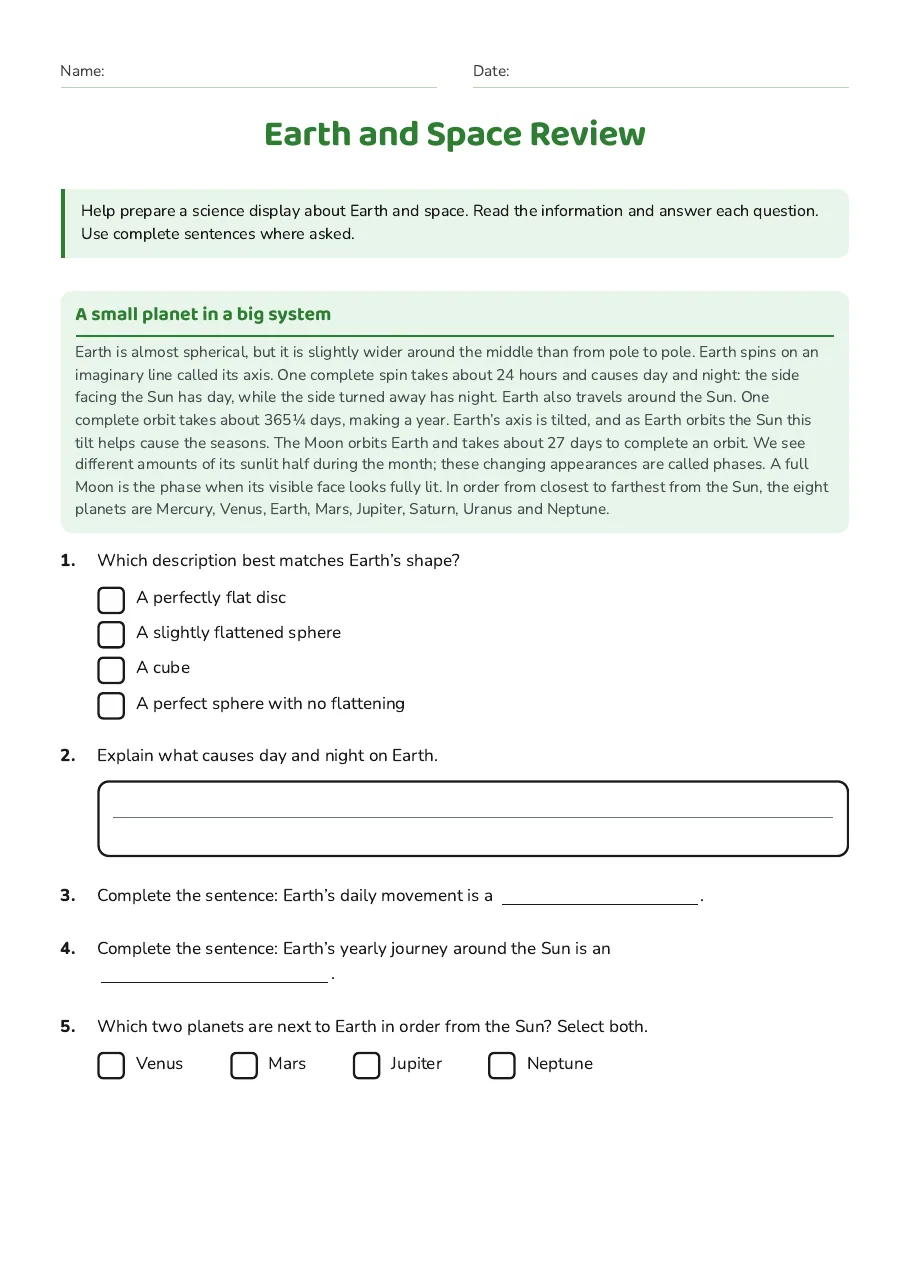
Earth and Space Review
A free science worksheet ready for your classroom. Open in Kuraplan to grab the print-ready PDF, customize it for your students, or generate a fresh version in seconds.
Earth and Space Review
A small planet in a big system
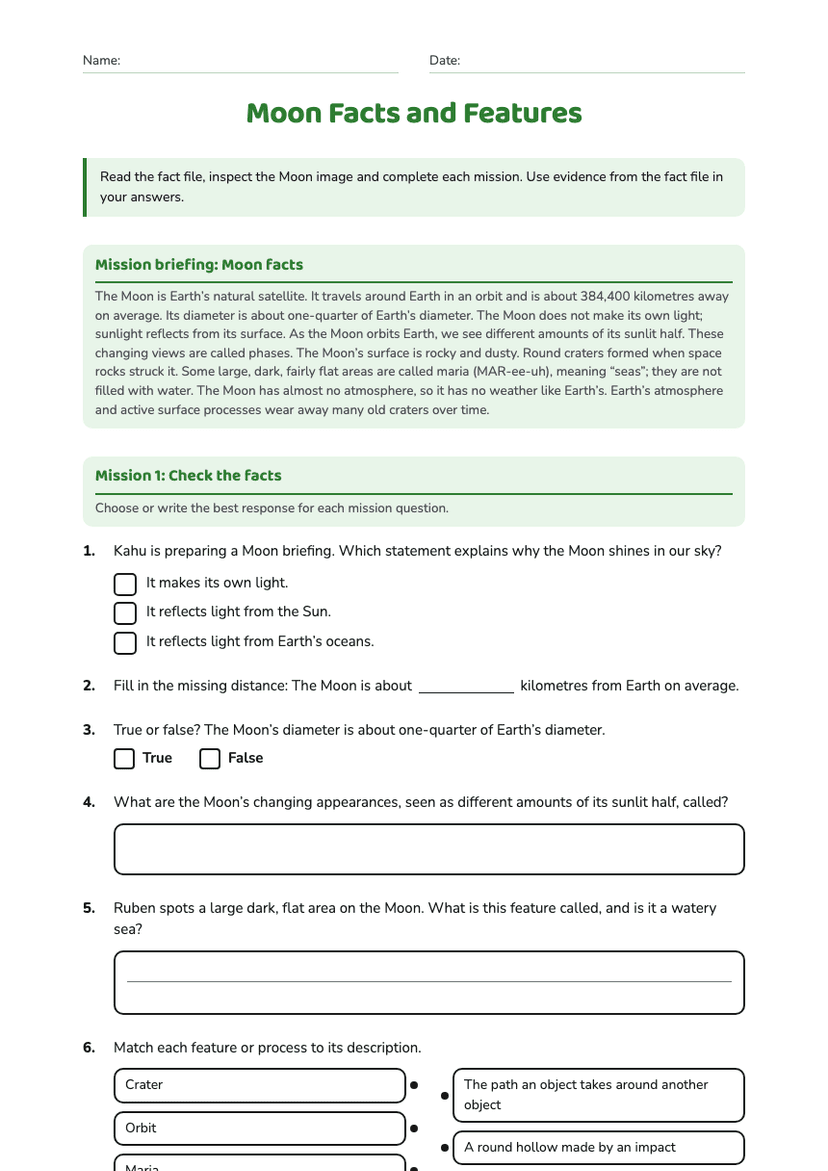
Earth is almost spherical, but it is slightly wider around the middle than from pole to pole. Earth spins on an imaginary line called its axis. One complete spin takes about 24 hours and causes day and night: the side facing the Sun has day, while the side turned away has night. Earth also travels around the Sun. One complete orbit takes about 365¼ days, making a year. Earth’s axis is tilted, and as Earth orbits the Sun this tilt helps cause the seasons. The Moon orbits Earth and takes about 27 days to complete an orbit. We see different amounts of its sunlit half during the month; these changing appearances are called phases. A full Moon is the phase when its visible face looks fully lit. In order from closest to farthest from the Sun, the eight planets are Mercury, Venus, Earth, Mars, Jupiter, Saturn, Uranus and Neptune.
- A perfectly flat disc
- A slightly flattened sphere
- A cube
- A perfect sphere with no flattening
- Venus
- Mars
- Jupiter
- Neptune
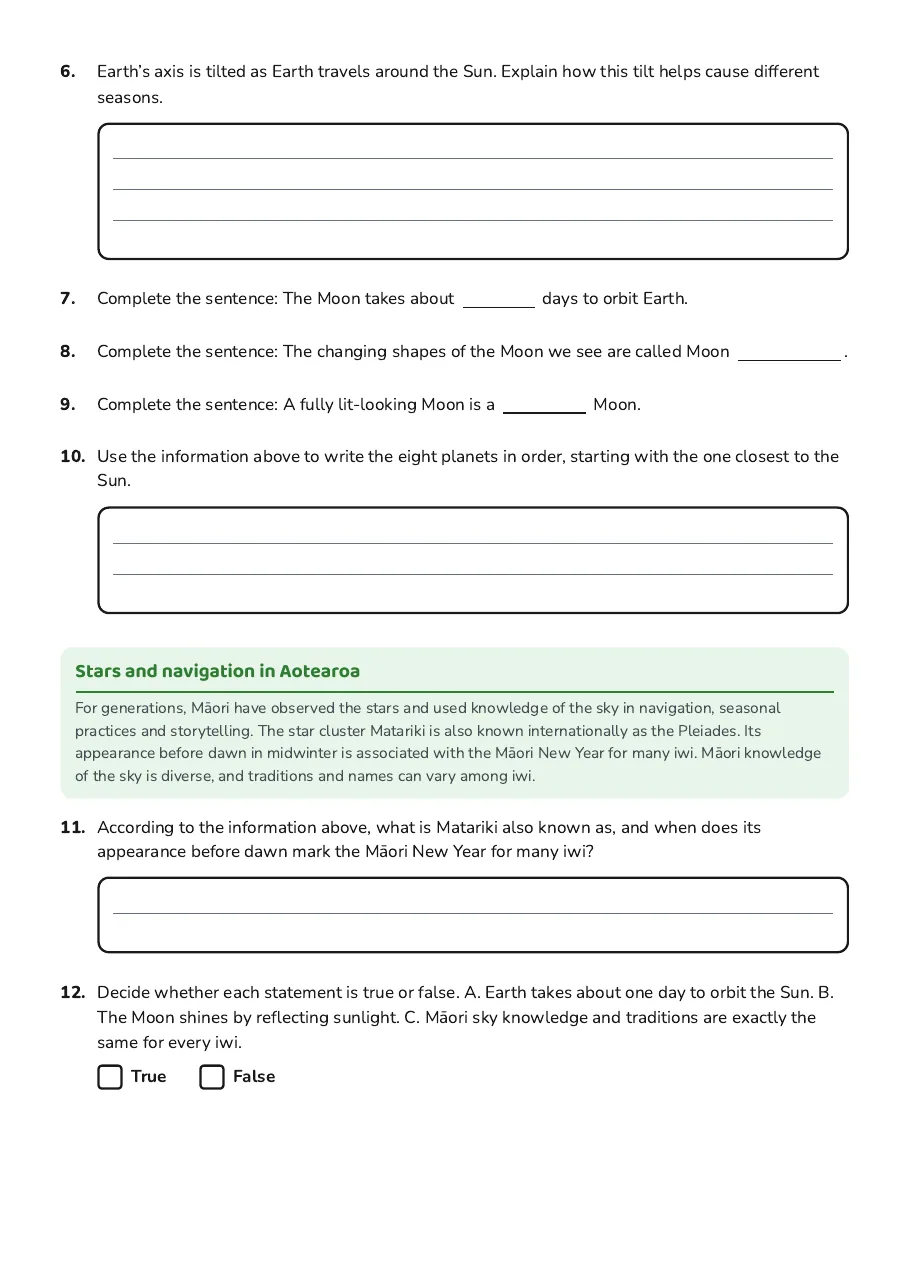
Stars and navigation in Aotearoa
For generations, Māori have observed the stars and used knowledge of the sky in navigation, seasonal practices and storytelling. The star cluster Matariki is also known internationally as the Pleiades. Its appearance before dawn in midwinter is associated with the Māori New Year for many iwi. Māori knowledge of the sky is diverse, and traditions and names can vary among iwi.
3 printable pages
Page 1
Page 2
Page 3
About This Worksheet
Free in Kuraplan
Sign up free, grab the PDF, and customize it for your class.
Print-Ready
Formatted for standard paper. Clean layout, easy to read.
AI-Generated
Created with Kuraplan's AI, designed for real classroom use.
For Teachers & Parents
Use in classrooms, for homework, tutoring, or homeschool.
Need a custom version of this worksheet?
Kuraplan's AI generates custom worksheets in seconds — differentiated for every learner, aligned to your curriculum.
Generate Custom Worksheets — Free