A free social sciences worksheet ready for your classroom. Open in Kuraplan to grab the print-ready PDF, customize it for your students, or generate a fresh version in seconds.
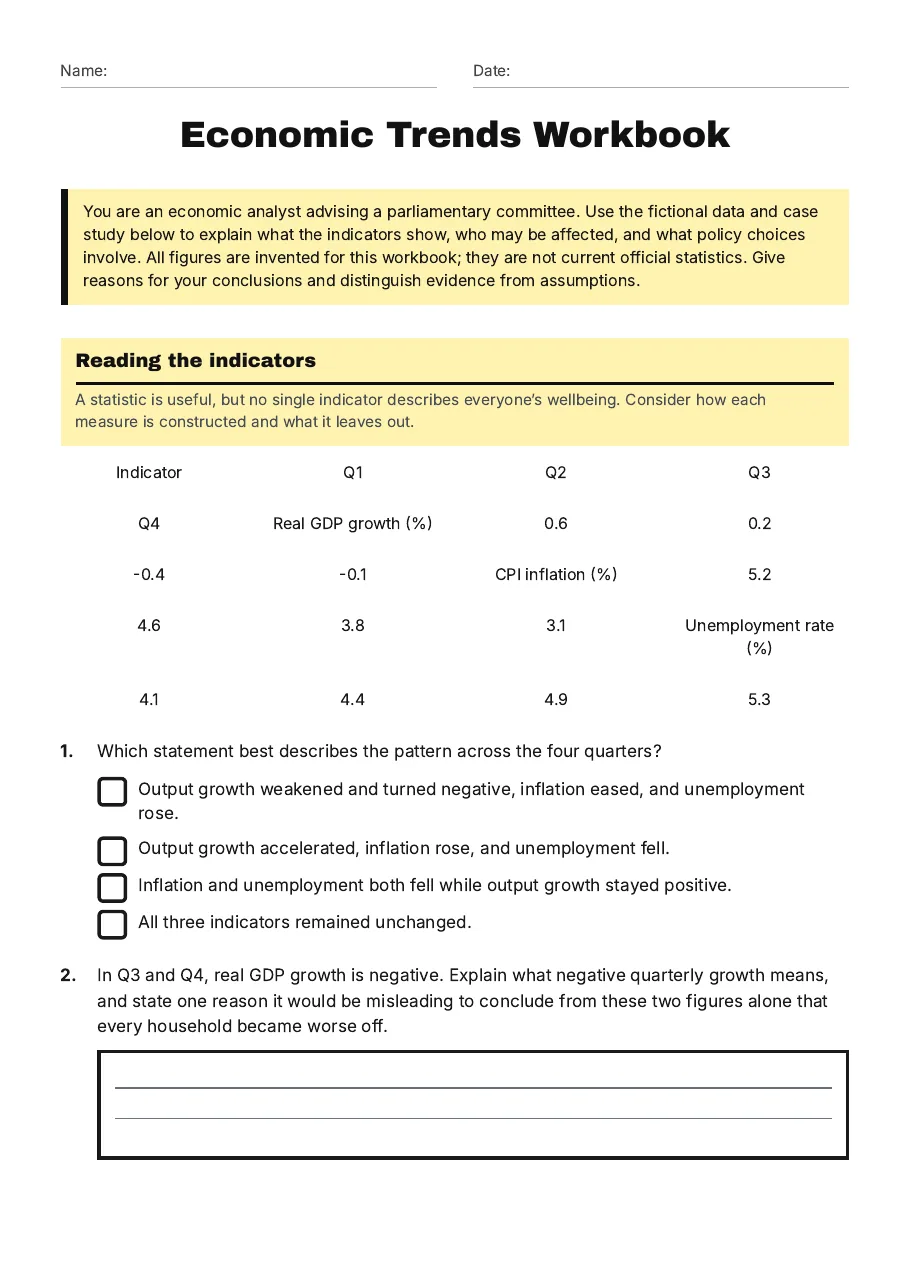
You are an economic analyst advising a parliamentary committee. Use the fictional data and case study below to explain what the indicators show, who may be affected, and what policy choices involve. All figures are invented for this workbook; they are not current official statistics. Give reasons for your conclusions and distinguish evidence from assumptions.
Reading the indicators
A statistic is useful, but no single indicator describes everyone’s wellbeing. Consider how each measure is constructed and what it leaves out.
Indicator
Q1
Q2
Q3
Q4
Real GDP growth (%)
0.6
0.2
-0.4
-0.1
CPI inflation (%)
5.2
4.6
3.8
3.1
Unemployment rate (%)
4.1
4.4
4.9
5.3
1.Which statement best describes the pattern across the four quarters?
Output growth weakened and turned negative, inflation eased, and unemployment rose.
Output growth accelerated, inflation rose, and unemployment fell.
Inflation and unemployment both fell while output growth stayed positive.
All three indicators remained unchanged.
2.In Q3 and Q4, real GDP growth is negative. Explain what negative quarterly growth means, and state one reason it would be misleading to conclude from these two figures alone that every household became worse off.
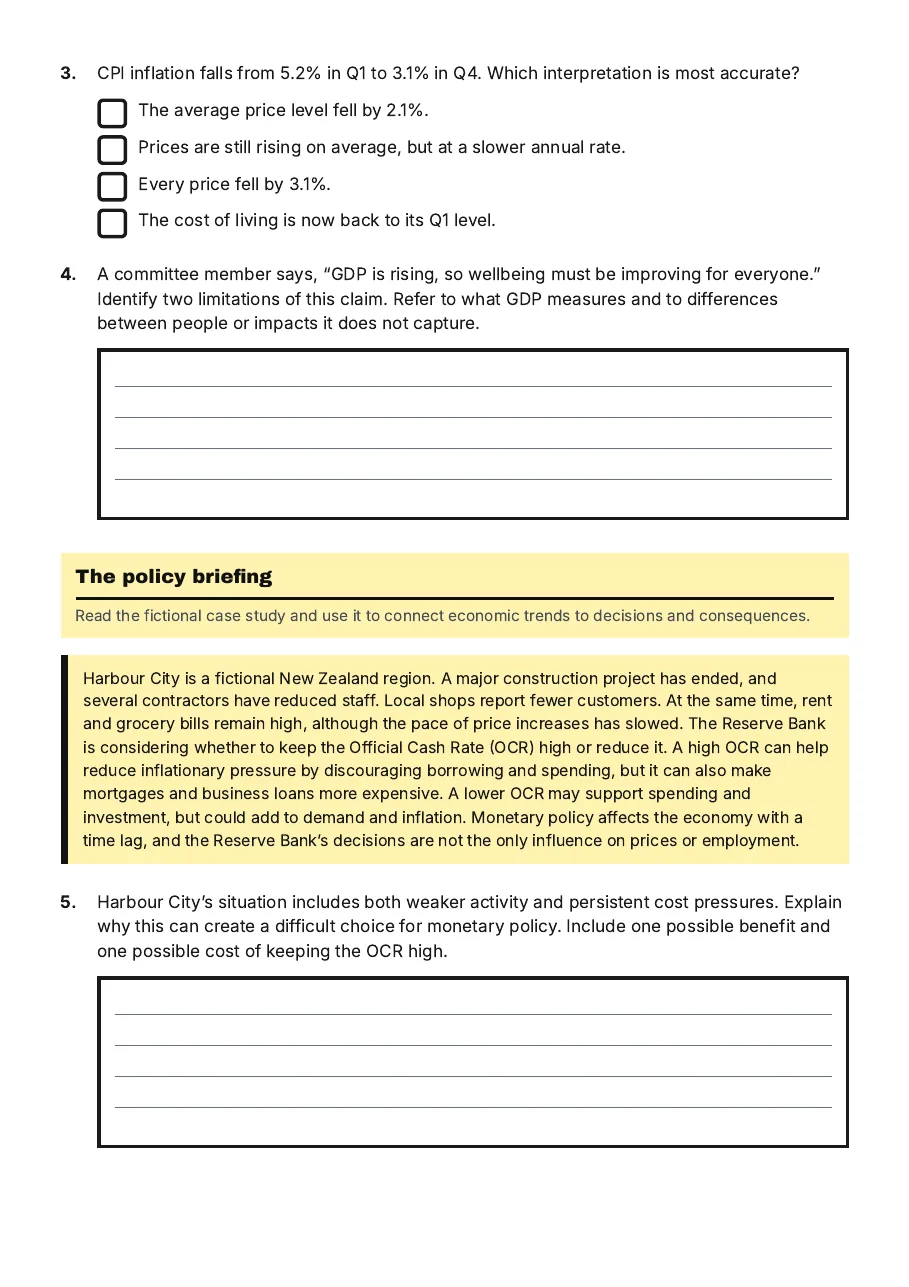
3.CPI inflation falls from 5.2% in Q1 to 3.1% in Q4. Which interpretation is most accurate?
The average price level fell by 2.1%.
Prices are still rising on average, but at a slower annual rate.
Every price fell by 3.1%.
The cost of living is now back to its Q1 level.
4.A committee member says, “GDP is rising, so wellbeing must be improving for everyone.” Identify two limitations of this claim. Refer to what GDP measures and to differences between people or impacts it does not capture.
The policy briefing
Read the fictional case study and use it to connect economic trends to decisions and consequences.
Harbour City is a fictional New Zealand region. A major construction project has ended, and several contractors have reduced staff. Local shops report fewer customers. At the same time, rent and grocery bills remain high, although the pace of price increases has slowed. The Reserve Bank is considering whether to keep the Official Cash Rate (OCR) high or reduce it. A high OCR can help reduce inflationary pressure by discouraging borrowing and spending, but it can also make mortgages and business loans more expensive. A lower OCR may support spending and investment, but could add to demand and inflation. Monetary policy affects the economy with a time lag, and the Reserve Bank’s decisions are not the only influence on prices or employment.
5.Harbour City’s situation includes both weaker activity and persistent cost pressures. Explain why this can create a difficult choice for monetary policy. Include one possible benefit and one possible cost of keeping the OCR high.
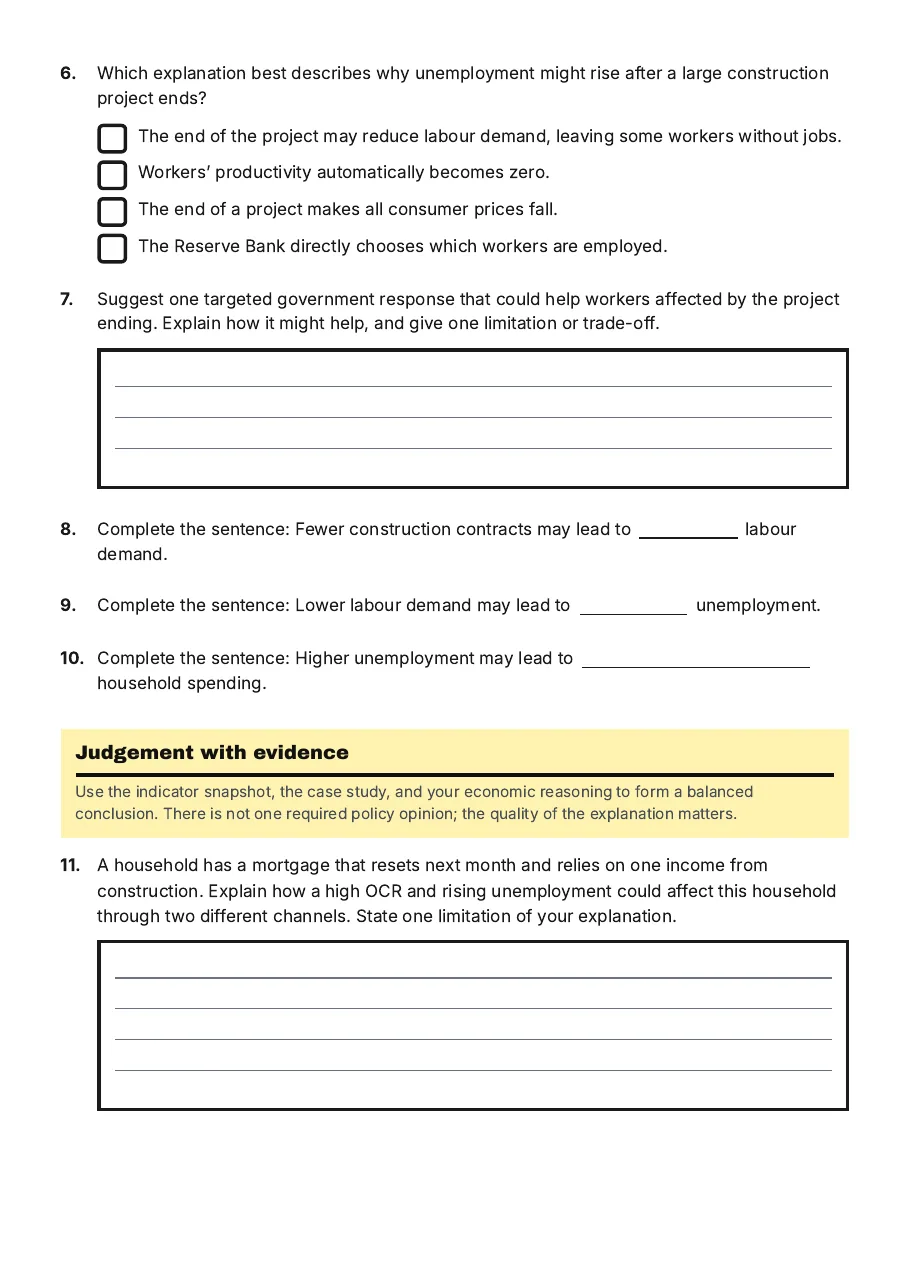
6.Which explanation best describes why unemployment might rise after a large construction project ends?
The end of the project may reduce labour demand, leaving some workers without jobs.
Workers’ productivity automatically becomes zero.
The end of a project makes all consumer prices fall.
The Reserve Bank directly chooses which workers are employed.
7.Suggest one targeted government response that could help workers affected by the project ending. Explain how it might help, and give one limitation or trade-off.
8.Complete the sentence: Fewer construction contracts may lead to labour demand.
9.Complete the sentence: Lower labour demand may lead to unemployment.
10.Complete the sentence: Higher unemployment may lead to household spending.
Judgement with evidence
Use the indicator snapshot, the case study, and your economic reasoning to form a balanced conclusion. There is not one required policy opinion; the quality of the explanation matters.
11.A household has a mortgage that resets next month and relies on one income from construction. Explain how a high OCR and rising unemployment could affect this household through two different channels. State one limitation of your explanation.
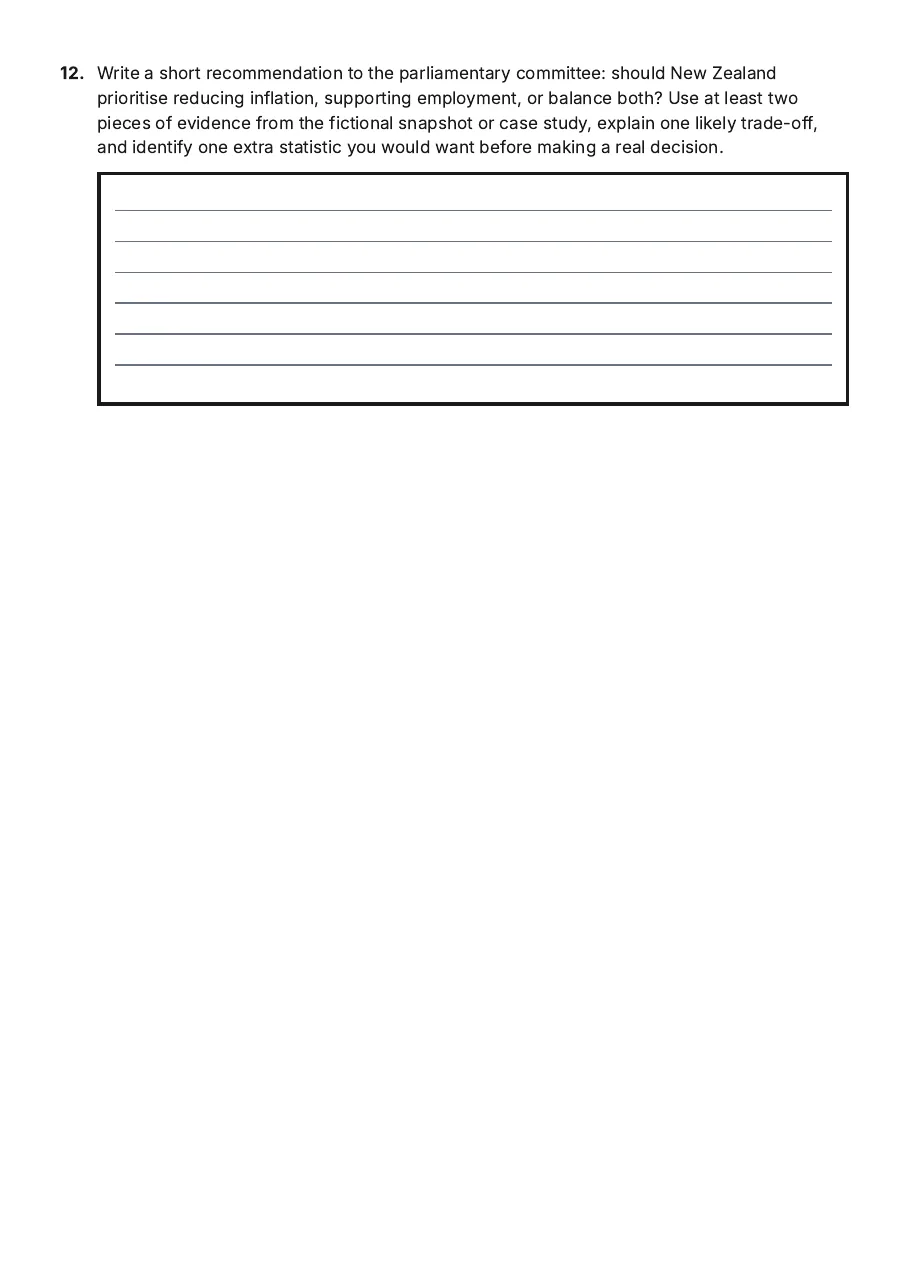
12.Write a short recommendation to the parliamentary committee: should New Zealand prioritise reducing inflation, supporting employment, or balance both? Use at least two pieces of evidence from the fictional snapshot or case study, explain one likely trade-off, and identify one extra statistic you would want before making a real decision.