ScienceFreePrintable
Enthalpy Change with Bond Energies
A free science worksheet ready for your classroom. Open in Kuraplan to grab the print-ready PDF, customize it for your students, or generate a fresh version in seconds.
Name:Date:
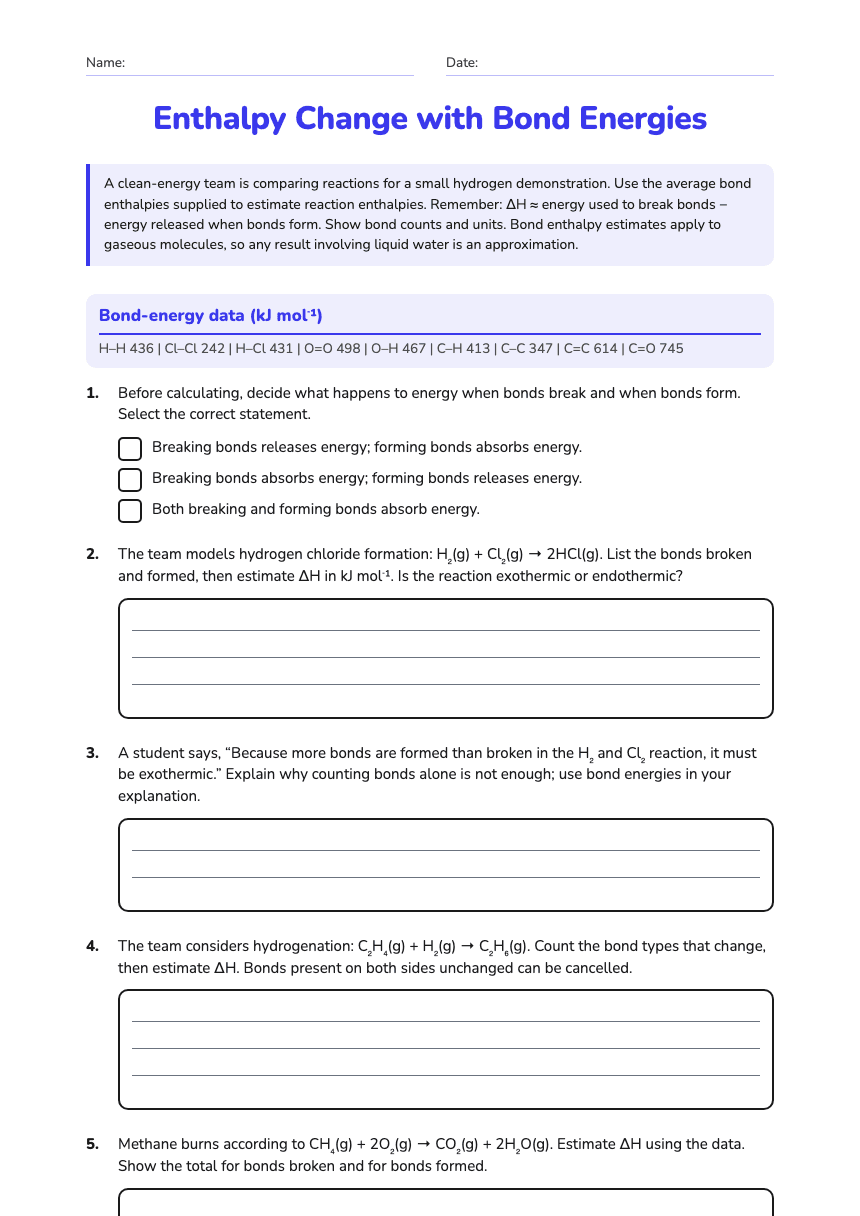
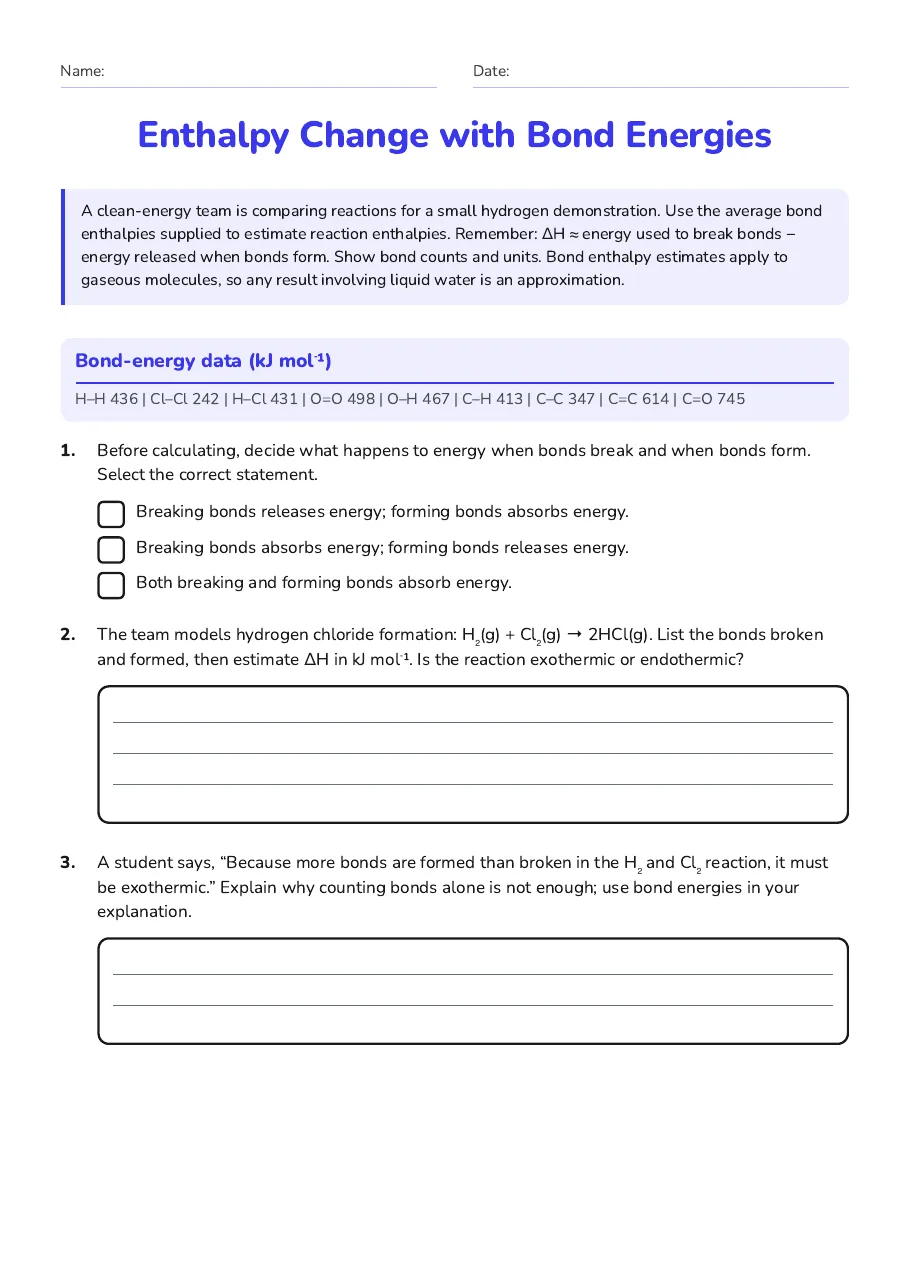
Enthalpy Change with Bond Energies
A clean-energy team is comparing reactions for a small hydrogen demonstration. Use the average bond enthalpies supplied to estimate reaction enthalpies. Remember: ΔH ≈ energy used to break bonds − energy released when bonds form. Show bond counts and units. Bond enthalpy estimates apply to gaseous molecules, so any result involving liquid water is an approximation.
Bond-energy data (kJ mol⁻¹)
H–H 436 | Cl–Cl 242 | H–Cl 431 | O=O 498 | O–H 467 | C–H 413 | C–C 347 | C=C 614 | C=O 745
1.Before calculating, decide what happens to energy when bonds break and when bonds form. Select the correct statement.
- Breaking bonds releases energy; forming bonds absorbs energy.
- Breaking bonds absorbs energy; forming bonds releases energy.
- Both breaking and forming bonds absorb energy.
2.The team models hydrogen chloride formation: H₂(g) + Cl₂(g) → 2HCl(g). List the bonds broken and formed, then estimate ΔH in kJ mol⁻¹. Is the reaction exothermic or endothermic?
3.A student says, “Because more bonds are formed than broken in the H₂ and Cl₂ reaction, it must be exothermic.” Explain why counting bonds alone is not enough; use bond energies in your explanation.
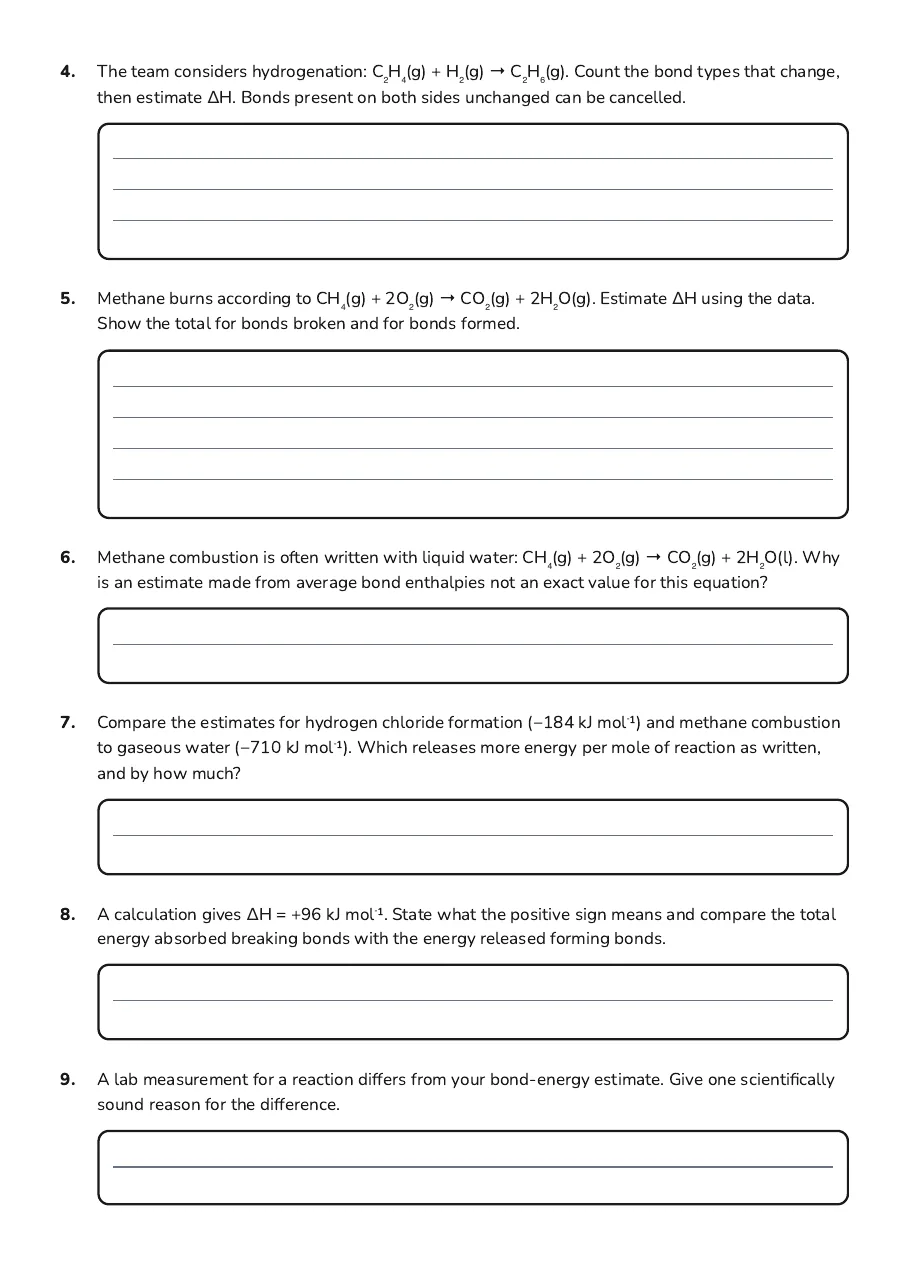
4.The team considers hydrogenation: C₂H₄(g) + H₂(g) → C₂H₆(g). Count the bond types that change, then estimate ΔH. Bonds present on both sides unchanged can be cancelled.
5.Methane burns according to CH₄(g) + 2O₂(g) → CO₂(g) + 2H₂O(g). Estimate ΔH using the data. Show the total for bonds broken and for bonds formed.
6.Methane combustion is often written with liquid water: CH₄(g) + 2O₂(g) → CO₂(g) + 2H₂O(l). Why is an estimate made from average bond enthalpies not an exact value for this equation?
7.Compare the estimates for hydrogen chloride formation (−184 kJ mol⁻¹) and methane combustion to gaseous water (−710 kJ mol⁻¹). Which releases more energy per mole of reaction as written, and by how much?
8.A calculation gives ΔH = +96 kJ mol⁻¹. State what the positive sign means and compare the total energy absorbed breaking bonds with the energy released forming bonds.
9.A lab measurement for a reaction differs from your bond-energy estimate. Give one scientifically sound reason for the difference.
2 printable pages
Page 1
Page 2
About This Worksheet
Free in Kuraplan
Sign up free, grab the PDF, and customize it for your class.
Print-Ready
Formatted for standard paper. Clean layout, easy to read.
AI-Generated
Created with Kuraplan's AI, designed for real classroom use.
For Teachers & Parents
Use in classrooms, for homework, tutoring, or homeschool.
Need a custom version of this worksheet?
Kuraplan's AI generates custom worksheets in seconds — differentiated for every learner, aligned to your curriculum.
Generate Custom Worksheets — Free No credit card Curriculum-aligned Under 60 seconds
More Science Worksheets
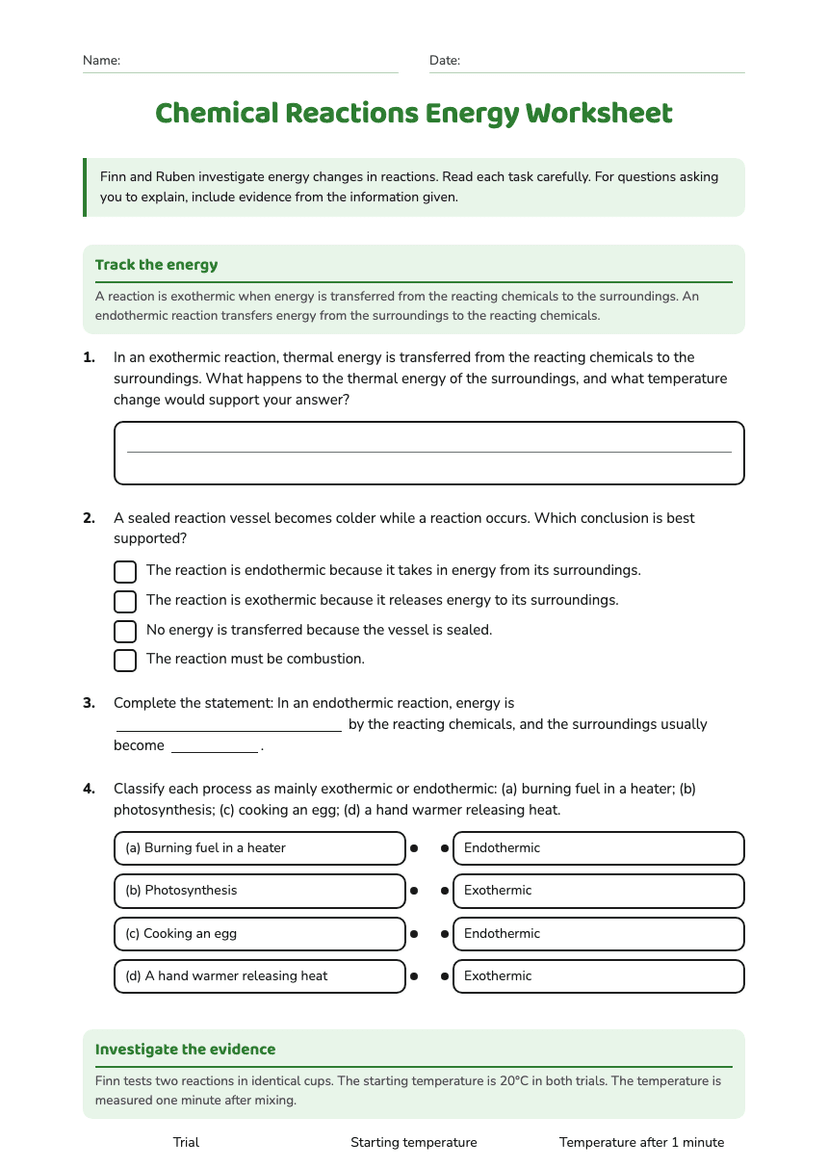
Chemical Reactions Energy Worksheet
Free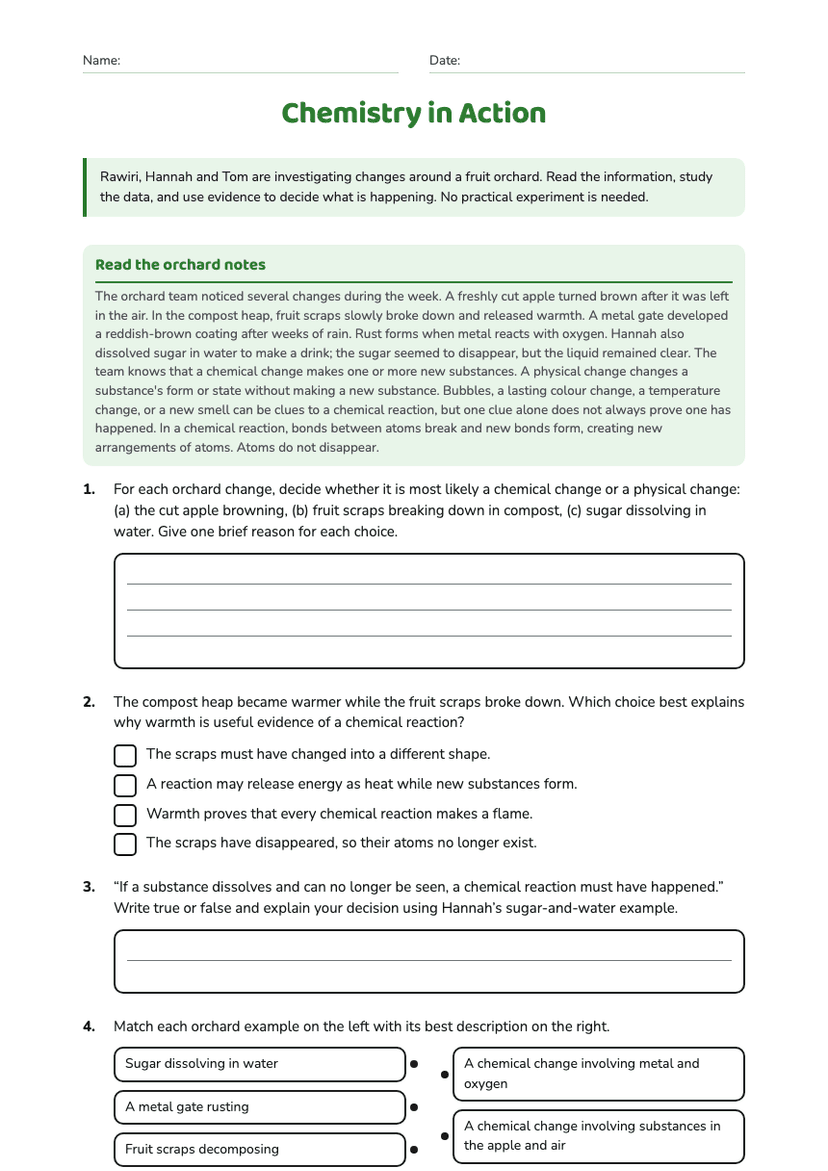
Year 7
Chemistry in Action
Free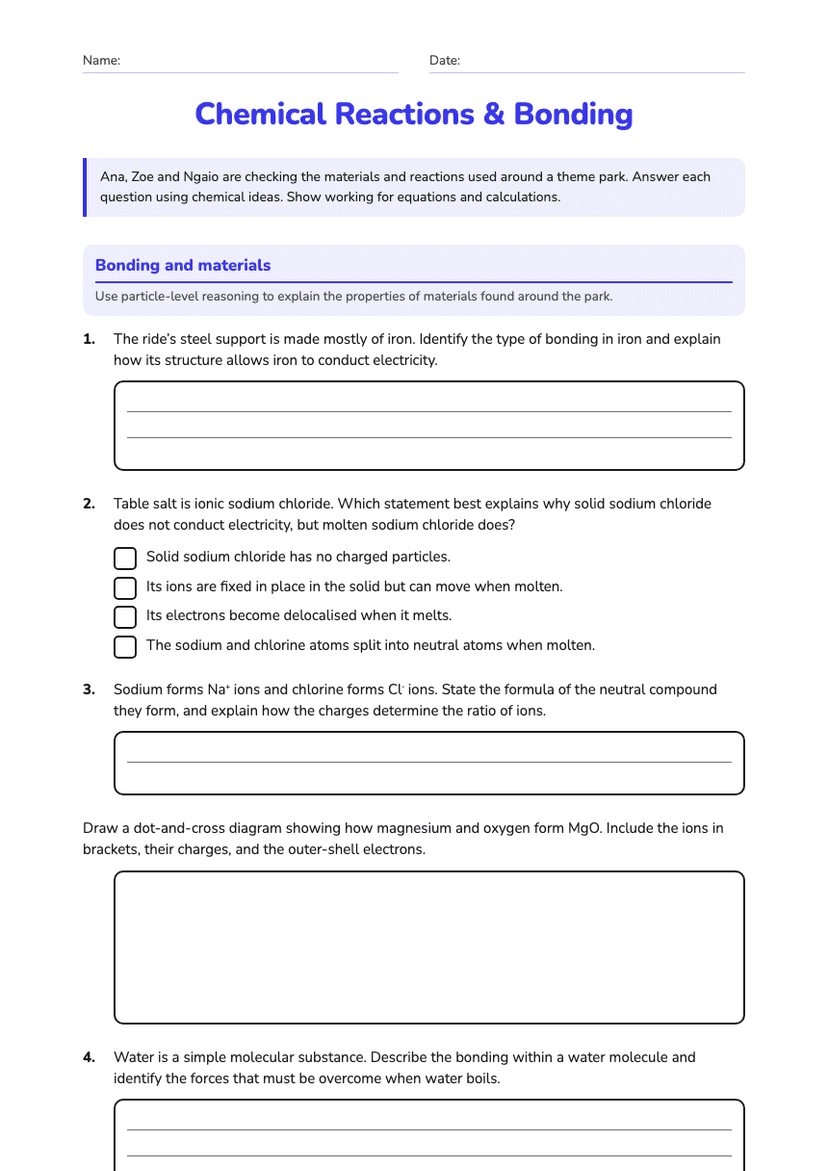
Year 11
Chemical Reactions & Bonding
Free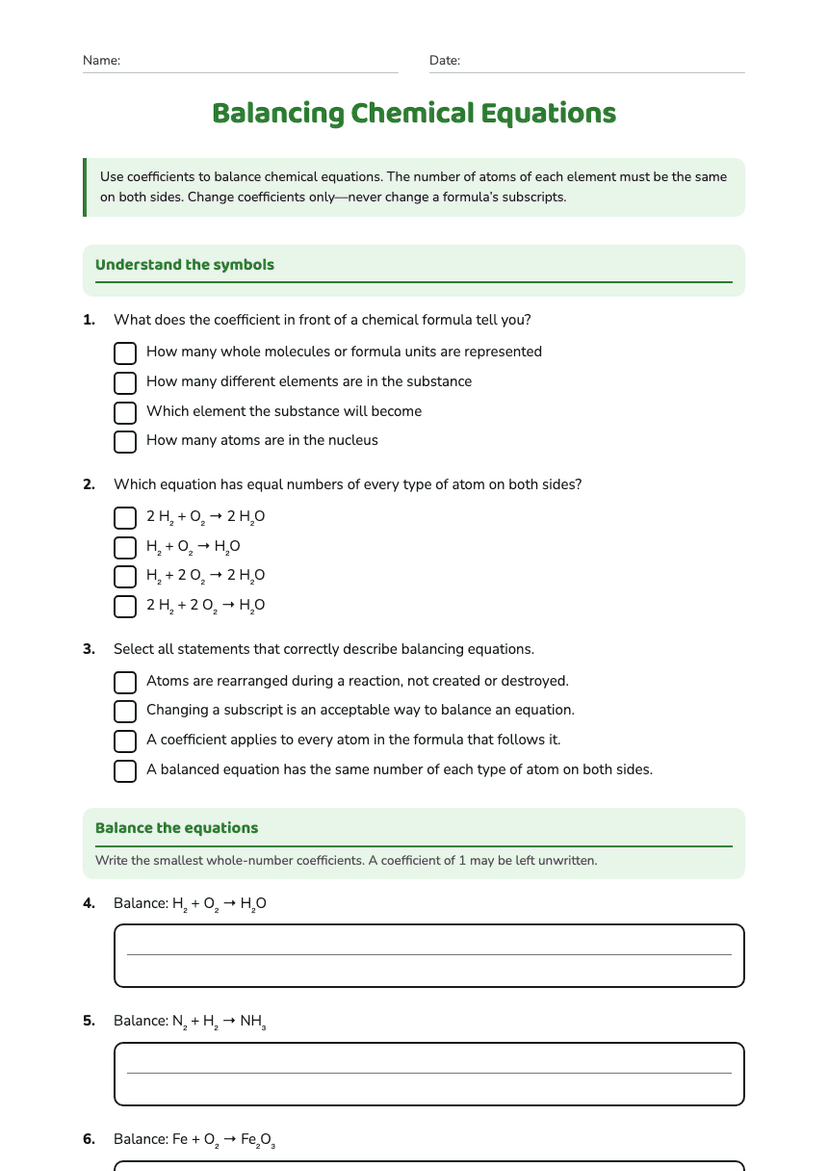
Year 7–8
Balancing Chemical Equations
Free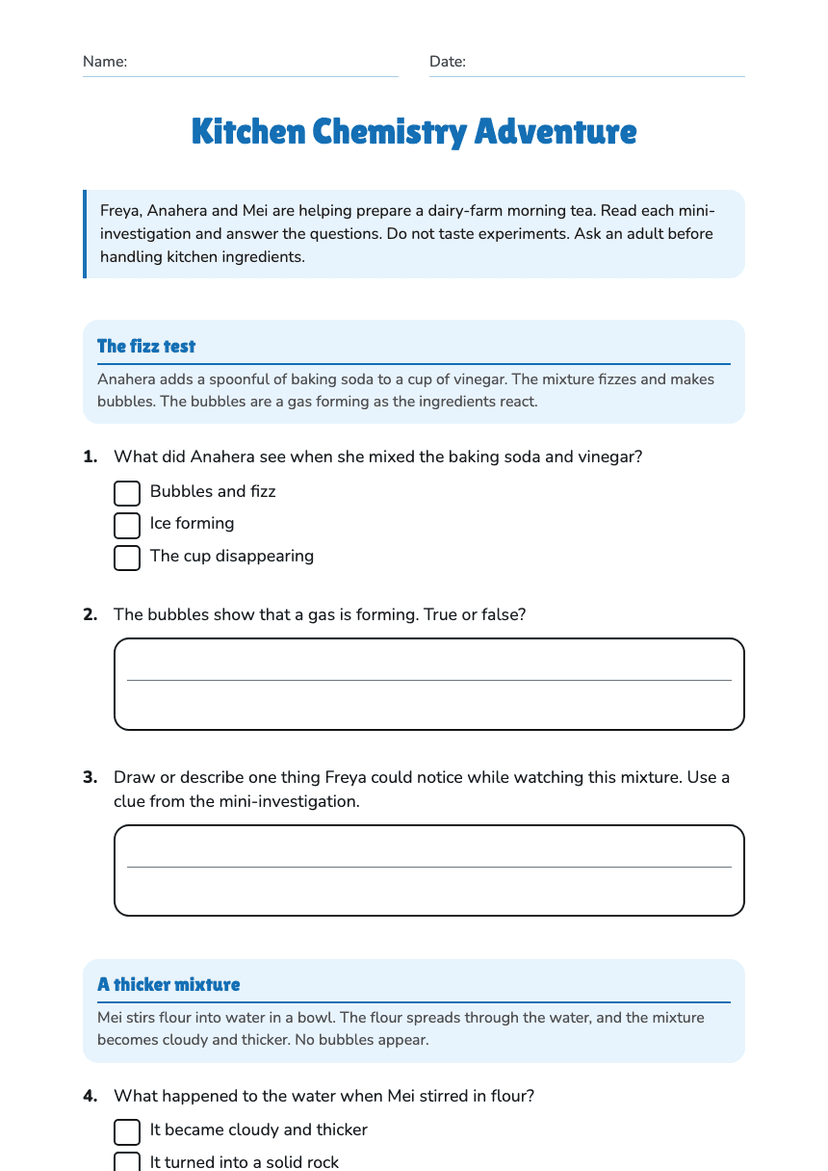
Year 2
Kitchen Chemistry Adventure
Free
Year 11
Chemical Reactions Introduction
Free
Year 9
Element Flashcards Worksheet
Free
Year 7–8