ScienceFreePrintable

Exploring Gravity's Universal Force

A free science worksheet ready for your classroom. Open in Kuraplan to grab the print-ready PDF, customize it for your students, or generate a fresh version in seconds.

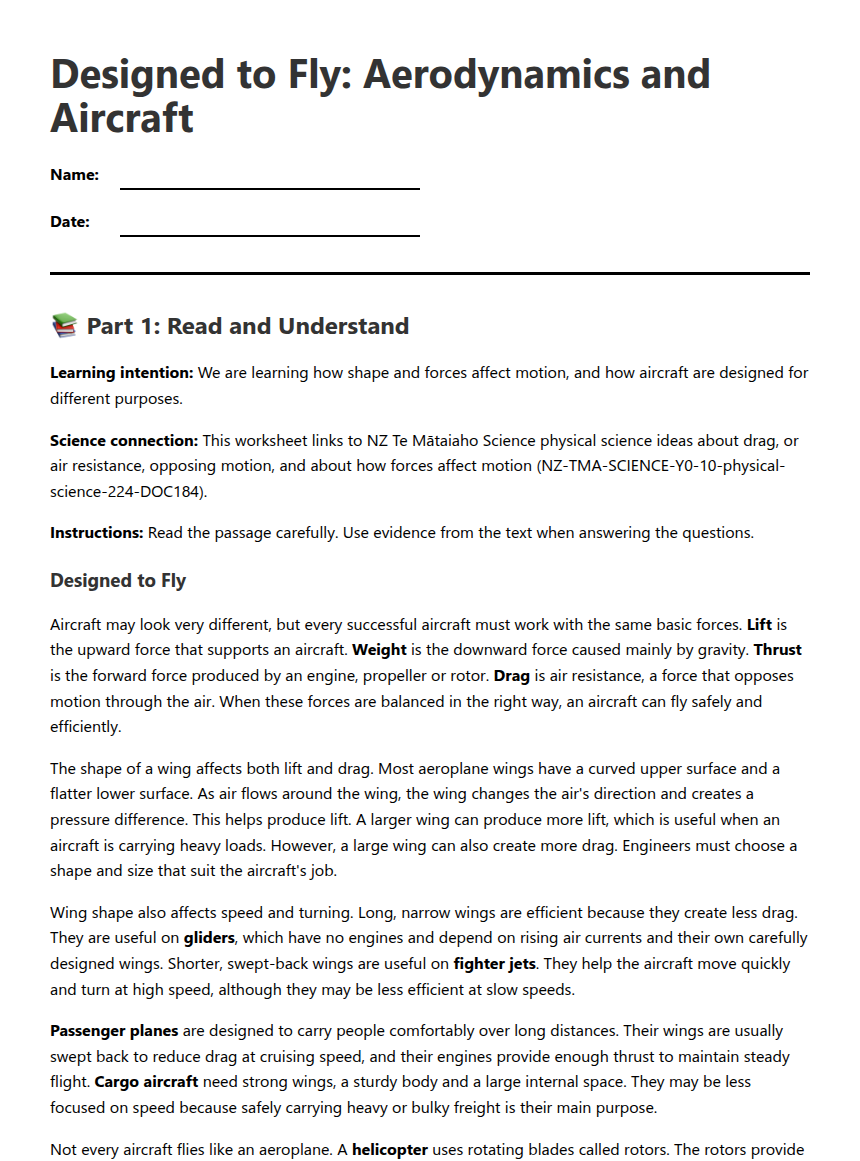
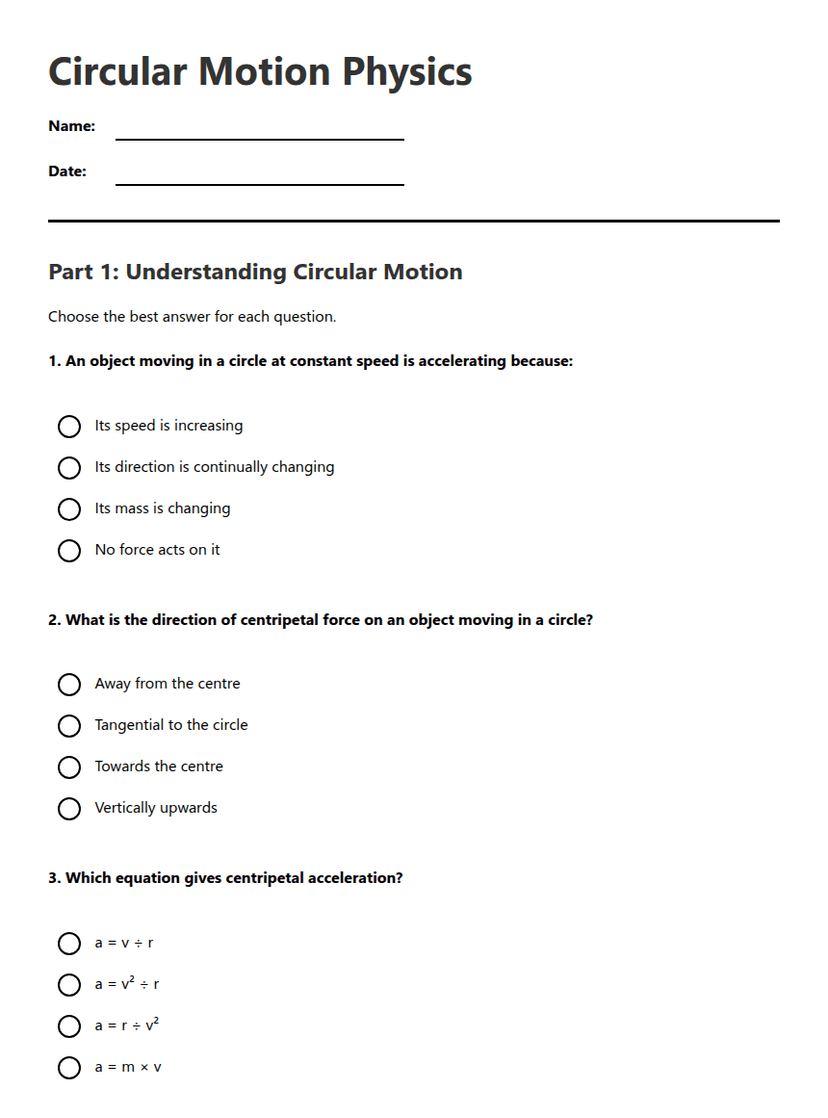
Exploring Gravity's Universal Force worksheet preview
Exploring Gravity's Universal Force

Exploring Gravity's Universal Force

Planets orbiting the sun showing gravitational forces

🌍 Part 1: Understanding Gravity

1. What is gravity?

A force that only affects objects on Earth

A universal force that affects all objects with mass

A force that only works in space

A magnetic force between planets

2. Which factors affect the strength of gravitational force? (Check all that apply)

The mass of the objects

The distance between objects

The colour of the objects

The temperature of the objects

3. Complete the sentence: The larger the mass of an object, the __________ its gravitational pull.

🌙 Part 2: Gravity and Celestial Bodies

4. Why doesn't the Moon float away from Earth?
5. What would happen to Earth's orbit if the Sun suddenly disappeared?

Earth would continue orbiting in the same path

Earth would move in a straight line through space

Earth would stop moving completely

Earth would spiral inward

6. Draw a diagram showing how gravity keeps planets in orbit around the Sun. Label the Sun, a planet, and the direction of gravitational force.

🌊 Part 3: Gravity's Effects on Earth

7. Fill in the blanks about tides:

Ocean tides are caused by the gravitational pull of the ________ and the ________. When the Moon is closest to Earth, we experience ________ tides. The gravitational force is ________ when objects are closer together.

8. Match the gravitational concepts with their descriptions:
1. Orbit
2. Mass
3. Gravitational pull
4. Celestial body
A. The amount of matter in an object
B. The force of attraction between objects
C. The path an object takes around another object
D. Natural objects in space like planets and stars

🚀 Part 4: Gravity in Action

9. Explain why astronauts float in space stations orbiting Earth, even though Earth's gravity is still affecting them.
10. If you could visit different planets, rank these planets from strongest to weakest gravitational pull (1 = strongest, 4 = weakest):

_____ Jupiter (mass: very large)

_____ Mars (mass: smaller than Earth)

_____ Earth (mass: medium)

_____ Mercury (mass: much smaller than Earth)

11. Calculate: If an object weighs 60 kg on Earth, approximately how much would it weigh on the Moon? (Moon's gravity is about 1/6 of Earth's gravity)
12. Critical thinking: How might understanding gravity be important for New Zealand's space industry and satellite technology?

About This Worksheet

Free in Kuraplan

Sign up free, grab the PDF, and customize it for your class.

Print-Ready

Formatted for standard paper. Clean layout, easy to read.

AI-Generated

Created with Kuraplan's AI, designed for real classroom use.

For Teachers & Parents

Use in classrooms, for homework, tutoring, or homeschool.

Need a custom version of this worksheet?

Kuraplan's AI generates custom worksheets in seconds — differentiated for every learner, aligned to your curriculum.

Generate Custom Worksheets — Free
No credit card Curriculum-aligned Under 60 seconds