ScienceFreePrintable

Forces and Motion Basics

A free science worksheet ready for your classroom. Open in Kuraplan to grab the print-ready PDF, customize it for your students, or generate a fresh version in seconds.
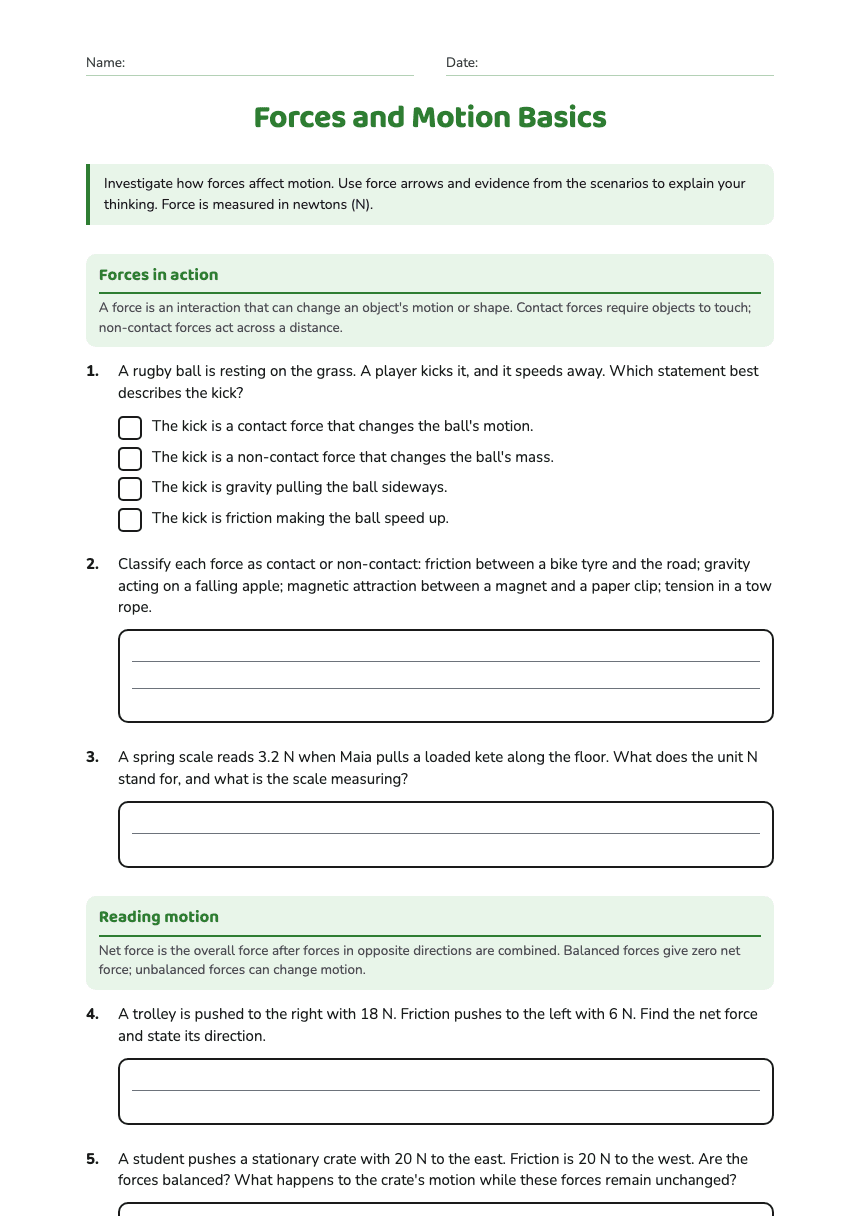
Forces and Motion Basics worksheet preview
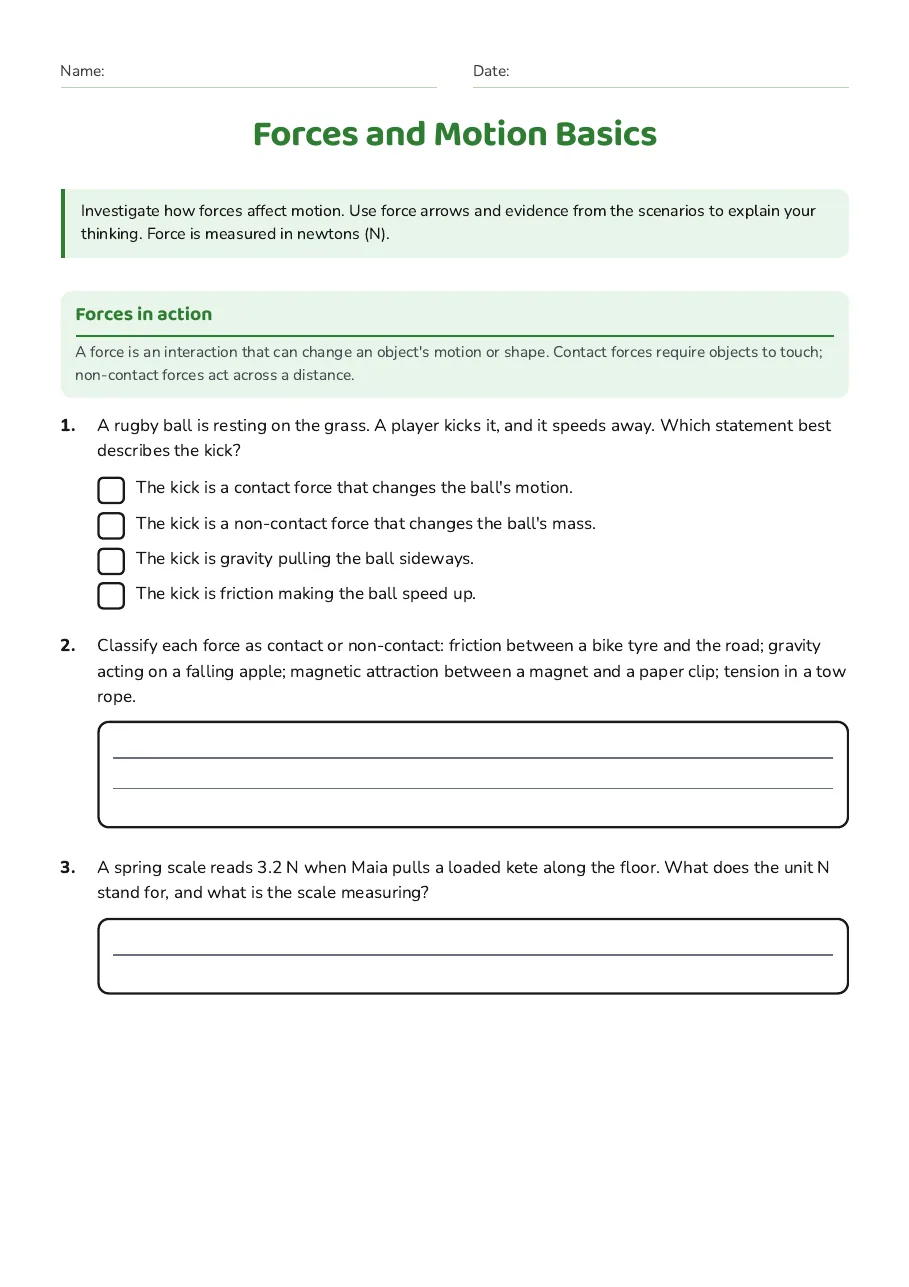
Name:Date:

Forces and Motion Basics

Investigate how forces affect motion. Use force arrows and evidence from the scenarios to explain your thinking. Force is measured in newtons (N).

Forces in action

A force is an interaction that can change an object's motion or shape. Contact forces require objects to touch; non-contact forces act across a distance.

1.A rugby ball is resting on the grass. A player kicks it, and it speeds away. Which statement best describes the kick?
  • The kick is a contact force that changes the ball's motion.
  • The kick is a non-contact force that changes the ball's mass.
  • The kick is gravity pulling the ball sideways.
  • The kick is friction making the ball speed up.
2.Classify each force as contact or non-contact: friction between a bike tyre and the road; gravity acting on a falling apple; magnetic attraction between a magnet and a paper clip; tension in a tow rope.
3.A spring scale reads 3.2 N when Maia pulls a loaded kete along the floor. What does the unit N stand for, and what is the scale measuring?

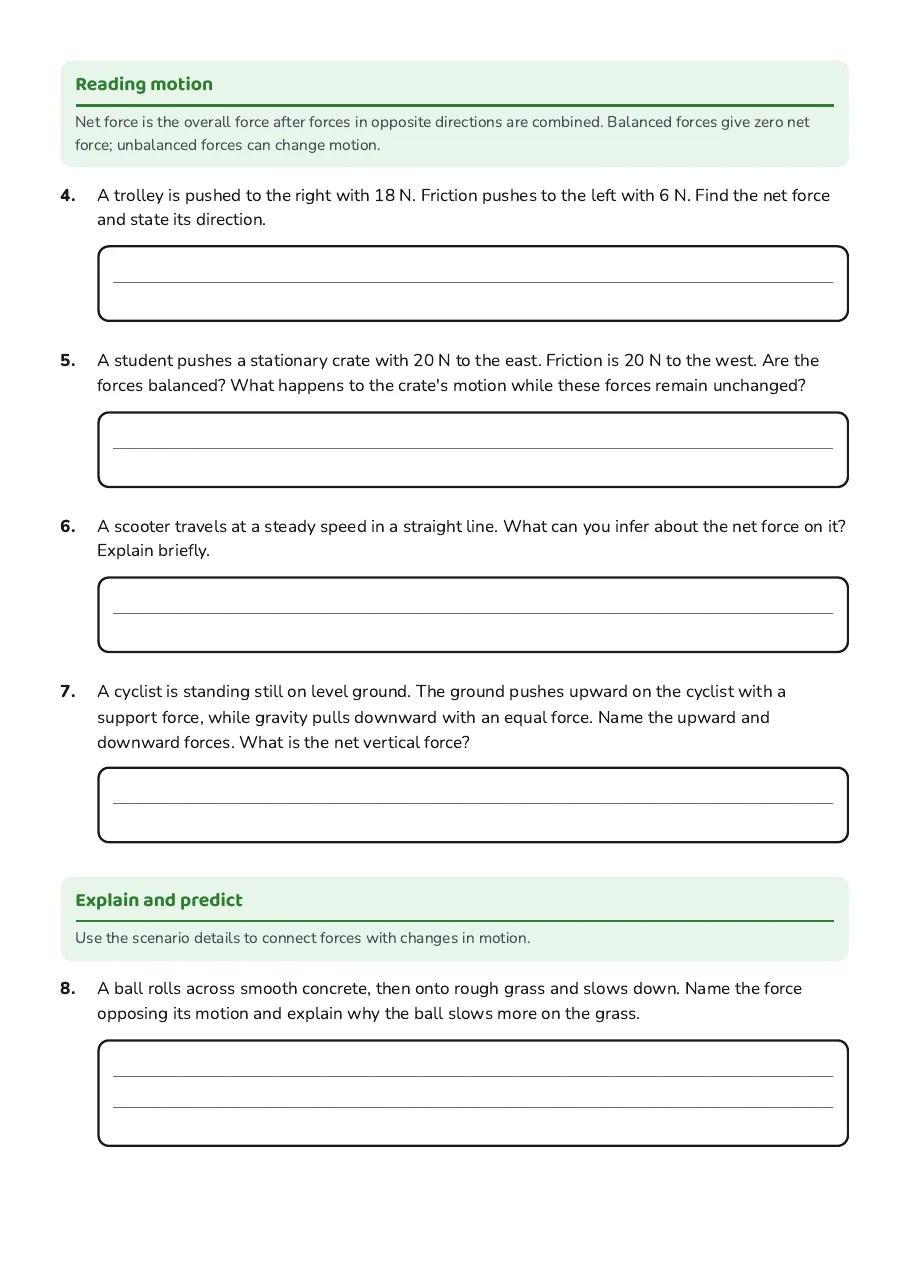
Reading motion

Net force is the overall force after forces in opposite directions are combined. Balanced forces give zero net force; unbalanced forces can change motion.

4.A trolley is pushed to the right with 18 N. Friction pushes to the left with 6 N. Find the net force and state its direction.
5.A student pushes a stationary crate with 20 N to the east. Friction is 20 N to the west. Are the forces balanced? What happens to the crate's motion while these forces remain unchanged?
6.A scooter travels at a steady speed in a straight line. What can you infer about the net force on it? Explain briefly.
7.A cyclist is standing still on level ground. The ground pushes upward on the cyclist with a support force, while gravity pulls downward with an equal force. Name the upward and downward forces. What is the net vertical force?

Explain and predict

Use the scenario details to connect forces with changes in motion.

8.A ball rolls across smooth concrete, then onto rough grass and slows down. Name the force opposing its motion and explain why the ball slows more on the grass.
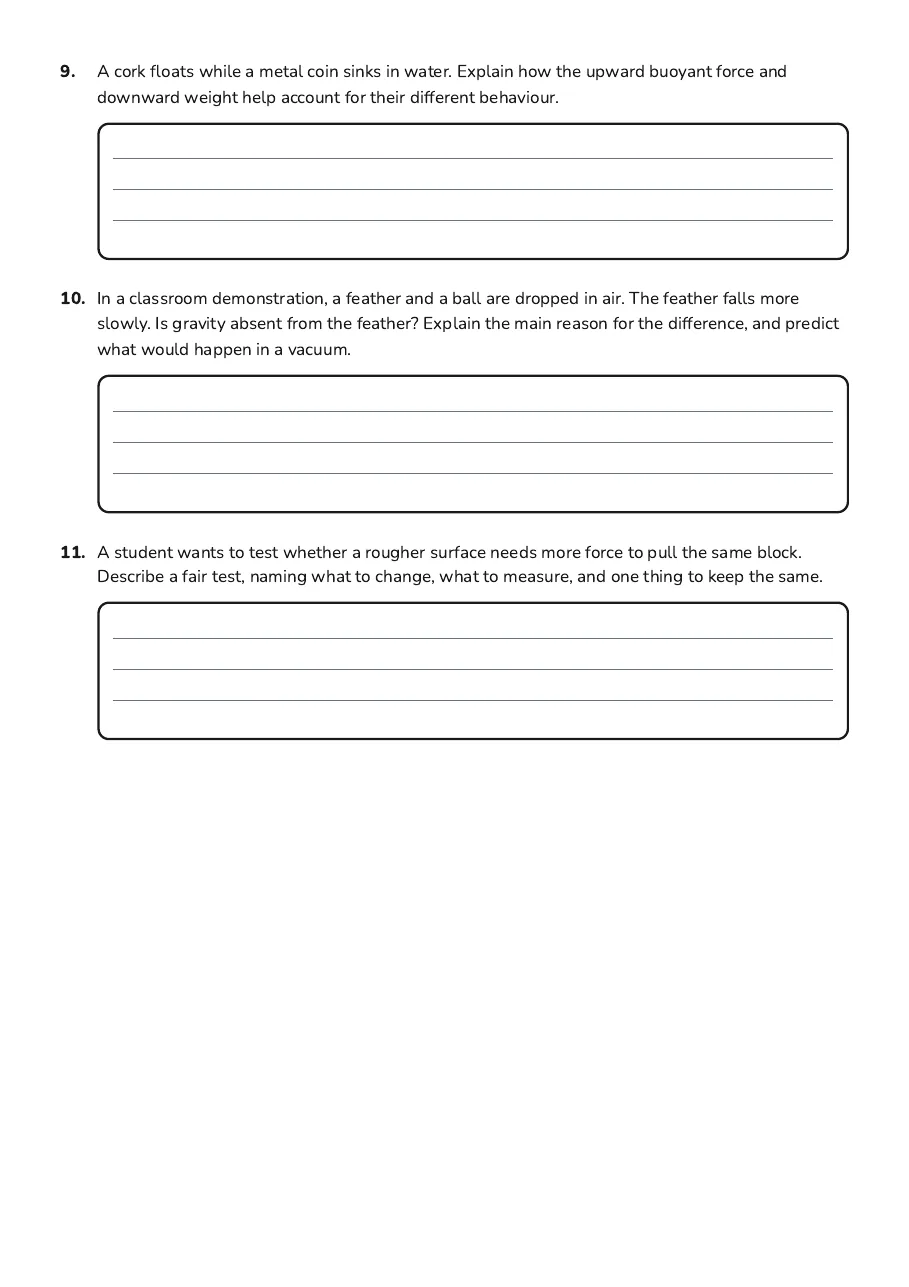
9.A cork floats while a metal coin sinks in water. Explain how the upward buoyant force and downward weight help account for their different behaviour.
10.In a classroom demonstration, a feather and a ball are dropped in air. The feather falls more slowly. Is gravity absent from the feather? Explain the main reason for the difference, and predict what would happen in a vacuum.
11.A student wants to test whether a rougher surface needs more force to pull the same block. Describe a fair test, naming what to change, what to measure, and one thing to keep the same.

3 printable pages

  • Forces and Motion Basics, page 1 of 3: Forces in action

    Page 1

  • Forces and Motion Basics, page 2 of 3: Reading motion, Explain and predict

    Page 2

  • Forces and Motion Basics, page 3 of 3: 9. A cork floats while a metal coin sinks in water. Explain how the upward buoyant force…

    Page 3

About This Worksheet

Free in Kuraplan

Sign up free, grab the PDF, and customize it for your class.

Print-Ready

Formatted for standard paper. Clean layout, easy to read.

AI-Generated

Created with Kuraplan's AI, designed for real classroom use.

For Teachers & Parents

Use in classrooms, for homework, tutoring, or homeschool.

Need a custom version of this worksheet?

Kuraplan's AI generates custom worksheets in seconds — differentiated for every learner, aligned to your curriculum.

Generate Custom Worksheets — Free
No credit card Curriculum-aligned Under 60 seconds