ScienceFreePrintable

Forces and Motion Concepts

A free science worksheet ready for your classroom. Open in Kuraplan to grab the print-ready PDF, customize it for your students, or generate a fresh version in seconds.
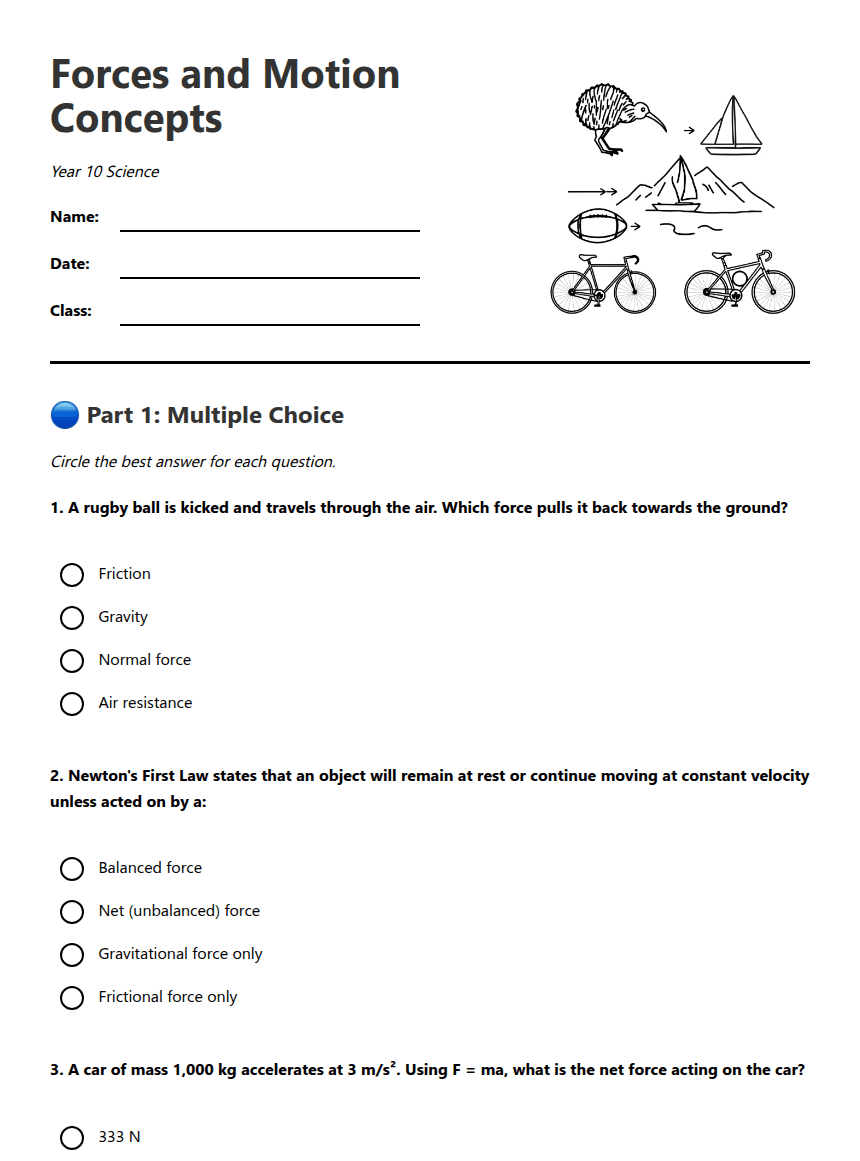
Forces and Motion Concepts worksheet preview

Forces and Motion Concepts

Year 10 Science
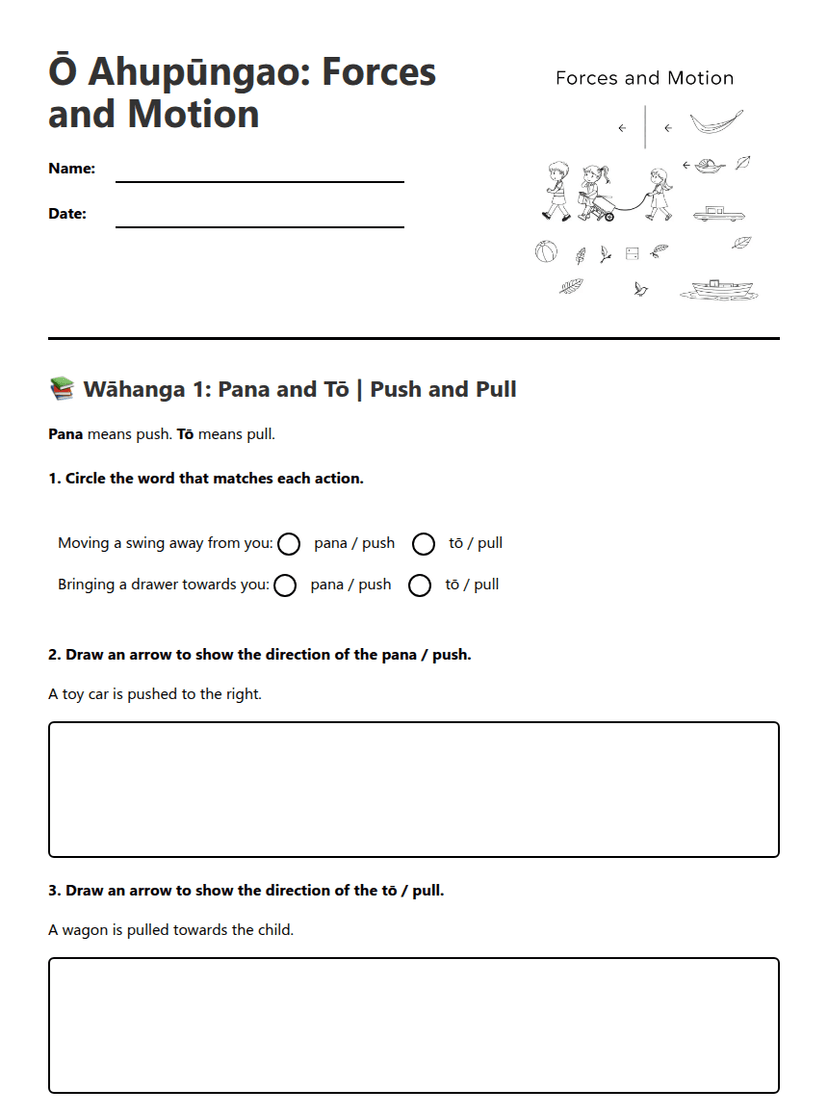
Forces and motion illustration

🔵 Part 1: Multiple Choice

Circle the best answer for each question.

1. A rugby ball is kicked and travels through the air. Which force pulls it back towards the ground?

Friction

Gravity

Normal force

Air resistance

2. Newton's First Law states that an object will remain at rest or continue moving at constant velocity unless acted on by a:

Balanced force

Net (unbalanced) force

Gravitational force only

Frictional force only

3. A car of mass 1,000 kg accelerates at 3 m/s². Using F = ma, what is the net force acting on the car?

333 N

1,003 N

3,000 N

30,000 N

4. Which of the following correctly describes velocity?

How fast an object is moving, with no direction

How fast an object is moving in a specific direction

The change in speed over time

The total distance covered by an object

5. Select ALL the contact forces from the list below:

Friction

Gravity

Normal force

Magnetism

Air resistance

✏️ Part 2: Short Answer

Answer each question clearly and in full sentences where required.

6. A cyclist travels 24 km in 1.5 hours. Calculate their average speed in km/h. Show your working.
7. A skateboard and rider have a combined mass of 60 kg. A force of 120 N is applied. Calculate the acceleration using F = ma. Show your working.
8. In your own words, explain Newton's Third Law of Motion. Give a real-life example from everyday New Zealand life to support your answer.
9. Explain the difference between speed and acceleration. Use units in your answer.

📈 Part 3: Graph Interpretation

Study the distance-time graph description below and answer the questions.

A student walks to school. The graph of their journey shows:
0–5 minutes: Distance increases steadily from 0 m to 500 m
5–8 minutes: Distance stays constant at 500 m
8–12 minutes: Distance increases steeply from 500 m to 1,200 m

10. What was the student doing between 5 and 8 minutes? How do you know from the graph?
11. During which section (0–5 min or 8–12 min) was the student moving faster? Calculate the speed for each section to justify your answer.
12. In the space below, sketch what a distance-time graph would look like for an object that is accelerating. Label your axes with correct units.

About This Worksheet

Free in Kuraplan

Sign up free, grab the PDF, and customize it for your class.

Print-Ready

Formatted for standard paper. Clean layout, easy to read.

AI-Generated

Created with Kuraplan's AI, designed for real classroom use.

For Teachers & Parents

Use in classrooms, for homework, tutoring, or homeschool.

Need a custom version of this worksheet?

Kuraplan's AI generates custom worksheets in seconds — differentiated for every learner, aligned to your curriculum.

Generate Custom Worksheets — Free
No credit card Curriculum-aligned Under 60 seconds