Formal vs. Non-Formal Writing
A free english worksheet ready for your classroom. Open in Kuraplan to grab the print-ready PDF, customize it for your students, or generate a fresh version in seconds.
Formal vs. Non-Formal Writing
Worksheet 1: Exploring Formal Writing
📖 Read the Text
Read the following formal text, then answer the questions below.
Sample Formal Text:
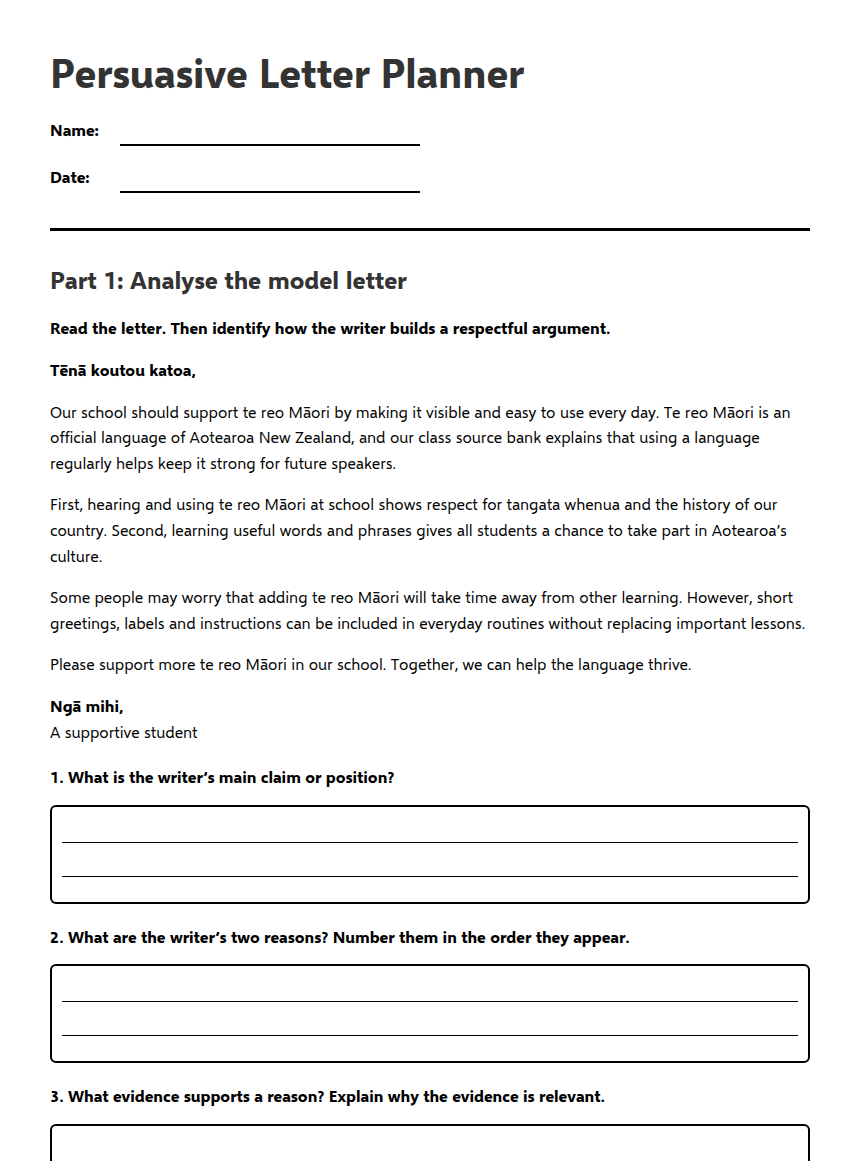
Dear Principal Tane,
I am writing to respectfully request permission to organise a school fundraiser for the Kaikōura Wildlife Trust. The event would take place on Friday, 14th June, and would involve students participating in a sponsored walk around the school grounds. All funds raised would be donated directly to support native bird conservation efforts in the South Island.
I believe this initiative would benefit both the school community and the environment. I would appreciate your consideration of this proposal.
Yours sincerely,
Aroha Ngata, Year 7
✅ Part 1: Identify the Features
✏️ Part 2: Write and Reflect
Difference 1: _________________________________________________________________________
Difference 2: _________________________________________________________________________
"Hey, can we pleeease do a fundraiser? It'd be so cool and help heaps of birds!!"
Formal vs. Non-Formal Writing
Worksheet 2: Exploring Non-Formal Writing
📖 Read the Text
Read the following non-formal text, then answer the questions below.
Sample Non-Formal Text (Group Chat Message):
Omg guys!! 😄 So I had this idea – what if we do a sponsored walk at school to raise money for those kiwi birds up in Kaikōura?? It'd be SO fun and we could totally get heaps of people involved. I already asked Mrs H and she reckons it's a great idea lol. We just need someone to talk to the principal about it. Who's keen?? Hit me up after school!! 🐦🙌
✅ Part 1: Identify the Features
✏️ Part 2: Write and Reflect
Non-Formal Phrases:
A. "Who's keen?" B. "Hit me up" C. "Heaps of people" D. "reckons it's a great idea"
___ "Please contact me"
___ "believes it is an excellent idea"
___ "a large number of students"
___ "Who would like to participate?"
About This Worksheet
Free in Kuraplan
Sign up free, grab the PDF, and customize it for your class.
Print-Ready
Formatted for standard paper. Clean layout, easy to read.
AI-Generated
Created with Kuraplan's AI, designed for real classroom use.
For Teachers & Parents
Use in classrooms, for homework, tutoring, or homeschool.
Need a custom version of this worksheet?
Kuraplan's AI generates custom worksheets in seconds — differentiated for every learner, aligned to your curriculum.
Generate Custom Worksheets — Free