Future of Space Exploration
A free science worksheet ready for your classroom. Open in Kuraplan to grab the print-ready PDF, customize it for your students, or generate a fresh version in seconds.
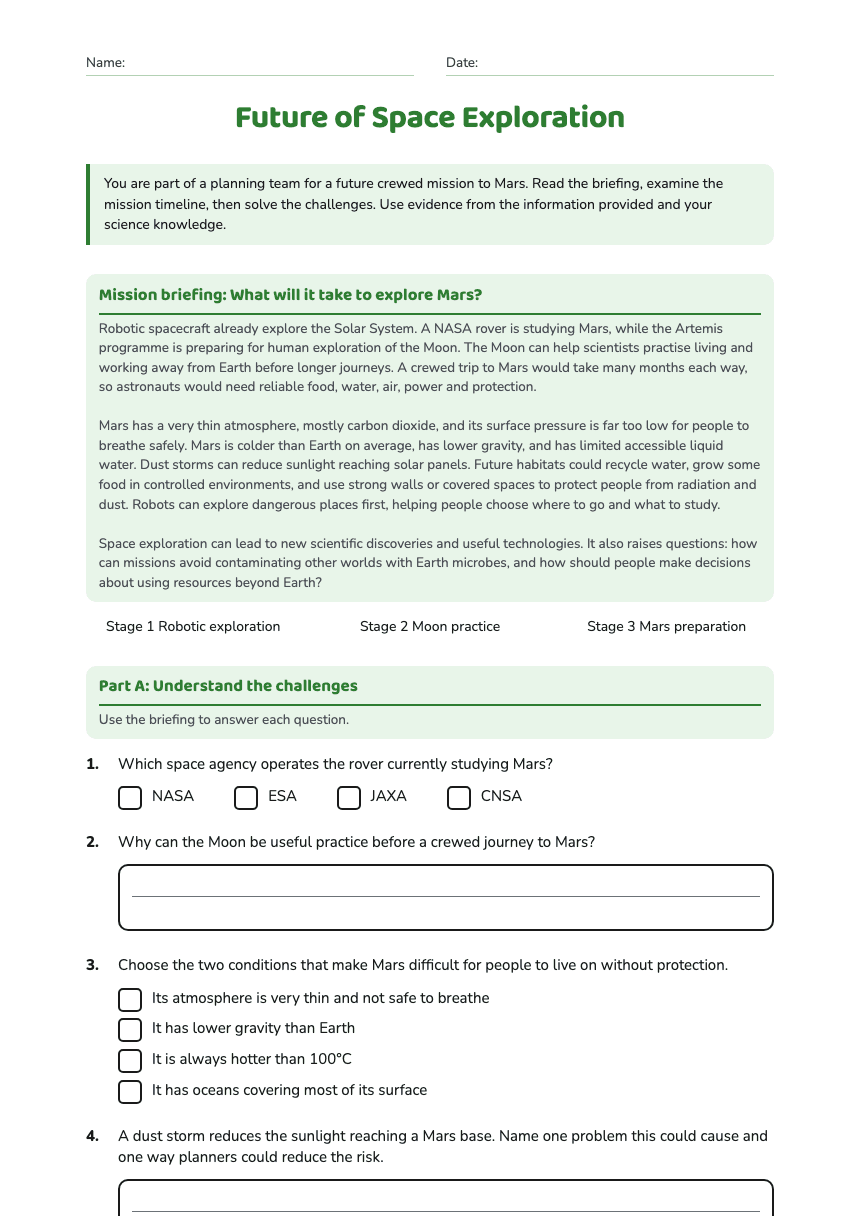
Future of Space Exploration
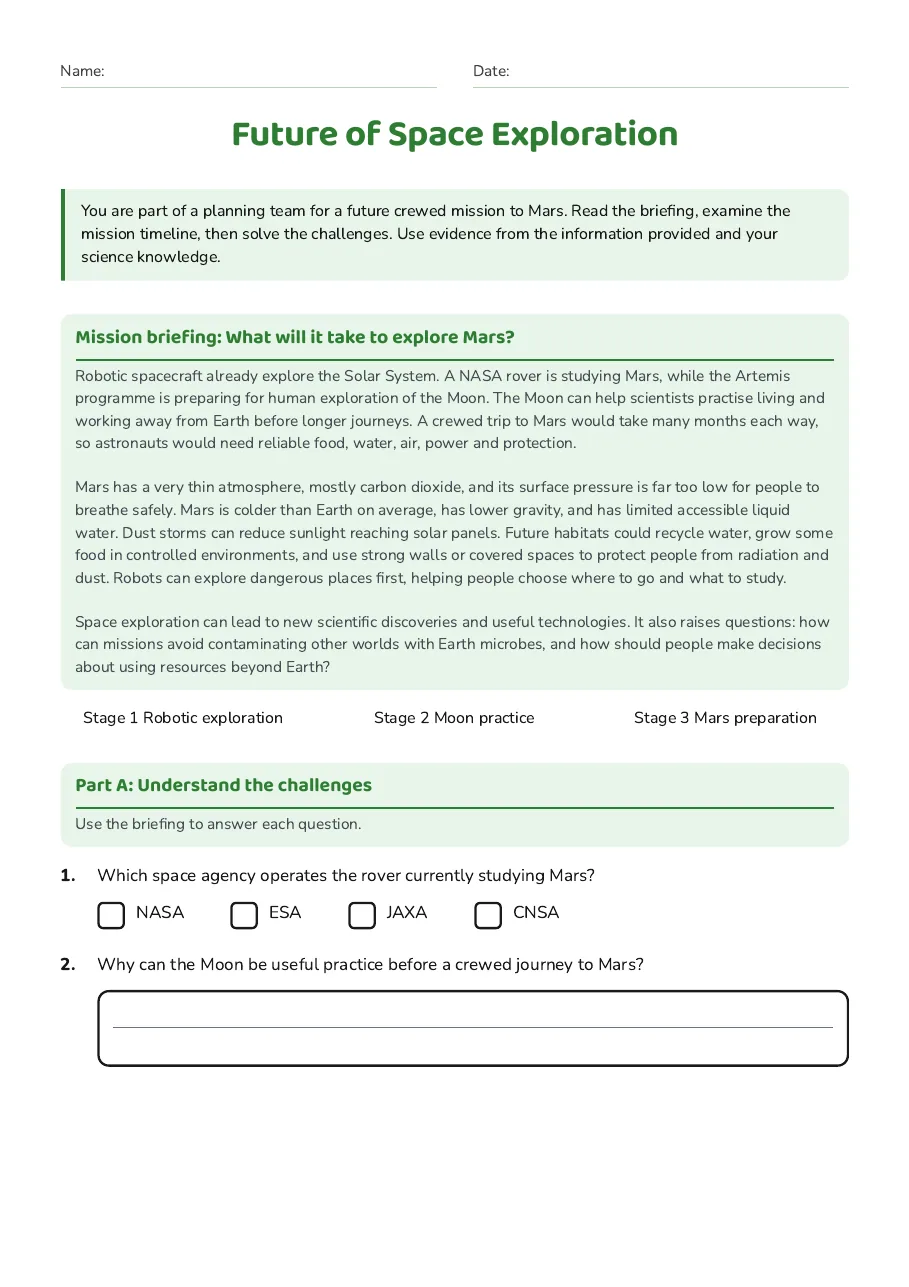
Mission briefing: What will it take to explore Mars?
Robotic spacecraft already explore the Solar System. A NASA rover is studying Mars, while the Artemis programme is preparing for human exploration of the Moon. The Moon can help scientists practise living and working away from Earth before longer journeys. A crewed trip to Mars would take many months each way, so astronauts would need reliable food, water, air, power and protection. Mars has a very thin atmosphere, mostly carbon dioxide, and its surface pressure is far too low for people to breathe safely. Mars is colder than Earth on average, has lower gravity, and has limited accessible liquid water. Dust storms can reduce sunlight reaching solar panels. Future habitats could recycle water, grow some food in controlled environments, and use strong walls or covered spaces to protect people from radiation and dust. Robots can explore dangerous places first, helping people choose where to go and what to study. Space exploration can lead to new scientific discoveries and useful technologies. It also raises questions: how can missions avoid contaminating other worlds with Earth microbes, and how should people make decisions about using resources beyond Earth?
Stage 1 Robotic exploration
Stage 2 Moon practice
Stage 3 Mars preparation
Part A: Understand the challenges
Use the briefing to answer each question.
- NASA
- ESA
- JAXA
- CNSA
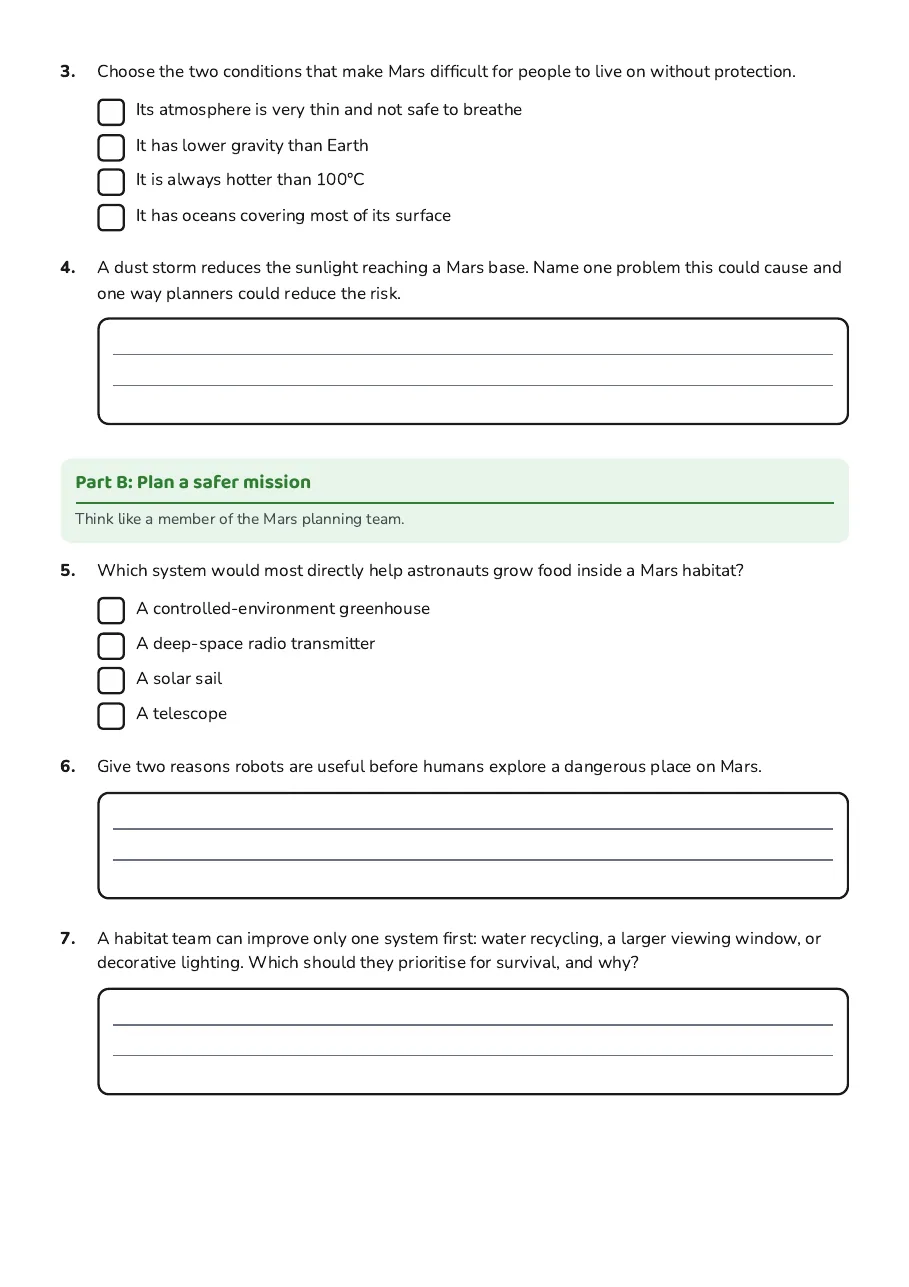
- Its atmosphere is very thin and not safe to breathe
- It has lower gravity than Earth
- It is always hotter than 100°C
- It has oceans covering most of its surface
Part B: Plan a safer mission
Think like a member of the Mars planning team.
- A controlled-environment greenhouse
- A deep-space radio transmitter
- A solar sail
- A telescope
4 printable pages
Page 1
Page 2
Page 3

Page 4
About This Worksheet
Free in Kuraplan
Sign up free, grab the PDF, and customize it for your class.
Print-Ready
Formatted for standard paper. Clean layout, easy to read.
AI-Generated
Created with Kuraplan's AI, designed for real classroom use.
For Teachers & Parents
Use in classrooms, for homework, tutoring, or homeschool.
Need a custom version of this worksheet?
Kuraplan's AI generates custom worksheets in seconds — differentiated for every learner, aligned to your curriculum.
Generate Custom Worksheets — Free