Geometry and Angles Pre-Test
A free maths worksheet ready for your classroom. Open in Kuraplan to grab the print-ready PDF, customize it for your students, or generate a fresh version in seconds.
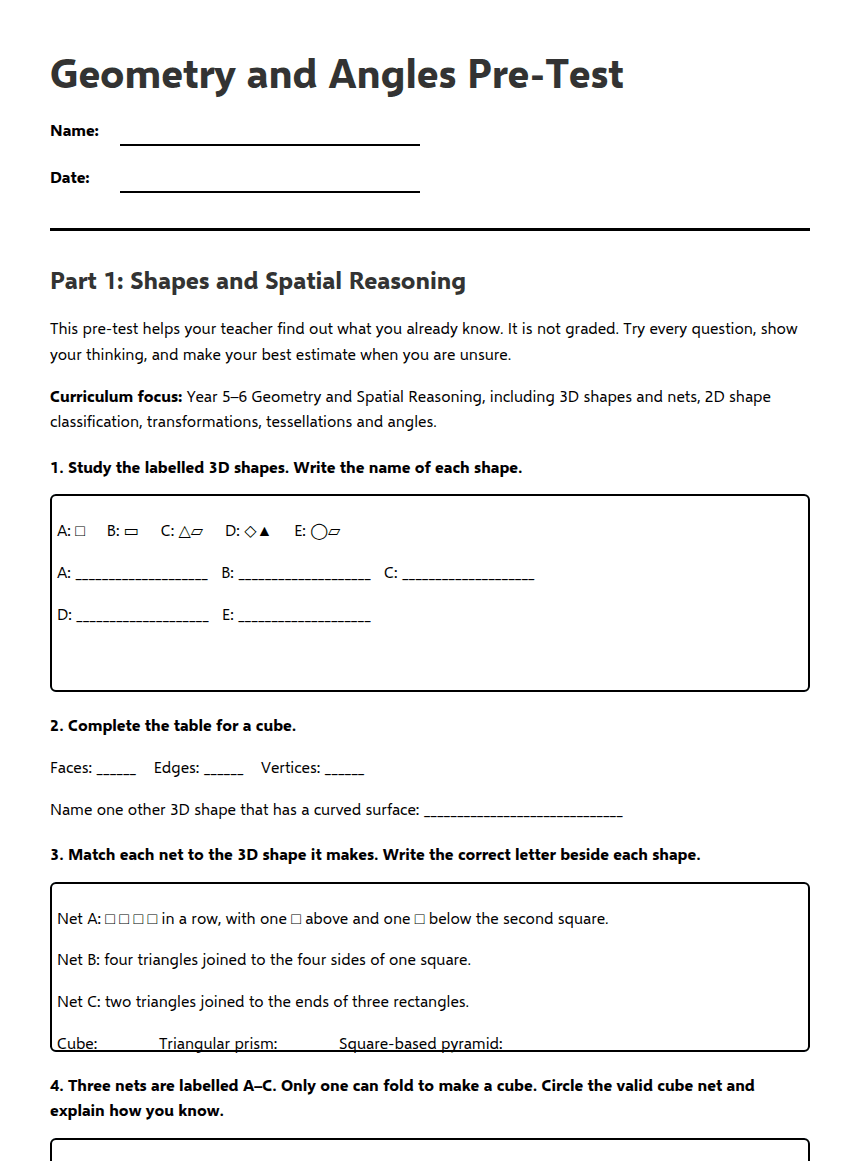
Geometry and Angles Pre-Test
Part 1: Shapes and Spatial Reasoning
This pre-test helps your teacher find out what you already know. It is not graded. Try every question, show your thinking, and make your best estimate when you are unsure.
Curriculum focus: Year 5–6 Geometry and Spatial Reasoning, including 3D shapes and nets, 2D shape classification, transformations, tessellations and angles.
A: □ B: ▭ C: △▱ D: ◇▲ E: ◯▱
A: ____________________ B: ____________________ C: ____________________
D: ____________________ E: ____________________
Faces: ______ Edges: ______ Vertices: ______
Name one other 3D shape that has a curved surface: ______________________________
Net A: □ □ □ □ in a row, with one □ above and one □ below the second square.
Net B: four triangles joined to the four sides of one square.
Net C: two triangles joined to the ends of three rectangles.
Cube: ______ Triangular prism: ______ Square-based pyramid: ______
A: □ □ □ □ □ □ in one straight row
B: □ □ □ □ in a row, with one □ above the second and one □ below the third
C: □ □ □ □ in a row, with both extra squares above the second
Valid net: A B C
Explanation: ____________________________________________________________
Part 2: 2D Shapes, Transformations and Angles
1: ▱ 2: ▭ 3: ▱ 4: □ 5: ◇ 6: ◈
1: ____________________ 2: ____________________ 3: ____________________
4: ____________________ 5: ____________________ 6: ____________________
Lines that stay the same distance apart are __________________ lines.
Lines that meet at a right angle are __________________ lines.
Give one example of parallel lines in the classroom: ______________________________
A: △ with three equal sides B: △ with two equal sides
C: △ with three different sides D: △ with one square corner
A: ____________________ B: ____________________ C: ____________________ D: ____________________
Grid: □ □ □ | □ □ □
□ ■ □ | □ □ □
□ ■ ■ | □ □ □
□ □ □ | □ □ □
The vertical line is shown by |. Draw the reflection on the right side.
Moving a shape without turning or flipping it is called a __________________.
Turning a shape around a point is called a __________________.
Name one shape that can tessellate on its own: ______________________________
A: ∠ 45° B: ∟ 90° C: ∠ 120° D: ⟳ 270°
A: ____________________ B: ____________________ C: ____________________ D: ____________________
a. A quarter turn is ______ degrees. A half turn is ______ degrees. A full turn is ______ degrees.
b. Angles on a straight line add to 180°. If one angle is 65°, the unknown angle is ______°.
c. Angles in a triangle add to 180°. Two angles are 50° and 60°. The unknown angle is ______°.
Confidence reflection
Circle one for each statement.
I can name and describe 3D shapes: Confident Almost there Need help
I can classify 2D shapes and triangles: Confident Almost there Need help
I can describe transformations and angles: Confident Almost there Need help
The topic I would most like to practise is:
Teacher Answer Key
Purpose: This pre-test is for baseline information. Use responses to plan teaching and support; it is not intended to be graded.
1. A cube; B rectangular prism; C triangular prism; D square-based pyramid; E cylinder.
2. 6 faces, 12 edges, 8 vertices. Example curved-surface shape: cylinder, cone or sphere.
3. Cube: A; triangular prism: C; square-based pyramid: B.
4. B is the intended valid net. Accept a clear explanation that the six squares fold to make all six faces of a cube without overlapping.
5. Similarity: both have flat faces, edges and vertices, or both have a repeated base. Difference: a prism has two matching parallel bases; a pyramid has one base and triangular faces meeting at one vertex.
6. 1 trapezium; 2 rectangle; 3 parallelogram; 4 square; 5 rhombus; 6 kite.
7. Parallel; perpendicular. Accept suitable classroom examples, such as opposite edges of a book for parallel lines.
8. A equilateral; B isosceles; C scalene; D right-angled.
9. The reflected shape is the same distance from the mirror line on the right. Translation; rotation.
10. Accept any accurate repeating tessellation with no gaps or overlaps. Examples include squares, equilateral triangles or regular hexagons.
11. A acute; B right; C obtuse; D reflex.
12. a. 90°, 180°, 360°. b. 115°. c. 70°.
About This Worksheet
Free in Kuraplan
Sign up free, grab the PDF, and customize it for your class.
Print-Ready
Formatted for standard paper. Clean layout, easy to read.
AI-Generated
Created with Kuraplan's AI, designed for real classroom use.
For Teachers & Parents
Use in classrooms, for homework, tutoring, or homeschool.
Need a custom version of this worksheet?
Kuraplan's AI generates custom worksheets in seconds — differentiated for every learner, aligned to your curriculum.
Generate Custom Worksheets — Free