Government Roles and Society
A free social sciences worksheet ready for your classroom. Open in Kuraplan to grab the print-ready PDF, customize it for your students, or generate a fresh version in seconds.
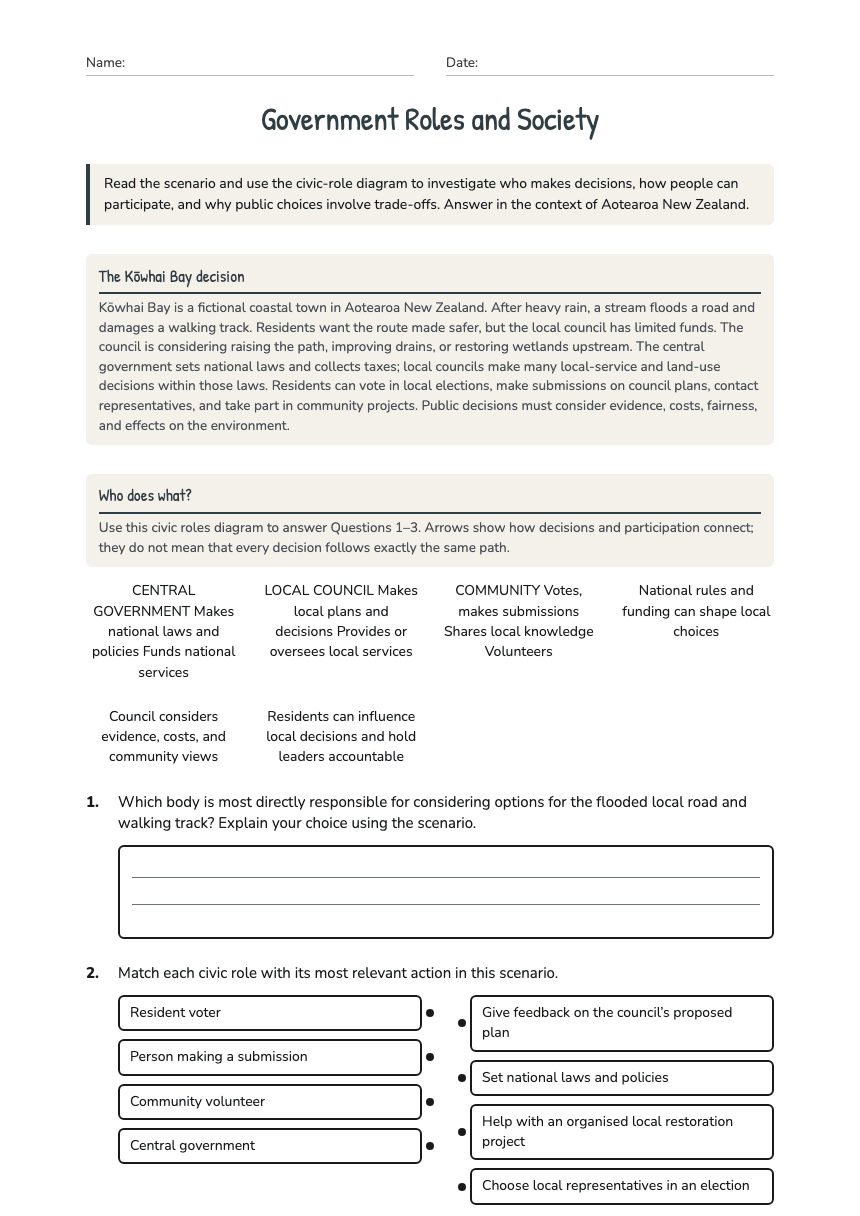
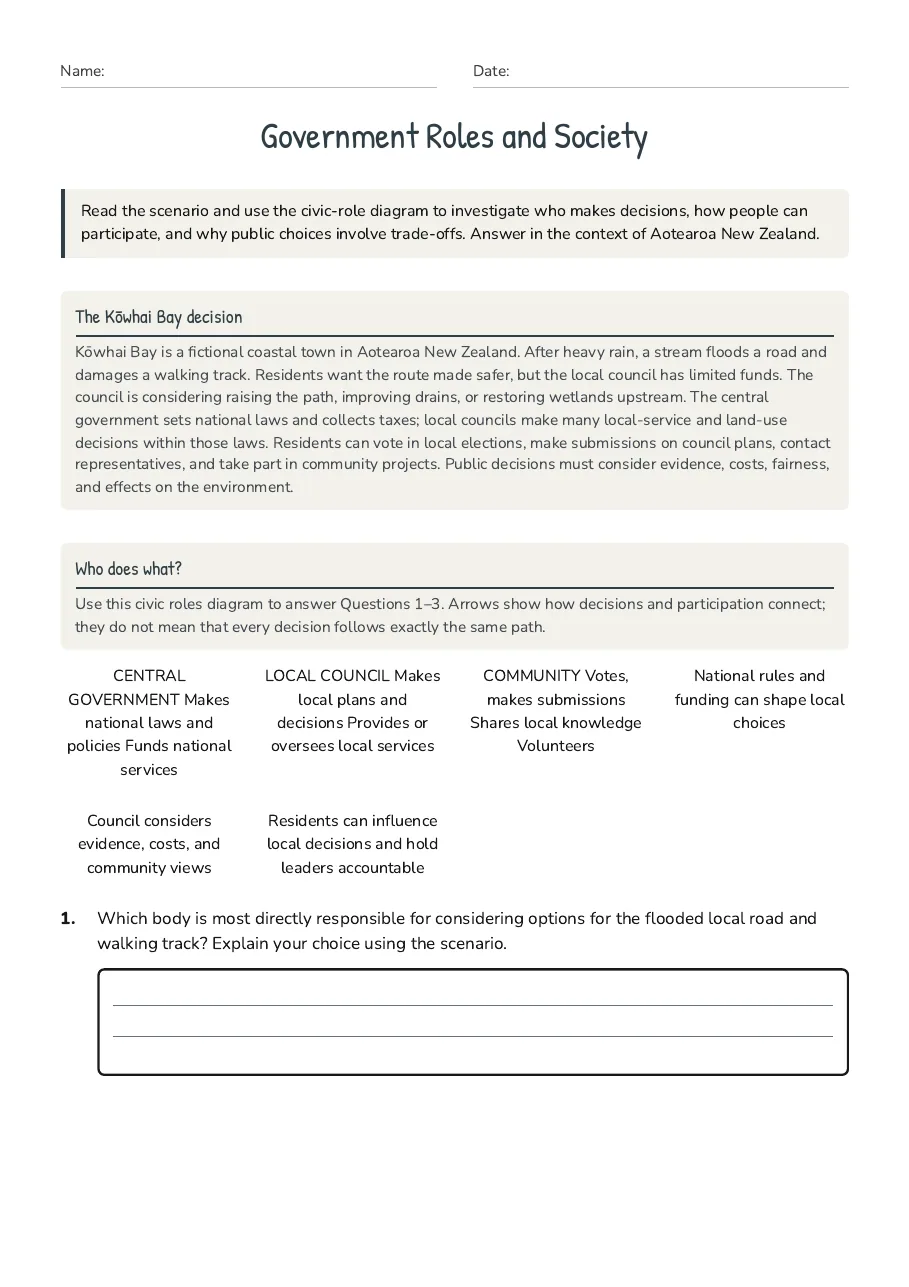
Government Roles and Society
The Kōwhai Bay decision
Kōwhai Bay is a fictional coastal town in Aotearoa New Zealand. After heavy rain, a stream floods a road and damages a walking track. Residents want the route made safer, but the local council has limited funds. The council is considering raising the path, improving drains, or restoring wetlands upstream. The central government sets national laws and collects taxes; local councils make many local-service and land-use decisions within those laws. Residents can vote in local elections, make submissions on council plans, contact representatives, and take part in community projects. Public decisions must consider evidence, costs, fairness, and effects on the environment.
Who does what?
Use this civic roles diagram to answer Questions 1–3. Arrows show how decisions and participation connect; they do not mean that every decision follows exactly the same path.
CENTRAL GOVERNMENT Makes national laws and policies Funds national services
LOCAL COUNCIL Makes local plans and decisions Provides or oversees local services
COMMUNITY Votes, makes submissions Shares local knowledge Volunteers
National rules and funding can shape local choices
Council considers evidence, costs, and community views
Residents can influence local decisions and hold leaders accountable
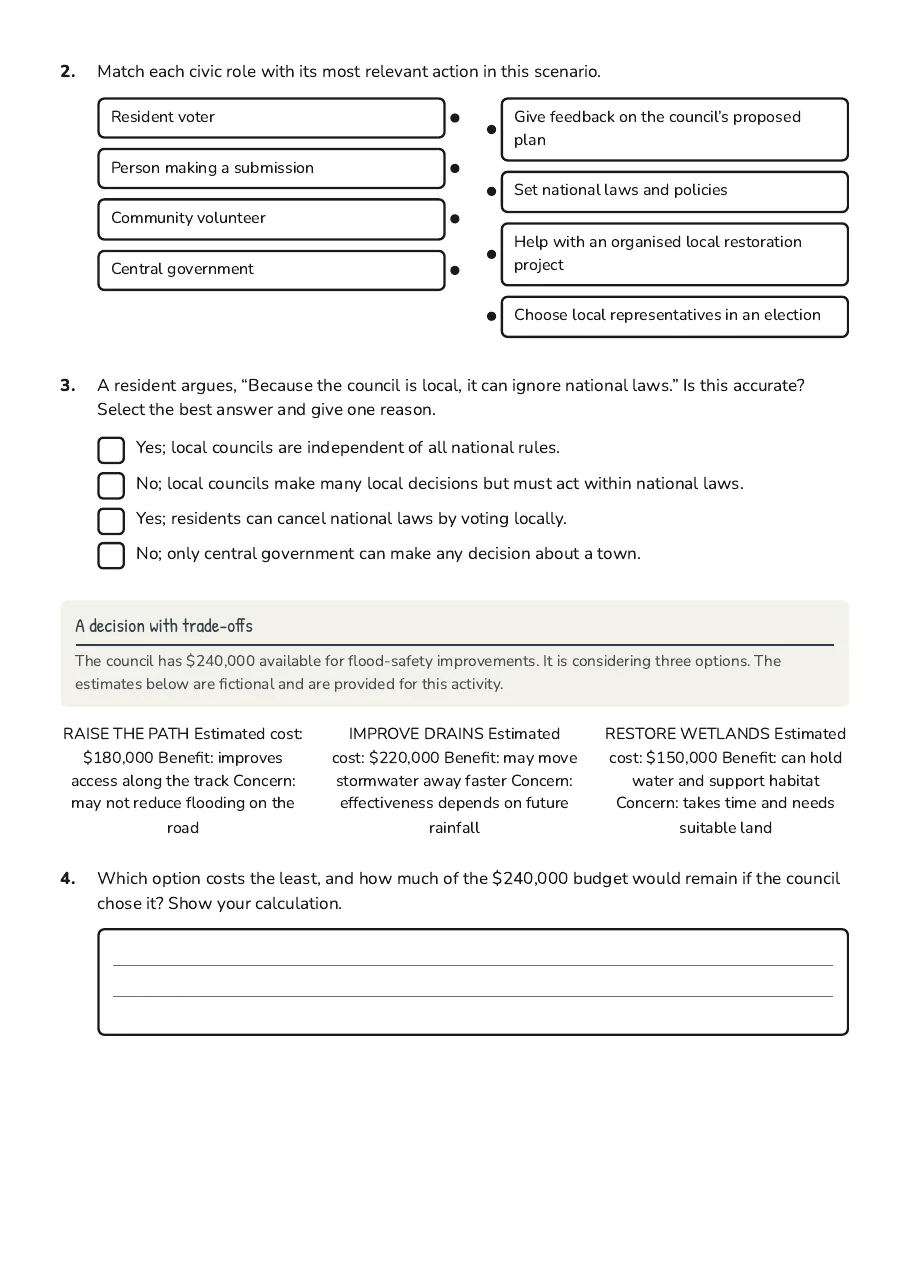
- Resident voter
- Person making a submission
- Community volunteer
- Central government
- Give feedback on the council’s proposed plan
- Set national laws and policies
- Help with an organised local restoration project
- Choose local representatives in an election
- Yes; local councils are independent of all national rules.
- No; local councils make many local decisions but must act within national laws.
- Yes; residents can cancel national laws by voting locally.
- No; only central government can make any decision about a town.
A decision with trade-offs
The council has $240,000 available for flood-safety improvements. It is considering three options. The estimates below are fictional and are provided for this activity.
RAISE THE PATH Estimated cost: $180,000 Benefit: improves access along the track Concern: may not reduce flooding on the road
IMPROVE DRAINS Estimated cost: $220,000 Benefit: may move stormwater away faster Concern: effectiveness depends on future rainfall
RESTORE WETLANDS Estimated cost: $150,000 Benefit: can hold water and support habitat Concern: takes time and needs suitable land
3 printable pages
Page 1
Page 2
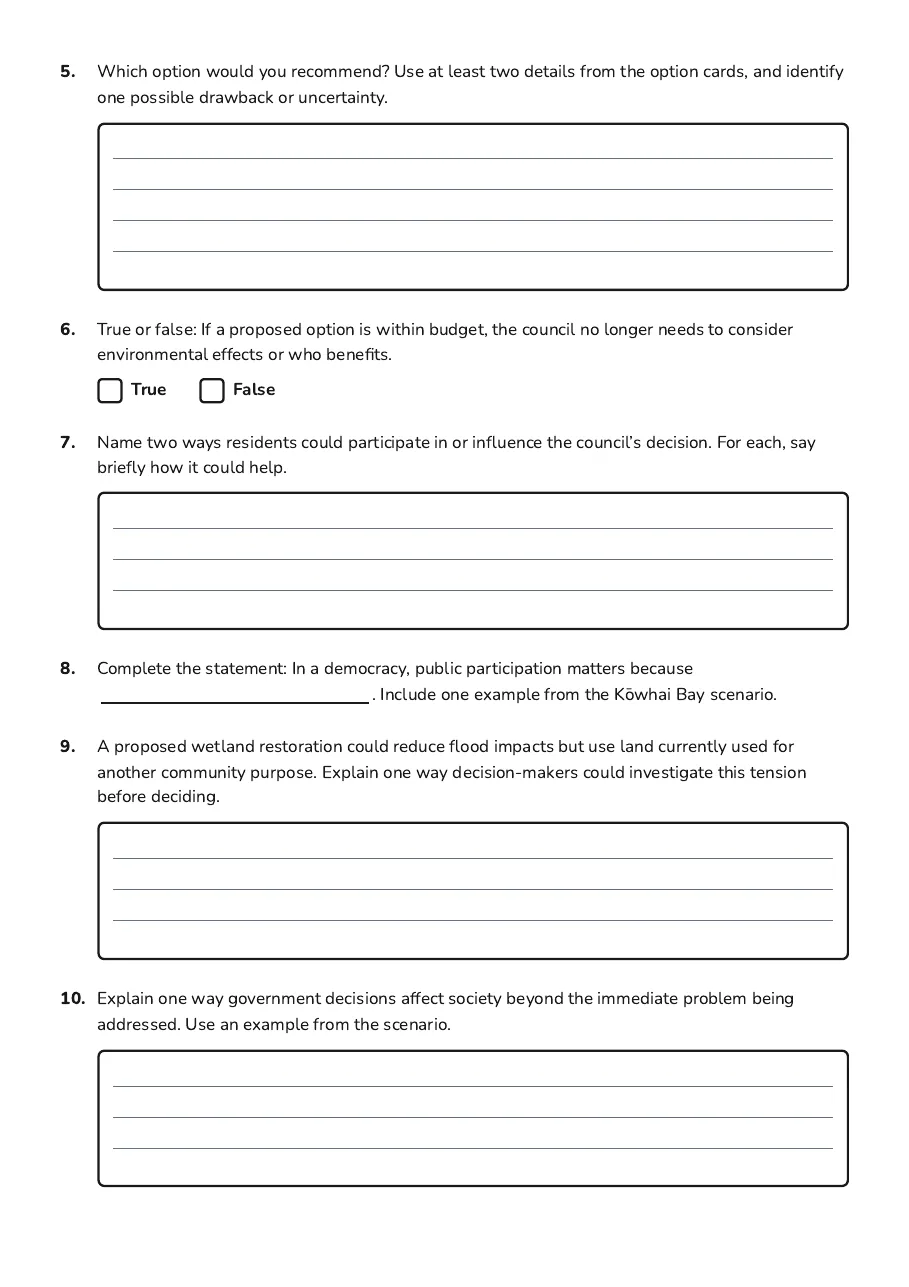
Page 3
About This Worksheet
Free in Kuraplan
Sign up free, grab the PDF, and customize it for your class.
Print-Ready
Formatted for standard paper. Clean layout, easy to read.
AI-Generated
Created with Kuraplan's AI, designed for real classroom use.
For Teachers & Parents
Use in classrooms, for homework, tutoring, or homeschool.
Need a custom version of this worksheet?
Kuraplan's AI generates custom worksheets in seconds — differentiated for every learner, aligned to your curriculum.
Generate Custom Worksheets — FreeMore Social Sciences Worksheets
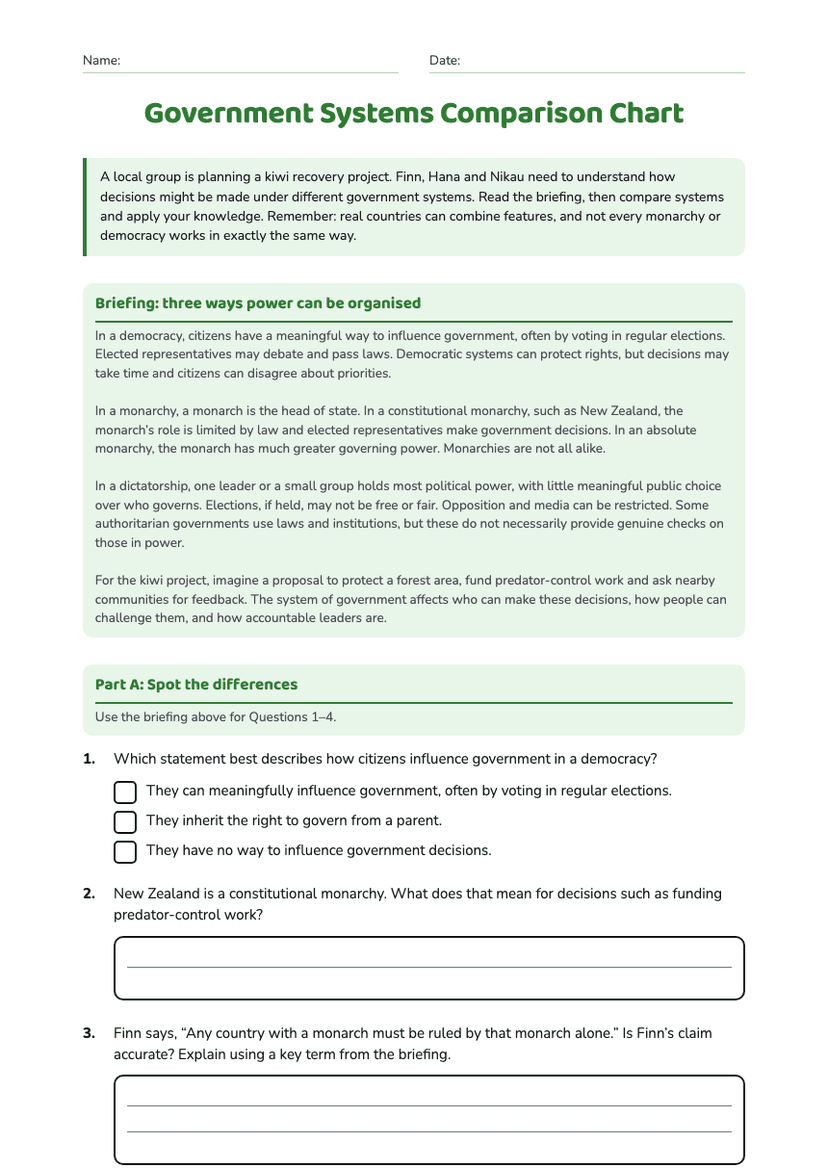
Government Systems Comparison Chart
Free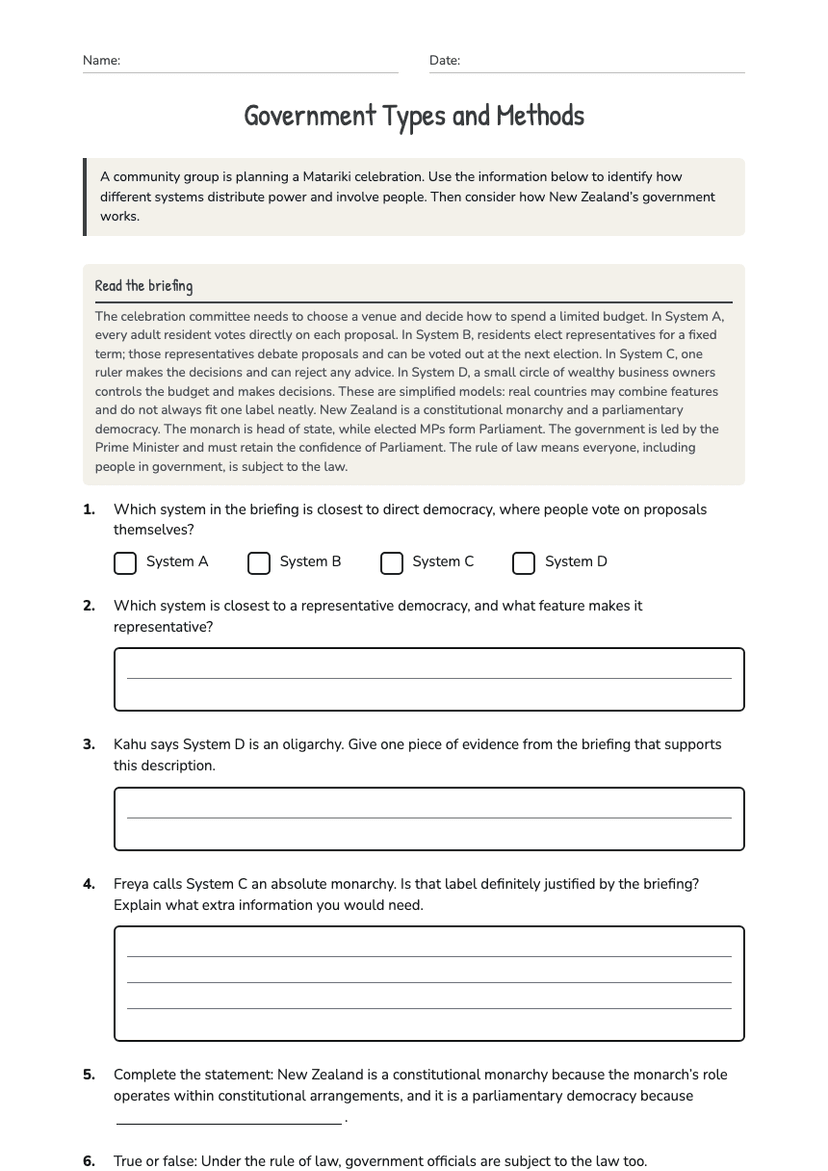
Government Types and Methods
Free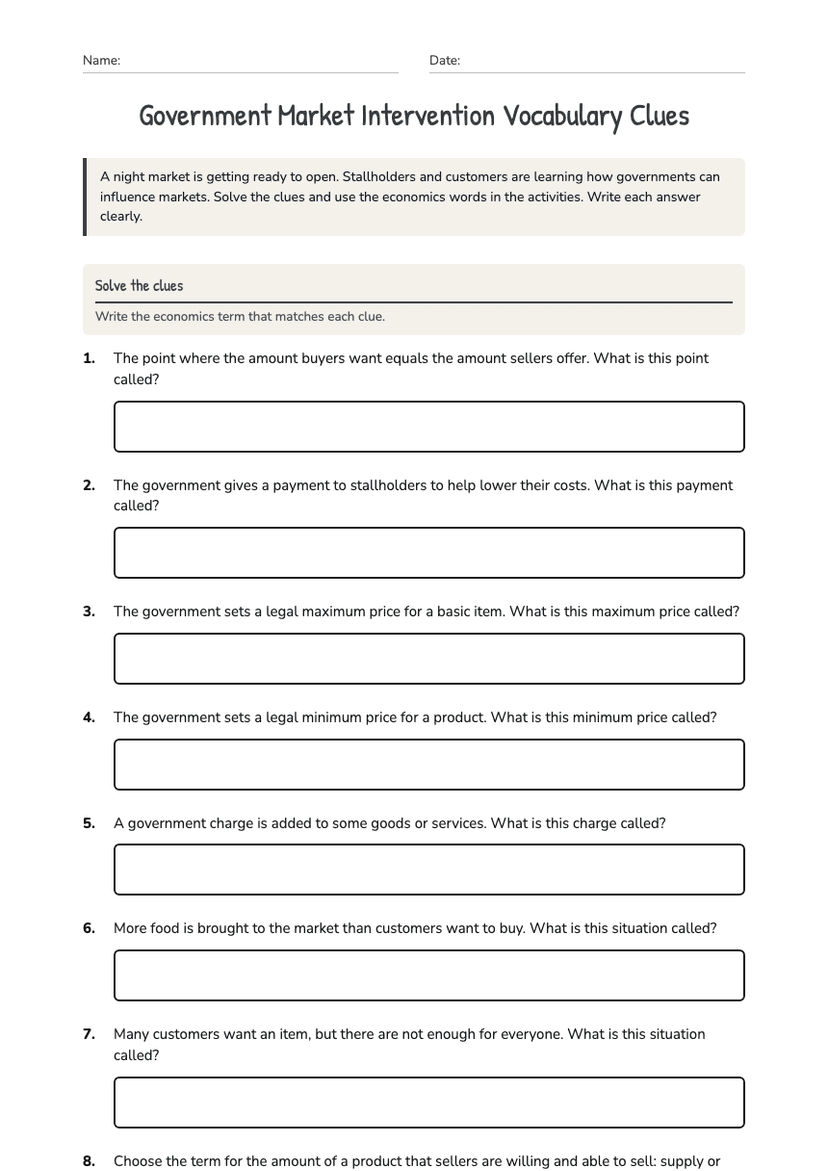
Government Market Intervention Vocabulary Clues
Free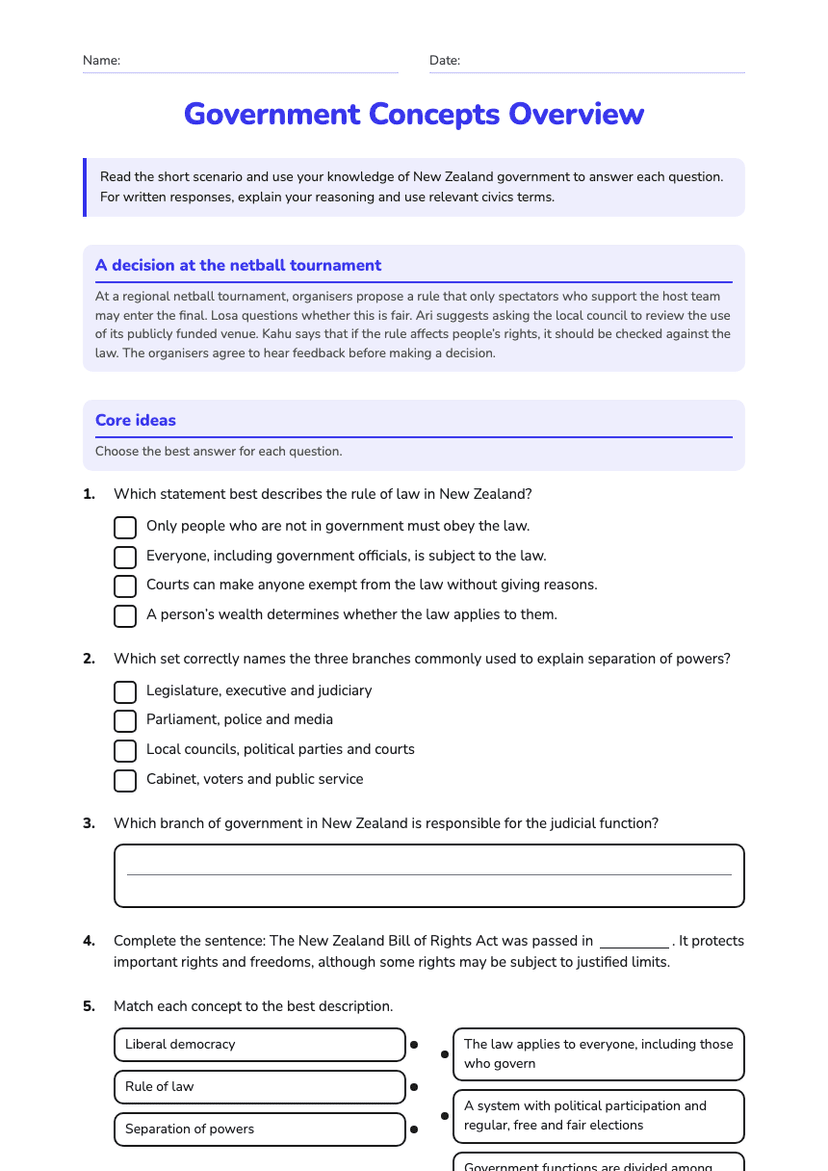
Government Concepts Overview
Free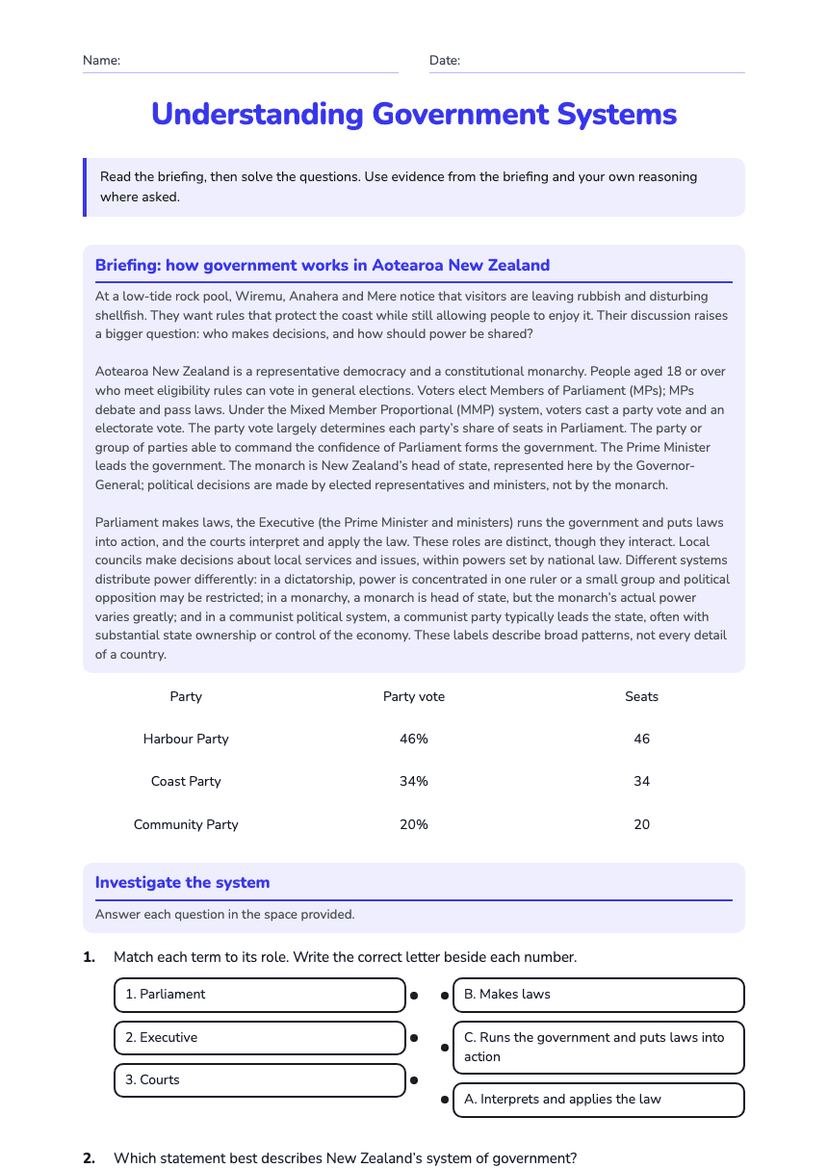
Understanding Government Systems
Free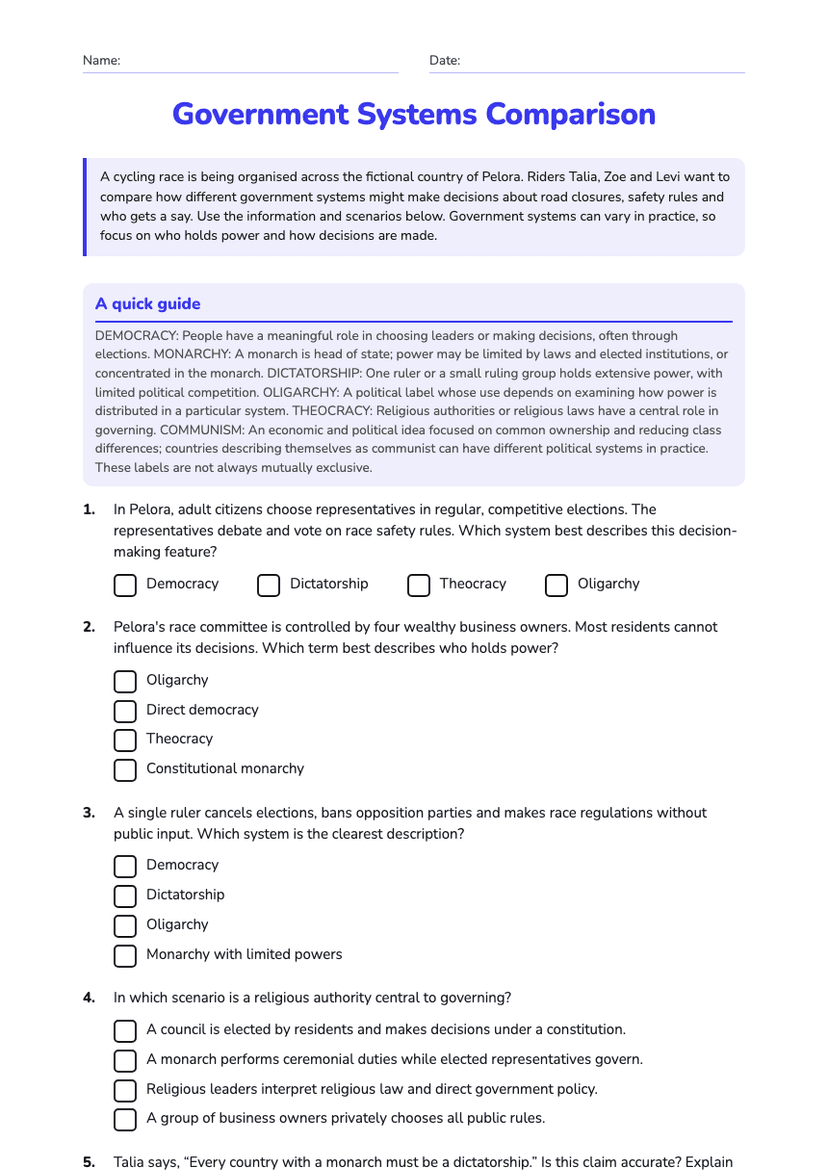
Government Systems Comparison
Free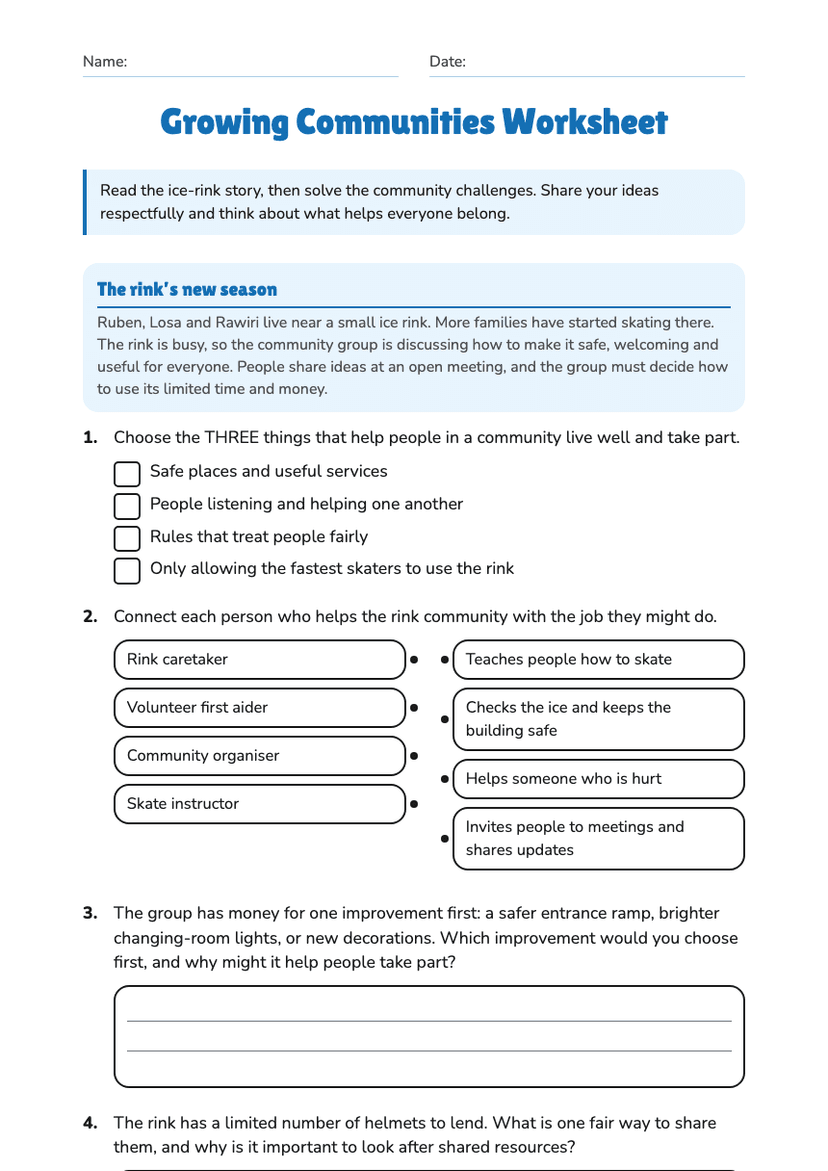
Growing Communities Worksheet
Free