EnglishFreePrintable

Haiku Poetry Exploration

A free english worksheet ready for your classroom. Open in Kuraplan to grab the print-ready PDF, customize it for your students, or generate a fresh version in seconds.
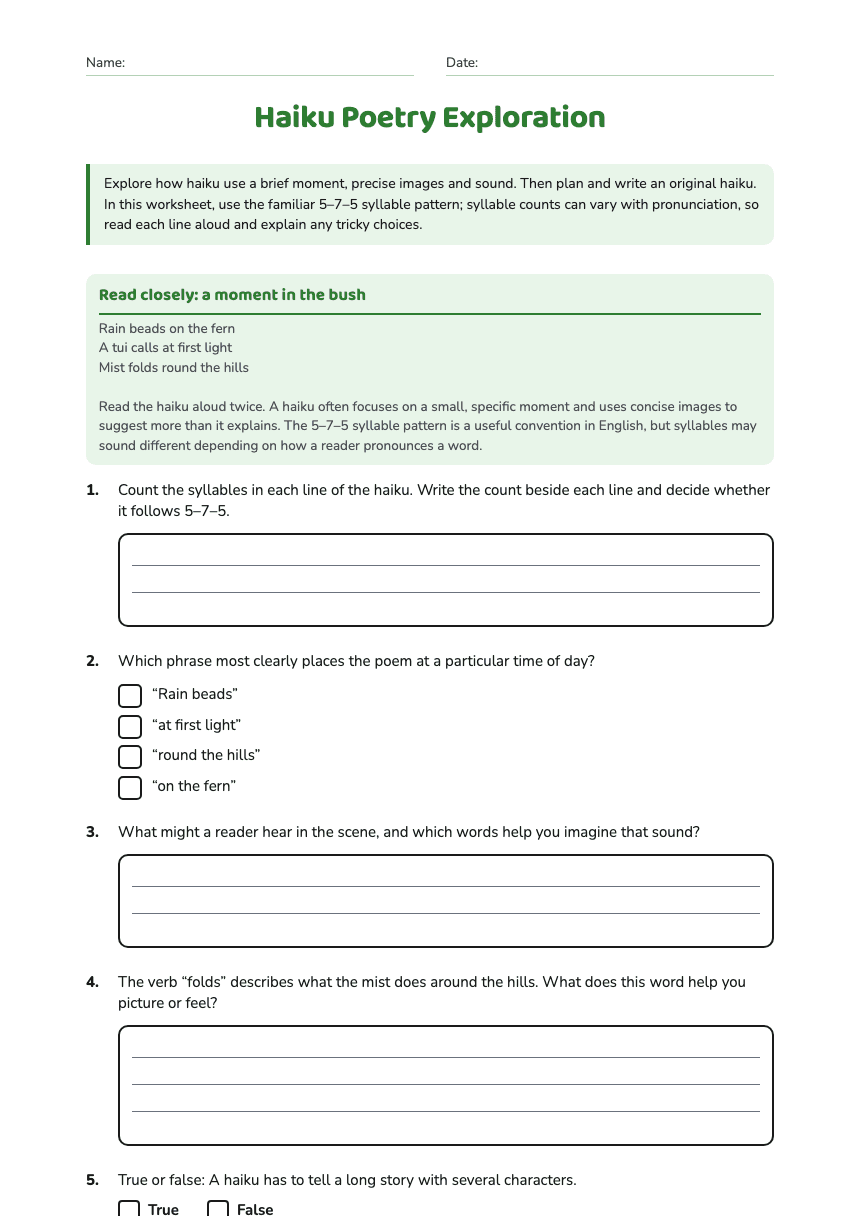
Haiku Poetry Exploration worksheet preview
Name:Date:

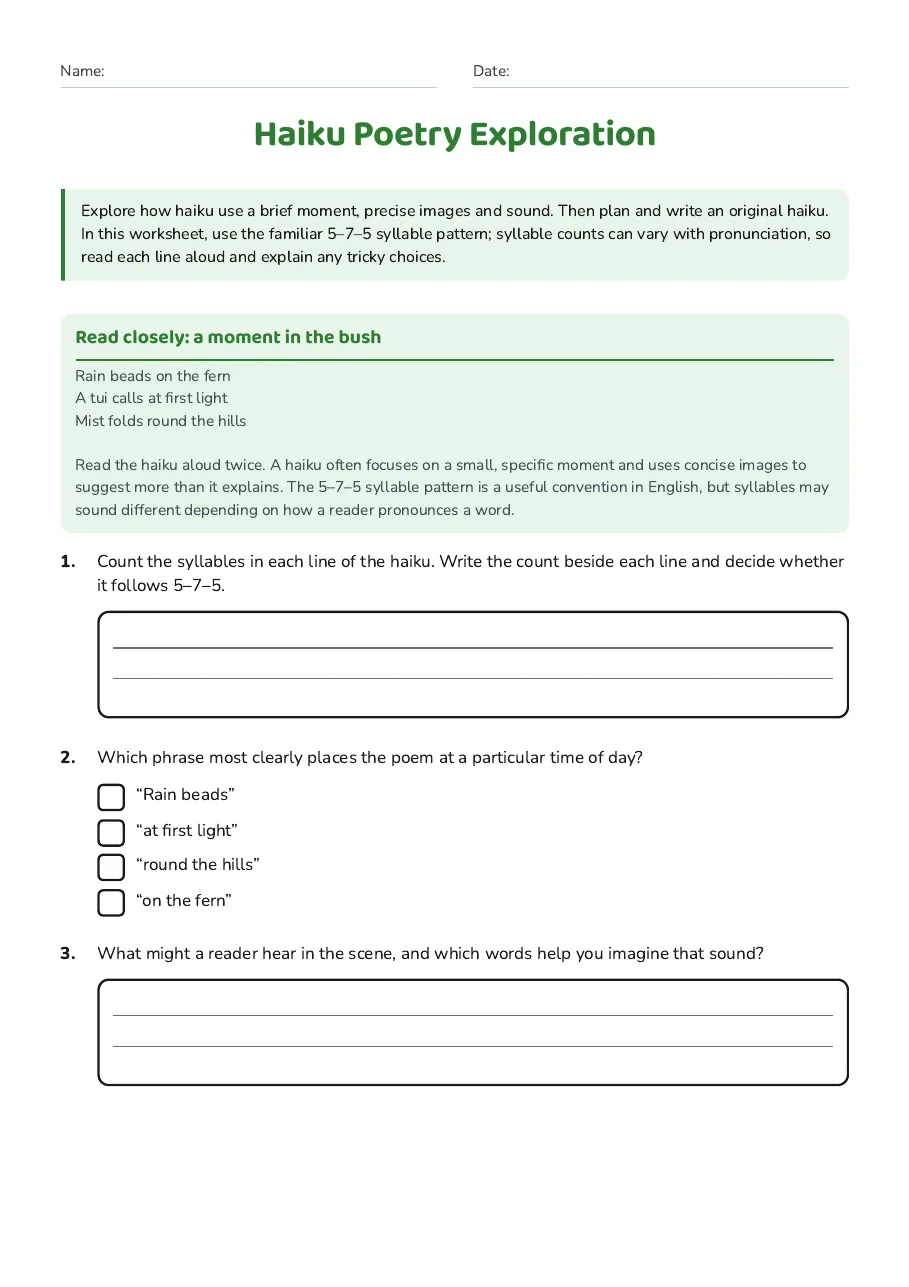
Haiku Poetry Exploration

Explore how haiku use a brief moment, precise images and sound. Then plan and write an original haiku. In this worksheet, use the familiar 5–7–5 syllable pattern; syllable counts can vary with pronunciation, so read each line aloud and explain any tricky choices.

Read closely: a moment in the bush

Rain beads on the fern A tui calls at first light Mist folds round the hills Read the haiku aloud twice. A haiku often focuses on a small, specific moment and uses concise images to suggest more than it explains. The 5–7–5 syllable pattern is a useful convention in English, but syllables may sound different depending on how a reader pronounces a word.

1.Count the syllables in each line of the haiku. Write the count beside each line and decide whether it follows 5–7–5.
2.Which phrase most clearly places the poem at a particular time of day?
  • “Rain beads”
  • “at first light”
  • “round the hills”
  • “on the fern”
3.What might a reader hear in the scene, and which words help you imagine that sound?
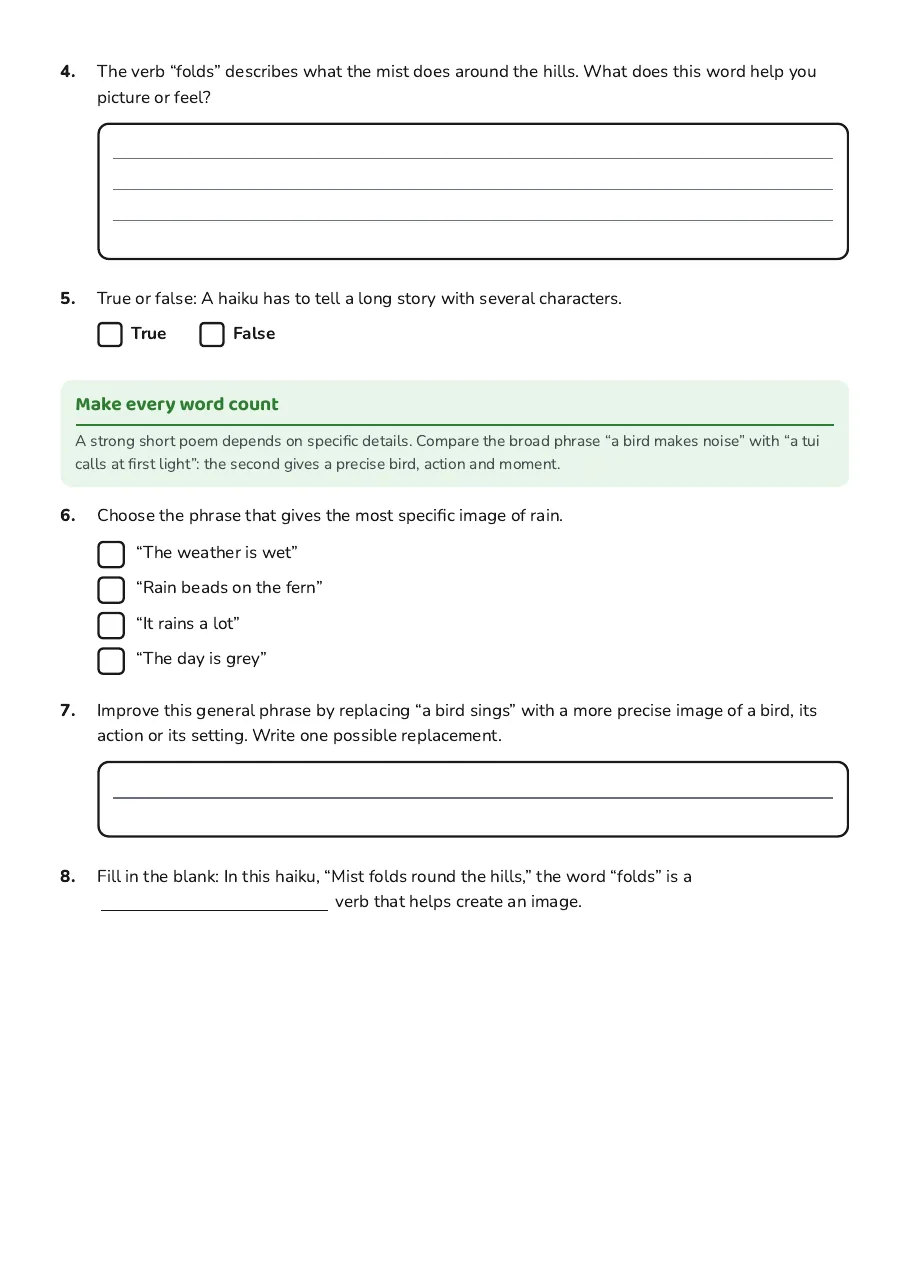
4.The verb “folds” describes what the mist does around the hills. What does this word help you picture or feel?
5.True or false: A haiku has to tell a long story with several characters.
TrueFalse

Make every word count

A strong short poem depends on specific details. Compare the broad phrase “a bird makes noise” with “a tui calls at first light”: the second gives a precise bird, action and moment.

6.Choose the phrase that gives the most specific image of rain.
  • “The weather is wet”
  • “Rain beads on the fern”
  • “It rains a lot”
  • “The day is grey”
7.Improve this general phrase by replacing “a bird sings” with a more precise image of a bird, its action or its setting. Write one possible replacement.
8.Fill in the blank: In this haiku, “Mist folds round the hills,” the word “folds” is a verb that helps create an image.

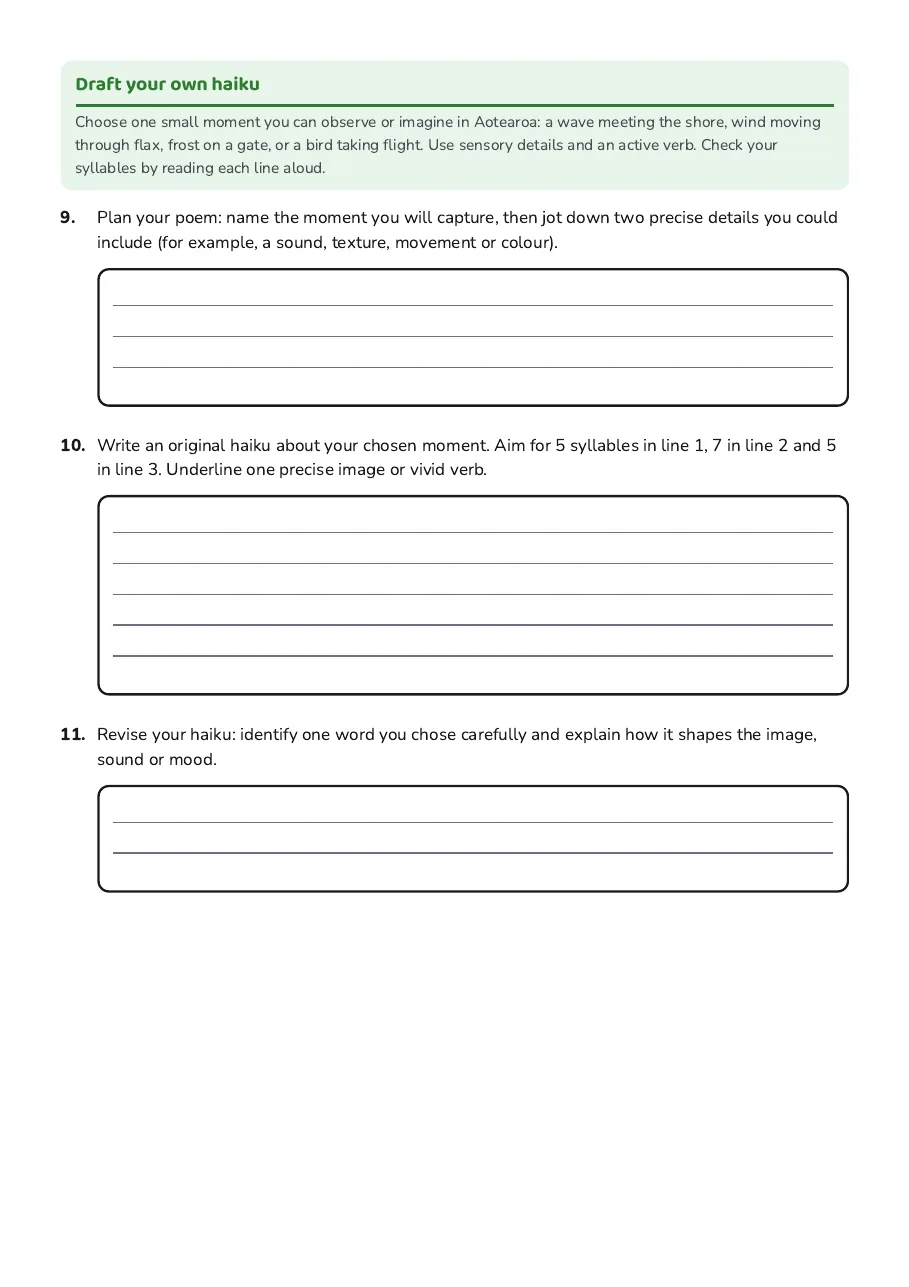
Draft your own haiku

Choose one small moment you can observe or imagine in Aotearoa: a wave meeting the shore, wind moving through flax, frost on a gate, or a bird taking flight. Use sensory details and an active verb. Check your syllables by reading each line aloud.

9.Plan your poem: name the moment you will capture, then jot down two precise details you could include (for example, a sound, texture, movement or colour).
10.Write an original haiku about your chosen moment. Aim for 5 syllables in line 1, 7 in line 2 and 5 in line 3. Underline one precise image or vivid verb.
11.Revise your haiku: identify one word you chose carefully and explain how it shapes the image, sound or mood.

3 printable pages

  • Haiku Poetry Exploration, page 1 of 3: Read closely: a moment in the bush

    Page 1

  • Haiku Poetry Exploration, page 2 of 3: Make every word count

    Page 2

  • Haiku Poetry Exploration, page 3 of 3: Draft your own haiku

    Page 3

About This Worksheet

Free in Kuraplan

Sign up free, grab the PDF, and customize it for your class.

Print-Ready

Formatted for standard paper. Clean layout, easy to read.

AI-Generated

Created with Kuraplan's AI, designed for real classroom use.

For Teachers & Parents

Use in classrooms, for homework, tutoring, or homeschool.

Need a custom version of this worksheet?

Kuraplan's AI generates custom worksheets in seconds — differentiated for every learner, aligned to your curriculum.

Generate Custom Worksheets — Free
No credit card Curriculum-aligned Under 60 seconds