Jupiter Facts and Comprehension
A free science worksheet ready for your classroom. Open in Kuraplan to grab the print-ready PDF, customize it for your students, or generate a fresh version in seconds.
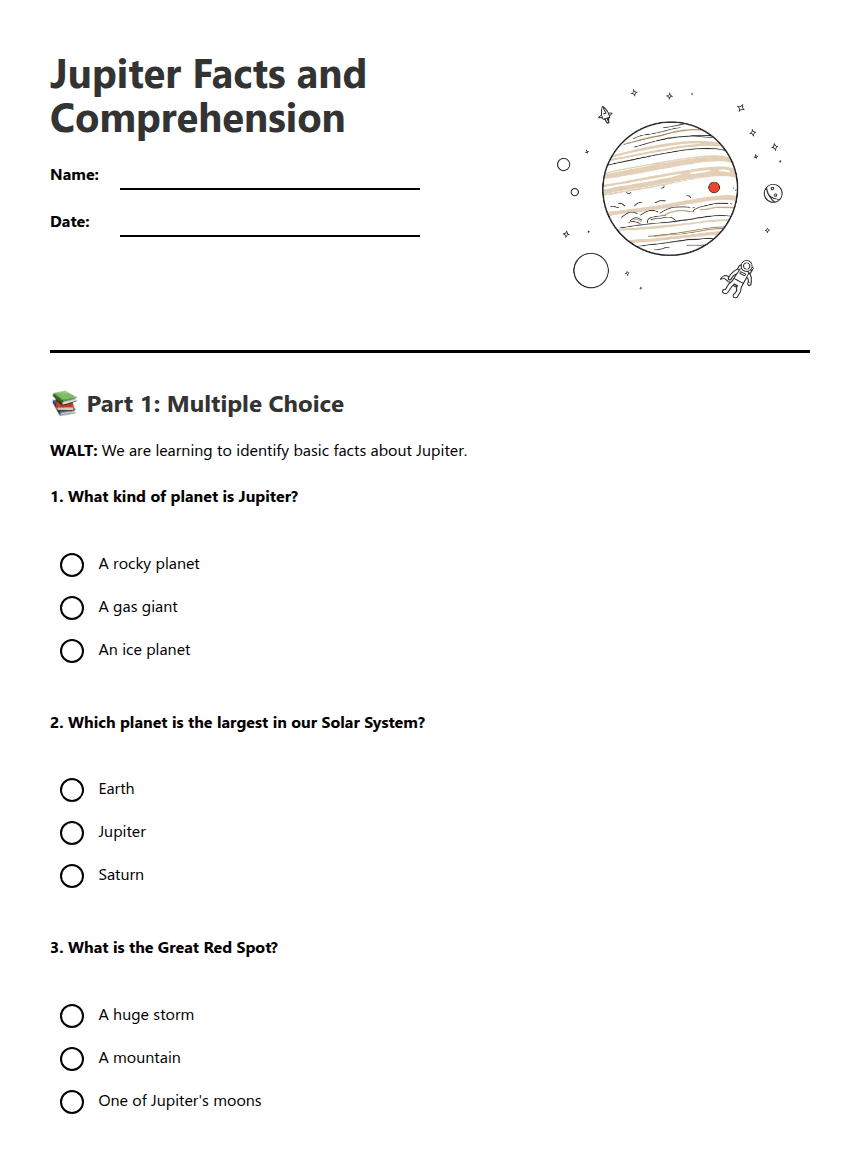
Jupiter Facts and Comprehension
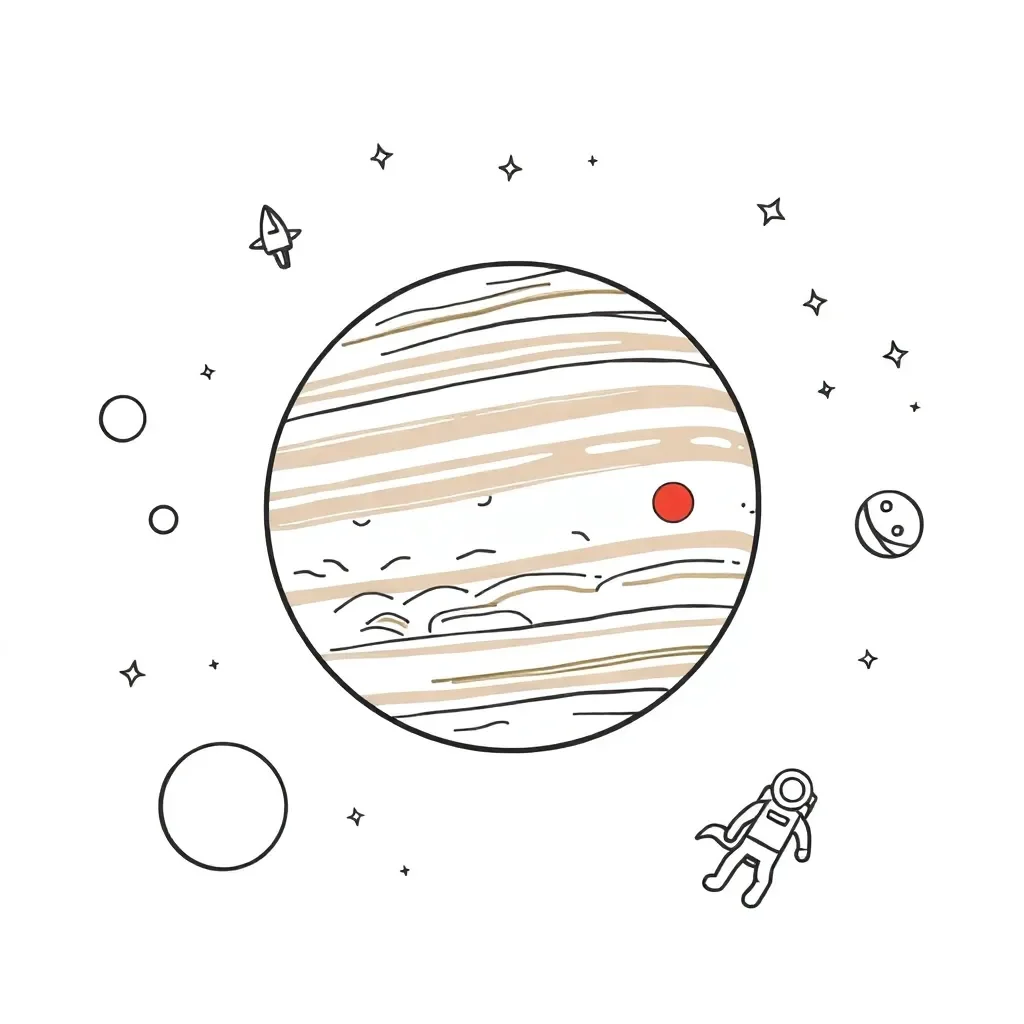
🪐 Jupiter Facts (Read First)
WALT: We are learning to read and remember facts about Jupiter.
Read the facts, then answer the questions below.
- 🌍 Jupiter is the biggest planet in our Solar System.
- 💨 Jupiter is a gas giant — it is made mostly of gas, not rock.
- ☀️ Jupiter is the fifth planet from the Sun.
- 🌀 Jupiter has a huge storm called the Great Red Spot. This storm has been spinning for hundreds of years.
- 🌈 Jupiter has colourful bands of cloud that wrap around it. These are made of different gases.
- 🌙 Jupiter has many moons — more than 90! Four big ones are called Io, Europa, Ganymede and Callisto. These are called the Galilean moons.
- 💍 Jupiter has rings, but they are very faint and hard to see.
- ⚡ Jupiter has very strong lightning storms in its clouds.
- 🏋️ Jupiter's gravity is very strong — much stronger than Earth's. If you could stand on Jupiter, you would feel very, very heavy!
- 🚀 Several spacecraft have visited Jupiter, including Voyager and Juno.
- 🔭 Jupiter is so big that more than 1,300 Earths could fit inside it.
- ⏱️ Jupiter spins very fast. One day on Jupiter is only about 10 hours long!
🌀 The Great Red Spot (Read First)
WALT: We are learning to read and remember facts about the Great Red Spot on Jupiter.
Read these facts carefully. They will help you answer the questions below.
- 🌀 The Great Red Spot is a giant storm on Jupiter. It is one of the biggest storms in our whole Solar System.
- 🌍 The Great Red Spot is bigger than Earth! If you put Earth next to it, Earth would fit inside the storm.
- 📅 The Great Red Spot has been spinning for a very long time — scientists think it has been there for hundreds of years. That means it was there long before your grandparents, or even their grandparents, were born!
- 🟠 The storm looks reddish and orange in colour. That is why it is called the Red Spot. Scientists are still not completely sure why it is that colour.
- 💨 The winds inside the Great Red Spot spin around and around in a big circle, going counterclockwise — that means they spin the opposite way to a clock.
- 📏 The Great Red Spot does not always stay the same size. It can shrink, grow, and change shape over time. Scientists have noticed it has been getting a little smaller in recent years.
- 🔭 You can see the Great Red Spot through a telescope from Earth if you look carefully at Jupiter.
📚 Part 1: Multiple Choice
WALT: We are learning to identify basic facts about Jupiter.
Use the facts above to help you answer these questions.
✏️ Part 2: Short Answers
Look back at the facts sections to help you answer these questions.
Jupiter is the ______ planet from the Sun.
Teacher Notes
WALT: Reinforce factual recall and simple explanations about Jupiter.
Time: 25–30 minutes, then break for a short activity or game.
Worksheet order note: The facts sections now appear first so students can read and refer back to them while answering questions. The Great Red Spot has its own dedicated facts section to give students enough detail for the related comprehension questions. Encourage students to point to or re-read facts as needed before answering each question.
Differentiation strategies: Give step-by-step prompts for students who need support; allow pointing or selecting answers for non-verbal learners; provide one-to-one reading of the facts sections; use larger font or coloured backgrounds for reading if helpful; allow students to circle or highlight facts before answering questions.
Dyslexia-friendly options: Offer both facts sections read aloud before questions begin; print facts in a sans-serif font; use coloured overlays; provide a printed set of fact cards (including the Great Red Spot cards separately) that students can hold and refer to apart from the question pages.
Support for non-verbal learners: Students may point to the correct fact bullet, use a communication device to select answers, or draw their responses where appropriate. For Question 7 about the Great Red Spot, students may point to the relevant bullet points in the Great Red Spot facts section as their answer.
Extension activities for advanced learners: Research and write one paragraph about why Jupiter's gravity is so strong; compare the size of Jupiter to Earth (e.g., "Jupiter is about 11 times wider than Earth"); find out what the Juno spacecraft discovered about Jupiter and share one new fact with the class; find out more about why the Great Red Spot might be getting smaller and write two sentences about what scientists think.
About This Worksheet
Free in Kuraplan
Sign up free, grab the PDF, and customize it for your class.
Print-Ready
Formatted for standard paper. Clean layout, easy to read.
AI-Generated
Created with Kuraplan's AI, designed for real classroom use.
For Teachers & Parents
Use in classrooms, for homework, tutoring, or homeschool.
Need a custom version of this worksheet?
Kuraplan's AI generates custom worksheets in seconds — differentiated for every learner, aligned to your curriculum.
Generate Custom Worksheets — Free