ScienceFreePrintable

Acids, Bases, and Reactions

A free science worksheet ready for your classroom. Open in Kuraplan to grab the print-ready PDF, customize it for your students, or generate a fresh version in seconds.
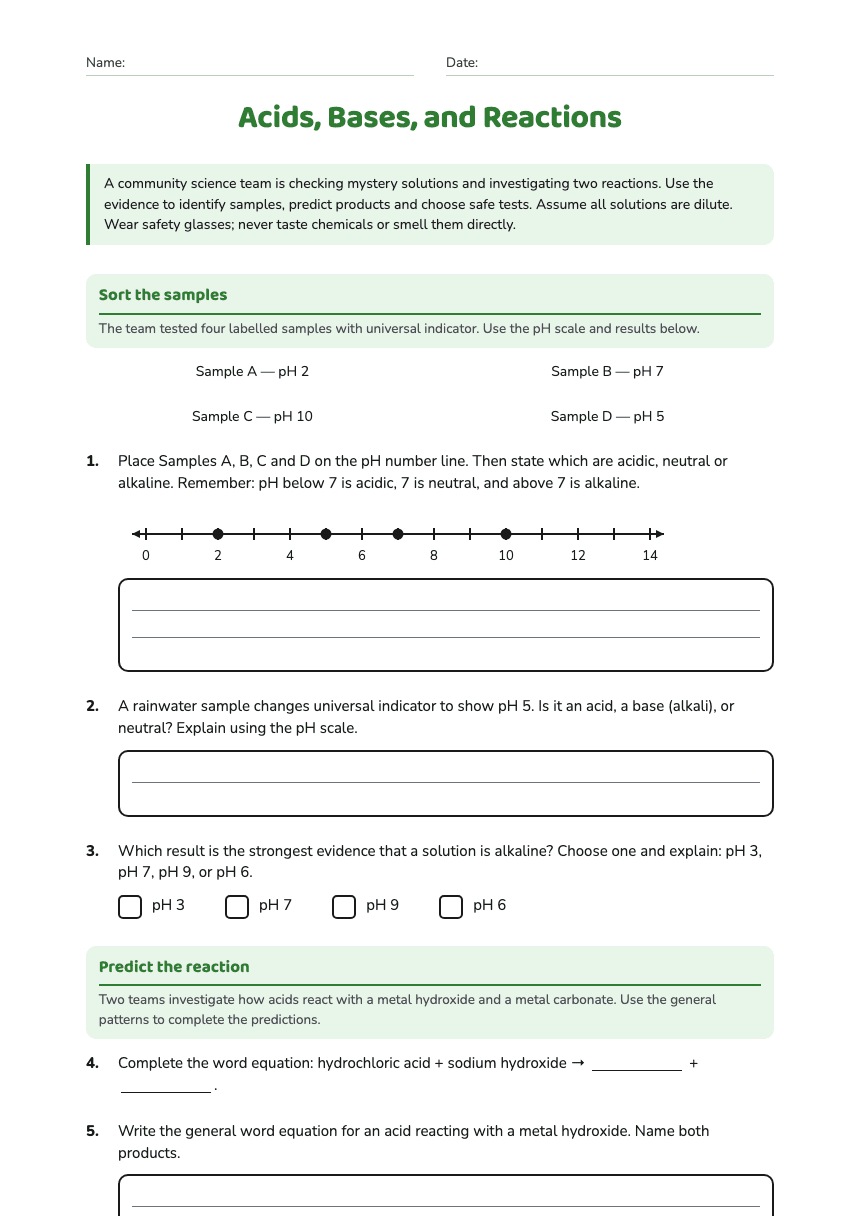
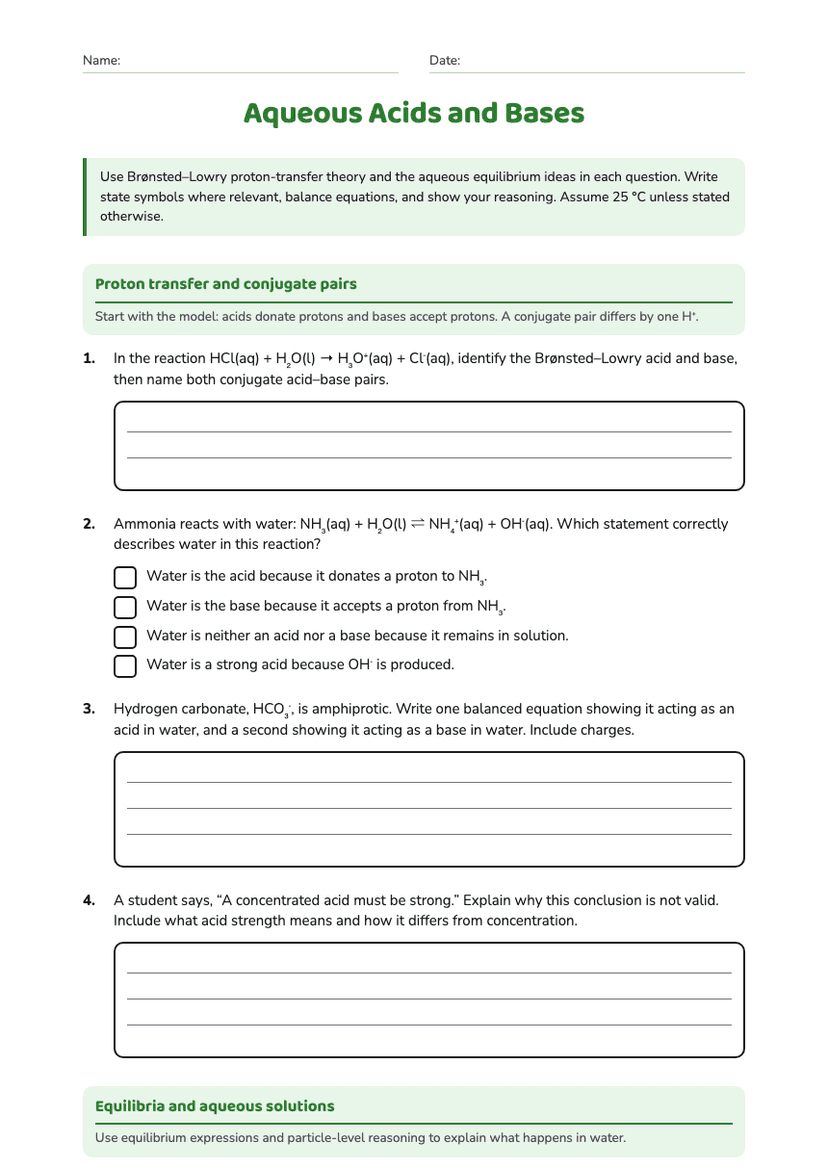
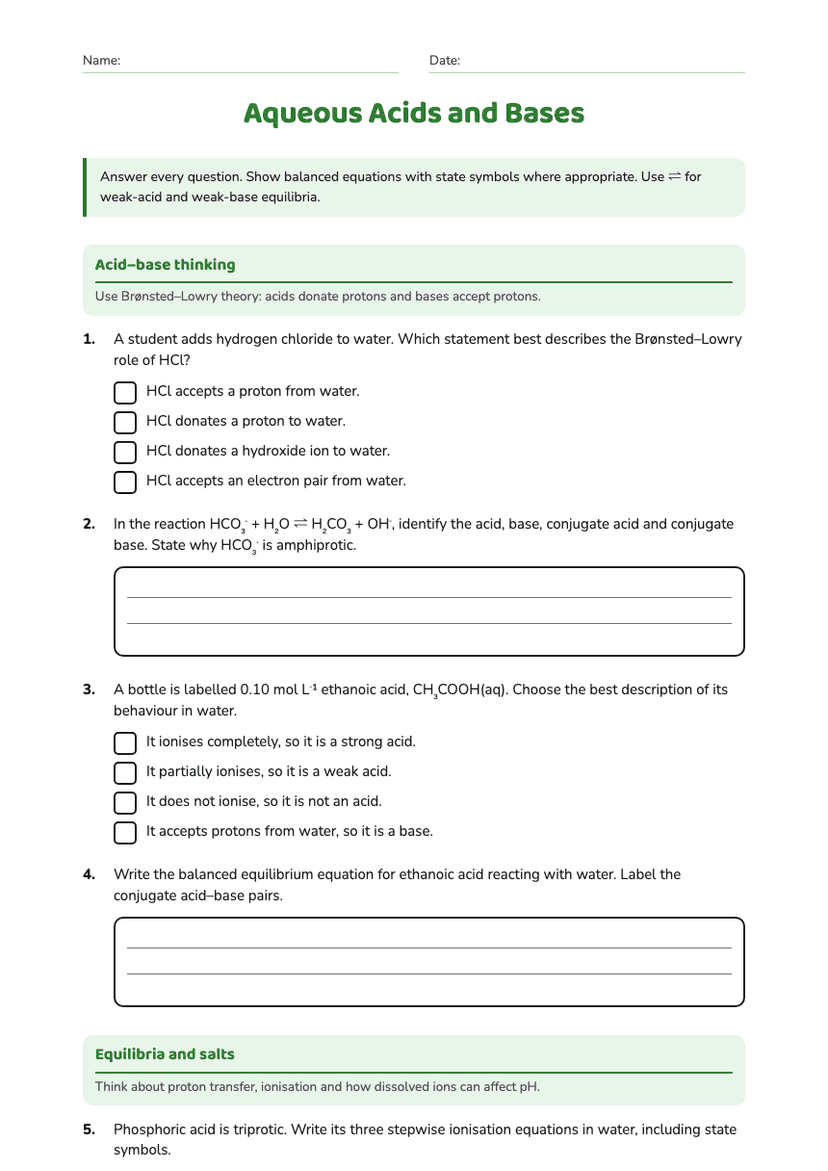
Acids, Bases, and Reactions worksheet preview
Name:Date:

Acids, Bases, and Reactions

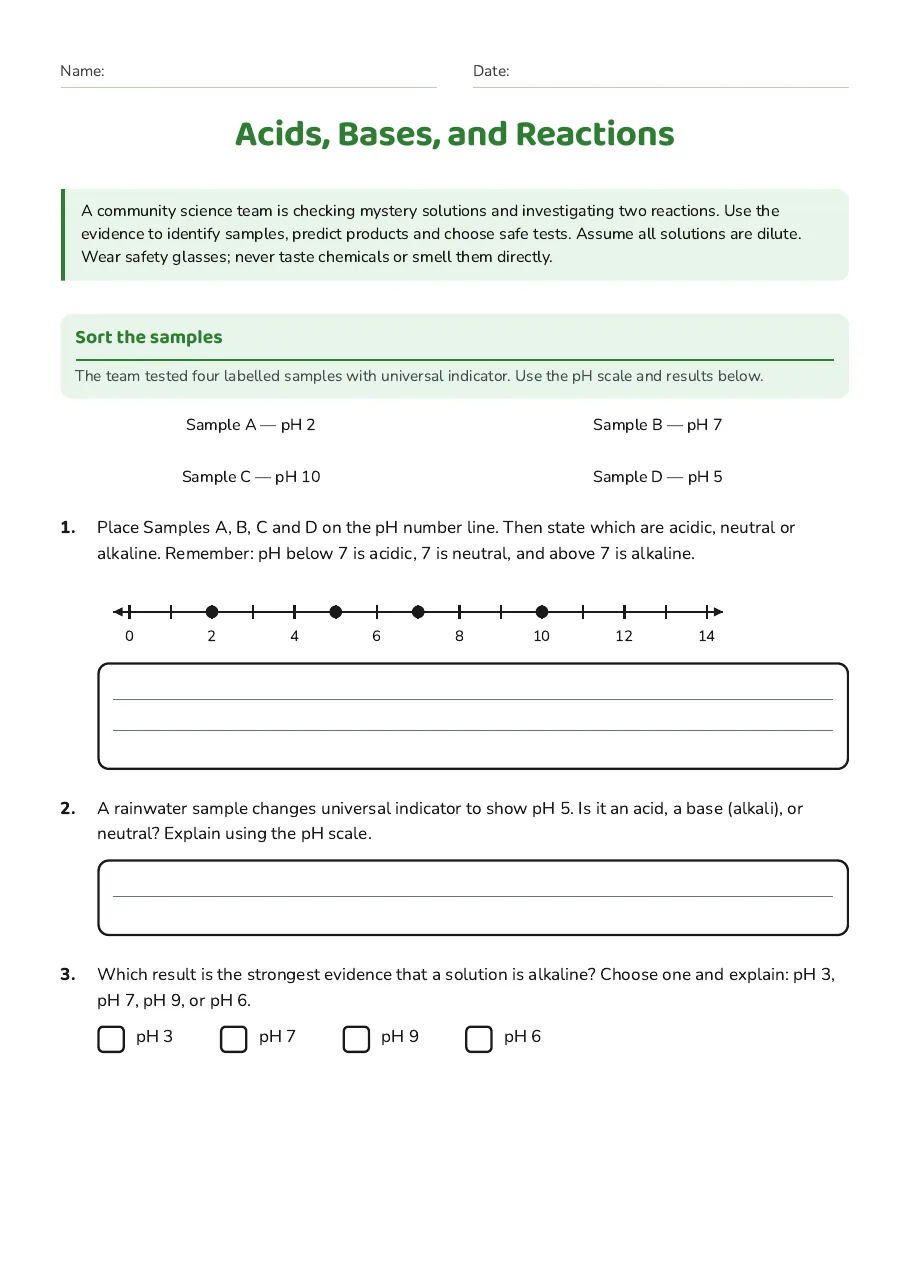
A community science team is checking mystery solutions and investigating two reactions. Use the evidence to identify samples, predict products and choose safe tests. Assume all solutions are dilute. Wear safety glasses; never taste chemicals or smell them directly.

Sort the samples

The team tested four labelled samples with universal indicator. Use the pH scale and results below.

Sample A — pH 2

Sample B — pH 7

Sample C — pH 10

Sample D — pH 5

1.Place Samples A, B, C and D on the pH number line. Then state which are acidic, neutral or alkaline. Remember: pH below 7 is acidic, 7 is neutral, and above 7 is alkaline.
02468101214
2.A rainwater sample changes universal indicator to show pH 5. Is it an acid, a base (alkali), or neutral? Explain using the pH scale.
3.Which result is the strongest evidence that a solution is alkaline? Choose one and explain: pH 3, pH 7, pH 9, or pH 6.
  • pH 3
  • pH 7
  • pH 9
  • pH 6

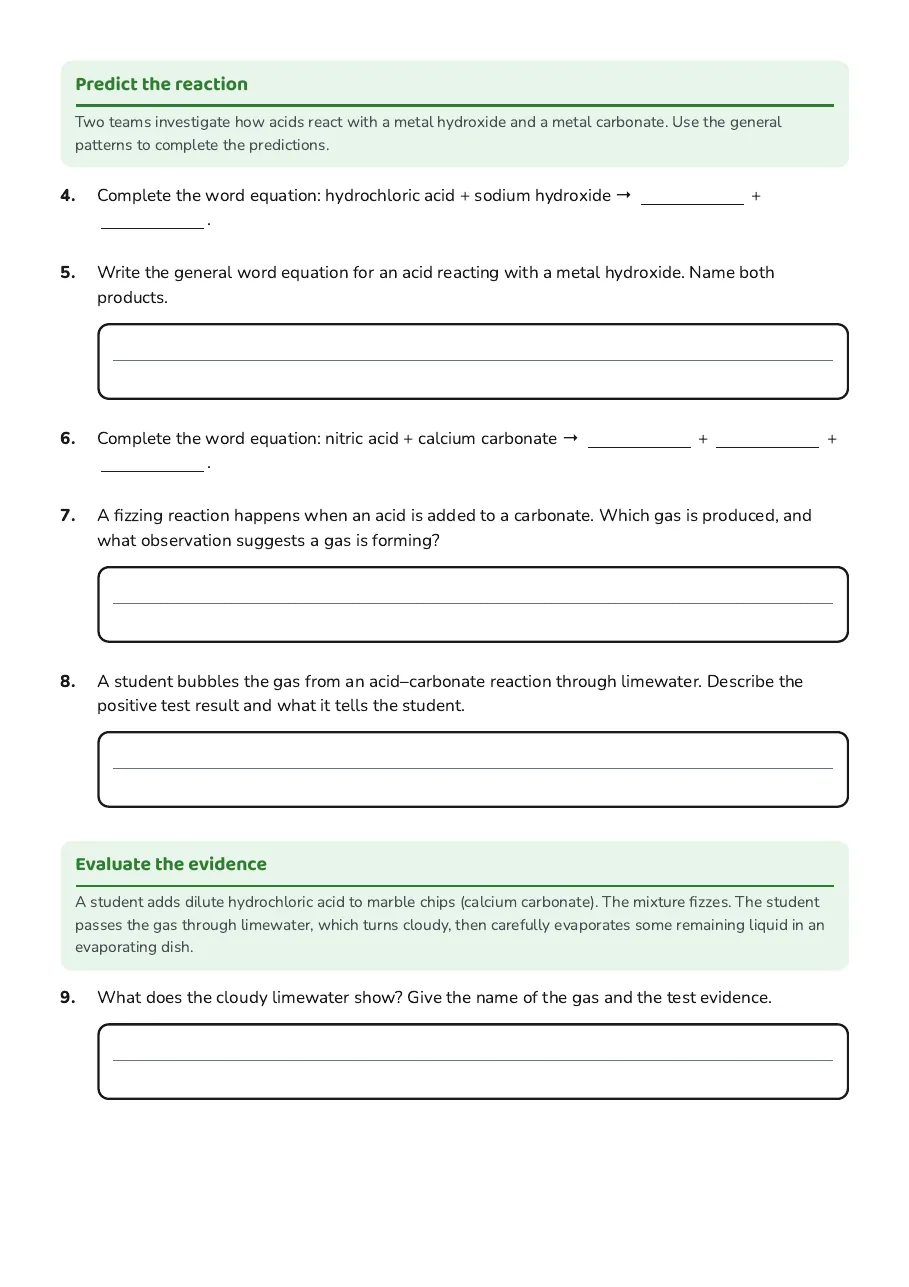
Predict the reaction

Two teams investigate how acids react with a metal hydroxide and a metal carbonate. Use the general patterns to complete the predictions.

4.Complete the word equation: hydrochloric acid + sodium hydroxide → + .
5.Write the general word equation for an acid reacting with a metal hydroxide. Name both products.
6.Complete the word equation: nitric acid + calcium carbonate → + + .
7.A fizzing reaction happens when an acid is added to a carbonate. Which gas is produced, and what observation suggests a gas is forming?
8.A student bubbles the gas from an acid–carbonate reaction through limewater. Describe the positive test result and what it tells the student.

Evaluate the evidence

A student adds dilute hydrochloric acid to marble chips (calcium carbonate). The mixture fizzes. The student passes the gas through limewater, which turns cloudy, then carefully evaporates some remaining liquid in an evaporating dish.

9.What does the cloudy limewater show? Give the name of the gas and the test evidence.
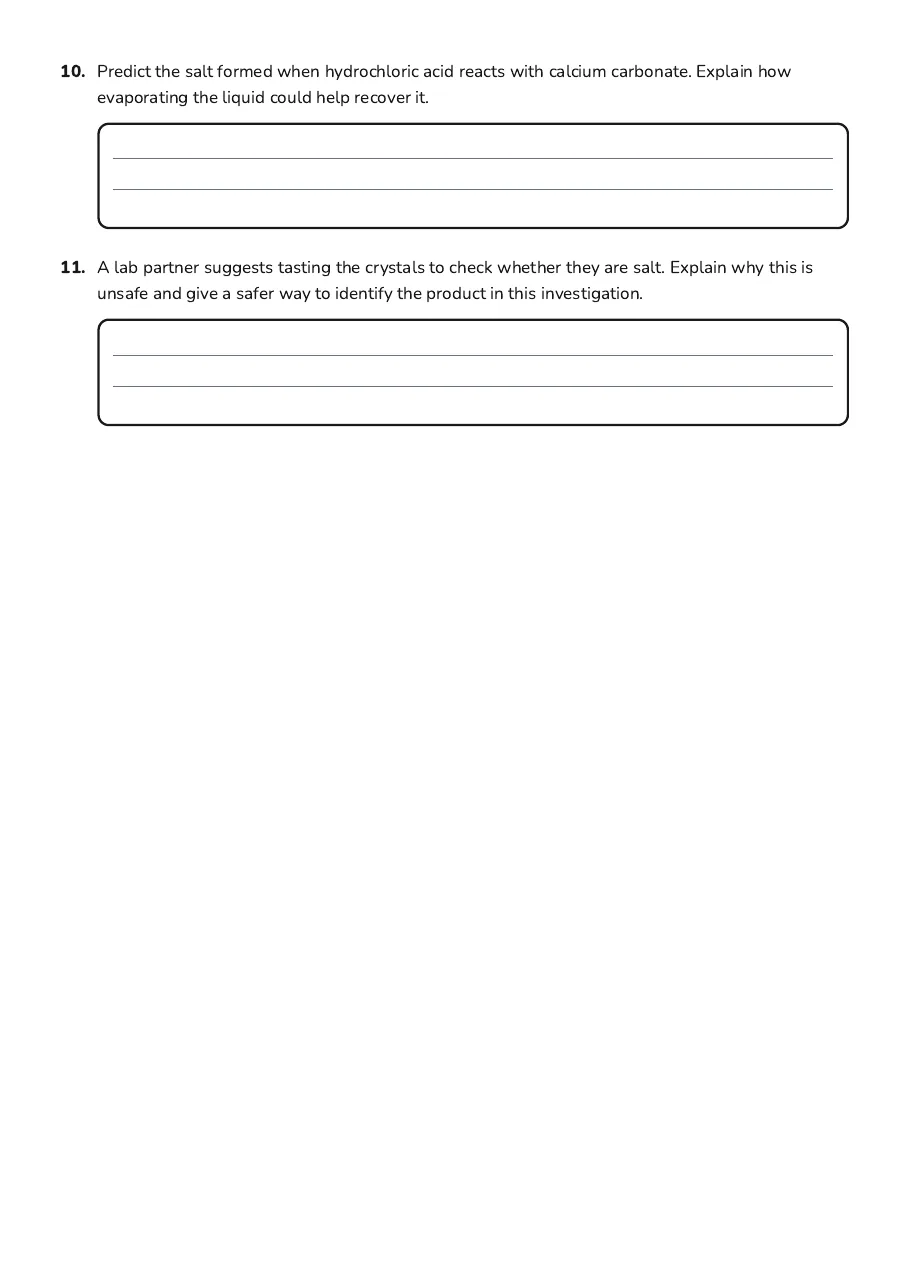
10.Predict the salt formed when hydrochloric acid reacts with calcium carbonate. Explain how evaporating the liquid could help recover it.
11.A lab partner suggests tasting the crystals to check whether they are salt. Explain why this is unsafe and give a safer way to identify the product in this investigation.

3 printable pages

  • Acids, Bases, and Reactions, page 1 of 3: Sort the samples

    Page 1

  • Acids, Bases, and Reactions, page 2 of 3: Predict the reaction, Evaluate the evidence

    Page 2

  • Acids, Bases, and Reactions, page 3 of 3: 10. Predict the salt formed when hydrochloric acid reacts with calcium carbonate. Explain…

    Page 3

About This Worksheet

Free in Kuraplan

Sign up free, grab the PDF, and customize it for your class.

Print-Ready

Formatted for standard paper. Clean layout, easy to read.

AI-Generated

Created with Kuraplan's AI, designed for real classroom use.

For Teachers & Parents

Use in classrooms, for homework, tutoring, or homeschool.

Need a custom version of this worksheet?

Kuraplan's AI generates custom worksheets in seconds — differentiated for every learner, aligned to your curriculum.

Generate Custom Worksheets — Free
No credit card Curriculum-aligned Under 60 seconds