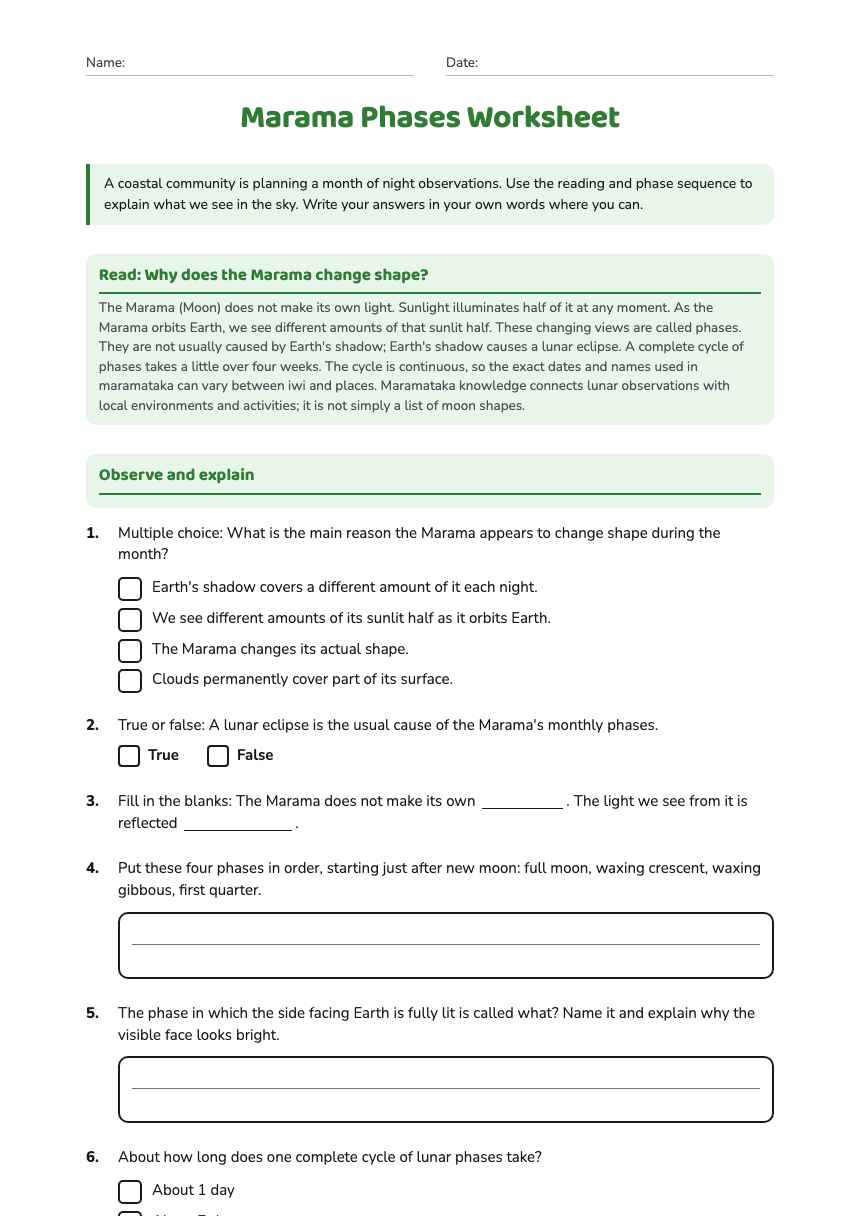
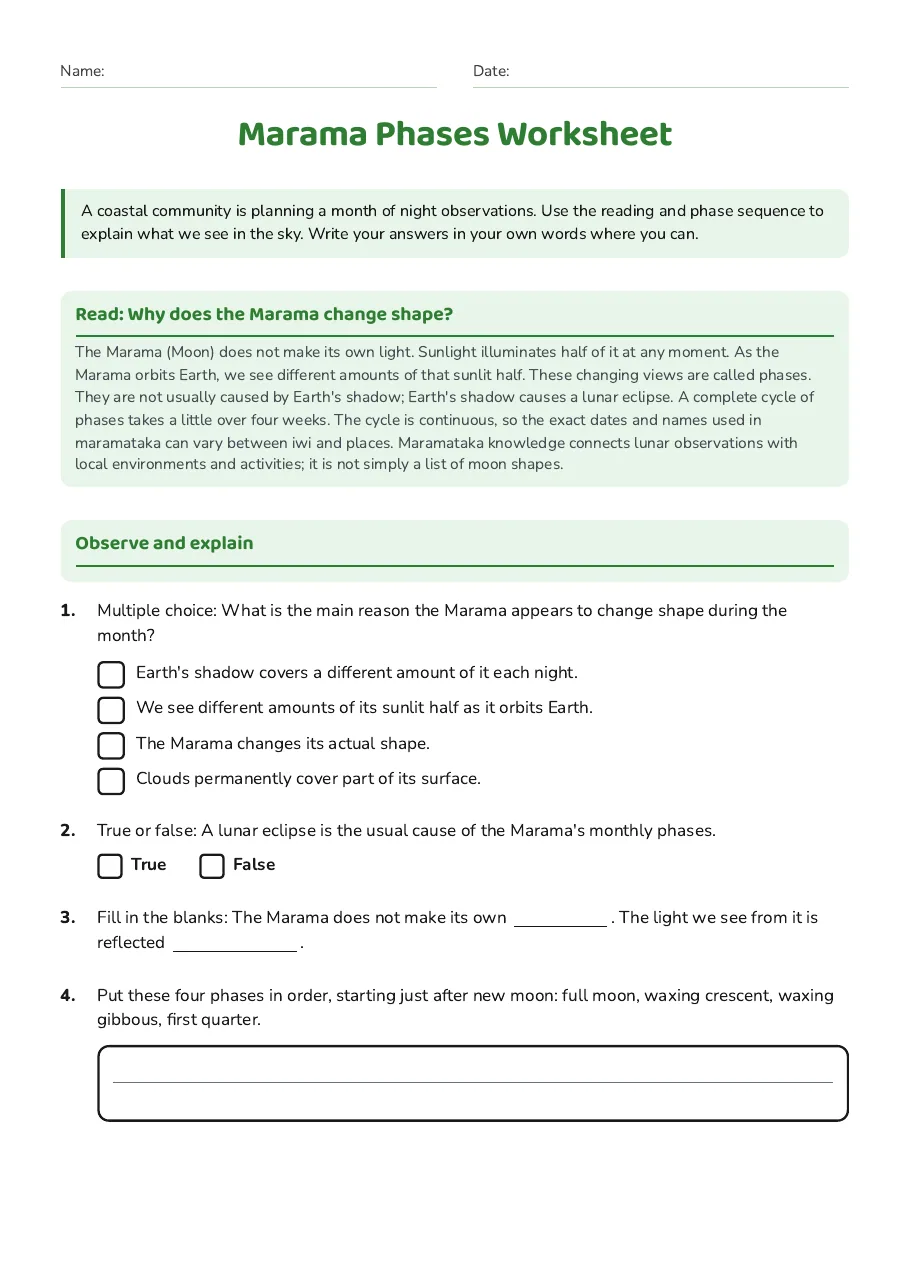
Marama Phases Worksheet
A free science worksheet ready for your classroom. Open in Kuraplan to grab the print-ready PDF, customize it for your students, or generate a fresh version in seconds.
Marama Phases Worksheet
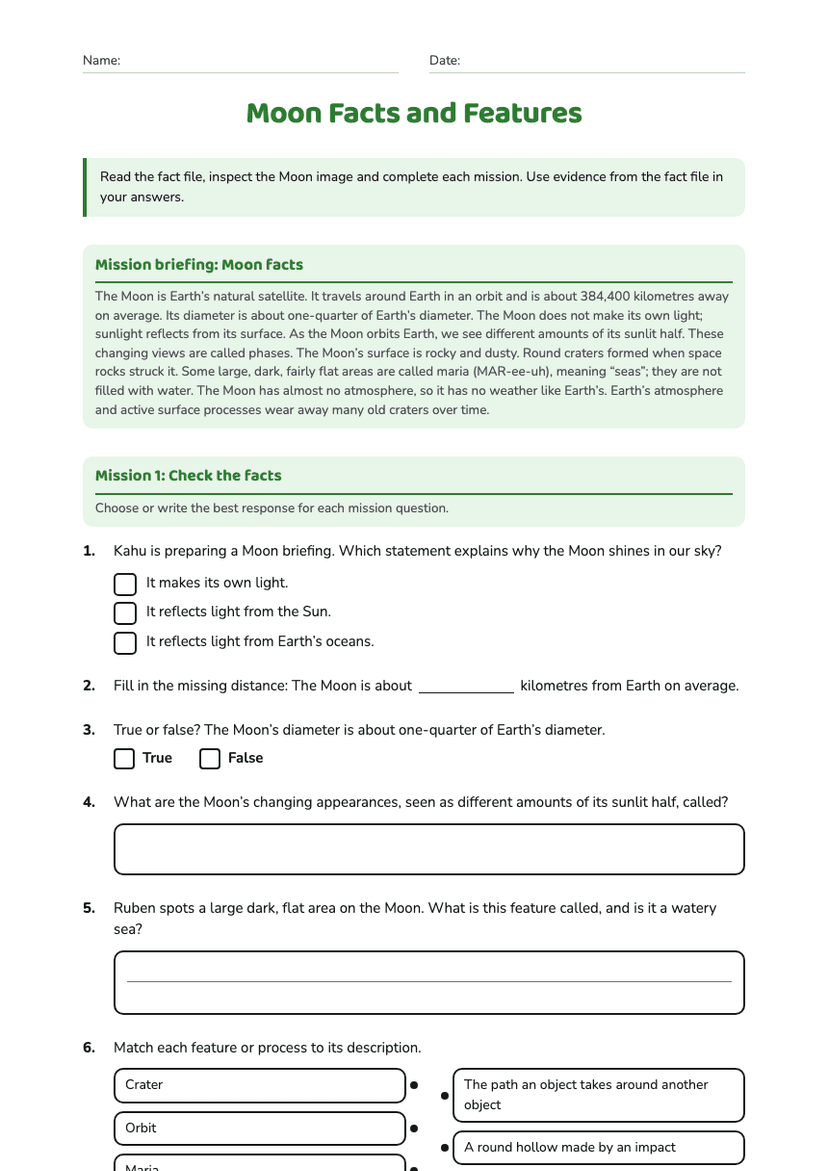
Read: Why does the Marama change shape?
The Marama (Moon) does not make its own light. Sunlight illuminates half of it at any moment. As the Marama orbits Earth, we see different amounts of that sunlit half. These changing views are called phases. They are not usually caused by Earth's shadow; Earth's shadow causes a lunar eclipse. A complete cycle of phases takes a little over four weeks. The cycle is continuous, so the exact dates and names used in maramataka can vary between iwi and places. Maramataka knowledge connects lunar observations with local environments and activities; it is not simply a list of moon shapes.
Observe and explain
- Earth's shadow covers a different amount of it each night.
- We see different amounts of its sunlit half as it orbits Earth.
- The Marama changes its actual shape.
- Clouds permanently cover part of its surface.
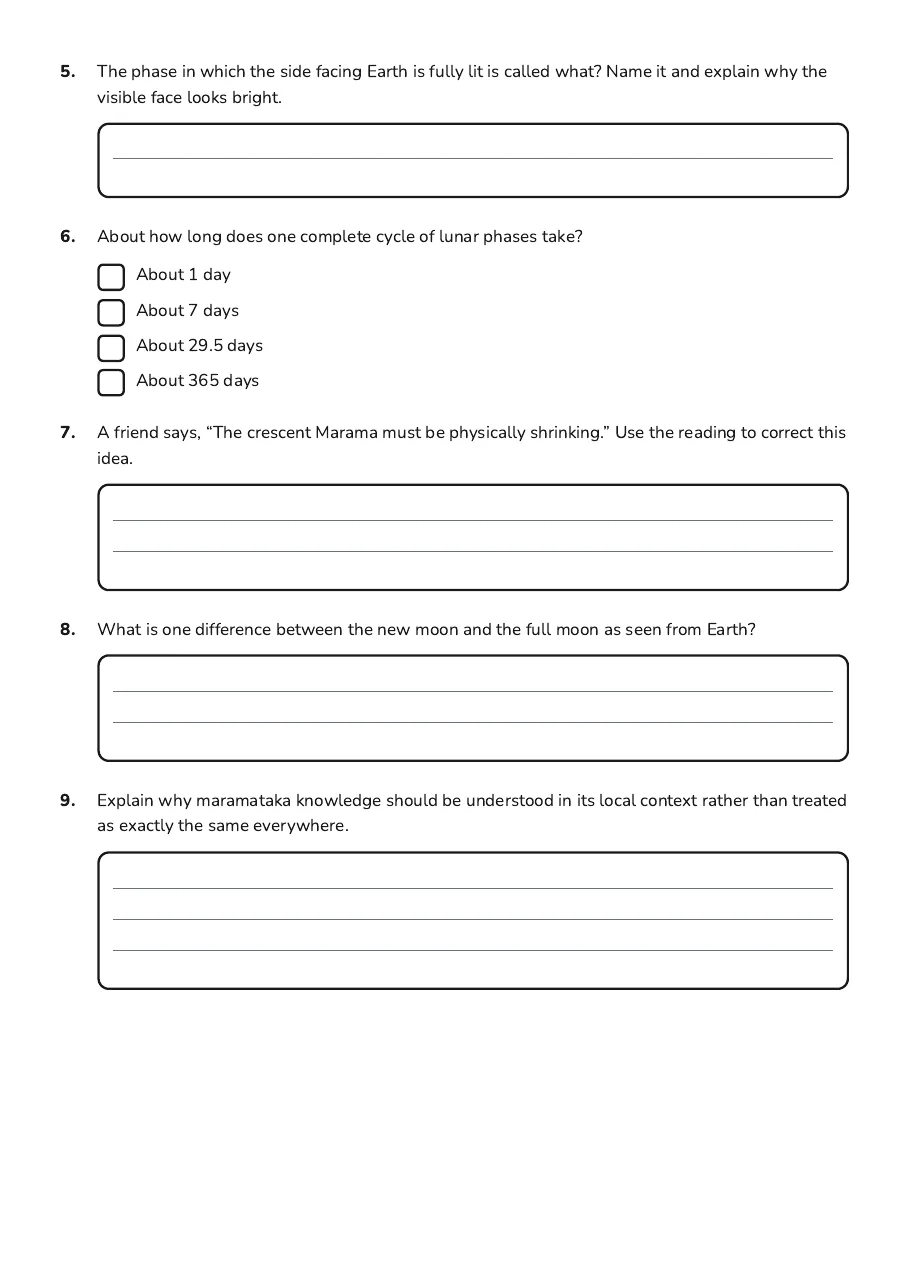
- About 1 day
- About 7 days
- About 29.5 days
- About 365 days
2 printable pages
Page 1
Page 2
About This Worksheet
Free in Kuraplan
Sign up free, grab the PDF, and customize it for your class.
Print-Ready
Formatted for standard paper. Clean layout, easy to read.
AI-Generated
Created with Kuraplan's AI, designed for real classroom use.
For Teachers & Parents
Use in classrooms, for homework, tutoring, or homeschool.
Need a custom version of this worksheet?
Kuraplan's AI generates custom worksheets in seconds — differentiated for every learner, aligned to your curriculum.
Generate Custom Worksheets — Free