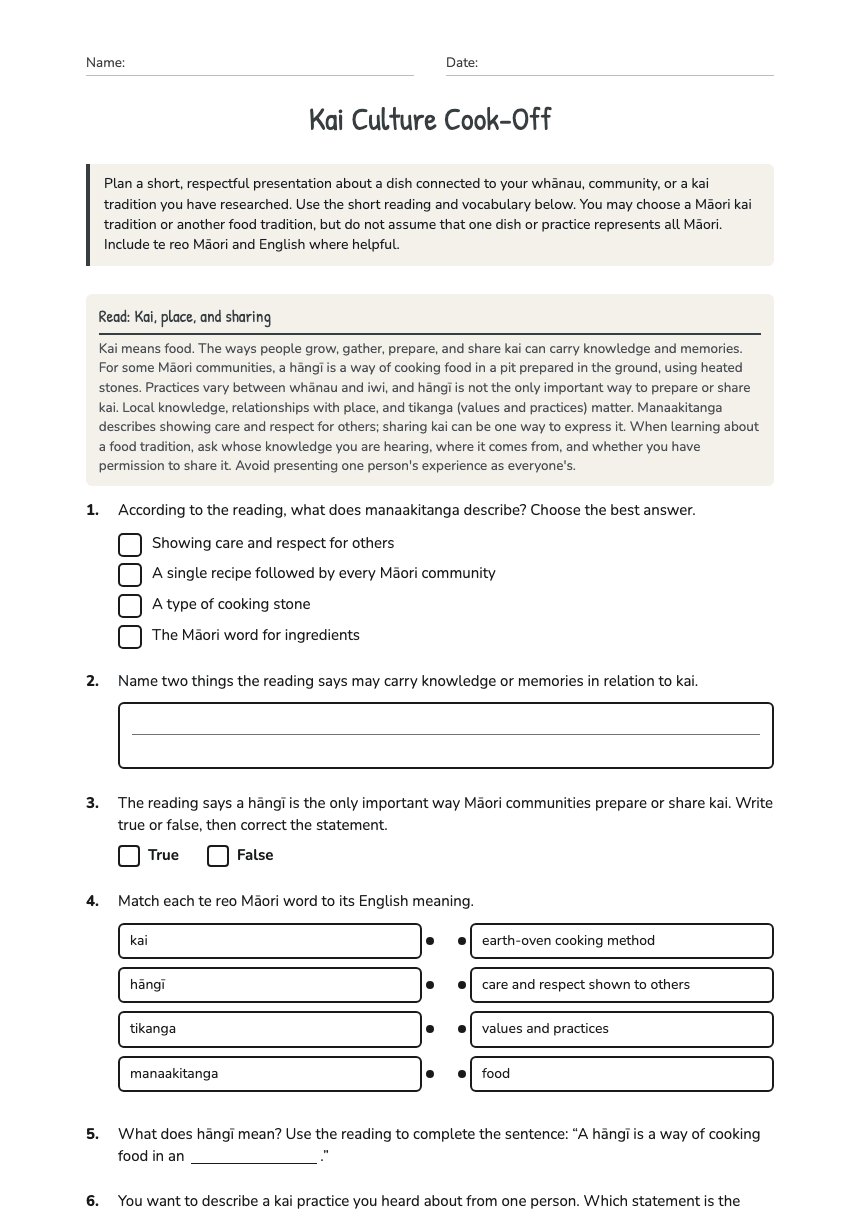
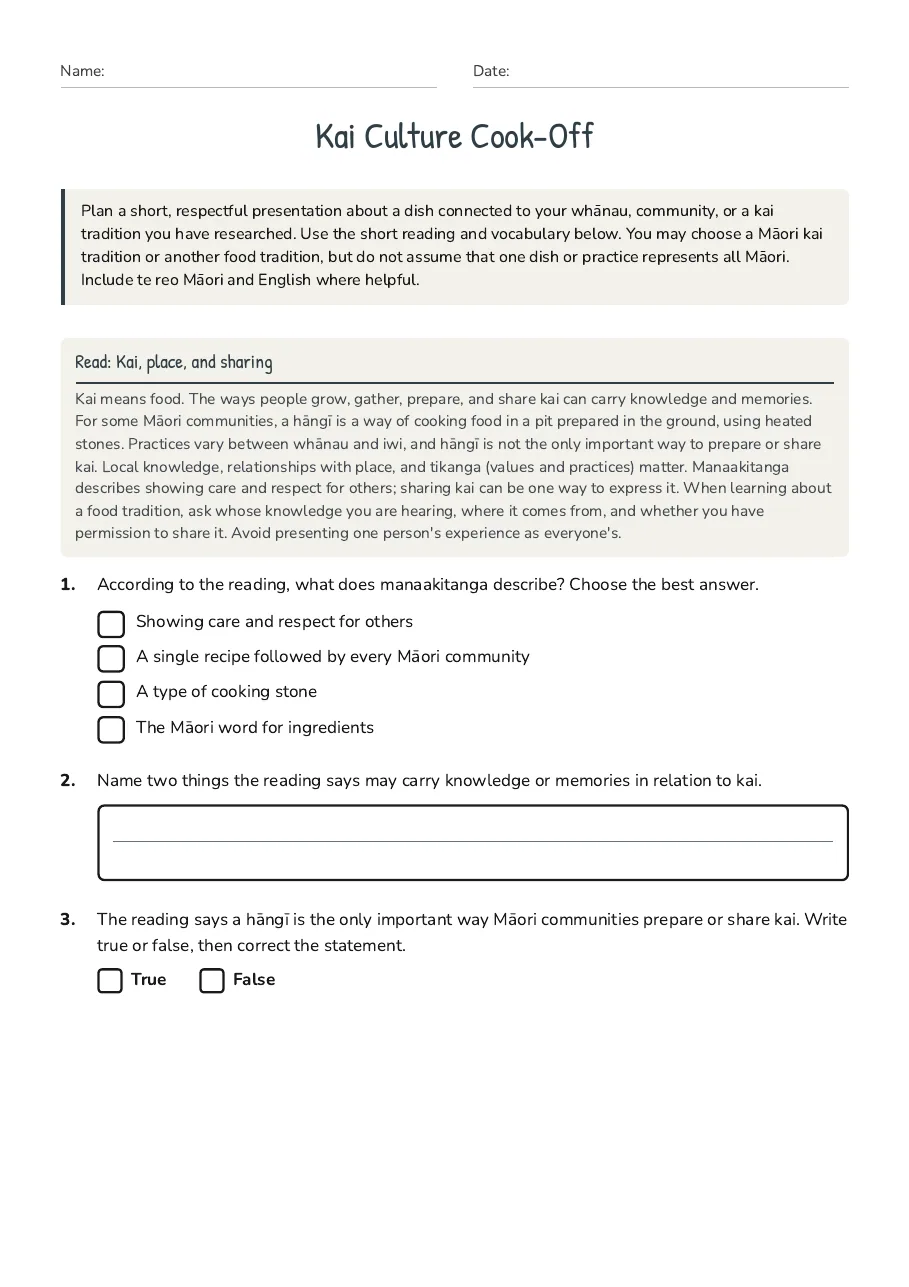
Kai Culture Cook-Off
A free te reo māori worksheet ready for your classroom. Open in Kuraplan to grab the print-ready PDF, customize it for your students, or generate a fresh version in seconds.
Kai Culture Cook-Off
Read: Kai, place, and sharing
Kai means food. The ways people grow, gather, prepare, and share kai can carry knowledge and memories. For some Māori communities, a hāngī is a way of cooking food in a pit prepared in the ground, using heated stones. Practices vary between whānau and iwi, and hāngī is not the only important way to prepare or share kai. Local knowledge, relationships with place, and tikanga (values and practices) matter. Manaakitanga describes showing care and respect for others; sharing kai can be one way to express it. When learning about a food tradition, ask whose knowledge you are hearing, where it comes from, and whether you have permission to share it. Avoid presenting one person's experience as everyone's.
- Showing care and respect for others
- A single recipe followed by every Māori community
- A type of cooking stone
- The Māori word for ingredients
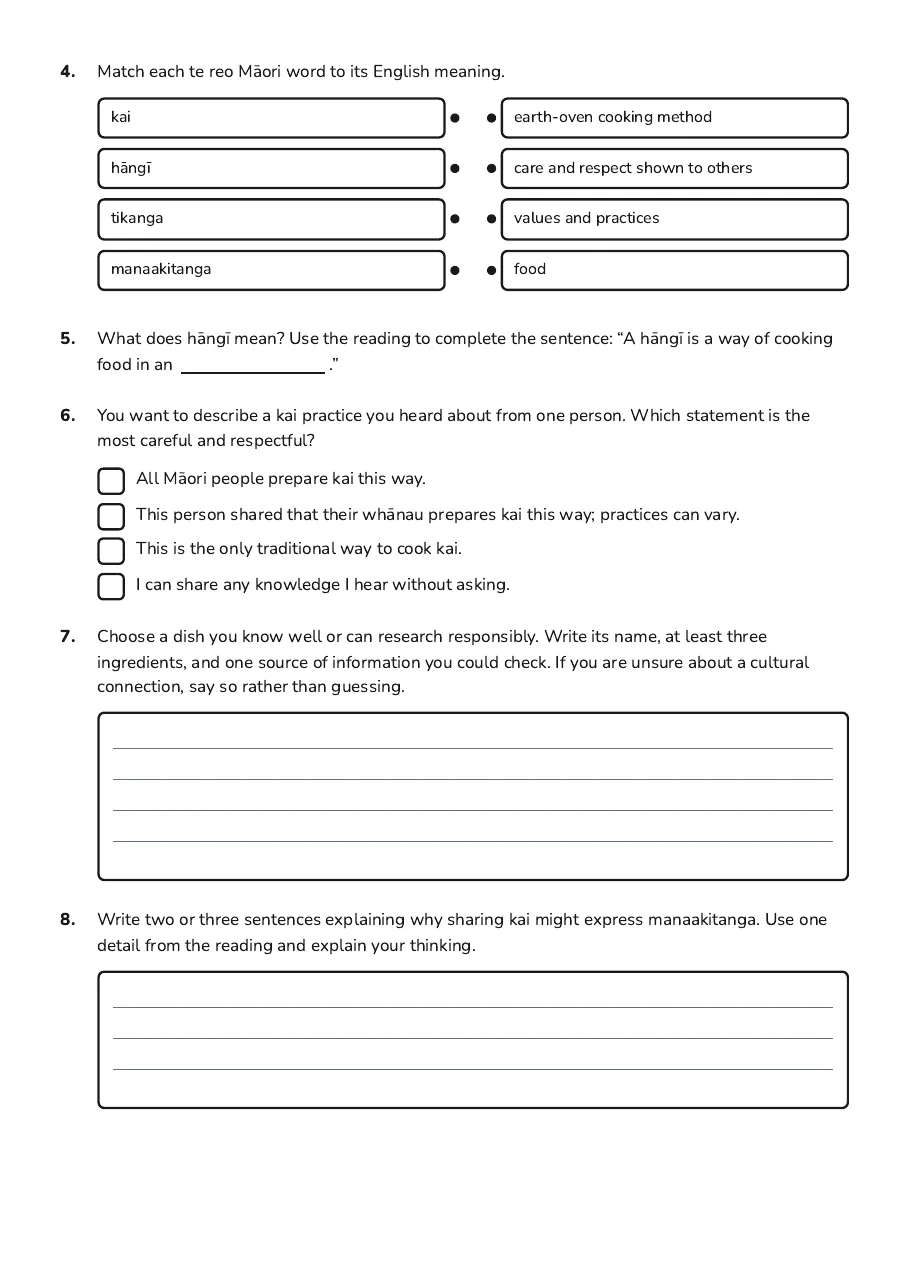
- kai
- hāngī
- tikanga
- manaakitanga
- earth-oven cooking method
- care and respect shown to others
- values and practices
- food
- All Māori people prepare kai this way.
- This person shared that their whānau prepares kai this way; practices can vary.
- This is the only traditional way to cook kai.
- I can share any knowledge I hear without asking.
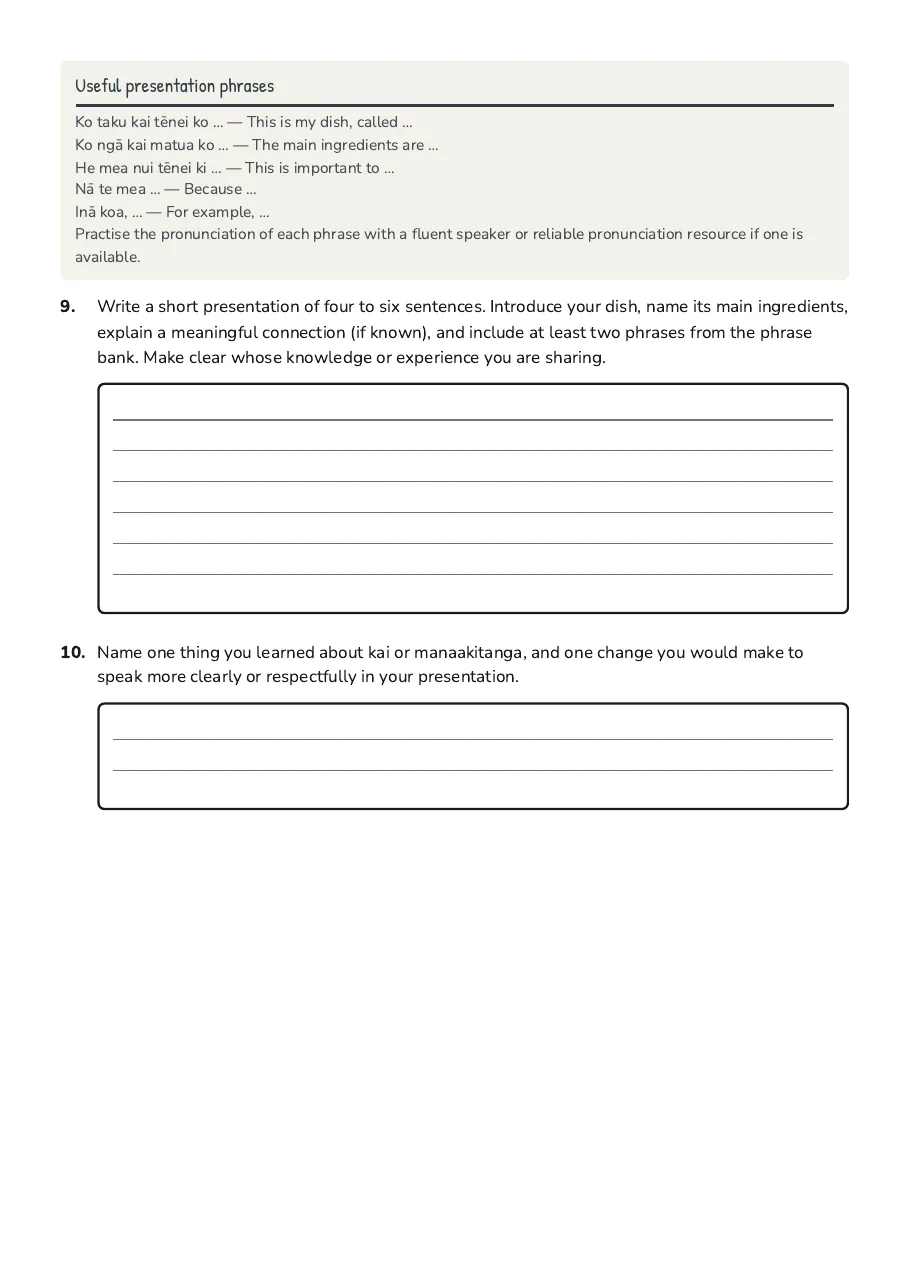
Useful presentation phrases
Ko taku kai tēnei ko … — This is my dish, called … Ko ngā kai matua ko … — The main ingredients are … He mea nui tēnei ki … — This is important to … Nā te mea … — Because … Inā koa, … — For example, … Practise the pronunciation of each phrase with a fluent speaker or reliable pronunciation resource if one is available.
3 printable pages
Page 1
Page 2
Page 3
About This Worksheet
Free in Kuraplan
Sign up free, grab the PDF, and customize it for your class.
Print-Ready
Formatted for standard paper. Clean layout, easy to read.
AI-Generated
Created with Kuraplan's AI, designed for real classroom use.
For Teachers & Parents
Use in classrooms, for homework, tutoring, or homeschool.
Need a custom version of this worksheet?
Kuraplan's AI generates custom worksheets in seconds — differentiated for every learner, aligned to your curriculum.
Generate Custom Worksheets — Free