Te Reo MāoriFreePrintable

Writing About Tikanga

A free te reo māori worksheet ready for your classroom. Open in Kuraplan to grab the print-ready PDF, customize it for your students, or generate a fresh version in seconds.
Writing About Tikanga worksheet preview
Name:Date:

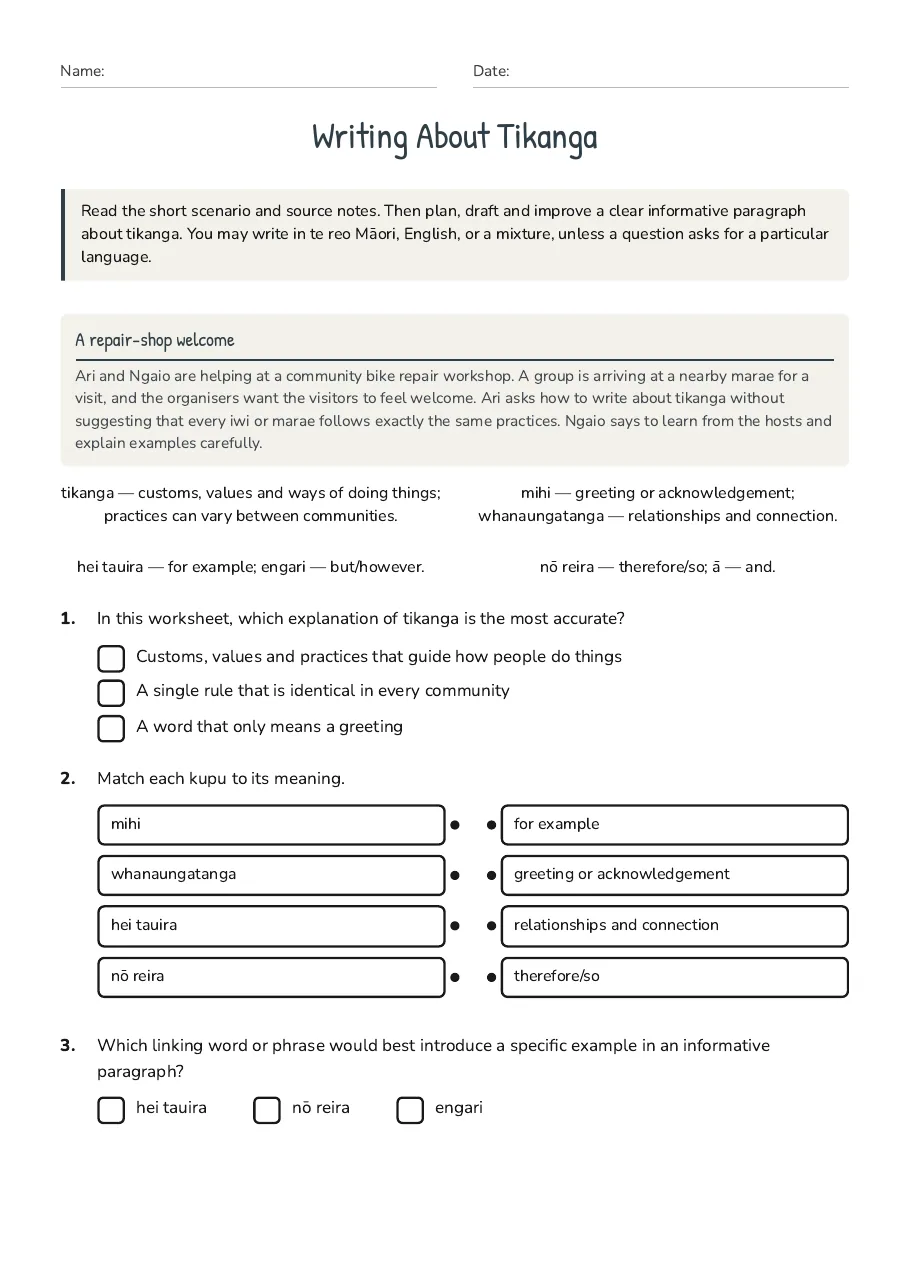
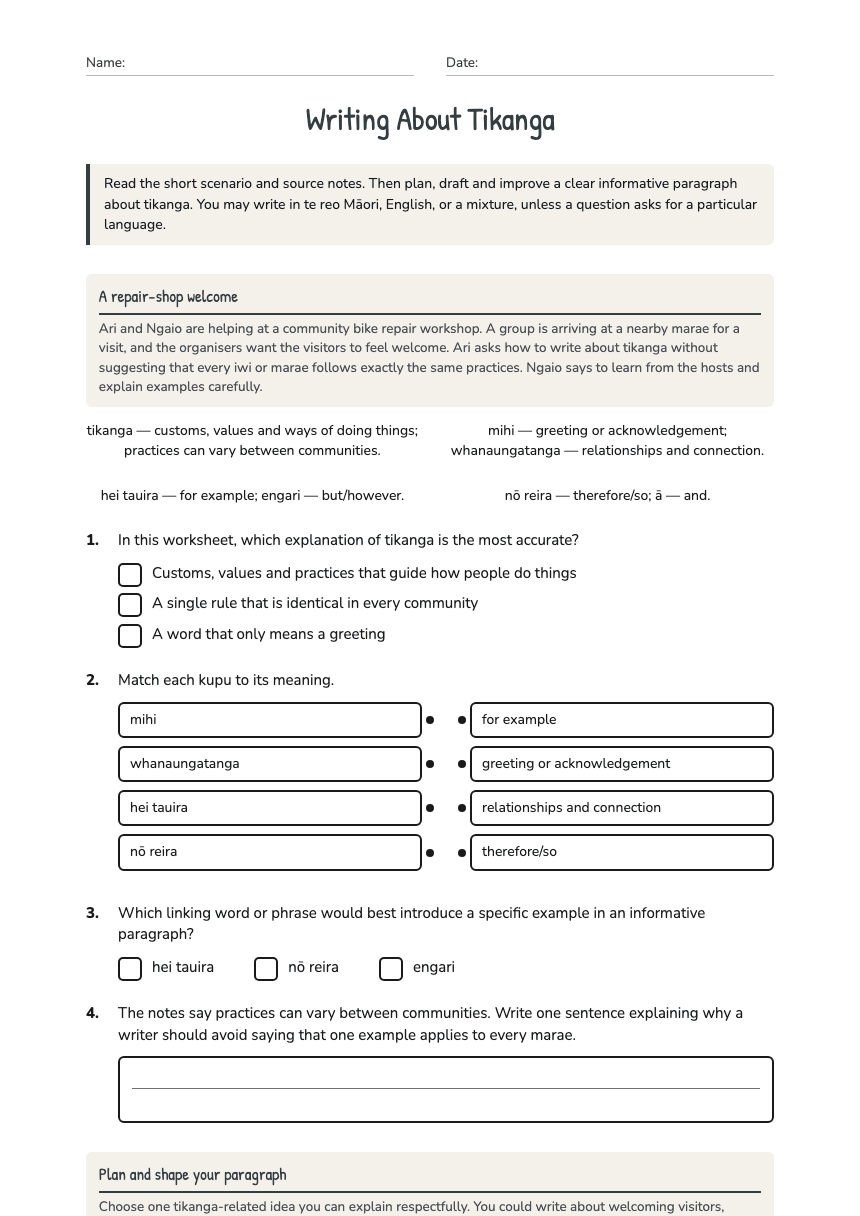
Writing About Tikanga

Read the short scenario and source notes. Then plan, draft and improve a clear informative paragraph about tikanga. You may write in te reo Māori, English, or a mixture, unless a question asks for a particular language.

A repair-shop welcome

Ari and Ngaio are helping at a community bike repair workshop. A group is arriving at a nearby marae for a visit, and the organisers want the visitors to feel welcome. Ari asks how to write about tikanga without suggesting that every iwi or marae follows exactly the same practices. Ngaio says to learn from the hosts and explain examples carefully.

tikanga — customs, values and ways of doing things; practices can vary between communities.

mihi — greeting or acknowledgement; whanaungatanga — relationships and connection.

hei tauira — for example; engari — but/however.

nō reira — therefore/so; ā — and.

1.In this worksheet, which explanation of tikanga is the most accurate?
  • Customs, values and practices that guide how people do things
  • A single rule that is identical in every community
  • A word that only means a greeting
2.Match each kupu to its meaning.
  • mihi
  • whanaungatanga
  • hei tauira
  • nō reira
  • for example
  • greeting or acknowledgement
  • relationships and connection
  • therefore/so
3.Which linking word or phrase would best introduce a specific example in an informative paragraph?
  • hei tauira
  • nō reira
  • engari
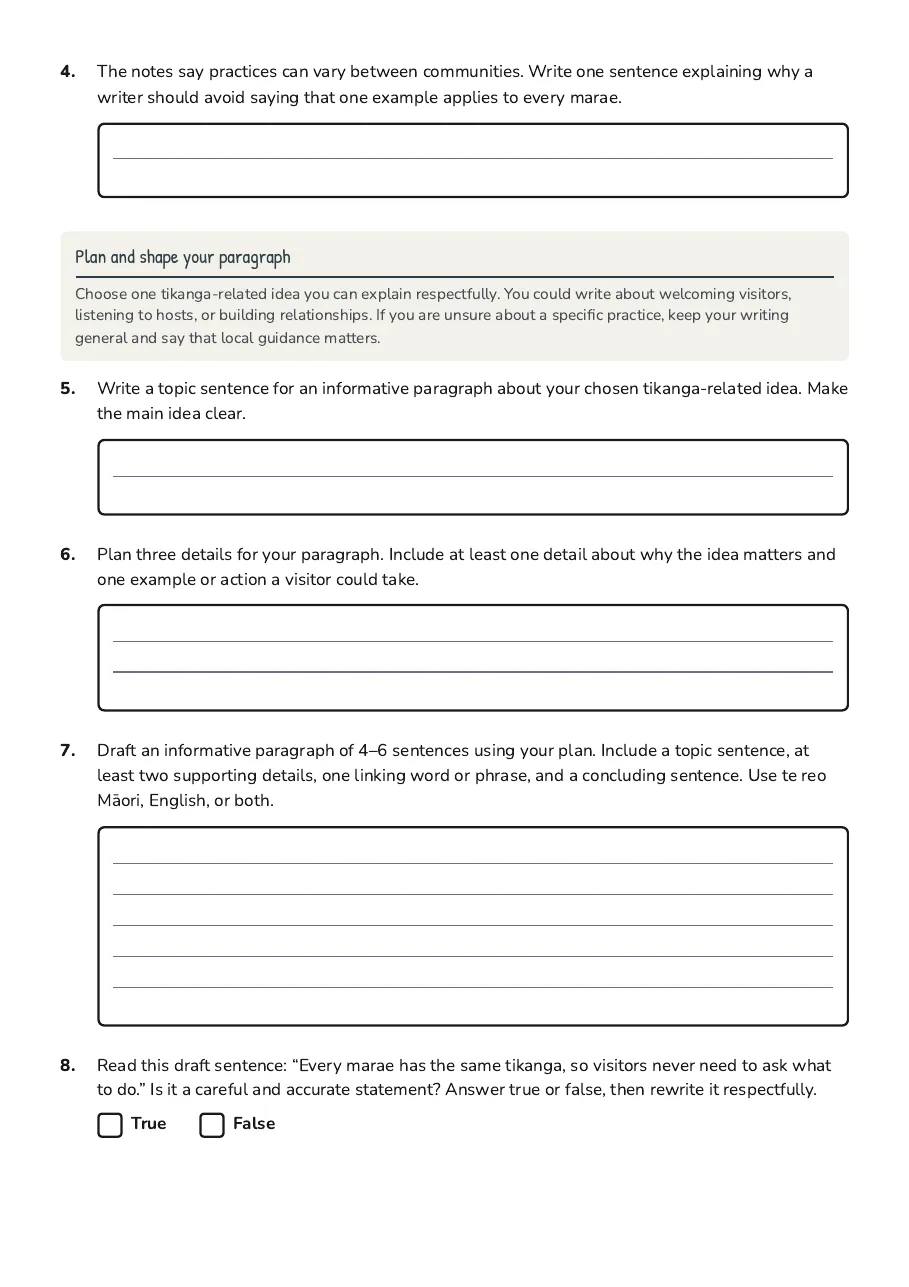
4.The notes say practices can vary between communities. Write one sentence explaining why a writer should avoid saying that one example applies to every marae.

Plan and shape your paragraph

Choose one tikanga-related idea you can explain respectfully. You could write about welcoming visitors, listening to hosts, or building relationships. If you are unsure about a specific practice, keep your writing general and say that local guidance matters.

5.Write a topic sentence for an informative paragraph about your chosen tikanga-related idea. Make the main idea clear.
6.Plan three details for your paragraph. Include at least one detail about why the idea matters and one example or action a visitor could take.
7.Draft an informative paragraph of 4–6 sentences using your plan. Include a topic sentence, at least two supporting details, one linking word or phrase, and a concluding sentence. Use te reo Māori, English, or both.
8.Read this draft sentence: “Every marae has the same tikanga, so visitors never need to ask what to do.” Is it a careful and accurate statement? Answer true or false, then rewrite it respectfully.
TrueFalse
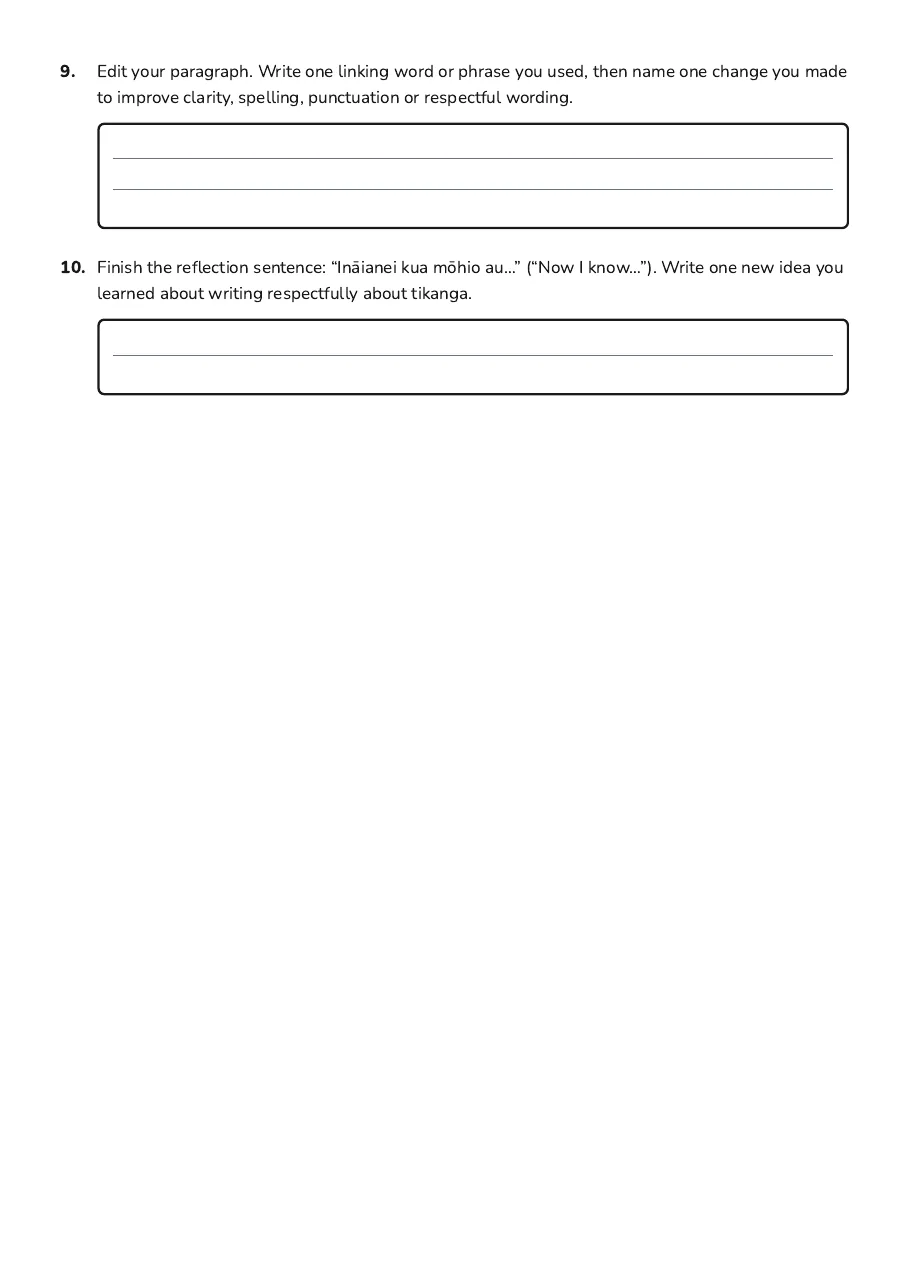
9.Edit your paragraph. Write one linking word or phrase you used, then name one change you made to improve clarity, spelling, punctuation or respectful wording.
10.Finish the reflection sentence: “Ināianei kua mōhio au…” (“Now I know…”). Write one new idea you learned about writing respectfully about tikanga.

3 printable pages

  • Writing About Tikanga, page 1 of 3: A repair-shop welcome

    Page 1

  • Writing About Tikanga, page 2 of 3: Plan and shape your paragraph

    Page 2

  • Writing About Tikanga, page 3 of 3: 9. Edit your paragraph. Write one linking word or phrase you used, then name one change…

    Page 3

About This Worksheet

Free in Kuraplan

Sign up free, grab the PDF, and customize it for your class.

Print-Ready

Formatted for standard paper. Clean layout, easy to read.

AI-Generated

Created with Kuraplan's AI, designed for real classroom use.

For Teachers & Parents

Use in classrooms, for homework, tutoring, or homeschool.

Need a custom version of this worksheet?

Kuraplan's AI generates custom worksheets in seconds — differentiated for every learner, aligned to your curriculum.

Generate Custom Worksheets — Free
No credit card Curriculum-aligned Under 60 seconds