Te Reo MāoriFreePrintable

Kai & Tikanga Māori Worksheet

A free te reo māori worksheet ready for your classroom. Open in Kuraplan to grab the print-ready PDF, customize it for your students, or generate a fresh version in seconds.
Kai & Tikanga Māori Worksheet worksheet preview
Name:Date:

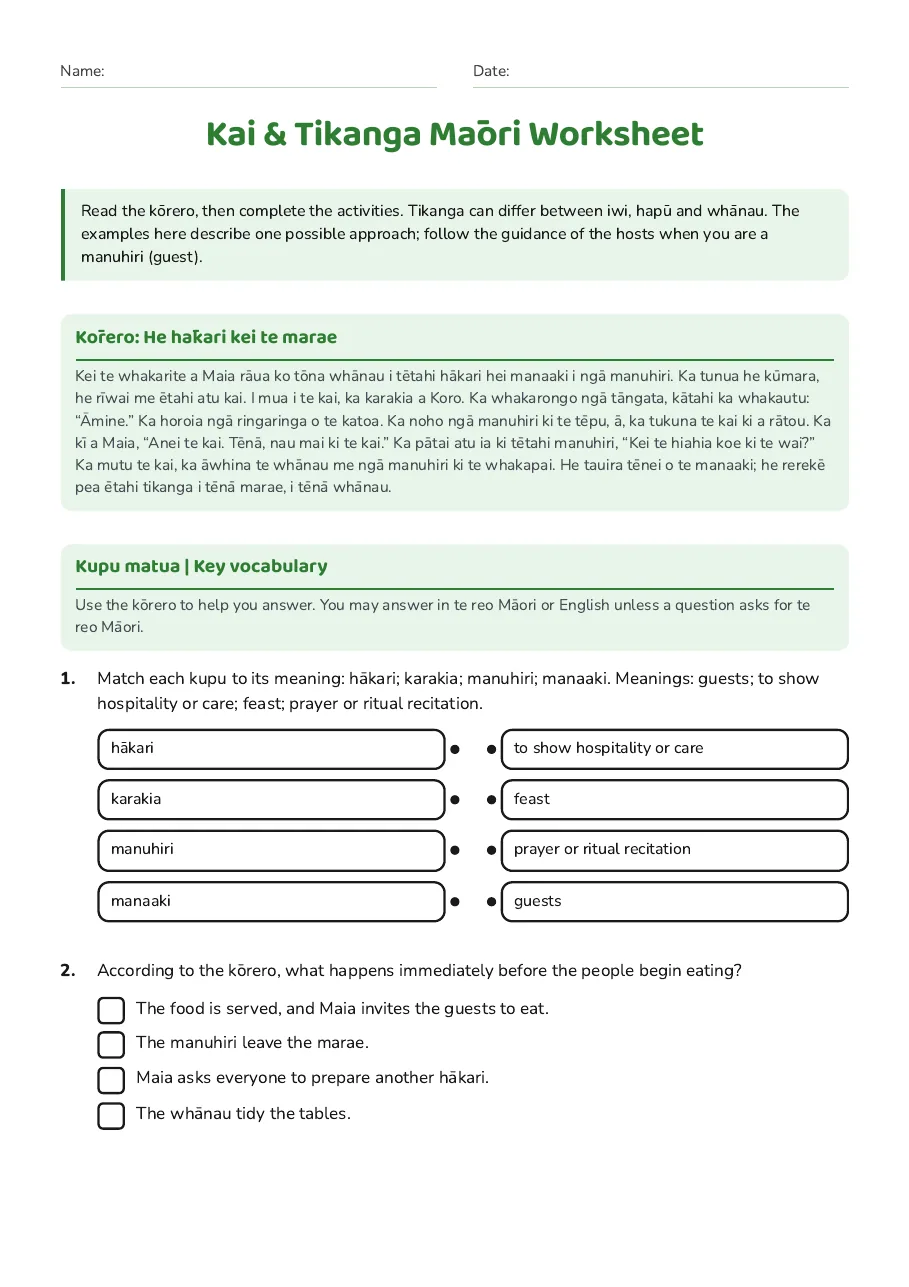
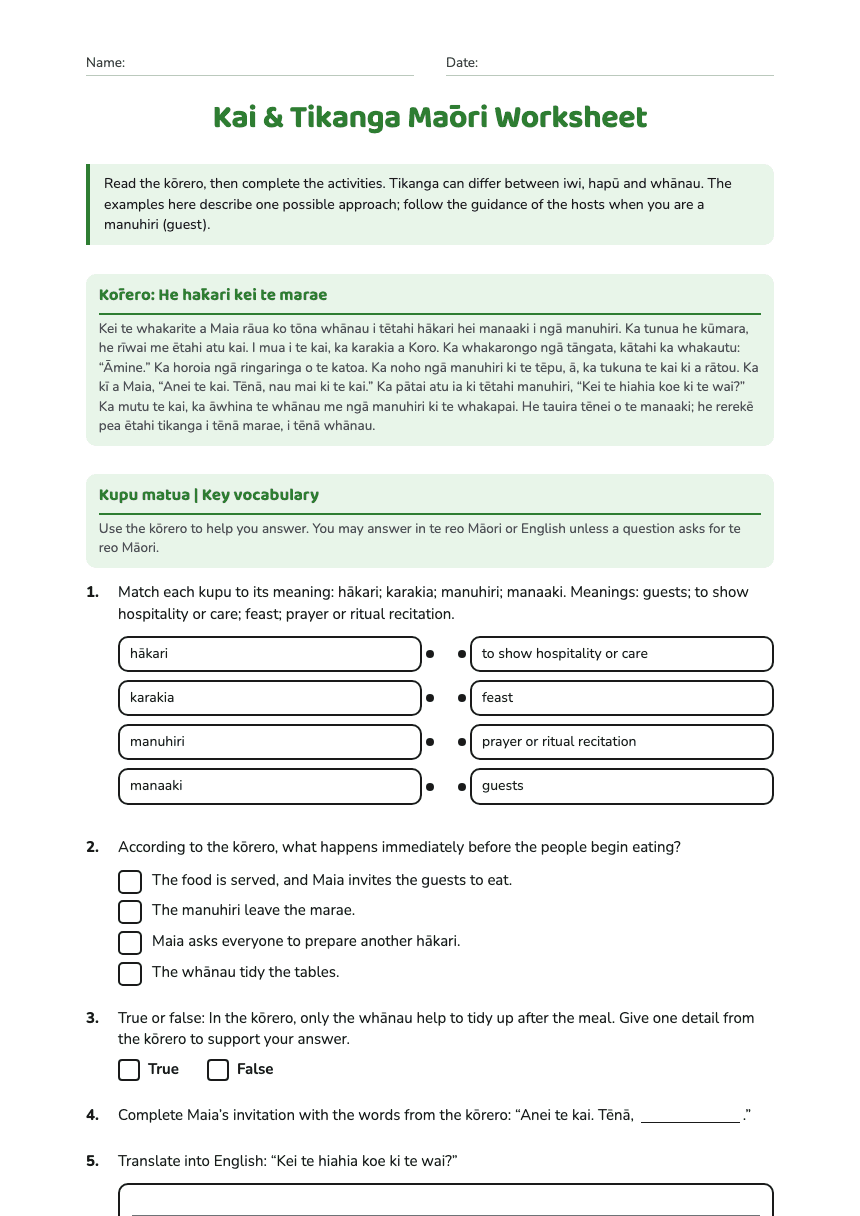
Kai & Tikanga Māori Worksheet

Read the kōrero, then complete the activities. Tikanga can differ between iwi, hapū and whānau. The examples here describe one possible approach; follow the guidance of the hosts when you are a manuhiri (guest).

Kōrero: He hākari kei te marae

Kei te whakarite a Maia rāua ko tōna whānau i tētahi hākari hei manaaki i ngā manuhiri. Ka tunua he kūmara, he rīwai me ētahi atu kai. I mua i te kai, ka karakia a Koro. Ka whakarongo ngā tāngata, kātahi ka whakautu: “Āmine.” Ka horoia ngā ringaringa o te katoa. Ka noho ngā manuhiri ki te tēpu, ā, ka tukuna te kai ki a rātou. Ka kī a Maia, “Anei te kai. Tēnā, nau mai ki te kai.” Ka pātai atu ia ki tētahi manuhiri, “Kei te hiahia koe ki te wai?” Ka mutu te kai, ka āwhina te whānau me ngā manuhiri ki te whakapai. He tauira tēnei o te manaaki; he rerekē pea ētahi tikanga i tēnā marae, i tēnā whānau.

Kupu matua | Key vocabulary

Use the kōrero to help you answer. You may answer in te reo Māori or English unless a question asks for te reo Māori.

1.Match each kupu to its meaning: hākari; karakia; manuhiri; manaaki. Meanings: guests; to show hospitality or care; feast; prayer or ritual recitation.
  • hākari
  • karakia
  • manuhiri
  • manaaki
  • to show hospitality or care
  • feast
  • prayer or ritual recitation
  • guests
2.According to the kōrero, what happens immediately before the people begin eating?
  • The food is served, and Maia invites the guests to eat.
  • The manuhiri leave the marae.
  • Maia asks everyone to prepare another hākari.
  • The whānau tidy the tables.
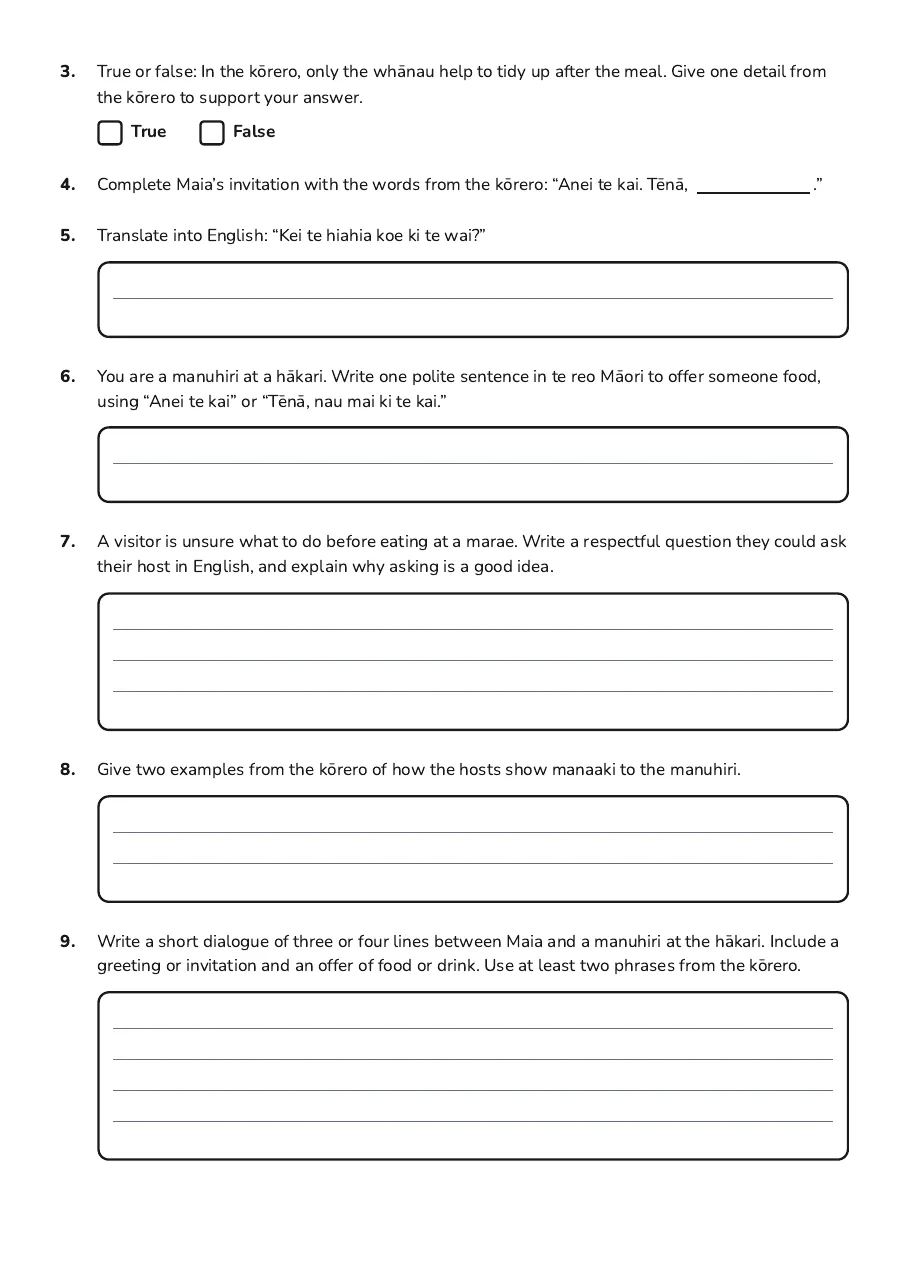
3.True or false: In the kōrero, only the whānau help to tidy up after the meal. Give one detail from the kōrero to support your answer.
TrueFalse
4.Complete Maia’s invitation with the words from the kōrero: “Anei te kai. Tēnā, .”
5.Translate into English: “Kei te hiahia koe ki te wai?”
6.You are a manuhiri at a hākari. Write one polite sentence in te reo Māori to offer someone food, using “Anei te kai” or “Tēnā, nau mai ki te kai.”
7.A visitor is unsure what to do before eating at a marae. Write a respectful question they could ask their host in English, and explain why asking is a good idea.
8.Give two examples from the kōrero of how the hosts show manaaki to the manuhiri.
9.Write a short dialogue of three or four lines between Maia and a manuhiri at the hākari. Include a greeting or invitation and an offer of food or drink. Use at least two phrases from the kōrero.
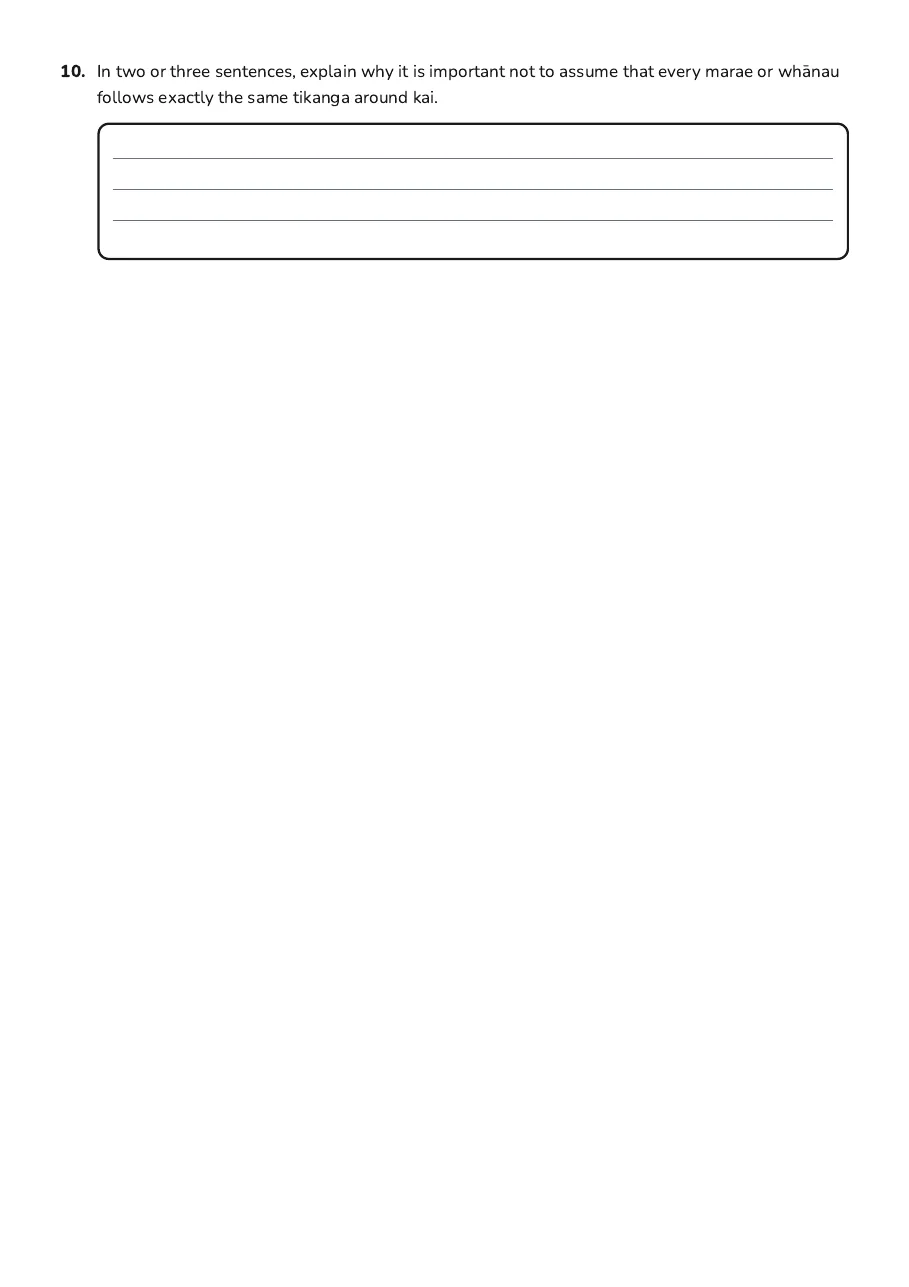
10.In two or three sentences, explain why it is important not to assume that every marae or whānau follows exactly the same tikanga around kai.

3 printable pages

  • Kai & Tikanga Māori Worksheet, page 1 of 3: Kōrero: He hākari kei te marae, Kupu matua | Key vocabulary

    Page 1

  • Kai & Tikanga Māori Worksheet, page 2 of 3: 3. True or false: In the kō rero, only the whā nau help to tidy up after the meal. Give…

    Page 2

  • Kai & Tikanga Māori Worksheet, page 3 of 3: 10. In two or three sentences, explain why it is important not to assume that every marae…

    Page 3

About This Worksheet

Free in Kuraplan

Sign up free, grab the PDF, and customize it for your class.

Print-Ready

Formatted for standard paper. Clean layout, easy to read.

AI-Generated

Created with Kuraplan's AI, designed for real classroom use.

For Teachers & Parents

Use in classrooms, for homework, tutoring, or homeschool.

Need a custom version of this worksheet?

Kuraplan's AI generates custom worksheets in seconds — differentiated for every learner, aligned to your curriculum.

Generate Custom Worksheets — Free
No credit card Curriculum-aligned Under 60 seconds

Explore more free resources