Kapa Haka Foundations
A free te reo māori worksheet ready for your classroom. Open in Kuraplan to grab the print-ready PDF, customize it for your students, or generate a fresh version in seconds.
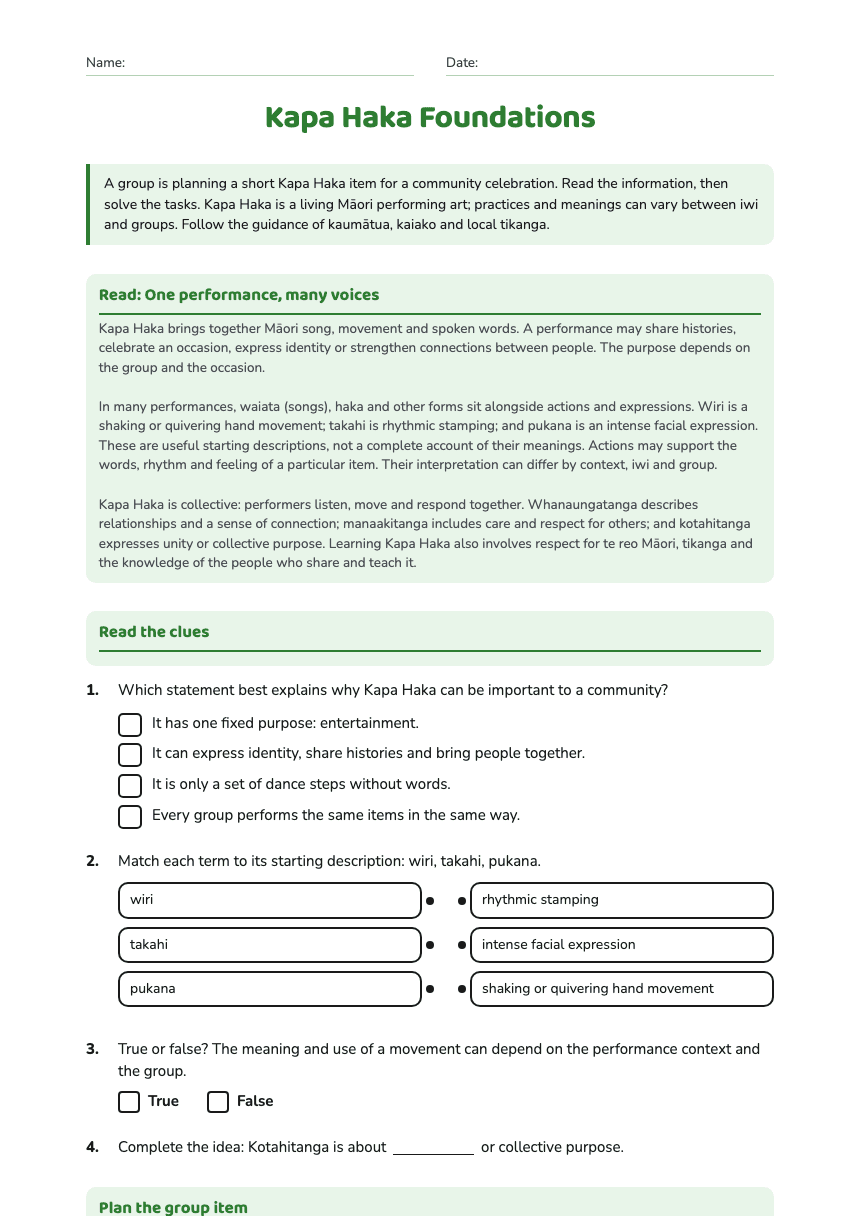
Kapa Haka Foundations
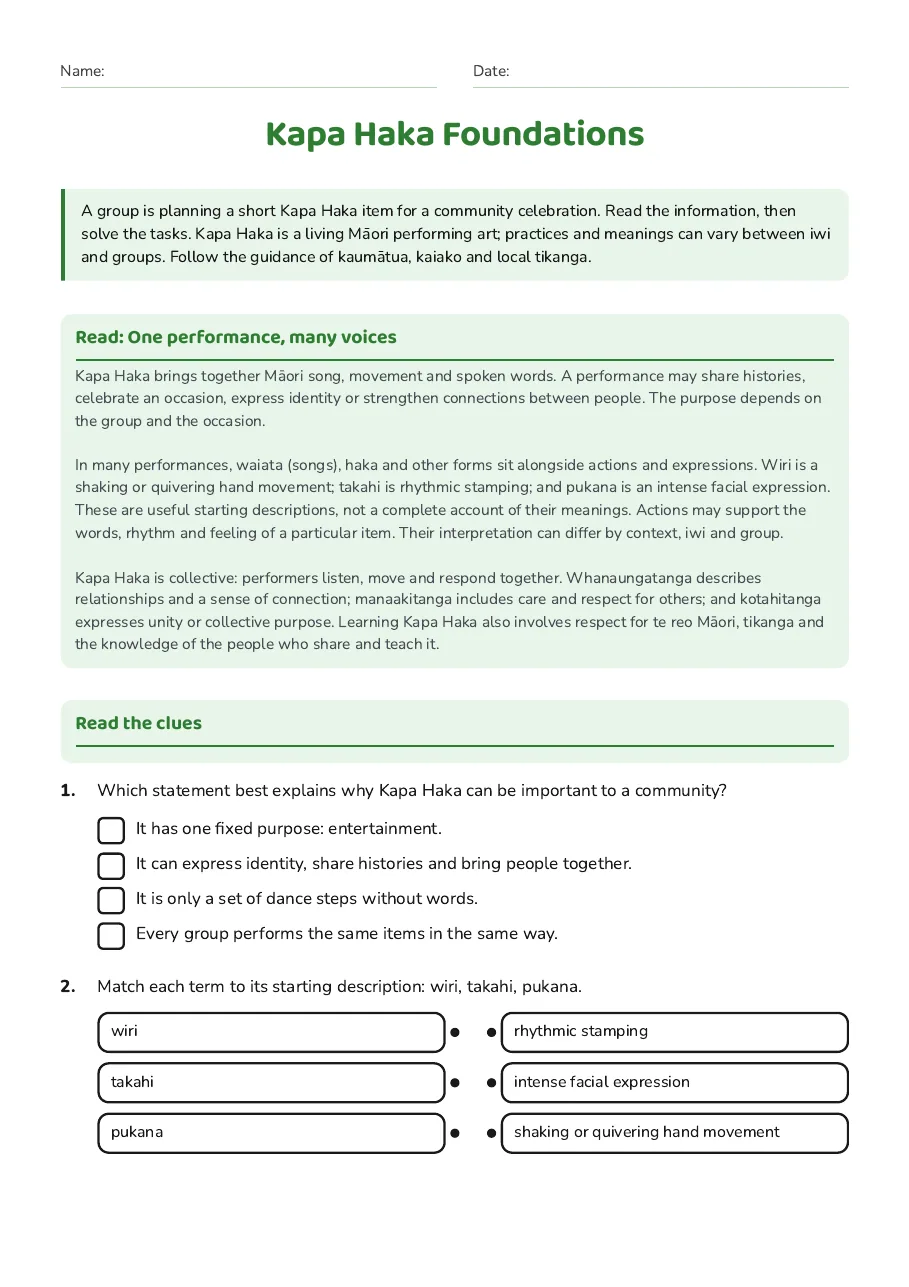
Read: One performance, many voices
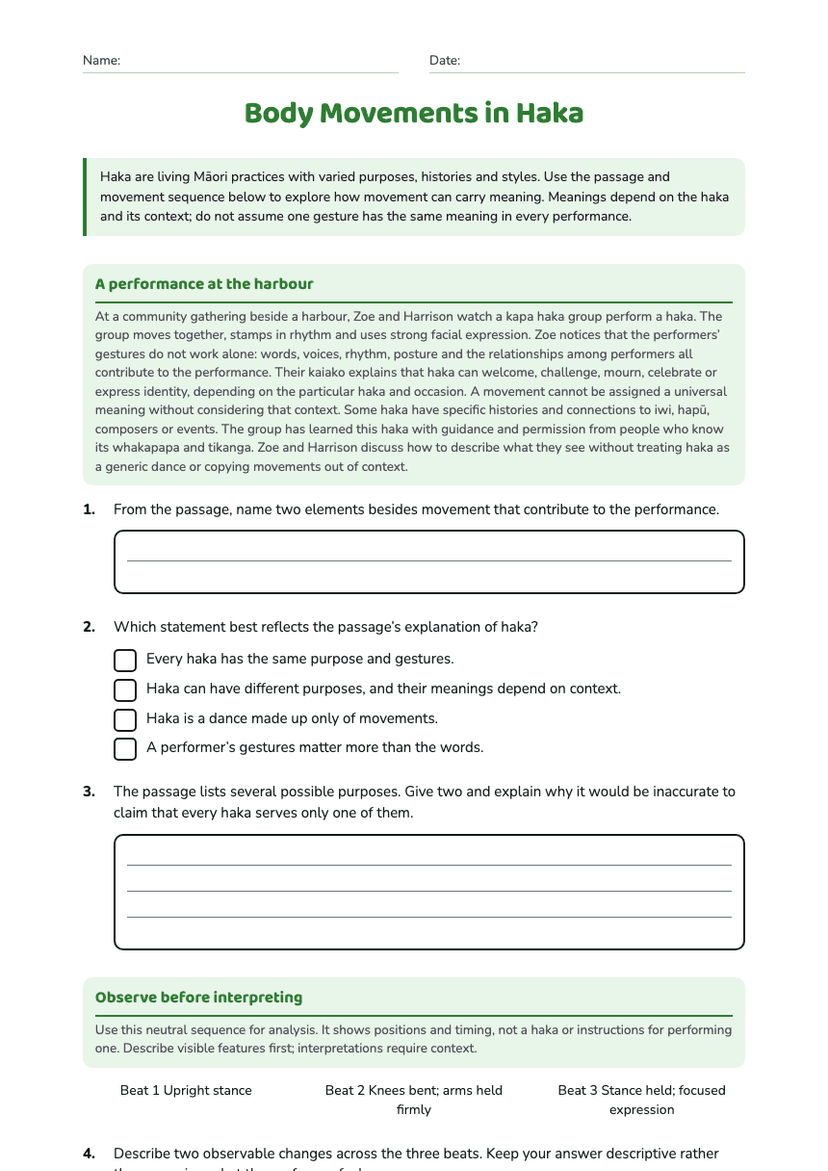
Kapa Haka brings together Māori song, movement and spoken words. A performance may share histories, celebrate an occasion, express identity or strengthen connections between people. The purpose depends on the group and the occasion. In many performances, waiata (songs), haka and other forms sit alongside actions and expressions. Wiri is a shaking or quivering hand movement; takahi is rhythmic stamping; and pukana is an intense facial expression. These are useful starting descriptions, not a complete account of their meanings. Actions may support the words, rhythm and feeling of a particular item. Their interpretation can differ by context, iwi and group. Kapa Haka is collective: performers listen, move and respond together. Whanaungatanga describes relationships and a sense of connection; manaakitanga includes care and respect for others; and kotahitanga expresses unity or collective purpose. Learning Kapa Haka also involves respect for te reo Māori, tikanga and the knowledge of the people who share and teach it.
Read the clues
- It has one fixed purpose: entertainment.
- It can express identity, share histories and bring people together.
- It is only a set of dance steps without words.
- Every group performs the same items in the same way.
- wiri
- takahi
- pukana
- rhythmic stamping
- intense facial expression
- shaking or quivering hand movement
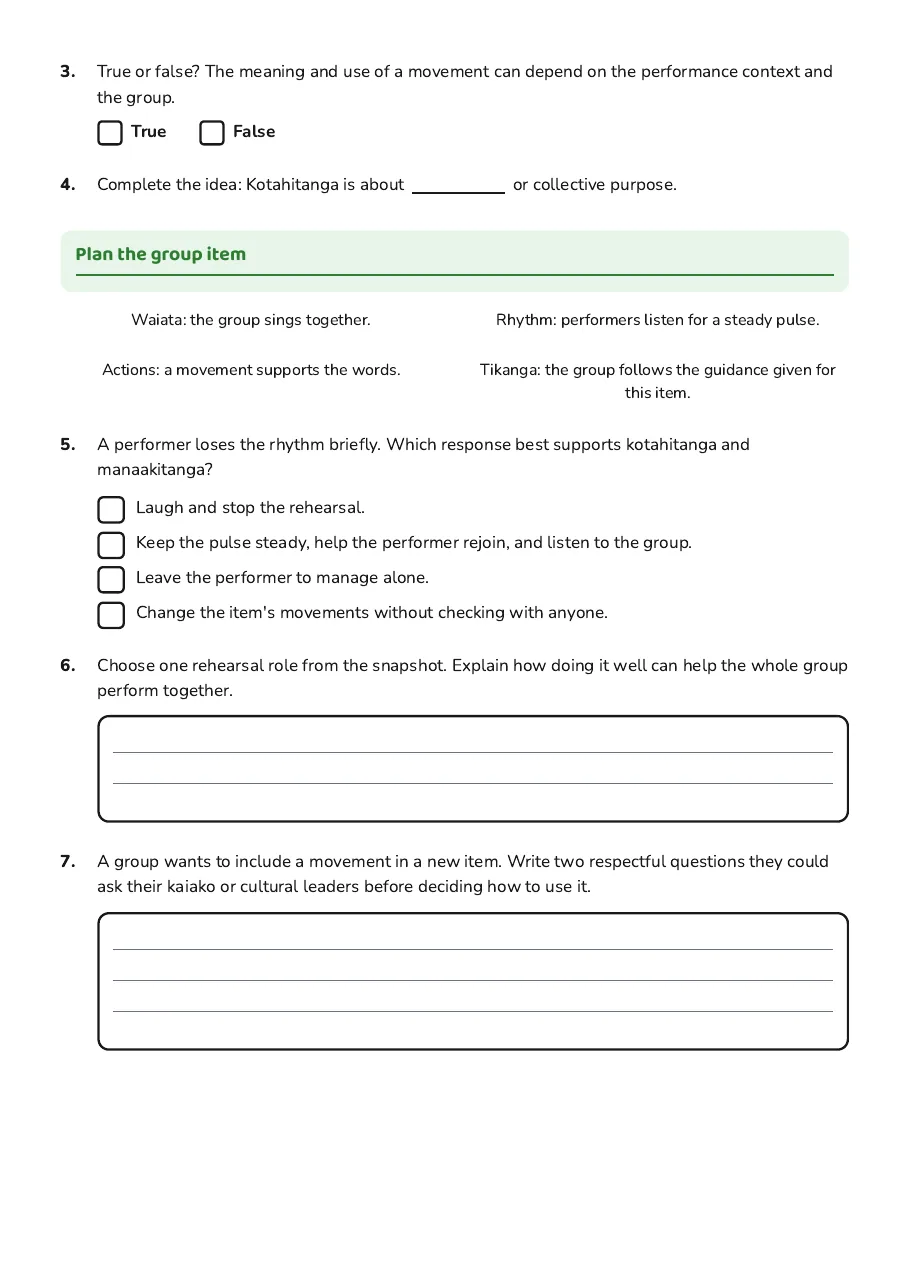
Plan the group item
Waiata: the group sings together.
Rhythm: performers listen for a steady pulse.
Actions: a movement supports the words.
Tikanga: the group follows the guidance given for this item.
- Laugh and stop the rehearsal.
- Keep the pulse steady, help the performer rejoin, and listen to the group.
- Leave the performer to manage alone.
- Change the item's movements without checking with anyone.
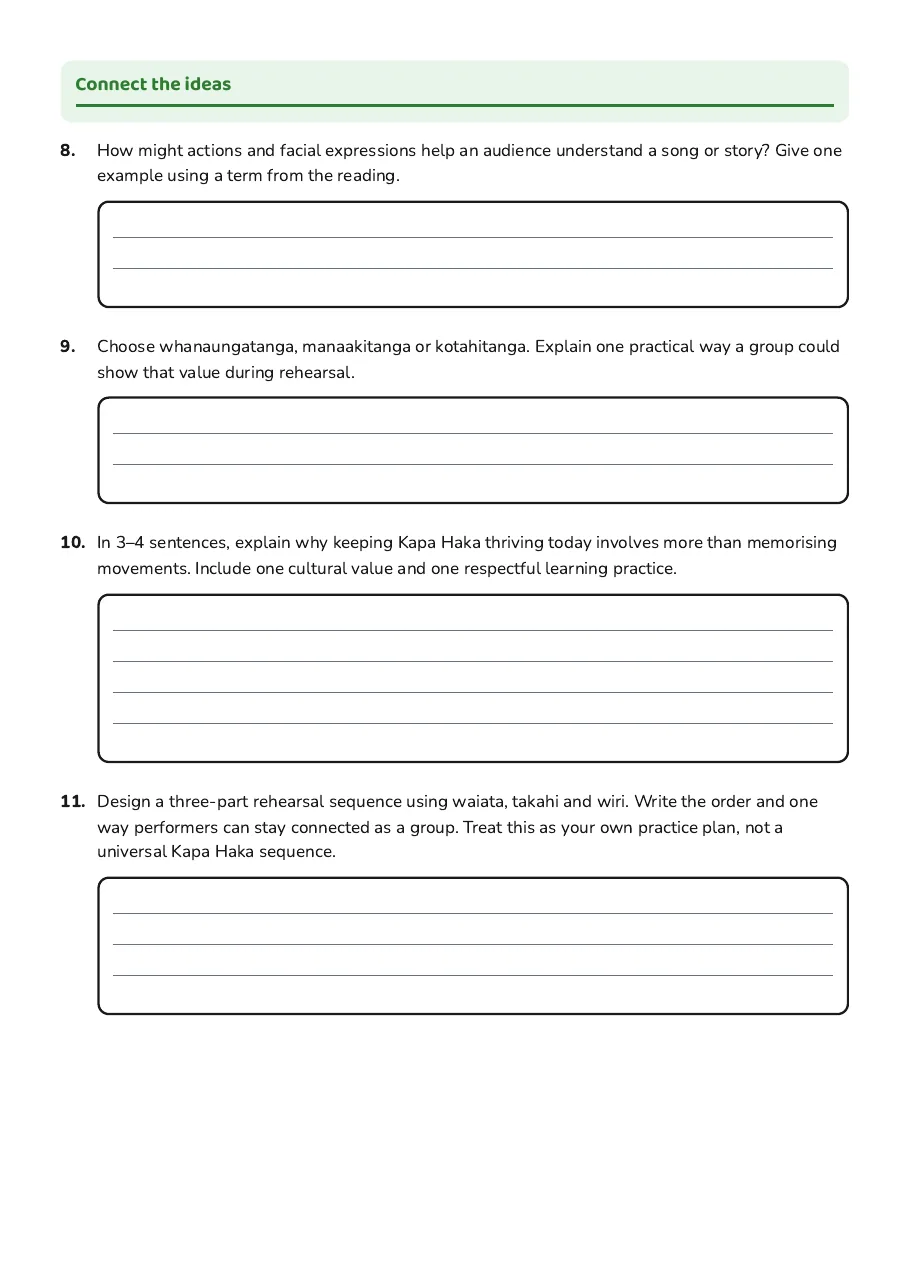
Connect the ideas
3 printable pages
Page 1
Page 2
Page 3
About This Worksheet
Free in Kuraplan
Sign up free, grab the PDF, and customize it for your class.
Print-Ready
Formatted for standard paper. Clean layout, easy to read.
AI-Generated
Created with Kuraplan's AI, designed for real classroom use.
For Teachers & Parents
Use in classrooms, for homework, tutoring, or homeschool.
Need a custom version of this worksheet?
Kuraplan's AI generates custom worksheets in seconds — differentiated for every learner, aligned to your curriculum.
Generate Custom Worksheets — Free