ScienceFreePrintable

Kitchen Chemistry Introduction

A free science worksheet ready for your classroom. Open in Kuraplan to grab the print-ready PDF, customize it for your students, or generate a fresh version in seconds.
Kitchen Chemistry Introduction worksheet preview
Name:Date:

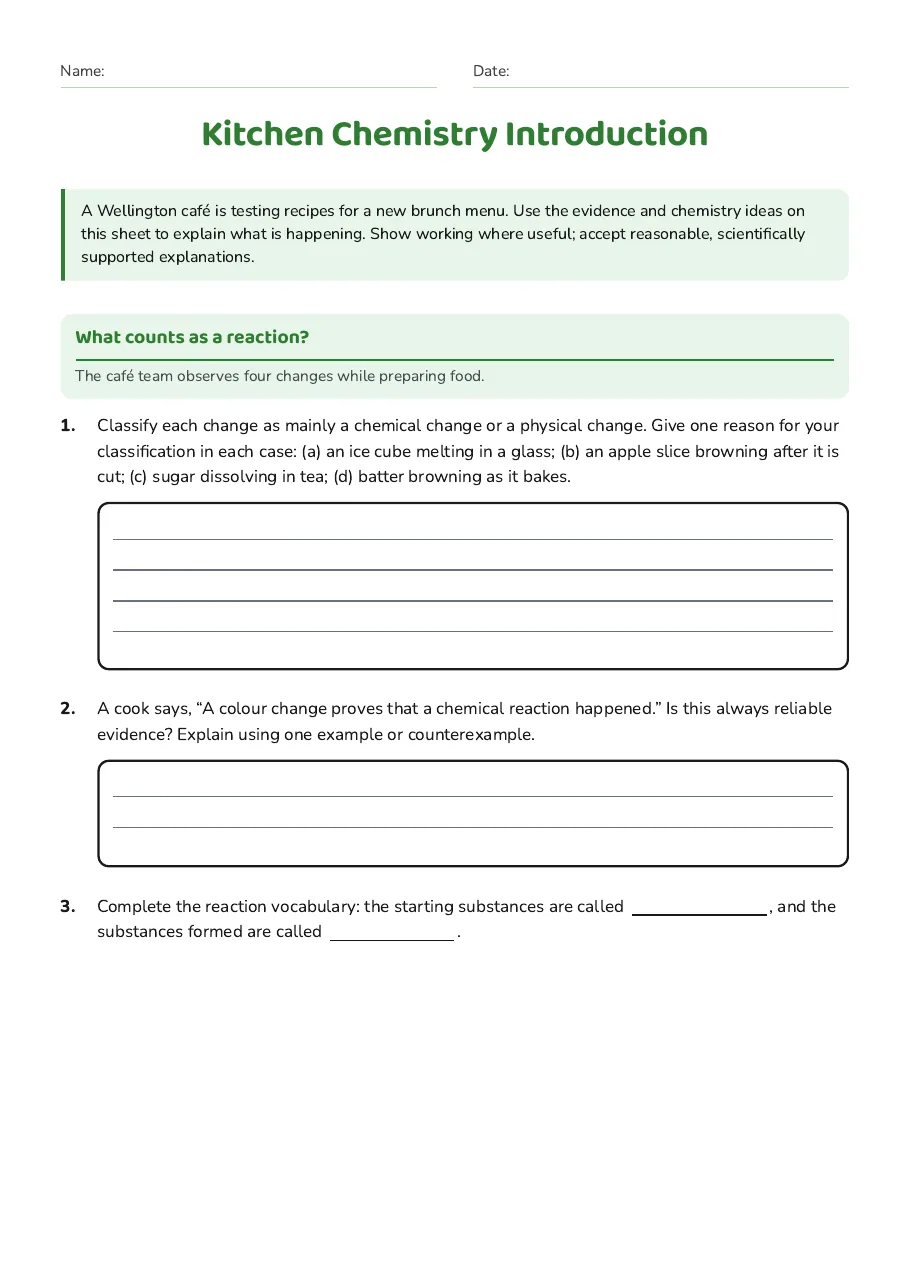
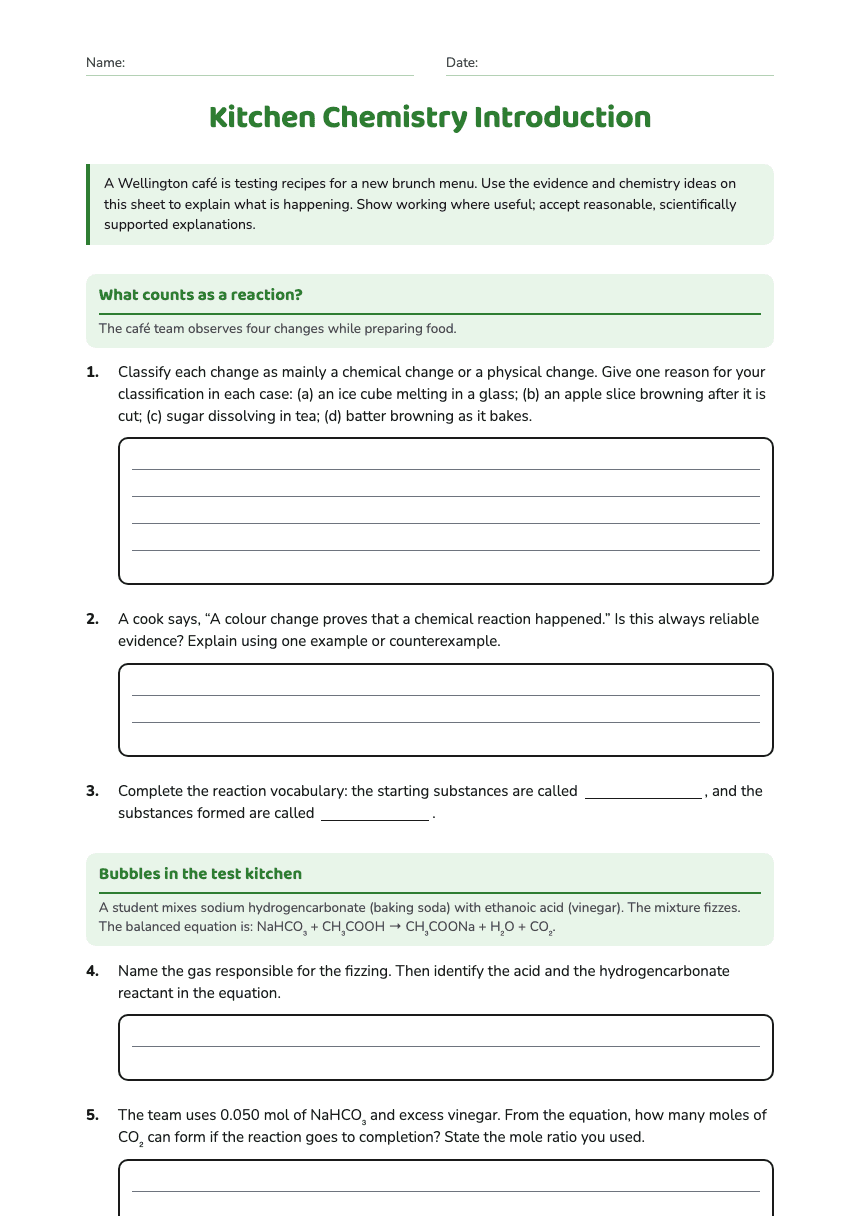
Kitchen Chemistry Introduction

A Wellington café is testing recipes for a new brunch menu. Use the evidence and chemistry ideas on this sheet to explain what is happening. Show working where useful; accept reasonable, scientifically supported explanations.

What counts as a reaction?

The café team observes four changes while preparing food.

1.Classify each change as mainly a chemical change or a physical change. Give one reason for your classification in each case: (a) an ice cube melting in a glass; (b) an apple slice browning after it is cut; (c) sugar dissolving in tea; (d) batter browning as it bakes.
2.A cook says, “A colour change proves that a chemical reaction happened.” Is this always reliable evidence? Explain using one example or counterexample.
3.Complete the reaction vocabulary: the starting substances are called , and the substances formed are called .

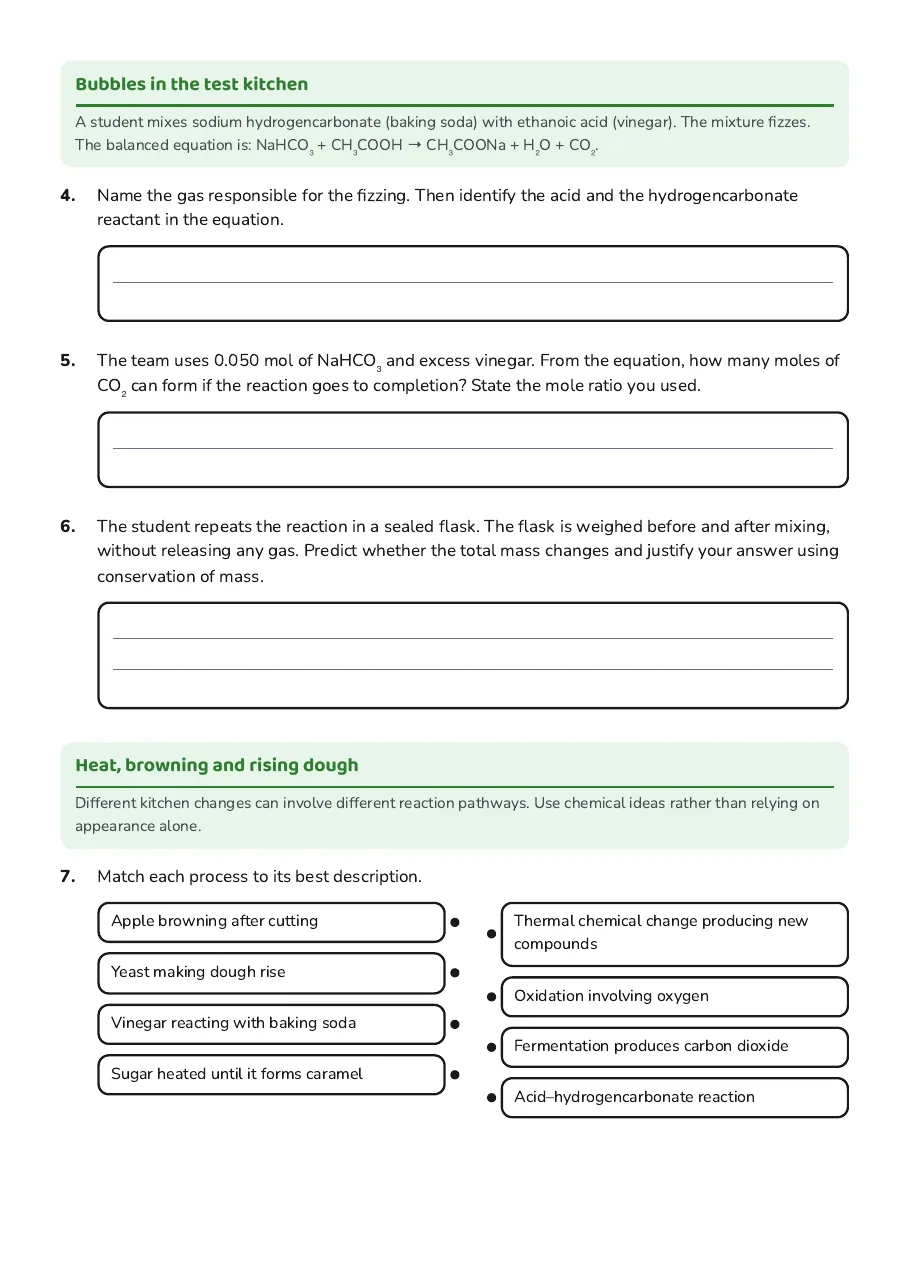
Bubbles in the test kitchen

A student mixes sodium hydrogencarbonate (baking soda) with ethanoic acid (vinegar). The mixture fizzes. The balanced equation is: NaHCO₃ + CH₃COOH → CH₃COONa + H₂O + CO₂.

4.Name the gas responsible for the fizzing. Then identify the acid and the hydrogencarbonate reactant in the equation.
5.The team uses 0.050 mol of NaHCO₃ and excess vinegar. From the equation, how many moles of CO₂ can form if the reaction goes to completion? State the mole ratio you used.
6.The student repeats the reaction in a sealed flask. The flask is weighed before and after mixing, without releasing any gas. Predict whether the total mass changes and justify your answer using conservation of mass.

Heat, browning and rising dough

Different kitchen changes can involve different reaction pathways. Use chemical ideas rather than relying on appearance alone.

7.Match each process to its best description.
  • Apple browning after cutting
  • Yeast making dough rise
  • Vinegar reacting with baking soda
  • Sugar heated until it forms caramel
  • Thermal chemical change producing new compounds
  • Oxidation involving oxygen
  • Fermentation produces carbon dioxide
  • Acid–hydrogencarbonate reaction
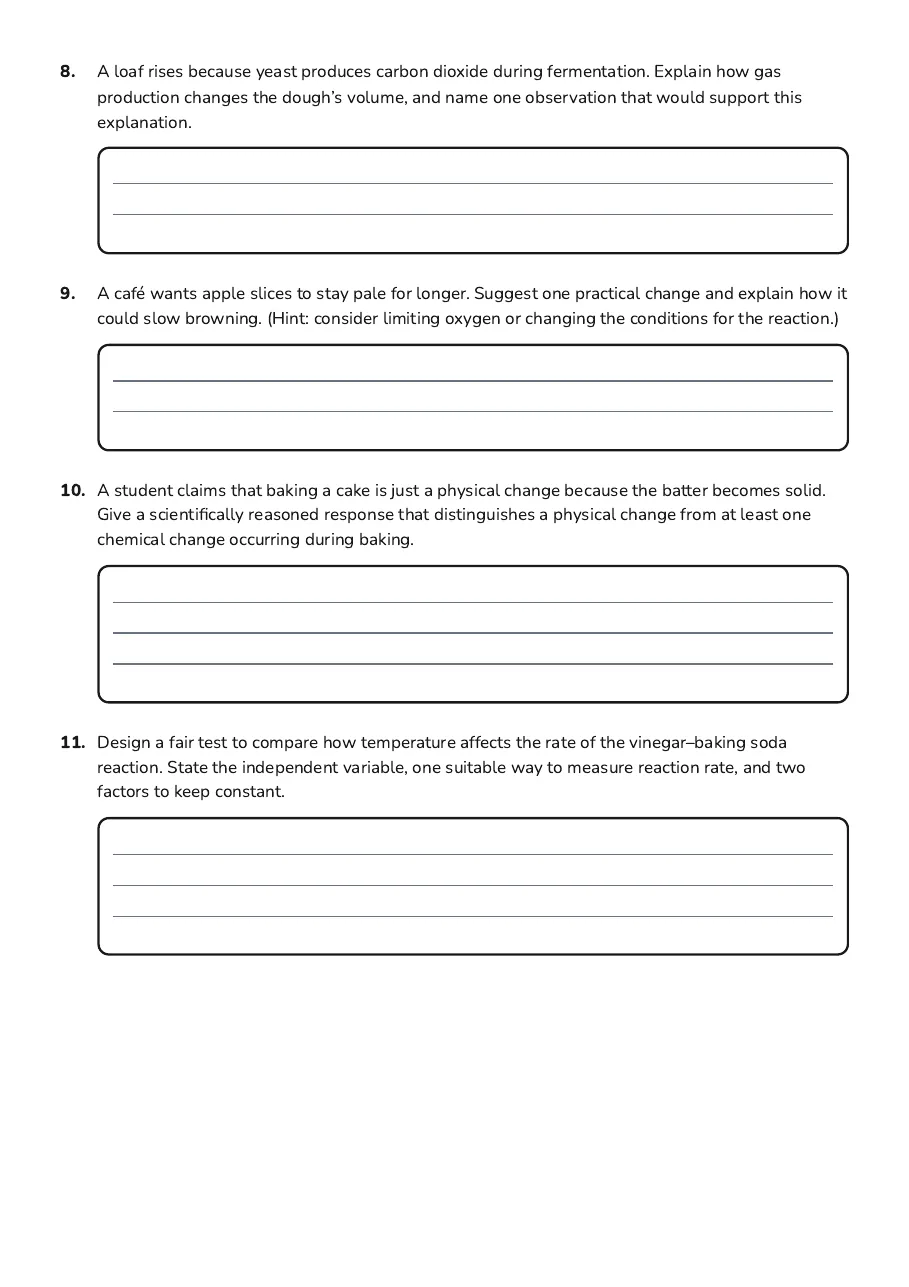
8.A loaf rises because yeast produces carbon dioxide during fermentation. Explain how gas production changes the dough’s volume, and name one observation that would support this explanation.
9.A café wants apple slices to stay pale for longer. Suggest one practical change and explain how it could slow browning. (Hint: consider limiting oxygen or changing the conditions for the reaction.)
10.A student claims that baking a cake is just a physical change because the batter becomes solid. Give a scientifically reasoned response that distinguishes a physical change from at least one chemical change occurring during baking.
11.Design a fair test to compare how temperature affects the rate of the vinegar–baking soda reaction. State the independent variable, one suitable way to measure reaction rate, and two factors to keep constant.

3 printable pages

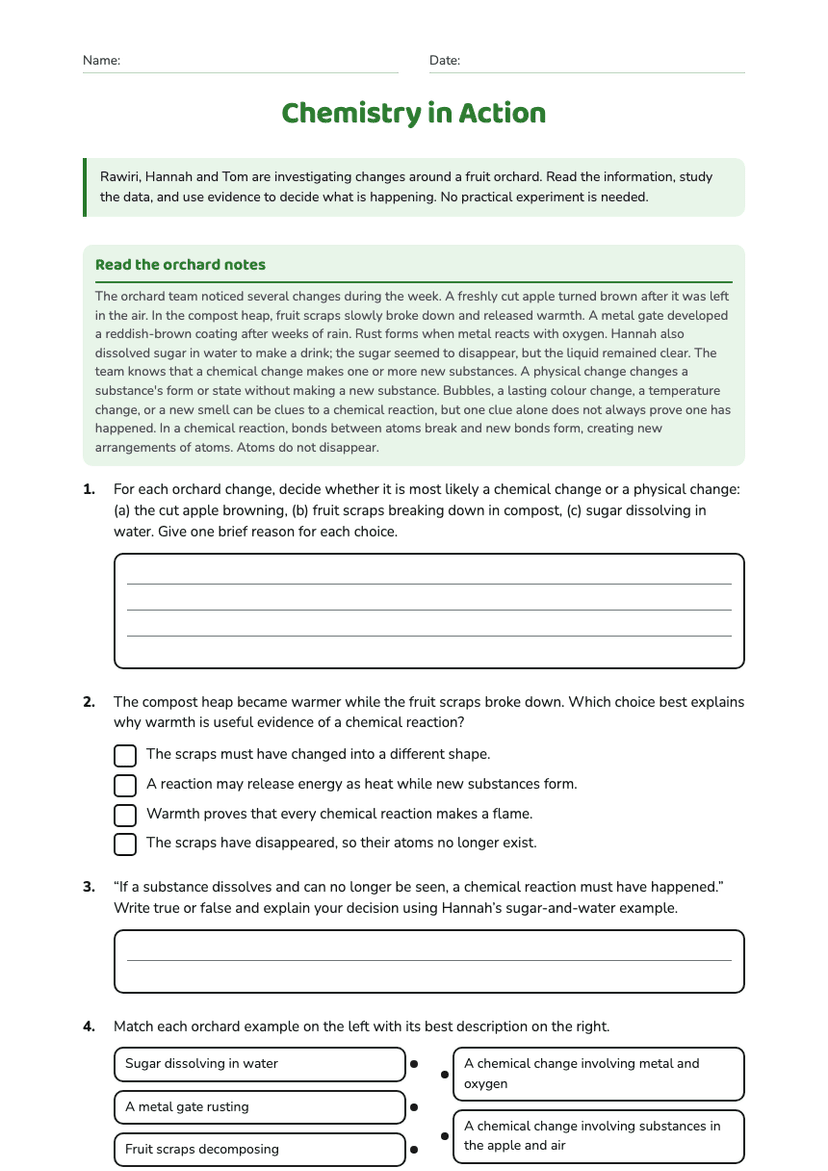
  • Kitchen Chemistry Introduction, page 1 of 3: What counts as a reaction?

    Page 1

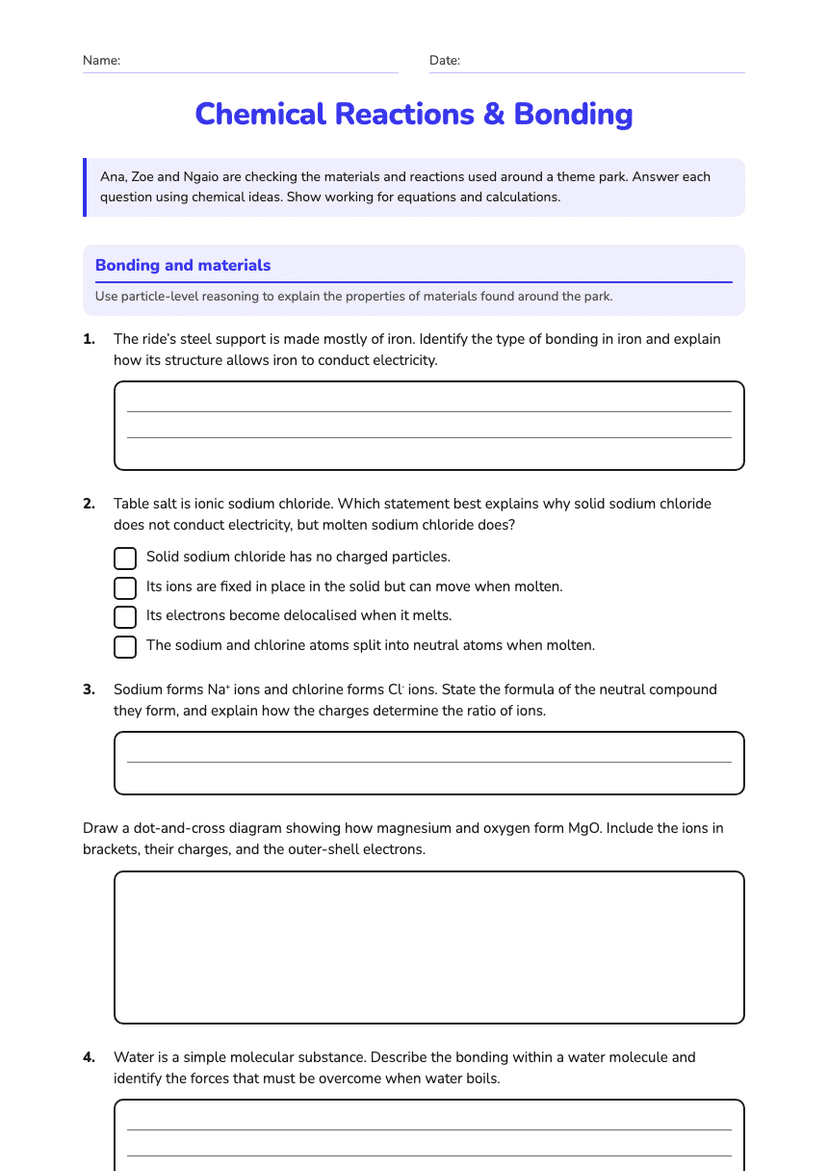
  • Kitchen Chemistry Introduction, page 2 of 3: Bubbles in the test kitchen, Heat, browning and rising dough

    Page 2

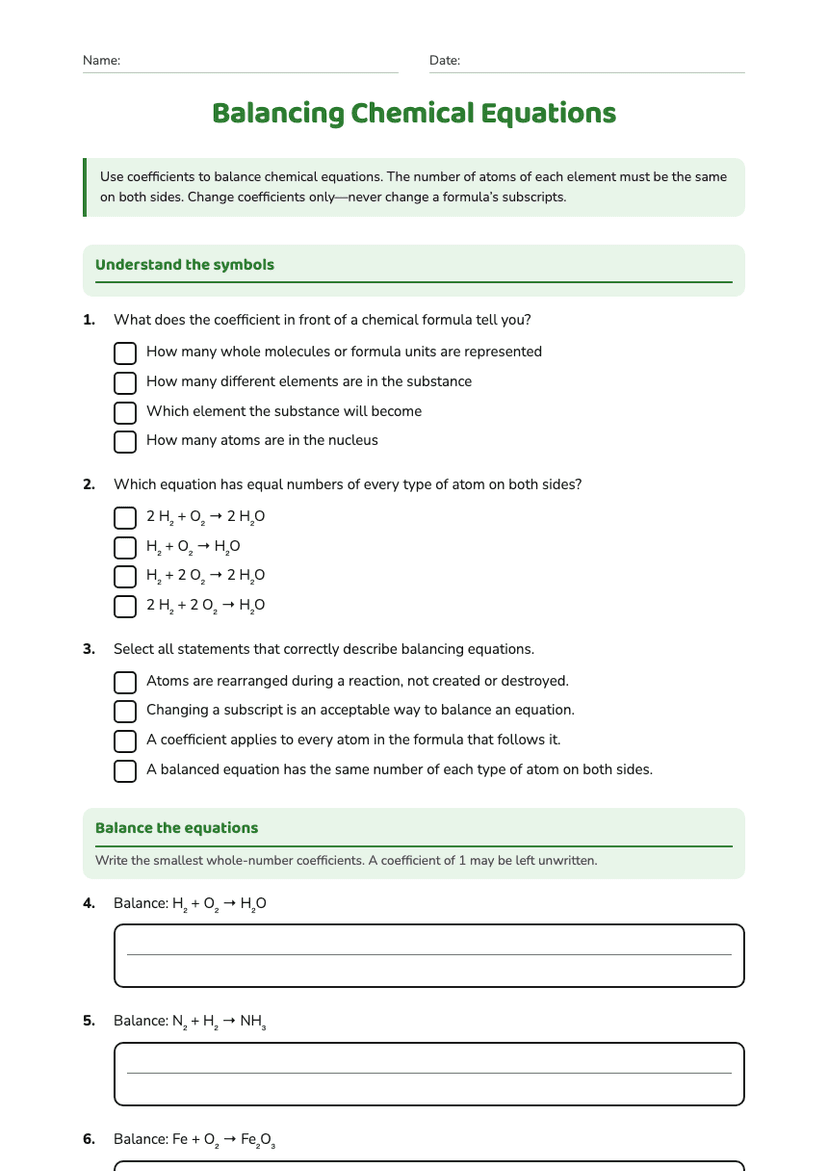
  • Kitchen Chemistry Introduction, page 3 of 3: 8. A loaf rises because yeast produces carbon dioxide during fermentation. Explain how gas

    Page 3

About This Worksheet

Free in Kuraplan

Sign up free, grab the PDF, and customize it for your class.

Print-Ready

Formatted for standard paper. Clean layout, easy to read.

AI-Generated

Created with Kuraplan's AI, designed for real classroom use.

For Teachers & Parents

Use in classrooms, for homework, tutoring, or homeschool.

Need a custom version of this worksheet?

Kuraplan's AI generates custom worksheets in seconds — differentiated for every learner, aligned to your curriculum.

Generate Custom Worksheets — Free
No credit card Curriculum-aligned Under 60 seconds