EnglishFreePrintable

Limerick Poetry Introduction

A free english worksheet ready for your classroom. Open in Kuraplan to grab the print-ready PDF, customize it for your students, or generate a fresh version in seconds.
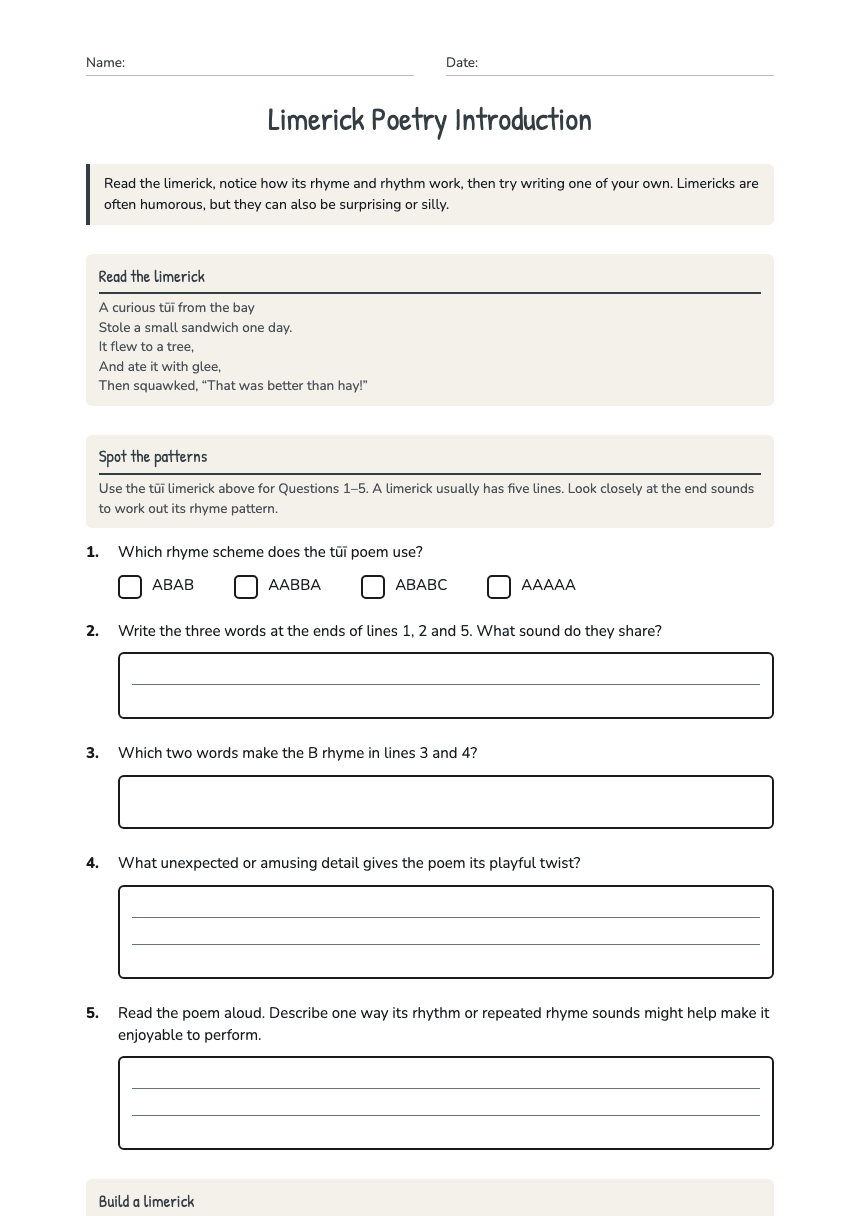
Limerick Poetry Introduction worksheet preview
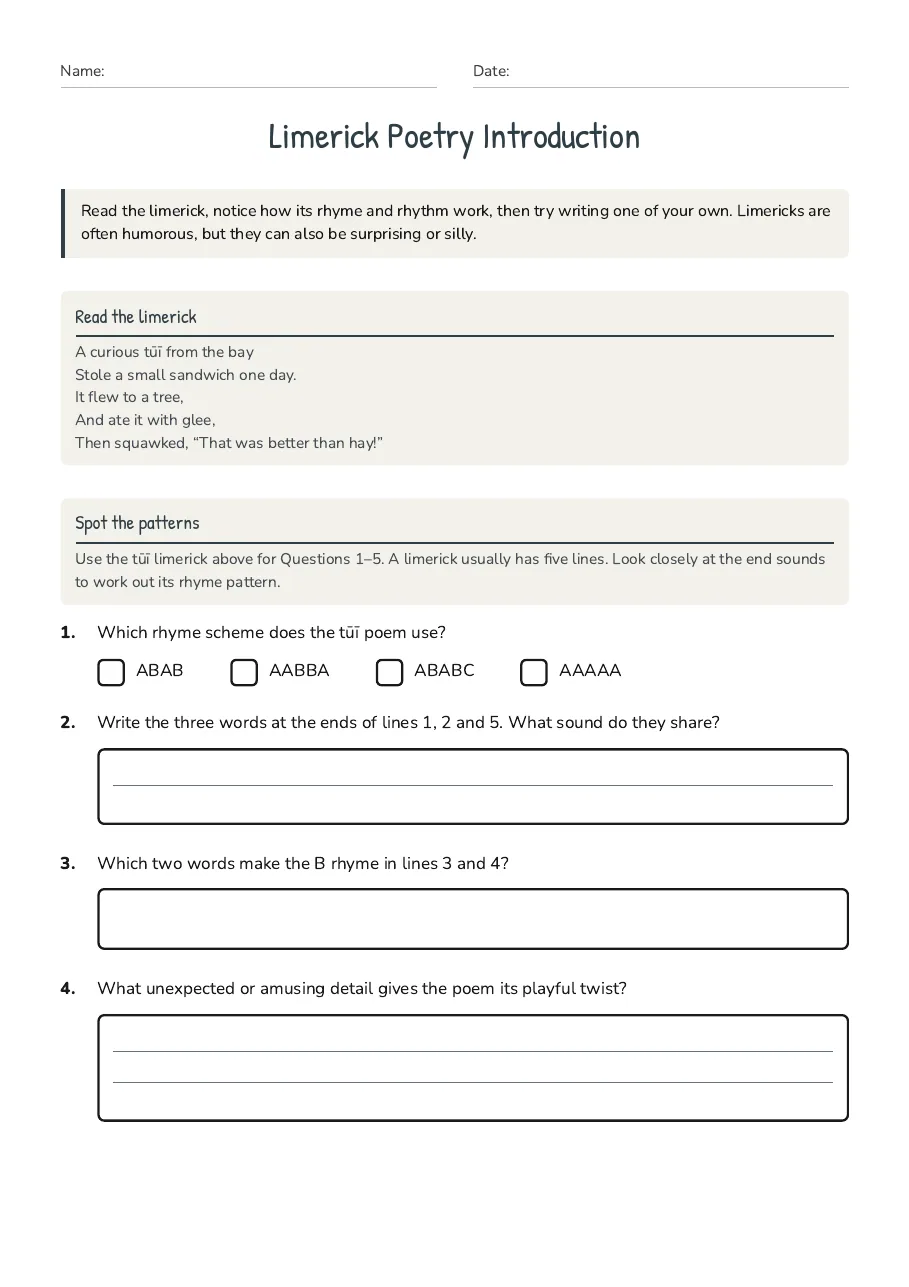
Name:Date:

Limerick Poetry Introduction

Read the limerick, notice how its rhyme and rhythm work, then try writing one of your own. Limericks are often humorous, but they can also be surprising or silly.

Read the limerick

A curious tūī from the bay Stole a small sandwich one day. It flew to a tree, And ate it with glee, Then squawked, “That was better than hay!”

Spot the patterns

Use the tūī limerick above for Questions 1–5. A limerick usually has five lines. Look closely at the end sounds to work out its rhyme pattern.

1.Which rhyme scheme does the tūī poem use?
  • ABAB
  • AABBA
  • ABABC
  • AAAAA
2.Write the three words at the ends of lines 1, 2 and 5. What sound do they share?
3.Which two words make the B rhyme in lines 3 and 4?
4.What unexpected or amusing detail gives the poem its playful twist?
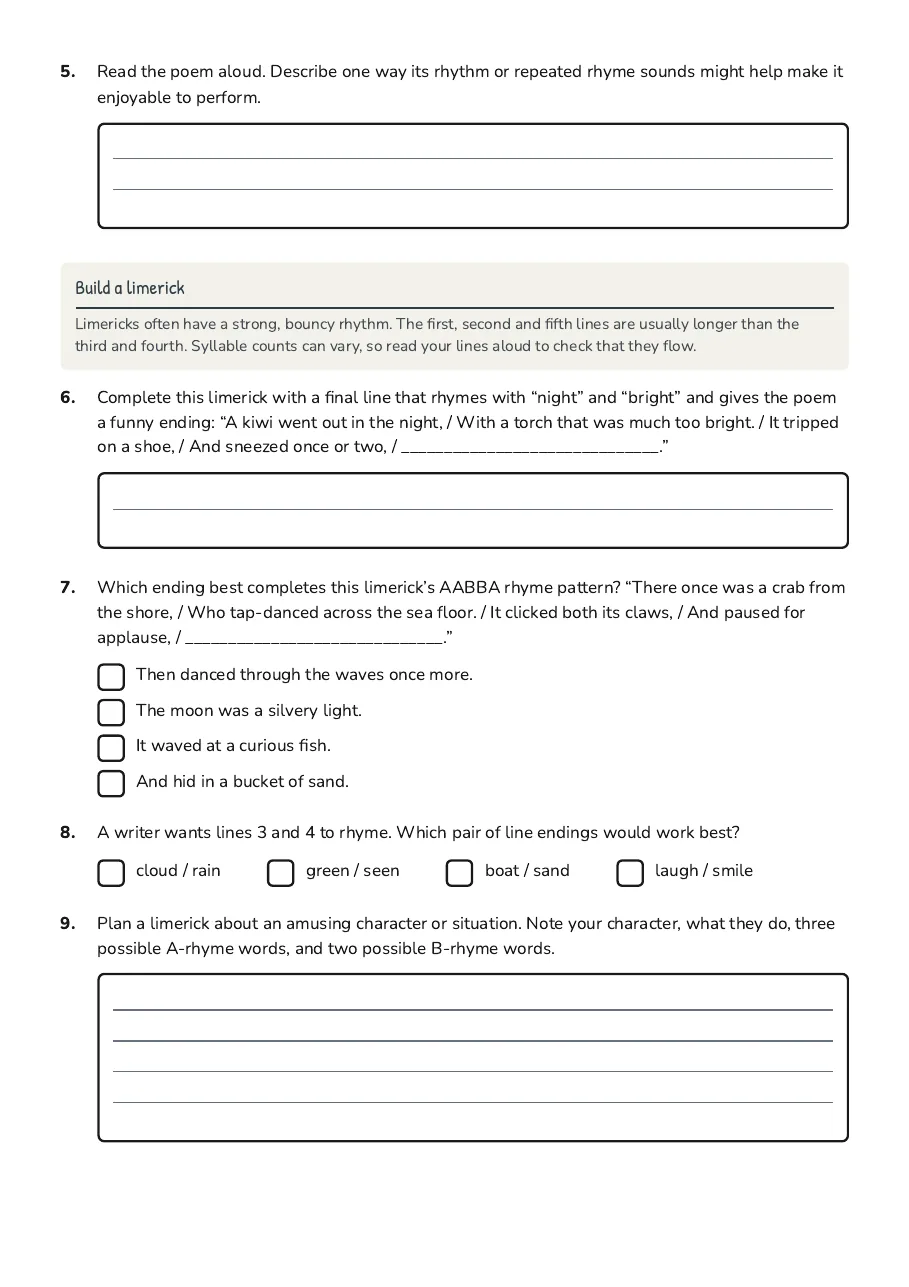
5.Read the poem aloud. Describe one way its rhythm or repeated rhyme sounds might help make it enjoyable to perform.

Build a limerick

Limericks often have a strong, bouncy rhythm. The first, second and fifth lines are usually longer than the third and fourth. Syllable counts can vary, so read your lines aloud to check that they flow.

6.Complete this limerick with a final line that rhymes with “night” and “bright” and gives the poem a funny ending: “A kiwi went out in the night, / With a torch that was much too bright. / It tripped on a shoe, / And sneezed once or two, / ______________________________.”
7.Which ending best completes this limerick’s AABBA rhyme pattern? “There once was a crab from the shore, / Who tap-danced across the sea floor. / It clicked both its claws, / And paused for applause, / ______________________________.”
  • Then danced through the waves once more.
  • The moon was a silvery light.
  • It waved at a curious fish.
  • And hid in a bucket of sand.
8.A writer wants lines 3 and 4 to rhyme. Which pair of line endings would work best?
  • cloud / rain
  • green / seen
  • boat / sand
  • laugh / smile
9.Plan a limerick about an amusing character or situation. Note your character, what they do, three possible A-rhyme words, and two possible B-rhyme words.
10.Write your own five-line limerick. Use an AABBA rhyme pattern, a playful or surprising idea, and a rhythm that sounds lively when read aloud. Underline or list the A and B rhymes.

3 printable pages

  • Limerick Poetry Introduction, page 1 of 3: Read the limerick, Spot the patterns

    Page 1

  • Limerick Poetry Introduction, page 2 of 3: Build a limerick

    Page 2

  • Limerick Poetry Introduction, page 3 of 3: 10. Write your own five-line limerick. Use an AABBA rhyme pattern, a playful or…

    Page 3

About This Worksheet

Free in Kuraplan

Sign up free, grab the PDF, and customize it for your class.

Print-Ready

Formatted for standard paper. Clean layout, easy to read.

AI-Generated

Created with Kuraplan's AI, designed for real classroom use.

For Teachers & Parents

Use in classrooms, for homework, tutoring, or homeschool.

Need a custom version of this worksheet?

Kuraplan's AI generates custom worksheets in seconds — differentiated for every learner, aligned to your curriculum.

Generate Custom Worksheets — Free
No credit card Curriculum-aligned Under 60 seconds