EnglishFreePrintable

Little Yellow Kiwi Poetry

A free english worksheet ready for your classroom. Open in Kuraplan to grab the print-ready PDF, customize it for your students, or generate a fresh version in seconds.
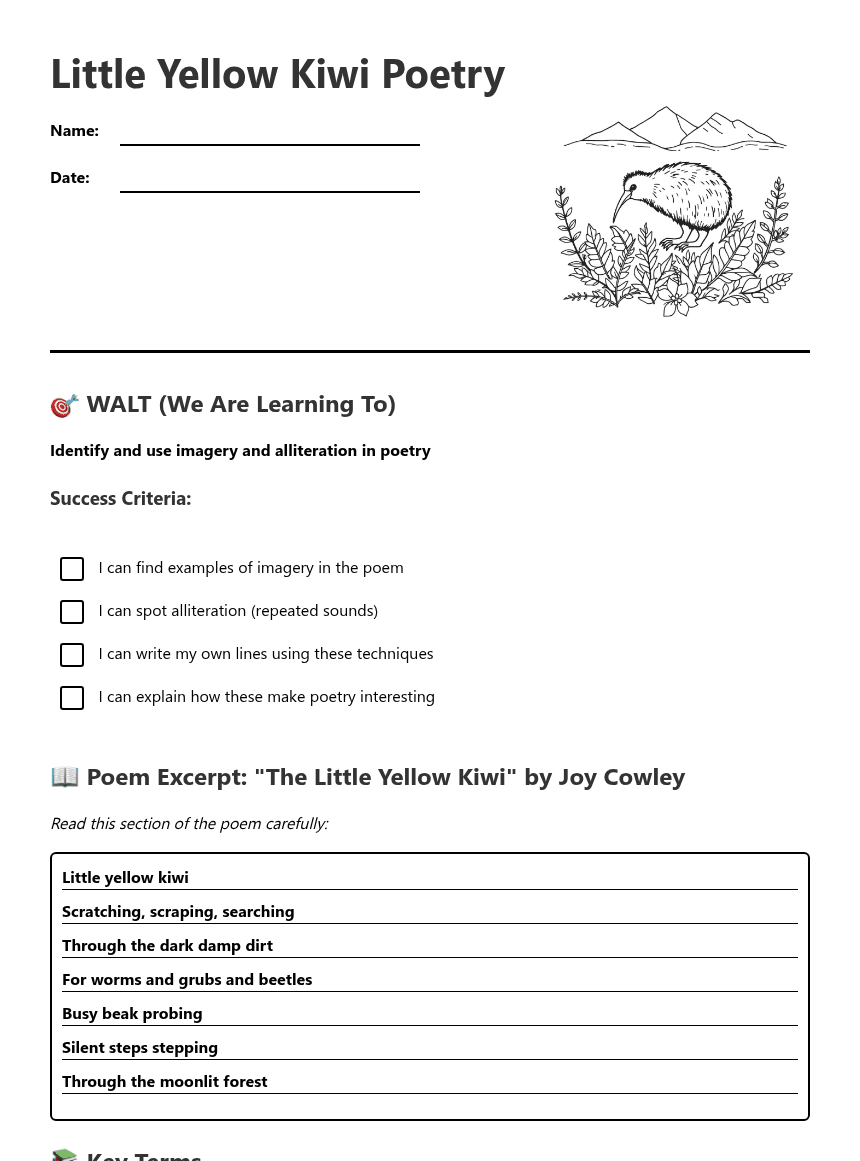
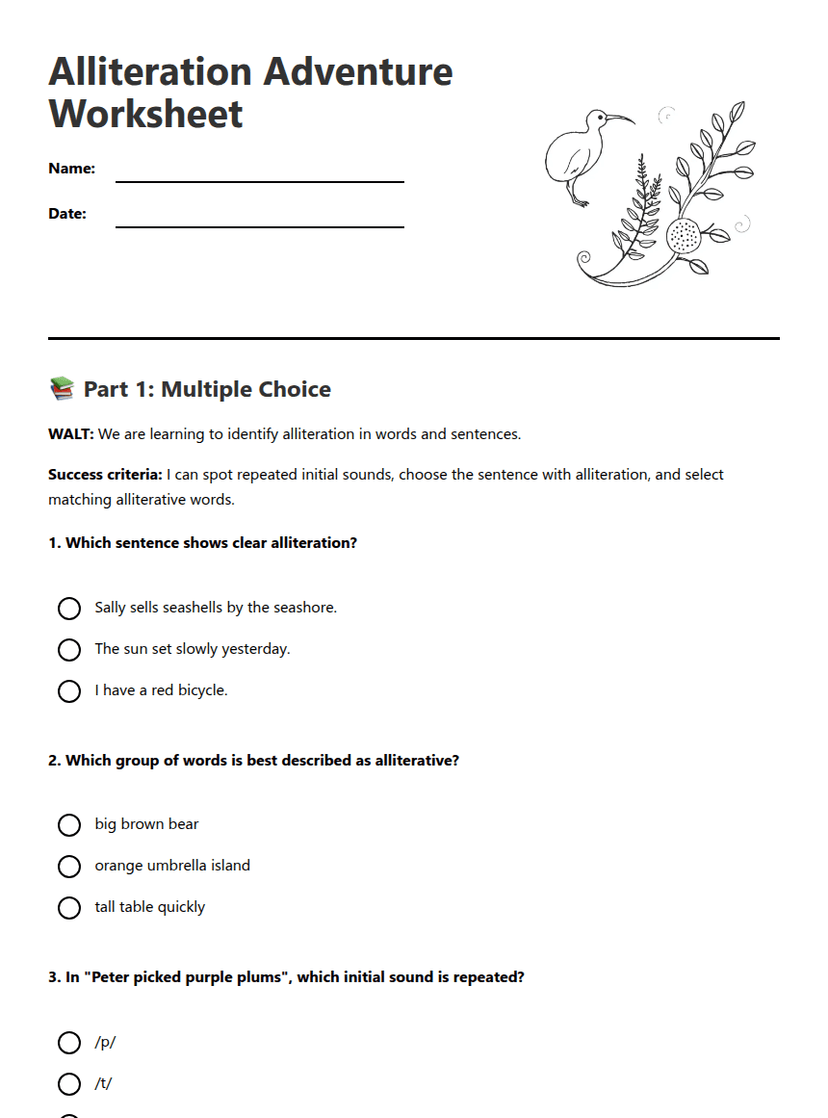
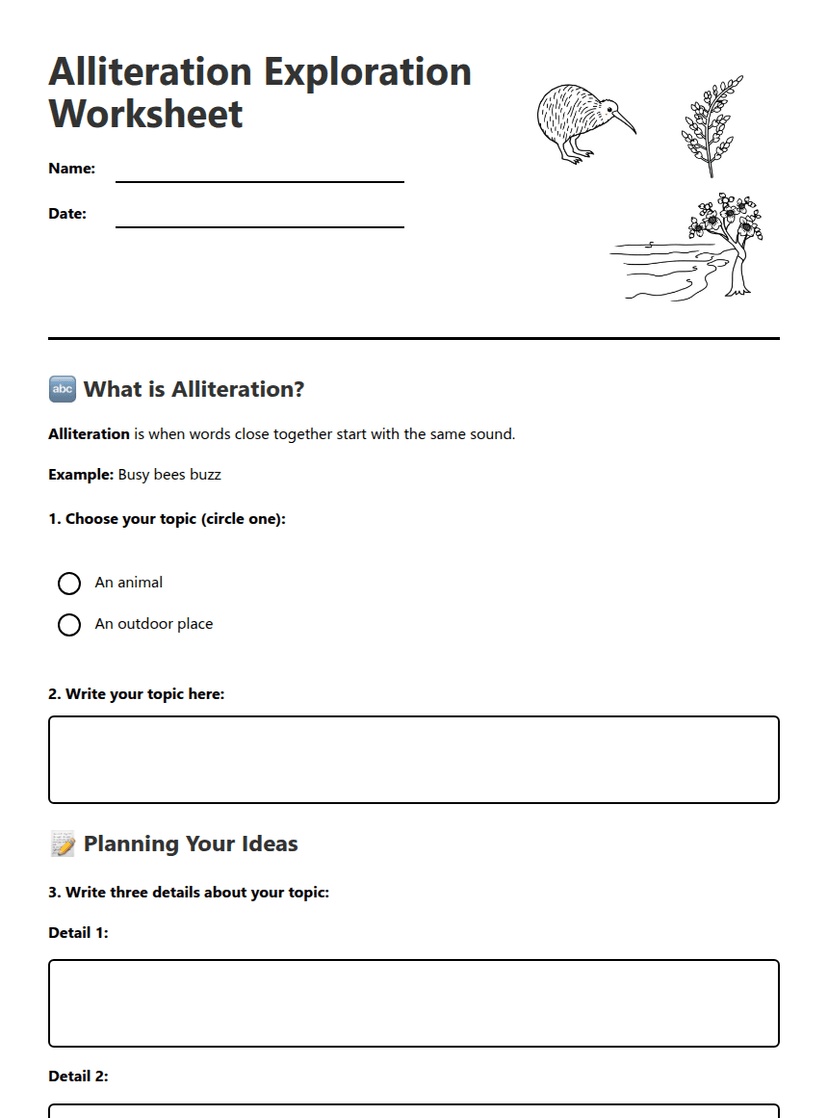
Little Yellow Kiwi Poetry worksheet preview
Little Yellow Kiwi Poetry

Little Yellow Kiwi Poetry

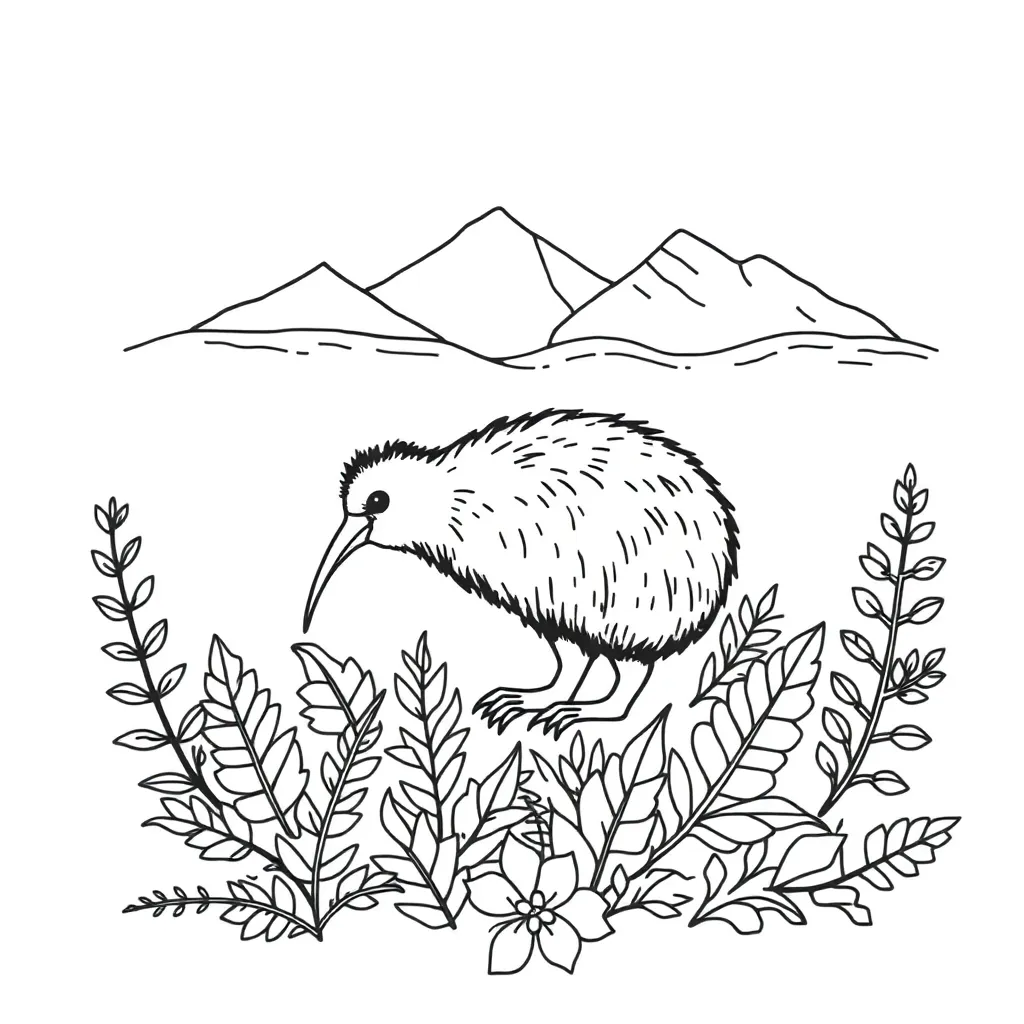
Little yellow kiwi bird illustration

🎯 WALT (We Are Learning To)

Identify and use imagery and alliteration in poetry

Success Criteria:

I can find examples of imagery in the poem

I can spot alliteration (repeated sounds)

I can write my own lines using these techniques

I can explain how these make poetry interesting

📖 Poem Excerpt: "The Little Yellow Kiwi" by Joy Cowley

Read this section of the poem carefully:

Little yellow kiwi
Scratching, scraping, searching
Through the dark damp dirt
For worms and grubs and beetles
Busy beak probing
Silent steps stepping
Through the moonlit forest

📚 Key Terms

Imagery

Definition: Words that help us picture, hear, feel, smell or taste something in our minds.

Example: "dark damp dirt" - we can picture and feel the wet soil

Alliteration

Definition: When words start with the same sound and are close together.

Example: "busy beak" - both words start with 'b'

🔍 Finding Poetry Techniques

1. Circle examples of alliteration in the poem above. Look for words that start with the same sound!
2. Find imagery that helps you picture the kiwi. Write three examples:
3. Which line helps you hear what the kiwi is doing? Tick one:

Little yellow kiwi

Scratching, scraping, searching

Through the moonlit forest

✍️ Create Your Own Poetry Lines

4. Write your own alliteration about a New Zealand animal. Use the pattern: [adjective] [adjective] [animal name]

Example: Sleepy silver seal

5. Create action words with alliteration (like "scratching, scraping, searching"):

My animal is: _________________, _________________, _________________

6. Write a line that helps us picture where your animal lives:
Through the _________________________________

💭 Discussion Questions

7. With a partner, discuss: Why do you think Joy Cowley used alliteration in this poem?

To make it fun to read aloud

To help us remember the words

To create rhythm and flow

To paint a picture with sounds

8. Share with your group: What do you picture when you read "moonlit forest"?

🌟 Extension Challenge

9. Advanced Task: Write a complete verse about your chosen animal using both imagery and alliteration:
_________________________________
_________________________________
_________________________________
_________________________________
10. Creative Challenge: Match the senses with imagery from the poem:
1. Sight
2. Touch
3. Sound
A. "dark damp dirt"
B. "scratching, scraping"
C. "moonlit forest"

🎯 Reflection

11. How confident do you feel about finding imagery in poems?

Very confident - I can spot it easily!

Quite confident - I can find most examples

Getting there - I need a bit more practice

Need help - I'd like more examples

12. What was your favourite alliteration from today's lesson and why?

About This Worksheet

Free in Kuraplan

Sign up free, grab the PDF, and customize it for your class.

Print-Ready

Formatted for standard paper. Clean layout, easy to read.

AI-Generated

Created with Kuraplan's AI, designed for real classroom use.

For Teachers & Parents

Use in classrooms, for homework, tutoring, or homeschool.

Need a custom version of this worksheet?

Kuraplan's AI generates custom worksheets in seconds — differentiated for every learner, aligned to your curriculum.

Generate Custom Worksheets — Free
No credit card Curriculum-aligned Under 60 seconds