New Zealand Earthquake Adventures
A free science worksheet ready for your classroom. Open in Kuraplan to grab the print-ready PDF, customize it for your students, or generate a fresh version in seconds.
New Zealand Earthquake Adventures
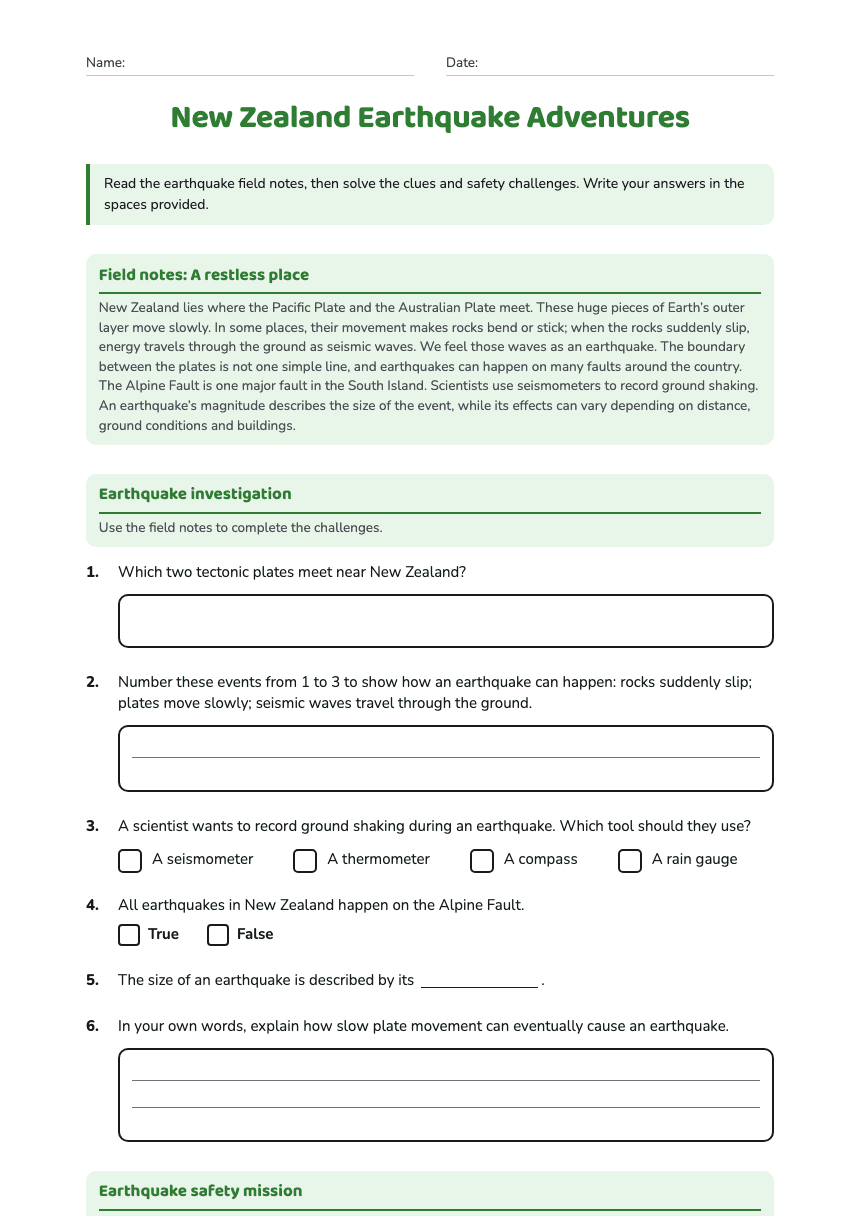
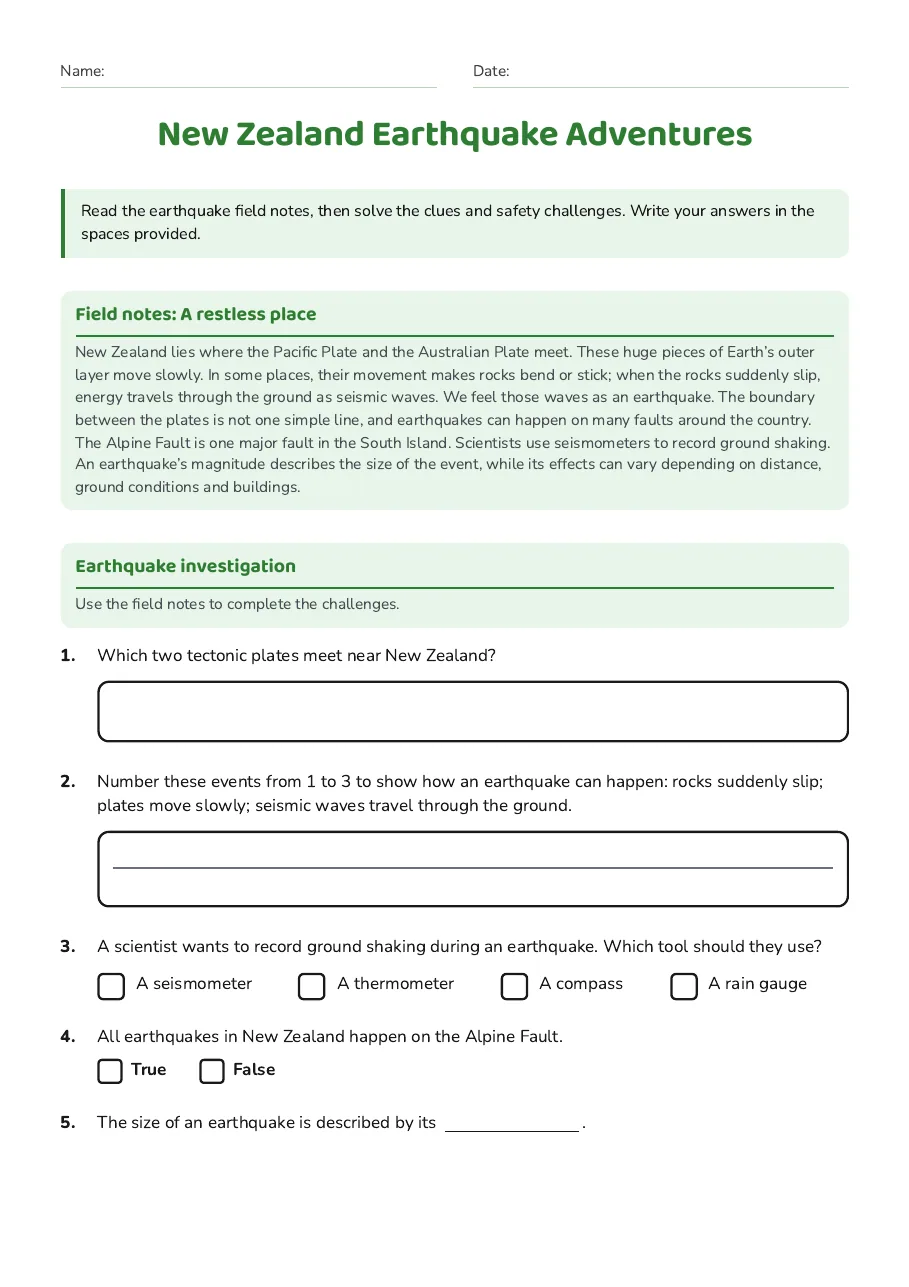
Field notes: A restless place
New Zealand lies where the Pacific Plate and the Australian Plate meet. These huge pieces of Earth’s outer layer move slowly. In some places, their movement makes rocks bend or stick; when the rocks suddenly slip, energy travels through the ground as seismic waves. We feel those waves as an earthquake. The boundary between the plates is not one simple line, and earthquakes can happen on many faults around the country. The Alpine Fault is one major fault in the South Island. Scientists use seismometers to record ground shaking. An earthquake’s magnitude describes the size of the event, while its effects can vary depending on distance, ground conditions and buildings.
Earthquake investigation
Use the field notes to complete the challenges.
- A seismometer
- A thermometer
- A compass
- A rain gauge
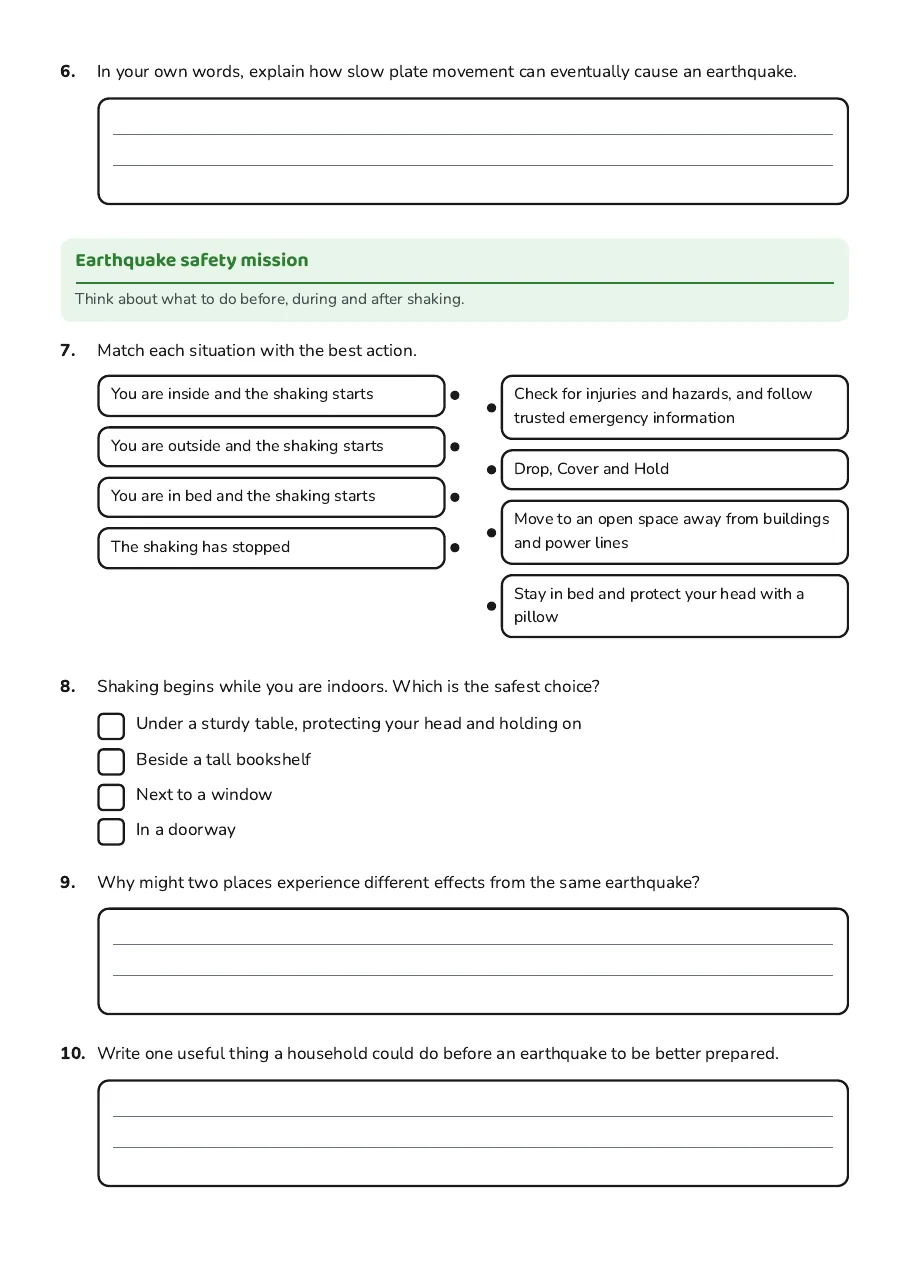
Earthquake safety mission
Think about what to do before, during and after shaking.
- You are inside and the shaking starts
- You are outside and the shaking starts
- You are in bed and the shaking starts
- The shaking has stopped
- Check for injuries and hazards, and follow trusted emergency information
- Drop, Cover and Hold
- Move to an open space away from buildings and power lines
- Stay in bed and protect your head with a pillow
- Under a sturdy table, protecting your head and holding on
- Beside a tall bookshelf
- Next to a window
- In a doorway
2 printable pages
Page 1
Page 2
About This Worksheet
Free in Kuraplan
Sign up free, grab the PDF, and customize it for your class.
Print-Ready
Formatted for standard paper. Clean layout, easy to read.
AI-Generated
Created with Kuraplan's AI, designed for real classroom use.
For Teachers & Parents
Use in classrooms, for homework, tutoring, or homeschool.
Need a custom version of this worksheet?
Kuraplan's AI generates custom worksheets in seconds — differentiated for every learner, aligned to your curriculum.
Generate Custom Worksheets — Free