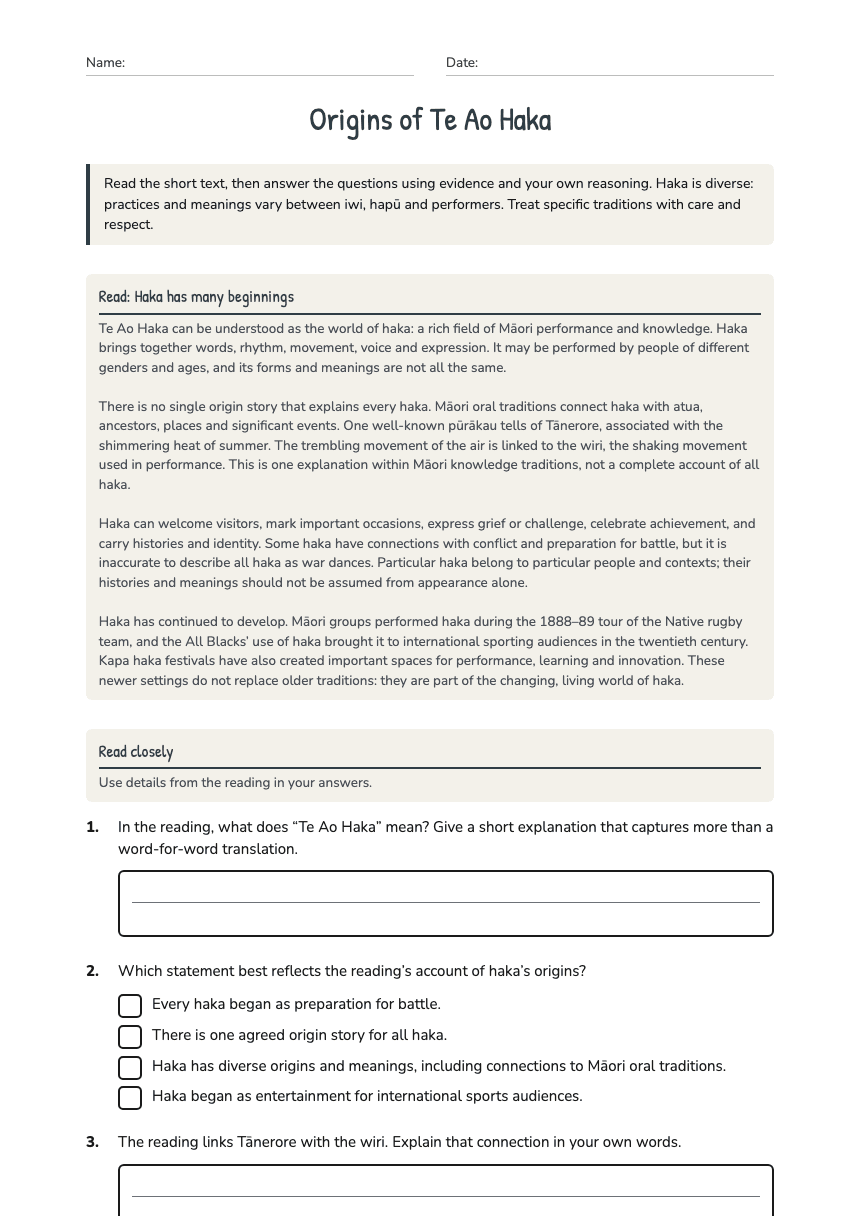
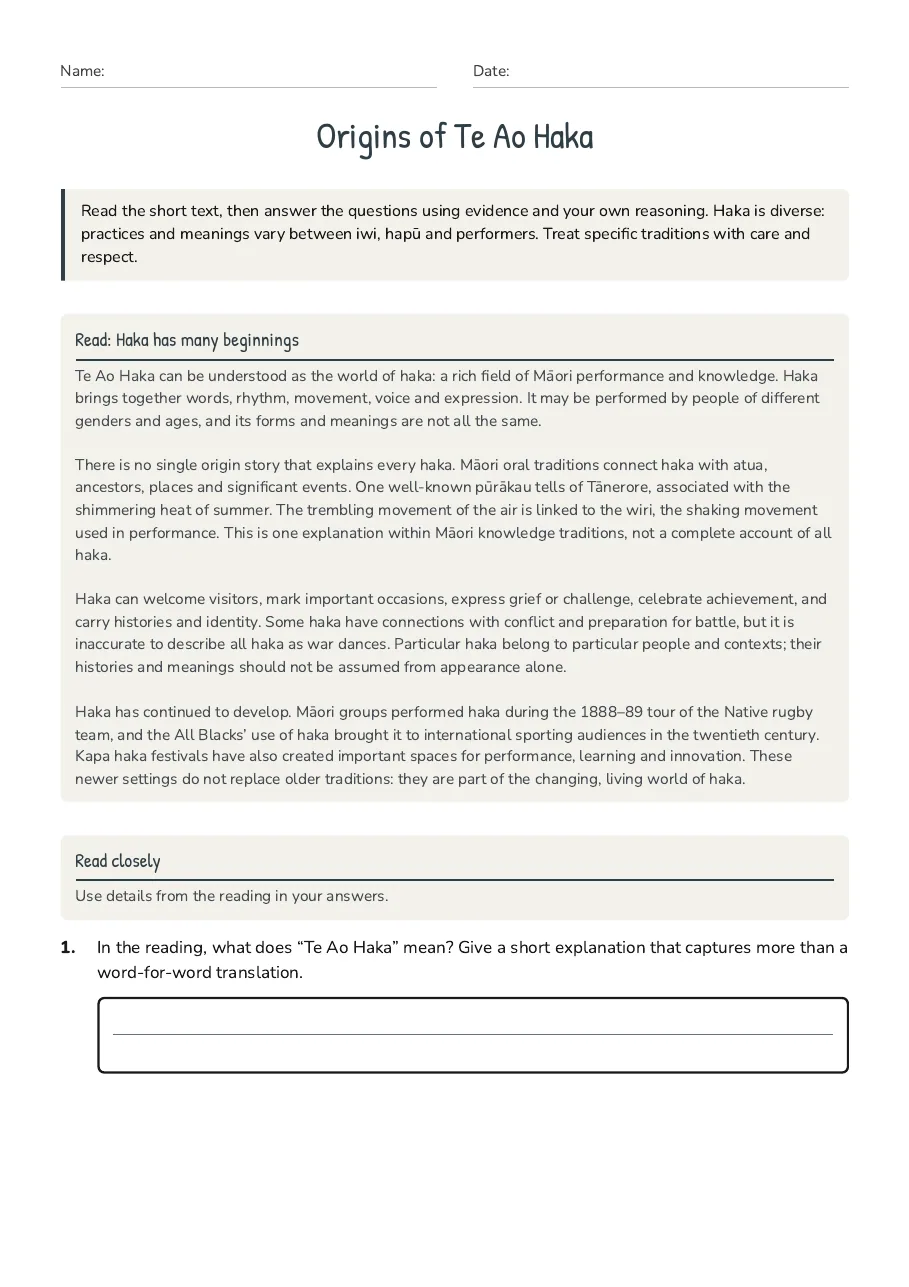
Origins of Te Ao Haka
A free te reo māori worksheet ready for your classroom. Open in Kuraplan to grab the print-ready PDF, customize it for your students, or generate a fresh version in seconds.
Origins of Te Ao Haka
Read: Haka has many beginnings
Te Ao Haka can be understood as the world of haka: a rich field of Māori performance and knowledge. Haka brings together words, rhythm, movement, voice and expression. It may be performed by people of different genders and ages, and its forms and meanings are not all the same. There is no single origin story that explains every haka. Māori oral traditions connect haka with atua, ancestors, places and significant events. One well-known pūrākau tells of Tānerore, associated with the shimmering heat of summer. The trembling movement of the air is linked to the wiri, the shaking movement used in performance. This is one explanation within Māori knowledge traditions, not a complete account of all haka. Haka can welcome visitors, mark important occasions, express grief or challenge, celebrate achievement, and carry histories and identity. Some haka have connections with conflict and preparation for battle, but it is inaccurate to describe all haka as war dances. Particular haka belong to particular people and contexts; their histories and meanings should not be assumed from appearance alone. Haka has continued to develop. Māori groups performed haka during the 1888–89 tour of the Native rugby team, and the All Blacks’ use of haka brought it to international sporting audiences in the twentieth century. Kapa haka festivals have also created important spaces for performance, learning and innovation. These newer settings do not replace older traditions: they are part of the changing, living world of haka.
Read closely
Use details from the reading in your answers.
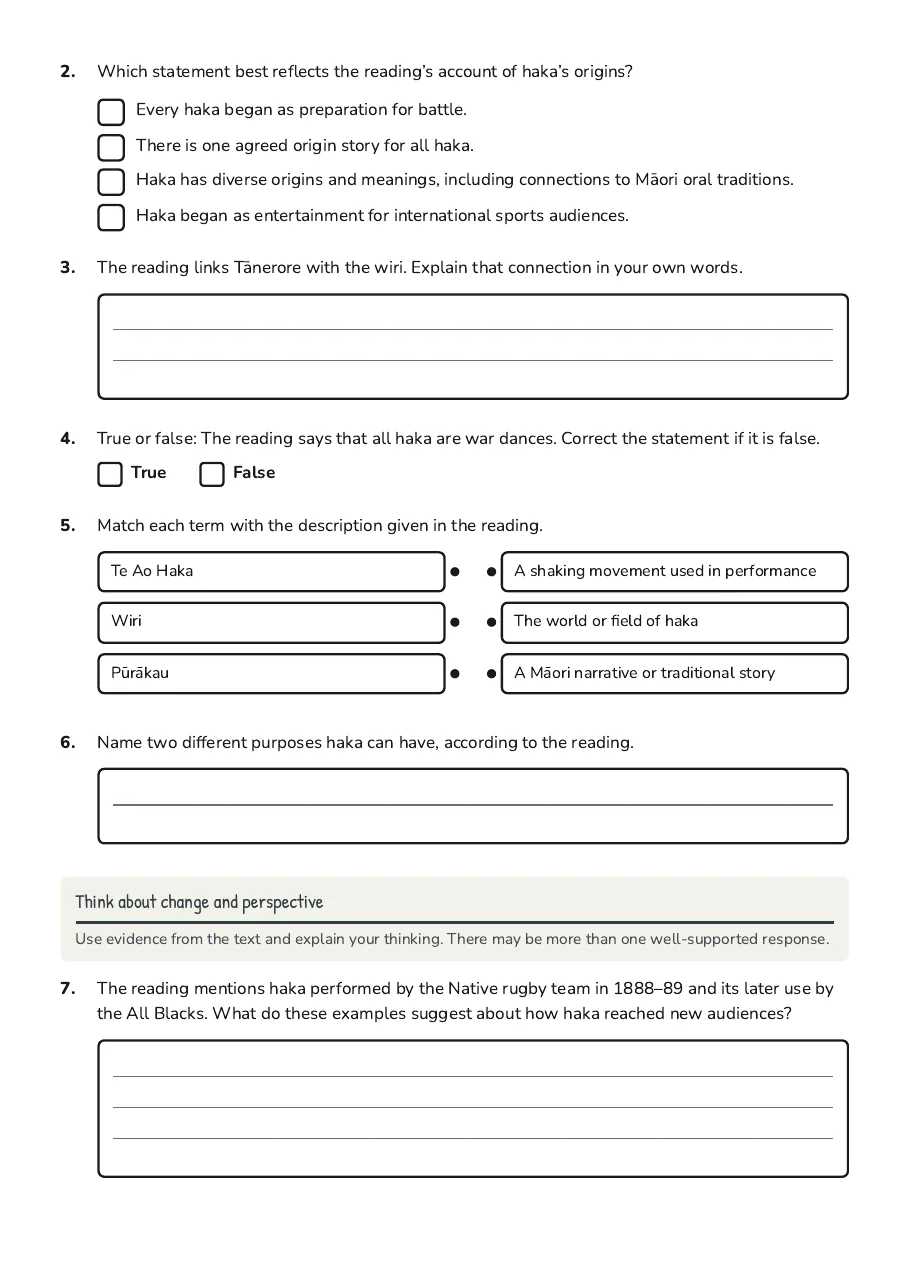
- Every haka began as preparation for battle.
- There is one agreed origin story for all haka.
- Haka has diverse origins and meanings, including connections to Māori oral traditions.
- Haka began as entertainment for international sports audiences.
- Te Ao Haka
- Wiri
- Pūrākau
- A shaking movement used in performance
- The world or field of haka
- A Māori narrative or traditional story
Think about change and perspective
Use evidence from the text and explain your thinking. There may be more than one well-supported response.
3 printable pages
Page 1
Page 2
Page 3
About This Worksheet
Free in Kuraplan
Sign up free, grab the PDF, and customize it for your class.
Print-Ready
Formatted for standard paper. Clean layout, easy to read.
AI-Generated
Created with Kuraplan's AI, designed for real classroom use.
For Teachers & Parents
Use in classrooms, for homework, tutoring, or homeschool.
Need a custom version of this worksheet?
Kuraplan's AI generates custom worksheets in seconds — differentiated for every learner, aligned to your curriculum.
Generate Custom Worksheets — Free