EnglishFreePrintable
Persuasive Writing Rubric
A free english worksheet ready for your classroom. Open in Kuraplan to grab the print-ready PDF, customize it for your students, or generate a fresh version in seconds.
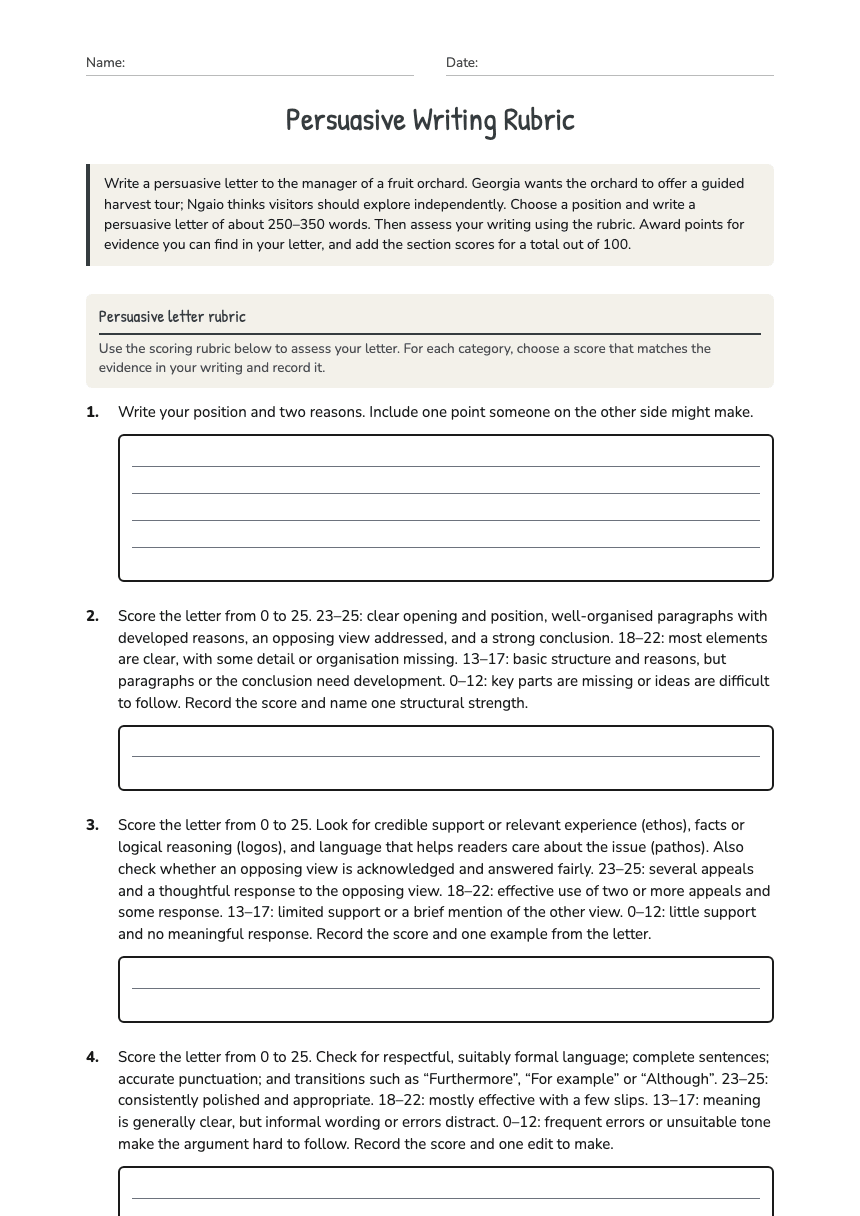
Name:Date:
Persuasive Writing Rubric
Write a persuasive letter to the manager of a fruit orchard. Georgia wants the orchard to offer a guided harvest tour; Ngaio thinks visitors should explore independently. Choose a position and write a persuasive letter of about 250–350 words. Then assess your writing using the rubric. Award points for evidence you can find in your letter, and add the section scores for a total out of 100.
Persuasive letter rubric
Use the scoring rubric below to assess your letter. For each category, choose a score that matches the evidence in your writing and record it.
1.Write your position and two reasons. Include one point someone on the other side might make.
2.Score the letter from 0 to 25. 23–25: clear opening and position, well-organised paragraphs with developed reasons, an opposing view addressed, and a strong conclusion. 18–22: most elements are clear, with some detail or organisation missing. 13–17: basic structure and reasons, but paragraphs or the conclusion need development. 0–12: key parts are missing or ideas are difficult to follow. Record the score and name one structural strength.
3.Score the letter from 0 to 25. Look for credible support or relevant experience (ethos), facts or logical reasoning (logos), and language that helps readers care about the issue (pathos). Also check whether an opposing view is acknowledged and answered fairly. 23–25: several appeals and a thoughtful response to the opposing view. 18–22: effective use of two or more appeals and some response. 13–17: limited support or a brief mention of the other view. 0–12: little support and no meaningful response. Record the score and one example from the letter.
4.Score the letter from 0 to 25. Check for respectful, suitably formal language; complete sentences; accurate punctuation; and transitions such as “Furthermore”, “For example” or “Although”. 23–25: consistently polished and appropriate. 18–22: mostly effective with a few slips. 13–17: meaning is generally clear, but informal wording or errors distract. 0–12: frequent errors or unsuitable tone make the argument hard to follow. Record the score and one edit to make.
5.Count the words in your letter and record the total. The target is 250–350 words. Then score this section: 23–25: within the target and the ideas are developed; 18–22: close to the target with a convincing message; 13–17: noticeably short or long, or some ideas need development; 0–12: far from the target and the message is unclear or underdeveloped.
6.Add the four section scores. Write the total out of 100, then name one successful feature and one next step for your writing.
2 printable pages
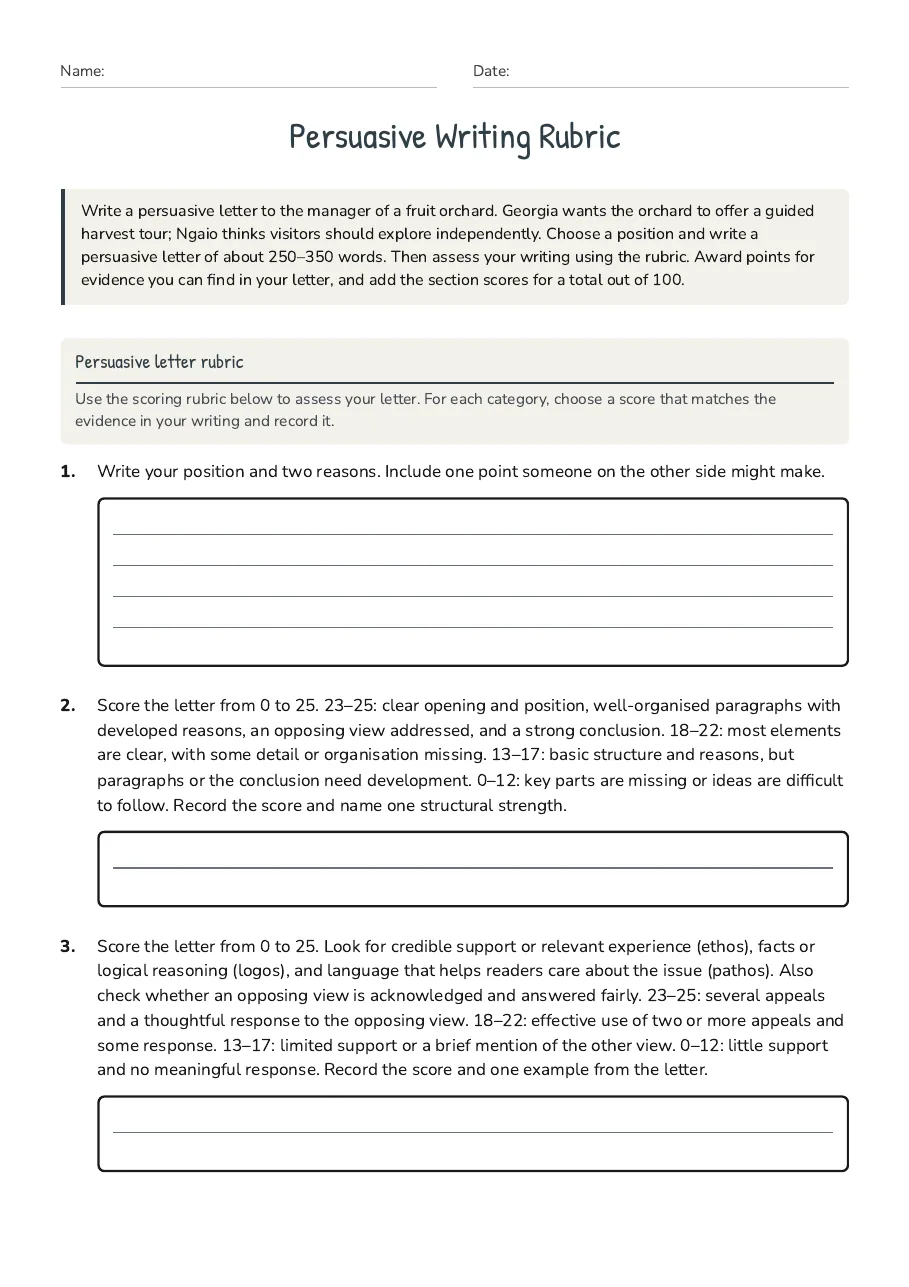
Page 1
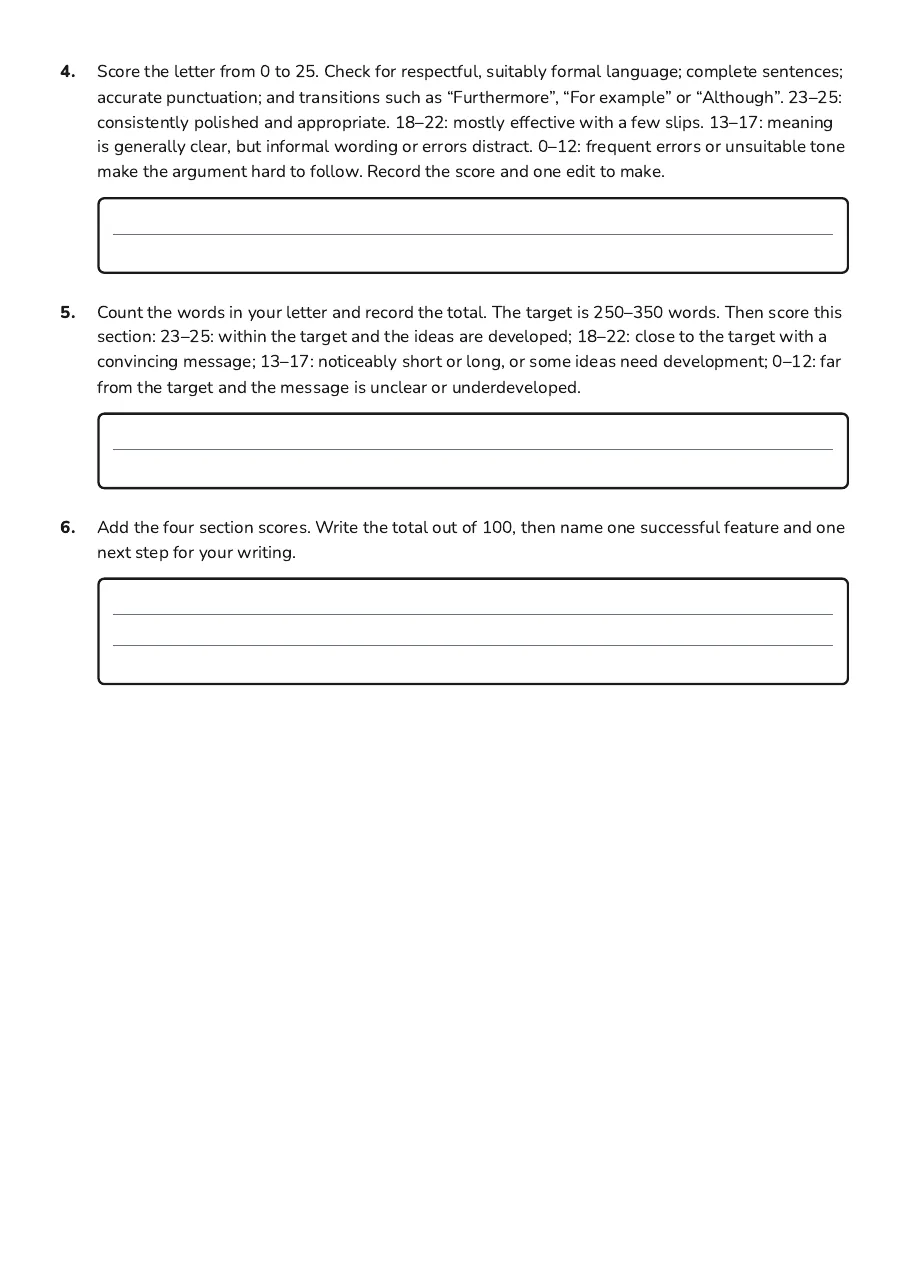
Page 2
About This Worksheet
Free in Kuraplan
Sign up free, grab the PDF, and customize it for your class.
Print-Ready
Formatted for standard paper. Clean layout, easy to read.
AI-Generated
Created with Kuraplan's AI, designed for real classroom use.
For Teachers & Parents
Use in classrooms, for homework, tutoring, or homeschool.
Need a custom version of this worksheet?
Kuraplan's AI generates custom worksheets in seconds — differentiated for every learner, aligned to your curriculum.
Generate Custom Worksheets — Free No credit card Curriculum-aligned Under 60 seconds
More English Worksheets
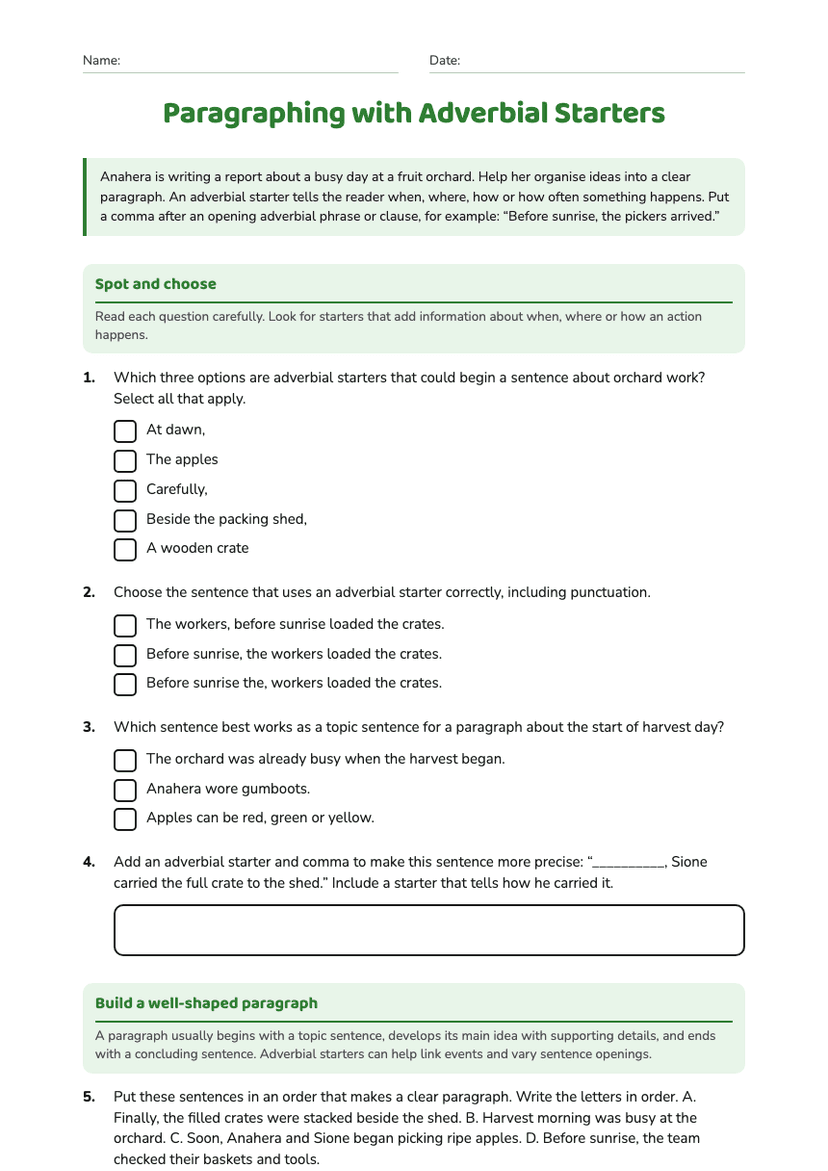
Year 5
Paragraphing with Adverbial Starters
Free
SCAR Narrative Writing Guide
Free
Year 12 Writing Scaffolds
Free
Year 12
Dunkirk Essay Analysis Worksheet
Free
Year 7–8
Persuasive Writing Planning Workshop
Free
Year 9
Curious Essay Explorers Introduction
Free
Year 5–6
Special Moment Recount Writing
Free
Year 2–3