EnglishFreePrintable

Poetry Analysis Deep Dive

A free english worksheet ready for your classroom. Open in Kuraplan to grab the print-ready PDF, customize it for your students, or generate a fresh version in seconds.
Poetry Analysis Deep Dive worksheet preview
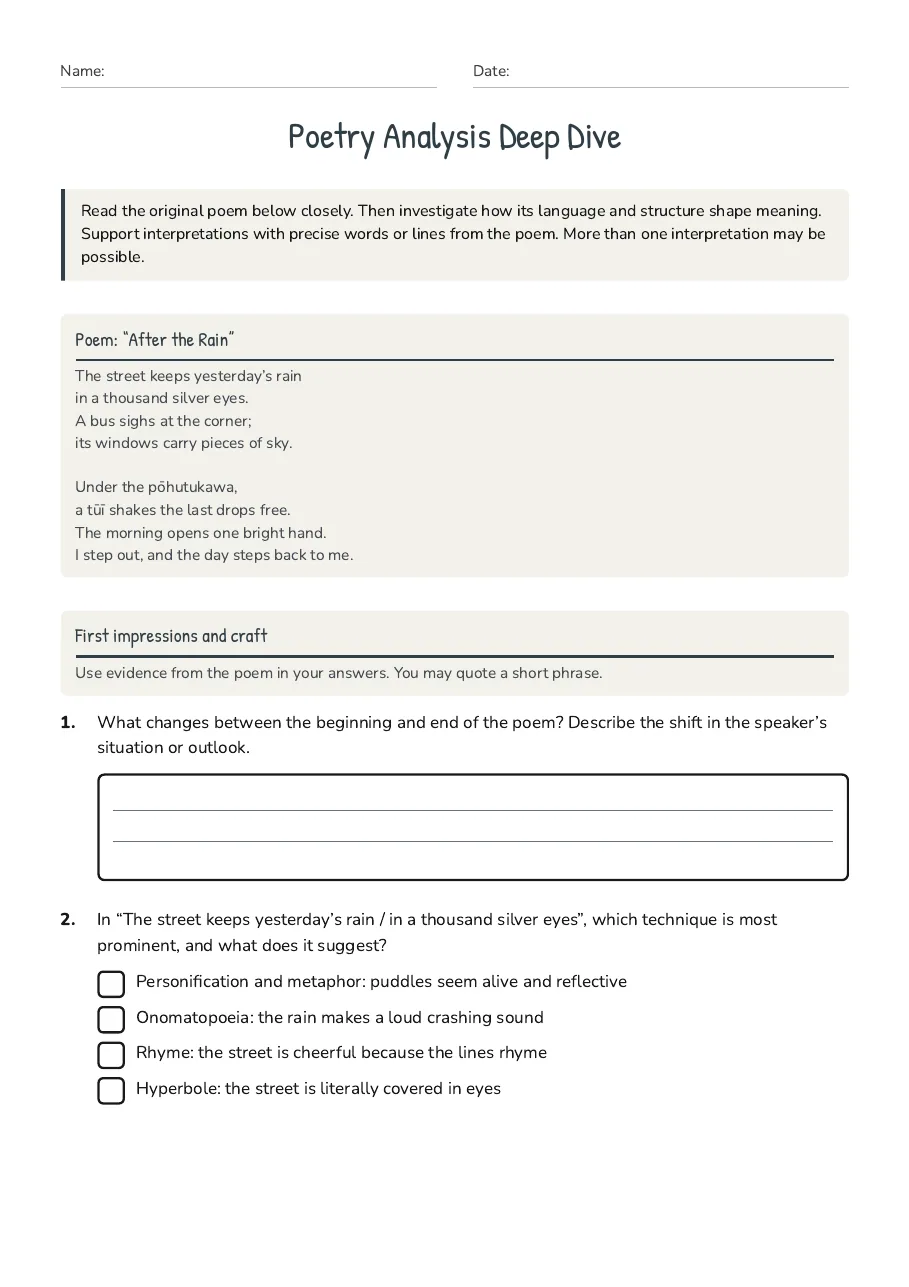
Name:Date:

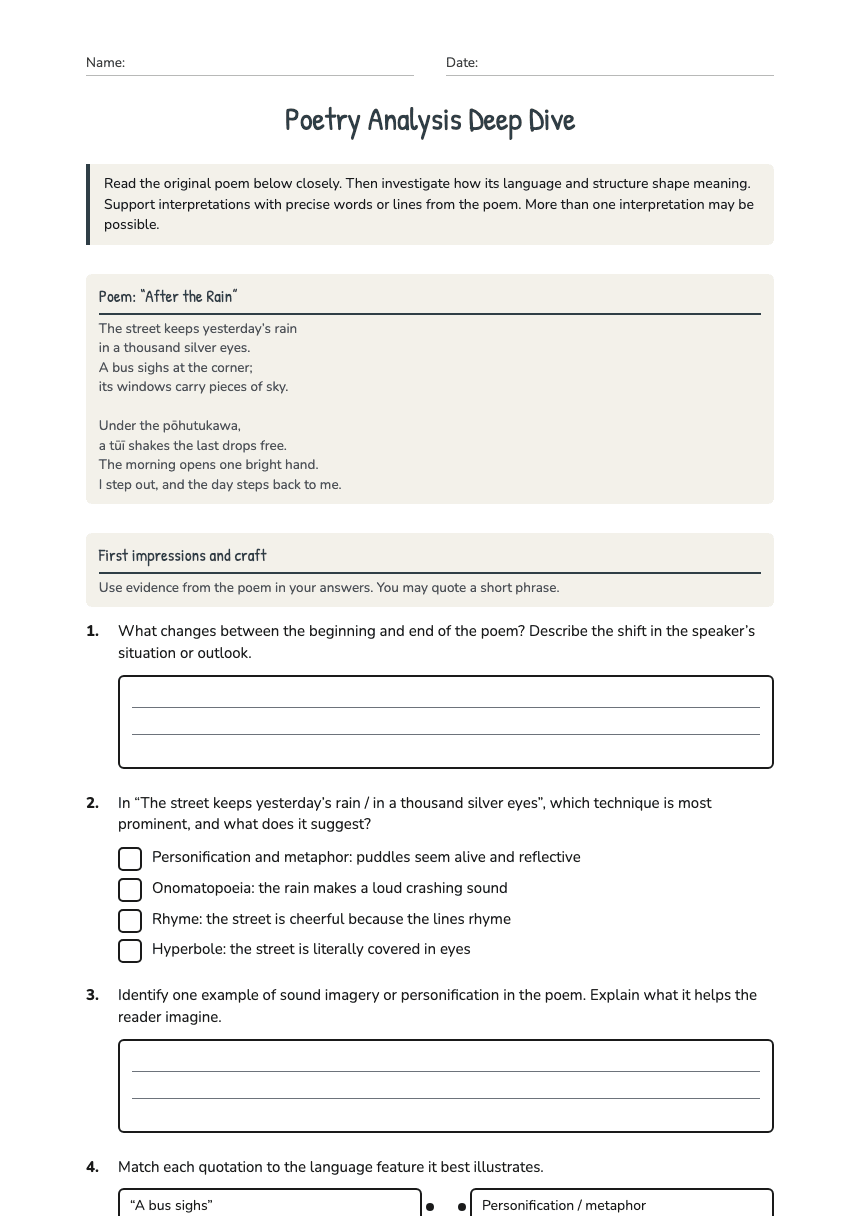
Poetry Analysis Deep Dive

Read the original poem below closely. Then investigate how its language and structure shape meaning. Support interpretations with precise words or lines from the poem. More than one interpretation may be possible.

Poem: “After the Rain”

The street keeps yesterday’s rain in a thousand silver eyes. A bus sighs at the corner; its windows carry pieces of sky. Under the pōhutukawa, a tūī shakes the last drops free. The morning opens one bright hand. I step out, and the day steps back to me.

First impressions and craft

Use evidence from the poem in your answers. You may quote a short phrase.

1.What changes between the beginning and end of the poem? Describe the shift in the speaker’s situation or outlook.
2.In “The street keeps yesterday’s rain / in a thousand silver eyes”, which technique is most prominent, and what does it suggest?
  • Personification and metaphor: puddles seem alive and reflective
  • Onomatopoeia: the rain makes a loud crashing sound
  • Rhyme: the street is cheerful because the lines rhyme
  • Hyperbole: the street is literally covered in eyes
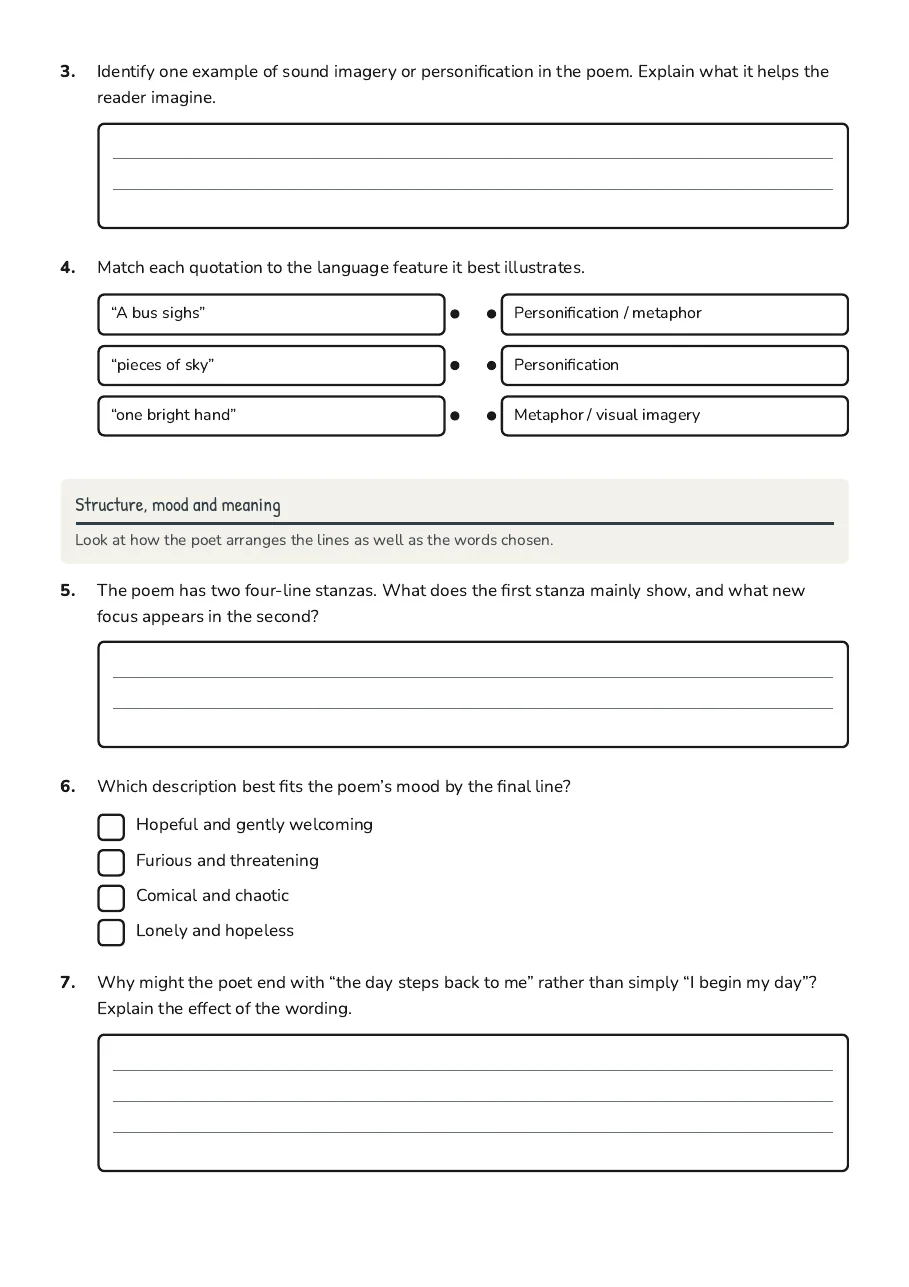
3.Identify one example of sound imagery or personification in the poem. Explain what it helps the reader imagine.
4.Match each quotation to the language feature it best illustrates.
  • “A bus sighs”
  • “pieces of sky”
  • “one bright hand”
  • Personification / metaphor
  • Personification
  • Metaphor / visual imagery

Structure, mood and meaning

Look at how the poet arranges the lines as well as the words chosen.

5.The poem has two four-line stanzas. What does the first stanza mainly show, and what new focus appears in the second?
6.Which description best fits the poem’s mood by the final line?
  • Hopeful and gently welcoming
  • Furious and threatening
  • Comical and chaotic
  • Lonely and hopeless
7.Why might the poet end with “the day steps back to me” rather than simply “I begin my day”? Explain the effect of the wording.
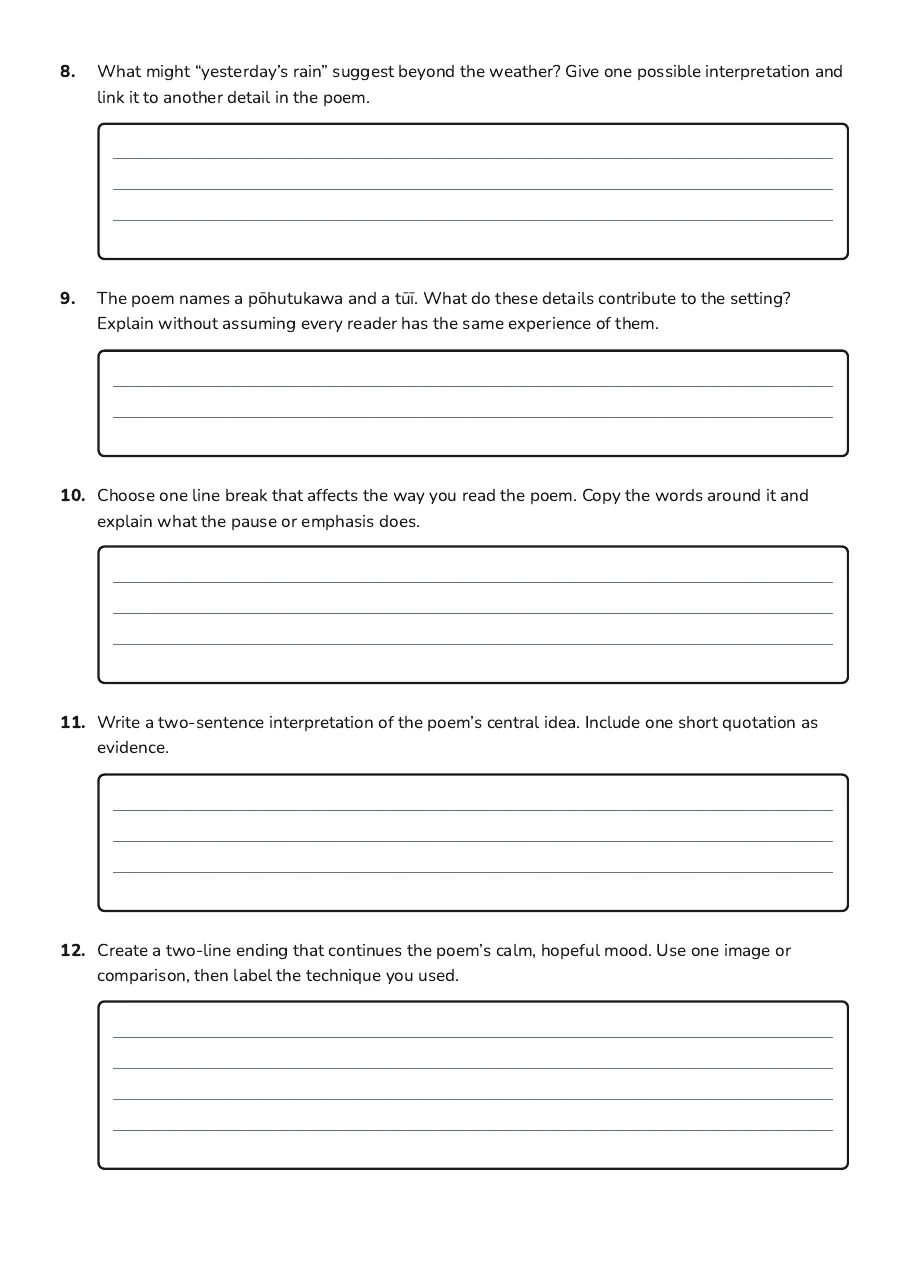
8.What might “yesterday’s rain” suggest beyond the weather? Give one possible interpretation and link it to another detail in the poem.
9.The poem names a pōhutukawa and a tūī. What do these details contribute to the setting? Explain without assuming every reader has the same experience of them.
10.Choose one line break that affects the way you read the poem. Copy the words around it and explain what the pause or emphasis does.
11.Write a two-sentence interpretation of the poem’s central idea. Include one short quotation as evidence.
12.Create a two-line ending that continues the poem’s calm, hopeful mood. Use one image or comparison, then label the technique you used.

3 printable pages

  • Poetry Analysis Deep Dive, page 1 of 3: Poem: “After the Rain”, First impressions and craft

    Page 1

  • Poetry Analysis Deep Dive, page 2 of 3: Structure, mood and meaning

    Page 2

  • Poetry Analysis Deep Dive, page 3 of 3: 8. What might “yesterday’s rain” suggest beyond the weather? Give one possible…

    Page 3

About This Worksheet

Free in Kuraplan

Sign up free, grab the PDF, and customize it for your class.

Print-Ready

Formatted for standard paper. Clean layout, easy to read.

AI-Generated

Created with Kuraplan's AI, designed for real classroom use.

For Teachers & Parents

Use in classrooms, for homework, tutoring, or homeschool.

Need a custom version of this worksheet?

Kuraplan's AI generates custom worksheets in seconds — differentiated for every learner, aligned to your curriculum.

Generate Custom Worksheets — Free
No credit card Curriculum-aligned Under 60 seconds